In recent manufacturing processes, the number of common causes of variation increases with the complexity of processes, leading to different shifts of the in-control process between multiple modes. Such a multimodal process violates the normality assumption, which decreases the efficiency of the commonly used methods and often disables the usage of SPC. This paper investigates the performance of one-class support vector machine (OSVM) in a multimodal setting. We have generated 5-modal synthetic data set with two correlated variables that violate the normality assumption. These methods were compared on the horizontally, vertically, and diagonally shifted out-of-control data. We have found that OSVM outperforms the other two commonly used SPC methods, which demonstrates that its more flexible decision boundary can naturally wrap the data from multimodal processes and can bring benefits to the control of modern complex processes.
The aim of this work is to assess the minimal technical requirements for using a simple RGB camera for motion sensing in a standard home environment. We experimentally verify the recording requirements for subsequent motion analysis. Our work contributes to the development of physical telerehabilitation without the need to use special HW and thus enable telerehabilitation for the general public, which is especially important during the COVID-19 lockdown. We have found out that such a system can work surprisingly well even with a low-cost camera in poor recording conditions and slow 3G internet connection.
The paper compares two approaches to multi-step ahead glycaemia forecasting. While the direct approach uses a different model for each number of steps ahead, the iterative approach applies one one-step ahead model iteratively. Although it is well known that the iterative approach suffers from the error accumulation problem, there are no clear outcomes supporting a proper choice between those two methods. This paper provides such comparison for different ARX models and shows that the iterative approach outperformed the direct method for one-hour ahead (12-steps ahead) forecasting. Moreover, the classical linear ARX model outperformed more complex non-linear versions for training data covering one-month period.
Backgroung: Type 1 diabetes is a disease that adversely affects the daily life of a large percentage of people worldwide. Daily glucose levels regulation and useful advices provided to patients regarding their diet are essential for diabetes treatment. For this reason, the interest of the academic community has focused on developing innovative systems, such as decision support systems, based on glucose prediction algorithms. The present work presents the predictive capabilities of ensemble methods compared to individual algorithms while combining each method with compartment models for fast acting insulin absorption simulation. Methods: An approach of combining widely used glycemia prediction algorithms is proposed and three different ensemble methods (Linear, Bagging and Boosting metaregressor) are applied and evaluated on their ability to provide accurate predictions for 30, 45 and 60 minutes ahead prediction horizon. Moreover, glycemia levels, long and short acting insulin dosages and consumed carbohydrates from six type one people with diabetes are used as input data and the results are evaluated in terms of root-mean square error and Clarke error grid analysis. Results: According to results, ensemble methods can provide more accurate glucose concentration in comparison to individual algorithms. Bagging metaregressor, specifically, performed better than individual algorithms in all prediction horizons for small datasets. Bagging ensemble method improved the percentage in zone A according to Clarkes error grid analysis by 4% and in some cases by 9%. Moreover, compartment models are proved to improve results in combination with any method at any prediction horizon. This strengthen the potential practical usefulness of the ensemble methods and the importance of building accurate compartment models.
The paper presents a DC microgrid model and its power management system based on metaheuristical optimization of a rolling horizon. The crucial components of such a system are forecasts of photovoltaic production and load power. The paper experimentally demonstrates how the forecasting error affects power management in terms of increased operational costs and increased probability of constraints violation. It is demonstrated that the benefits of the optimized power scheduling decrease linearly with increasing mean absolute percentage error (MAPE) of load and photovoltaic production forecast. In our scenario, the state-of-charge constraints for electric vehicle battery were not affected by inaccurate forecasts, which is very important for the electric vehicle user's acceptance of the power management system.
Background: The classification of sleep signals is a subjective and time consuming task. A large number of automatic classifiers have been published in the past decade but a sleep community has no strong confidence to use them in clinical practice and still remains using a standard manual scoring according standardized rules. New method: We developed a semi-supervised data-driven approach for objective and efficient evaluation of polysomnographic (PSG) data. The proposed algorithm finds a representative set of signal segments that are subsequently scored by a sleep neurologist. The remaining part of the recording is then automatically classified using these templates. Results: The method was evaluated on 36 PSG recordings (18 chronic insomniacs, 18 healthy controls). We show a faster and objective evaluation of PSG data compared to the manual scoring that is over-performing automated classifiers (accuracy increases similar to 14%). The classification results are comparable on both datasets. Comparison with existing method(s): The methodology that we propose has not yet been published in the area of sleep PSG data processing. The performance of our method is comparable to various published automated approaches (a typical published classification accuracy is similar to 75-95%). The method allows the evaluation of PSG recordings in more general terms and across different recording devices and standards. Conclusions: The proposed solution is not based on a single-purpose rules or heuristics and training model is not trained on other patient's sleep recordings. The method is applicable to wide range of similar tasks and various types of physiological signals.
Glycaemia prediction plays a vital role in preventing complications related to diabetes mellitus type 1, supporting physicians in their clinical decisions and motivating diabetics to improve their everyday life. Several algorithms, such as mathematical models or neural networks, have been proposed for blood glucose prediction. An approach of combining several glycaemia prediction models is proposed. The main idea of this framework is that the outcome of each prediction model becomes a new feature for a simple regressive model. This approach can be applied to combine any blood glycaemia prediction algorithms. As an example, the proposed method was used to combine an Autoregressive model with exogenous inputs, a Support Vector Regression model and an Extreme Learning Machine for regression model. The multiple-predictor was compared to these three prediction algorithms on the continuous glucose monitoring system and insulin pump readings of one type 1 diabetic patient for one month. The algorithms were evaluated in terms of root-mean-square error and Clarke error-grid analysis for 30, 45 and 60 min prediction horizons.
Active learning is very useful for classification problems where it is hard or time-consuming to acquire classes of data in order to create a subset for training a classifier. The classification of over-night polysomnography records to sleep stages is an example of such application because an expert has to annotate a large number of segments of a record. Active learning methods enable us to iteratively select only the most informative instances for the manual classification so the total expert’s effort is reduced. However, the process is able to be insufficiently initialised because of a large dimensionality of polysomnography (PSG) data, so the fast convergence of active learning is at risk. In order to prevent this threat, we have proposed a variant of the query-by-committee active learning scenario which take into account all features of data so it is not necessary to reduce a feature space, but the process is quickly initialised. The proposed method is compared to random sampling and margin uncertainty sampling which is another well-known active learning method. It was shown that, during crucial first iteration of the process, the provided variant of query-by-committee acquired the best results among other strategies in most cases.
Sleep scoring is an important tool for physicians. Assigning of segments of long biomedical signal into sleep stages is, however, a very time consuming, tedious and expensive task which is performed by an expert. Automatic sleep scoring is not well accepted in clinical practice because of low interactivity and unacceptable error, which is often caused by inter-patient variability. This is solved by proposing a semi-automatic approach, where parts of the signal are selected for manual labeling by active learning and the resulting classifier is used for automatic labeling of the remaining signal. The active learning is disturbed by noisy ambiguous data instances caused by continuous character of the sleep stage transitions and a removal of such transitional instances from the training set prior to active learning can improve the efficiency of the method. This paper proposes to use the hidden Markov model for the detection of the transitional instances. It shows experimentally on 35 sleep EEG recordings that such a method significantly improves the semi-automatic method. A complete methodology for semi-automatic sleep scoring is proposed and evaluated, which can be better accepted as a decision support tool for sleep scoring experts.
Semiautomatic sleep staging system based on EEG classification is focused in the paper. Such an expert-in-the-loop system interacts with the annotating expert by suggesting him EEG segments that should be annotated. After a sufficient number of labeled segments is reached, a pattern classification model is trained and used for automatic annotation of the rest of the signal. It is shown that this can save 85% of the labeling effort and consequently improve the annotation quality due to the prevention of errors caused by expert's fatigue. The selection of the data for labeling is based on confidence based active learning approach. It is shown that such a strategy is statistically significantly better in terms of mean class error than baseline random sampling strategy. Moreover, it is argued that transitional instances that correspond to transitions between sleep stages are often erroneously labeled and their elimination can improve especially the active learning process. This hypothesis is examined and surprisingly such elimination significantly improved the random sampling strategy which became comparable to the active learning without removal of transitions. Although the active learning strategy with transitions removal performed better in terms of mean, there were not sufficient data that would prove this statistically.
This work addresses the area of a computer-assisted sleep staging using a standard scalp EEG recordings and AASM 2012 scoring rules. We focused on real clinical EEG data containing a large amount of artifacts and/or missing electrodes. The sleep-related features were extracted for 30-seconds segments. Power-in-band features were estimated by a method using Continuous Wavelet Transform (CWT). In addition, entropy, spectral entropy, fractal dimensions and statistical features were used as the input of classifiers. Inter-personal differences and the characteristics of extracted features were evaluated for individual sleep classes. Two expert-in-the-loop strategies and three different classifiers were used to classify data into sleep stages. The results were compared with a fully automated classification and with gold standard expert sleep staging. Due to the proposed improvements the final mean classification sensitivity of expert-in-the-loop approach was increased up to 18.4%. The implemented solution allows to classify sleep recordings contaminated by a large amount of the naturally occurring artifacts that are impossible to process by traditional automated classification methods.
Measurement of muscle parameters plays an inherent role in investigating top athletes. However, traditional measurement approaches are based on collected muscle parameters in the laboratory and are not applicable directly on the sports grounds. The paper presents measurement of muscle parameter using handheld and easy to use MyotonPRO device during physical exercise (demonstrating by squats) in the group of active sportsmen (10 male, 23.5 ± 3.2 years) and in the group of non-sportive people (10 male, 25.1 ± 5.4 years). Measured muscles were gluteus maximus, vastus medialis and vastus lateralis on both sides of the body. The t-test with significant level of 5% was used for statistical comparison. The parameter of mechanical stress relaxation time has been found as the most significant marker in this study. Changes occurred in the muscle gluteus maximus on both sides of body and in the vastus medialis muscle on the right side. All results are discussed.
Classification of a PSG record to individual sleep stages is an expensive and time-consuming process because a trained human annotator (typically a physician) has to go through all segments of the record and classify them to their classes. In consequence, many semi-automated methods have been proposed in order to reduce the expert's effort. The active learning approach is also well-suited for this type of task because it allows to select only the most informative instances for labeling without the quality of classification to be reduced. On the other hand the unsatisfactory initialization of active learning can cause a slower learning process. In this paper we introduce the method for creating of the initial set of labeled instances to eliminate this threat. Because k-means algorithm is commonly used as the initialization method, the comparison between these two methods is provided.
The quality of life of the elderly is becoming more and more important. Prevention and early evaluation of falls in elderly people is a very important issue. Achieving the best comfort can be possible by contactless methods. The paper describes machine learning approach to a fall detection based on body posture classification using 8x8 pixel image acquired by Grid-EYE array temperature sensor. State-of-the-art computer vision tool - deep neural network - is used. The best result is achieved if classification into three or five classes is assumed. Even with such low resolution thermal image sensor, the final sensitivity and specificity of the class "laying" which corresponds to posture of a fallen person reaches 0.85 and 0.93, respectively.
Detection of artifacts in sleep electroencephalography (EEG) is one of the important tasks on the preprocessing step. Despite many algorithms of artifact detection developed through years, many of them lose their benefits in sleep EEG application. This study proposes a method of artifact detection based on a classification of quasi-stationary EEG epochs with random forest classifier. The method was tested on data of three sleep stages and pre-sleep wake EEG. Results showed 16% increase in F-1 for the wake and 9%, 5% and 16% for different sleep stages in comparison to a baseline. All false detection at every presented sleep stage is investigated.
We aimed to comparison of the most common methods for time-frequency analysis of biological signals, short-time Fourier Transform (STFT) and Continuous Wavelet Transform (CWT). This comparison was performed over sleep EEG data. We have acquired frequency-to-time graphs, spectrograms for STFT and scalograms for CWT. It has been confirmed that the results of STFT are significantly affected by the size of the sliding window through which the STFT is performed. The rapid changes in the EEG like movement artifacts were more noticeable when the window size was around 1–3 s. Conversely, the slow changes associated with deep sleep or sleep stage transitions were most pronounced with a window size over 60 s. This drawback disappears using the CWT method. We use CWT with the analytic Morse wavelet, symmetry parameter of 3 and a time-bandwidth product of 60. The resulting scalogram shows both faster and slower changes in EEG. Especially in the low-frequency range; it is possible to distinguish different deep sleep patterns. The described approaches may facilitate the visual evaluation of long-term sleep EEG recordings, or allow effective analysis of an unknown EEG signal structure. The research has been supported by the project No. 17-20480 of the GA CR.
The study is devoted to data processing methods in automatic sleep polysomnography (PSG) analysis. The idea is in using covariance matrices a carrier of a discriminative information. In the study, we are challenging with a problem of sleep stage classification. We are trying to solve that problem using spatial geometric analysis. For experiments, we took data from seven patients; data were recorded in National Institute of Mental Health. Artifact-free segments were extracted from the data. The covariance matrix was obtained for each segment. The classification was performed using a minimum distance to a class or in k-nearest-neighbor (KNN) method. A distance between objects was calculated using Riemannian Geometry. Classification methods were tested by cross-validation scheme. Using only covariance matrix of multimodal data and without additional information divided by frequency ranges, it is possible to classify sleep stages with high accuracy: the average accuracy for KNN is 0.929, for minimum distance to a class center it is only 0.816. Advantages of the method are working with data from different domains, adjustability to a different number of channels. Support: project No. 17-20480S of GACR, project “National Institute of Mental Health (NIMH-CZ),” Grant No. ED2.1.00/03.0078 and project No. LO1611.
Preventing complications in diabetes as well as support physicians and patients to treat the disease optimally, prediction of blood glucose levels is essential. In the most common treatment of type I diabetes, the diabetic measures the blood glucose level daily, based on which a proper dosage can be determined. Additionally, there are several other factors that affect the blood glucose concentration,such as carbohydrate intake and level of exercise. One of the main challenges is to make accurate long term predictions. Autoregressive models in combination with compartment models for estimating the insulin concentration can be determined as the first approach to this purpose. This paper provides a snapshot of the state-of-the-art for the model predictor, testing the results and comparing them with results from short-term prediction.
This paper introduces the semi-automatic process using active learning methods which could improve the current state, where a human specialist has to annotate a multiple hours long polysomnographical record to sleep stages. This work is focused on the utilization of density-weighted methods of active learning, one of them turned out to be well-suited for this type of task. Moreover, we proposed several criteria for the comparison of active learning methods. The method saves more than 80% of expert’s annotation effort.
A multiple-steps ahead prediction of glucose level from real time continuous glucose monitoring system (RT-CGMS) device is presented. Both linear and nonlinear autoregressive models with exogenous inputs are used for the system identification. Insulin and nutritional income are used as the exogenous inputs. To better represent the dynamical character of those external factors, simple compartment models are used providing a signal of the influence of the insulin and nutrition. Those signals are used as inputs to regressive models. The main problem of adaptation of those compartment models to particular patient is solved using continuous particle swarm optimization algorithm. The proposed approach is demonstrated on data from type I diabetic patients with RT-CGMS and insulin pump. The results provide the first step of creation of future mobile application for decision support of type 1 diabetics.
 Lenka Lhotska合作论文数Department of Cybernetics , Faculty of Electrical Engineering
Czech Technical University47
Lenka Lhotska合作论文数Department of Cybernetics , Faculty of Electrical Engineering
Czech Technical University47 Václav Gerla合作论文数Faculty of Electrical Engineering, Czech Technical University15
 Kyriaki Saiti合作论文数7
 Katerina Stechova合作论文数6
 Vaclav Kremen合作论文数Faculty of Electrical Engineering, Czech Technical University in Prague5
 Fabio Moretti合作论文数Dipartimento di Informatica e Automazione, Università degli Studi “Roma Tre”5
 Nela Grimova合作论文数4
 Elizaveta Saifutdinova合作论文数4
 Pavlina Pithova合作论文数4
 Daniel Novak合作论文数Department of Cybernetics, Czech Technical University in Prague4
 Stefano Pizzuti合作论文数ENEA4E. Saifutdinova合作论文数3Gabriele Comodi合作论文数Dipartimento di Ingegneria Industriale e Scienze Matematiche, Università Politecnica delle Marche3
 Alessandro Fonti合作论文数3
 Mauro Annunziato合作论文数3
 Miroslav Bursa合作论文数3
 Andrea Giantomassi合作论文数3Pavlina Pit'hova合作论文数2
 Jindrich Adolf合作论文数Czech Institute of Informatics, Robotics and Cybernetics, Czech Technical University in Prague, Prague, Czech Republic2
 Daniela Dudysová合作论文数Natl Inst Mental Hlth2
 Fiorella Lauro合作论文数2
 Jan Jantzen合作论文数Samso Energy Academy;Department of Financial and Management Engineering, School of Engineering, University of the Aegean2
 Libor Preucil合作论文数Intelligent and Mobile Robotics Research Laboratory, Czech Institute of Informatics, Robotics and Cybernetics, Czech Technical University in Prague2
 Martin Saska合作论文数Informatics VII: Robotics and Telematics, Julius-Maximilians University Wuerzburg2
 Ritesh Kumar合作论文数Jawaharlal Nehru University2Jaromir Dolezal合作论文数Dept. of Cybernetics, Czech Technical University in Prague2
 Amol P Bhondekar合作论文数2
 Jens Strackeljan合作论文数2
 Petr Kadera合作论文数Faculty of Electrical Engineering, Czech Technical University in Prague2
 Rishemjit Kaur合作论文数2
 Jakub Kuzilek合作论文数FEE, CTU in Prague2Stefan Costea合作论文数1Djordjevic, V.合作论文数1
 Sankho T Sarkar合作论文数1R. Brzezny合作论文数1Charlotte Panuskova合作论文数1
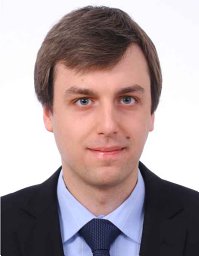 Petr Novák合作论文数Czech Inst Informat Robot & Cybernet, Czech Tech Univ1Iva Milerska合作论文数Czech Inst Informat Robot & Cybernet, Czech Tech Univ1
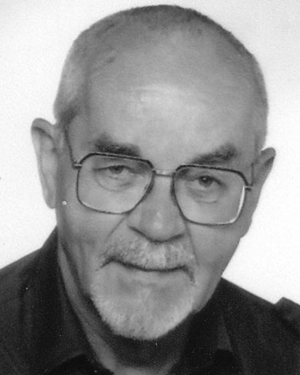 K. Paul合作论文数1
 Matej Murgas合作论文数1
 P. Sos合作论文数Psychiat Slany Sro1Jana Kopřivová合作论文数1Imran Khan合作论文数1
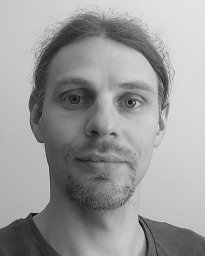 Jan Zegklitz合作论文数1
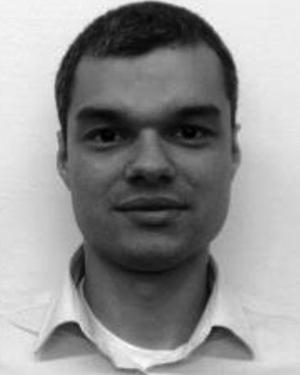 Julius Bems合作论文数1
 Tomas Sieger合作论文数Charles University in Prague, General University Hospital;Faculty of Electrical Engineering, Czech Technical University;General University Hospital, Czech Technical University1
 Stefano Panzieri合作论文数Dipartimento di Ingegneria - Sez. Informatica e Automazione1
 Josef Kautzner合作论文数Institute for Clinical and Experimental Medicine;Lékařské Fakultě Univerzity Karlovy v Praze1
 Karla Stépánová合作论文数1




