This thesis presents several techniques that advance search-based algorithms for solving Constraint Optimization Problems (COPs). These techniques exploit structural features common in such problems. In particular, the thesis presents a number of innovative algorithms, and associated data structures, designed to exploit decomposition and symmetry in COPs. First, a new technique called component templating is introduced. Component templates are data structures for efficiently representing the disjoint sub-problems that are encountered during search. Information about each disjoint sub-problem can then be reused during search, increasing efficiency. A new algorithm called OR-decomposition is introduced. This algorithm obtains many of the computational benefits of decomposition without the need to resort to separate recursions. That is, the algorithm explores a standard OR tree rather than an AND-OR tree. In this way, the search algorithm gains greater freedom in its variable ordering compared to previous decomposition algorithms. Although decomposition algorithms such as OR-decomposition are effective techniques for solving COPs with low tree-width, existing decomposition algorithms offer little advantage over branch and bound search on problems with high tree-width. A new method for exploiting decomposition on problems with high tree-width is presented. This technique involves detecting and exploiting decompositions on a selected subset of the problem’s objectives. Such decompositions can then be used to more efficiently compute additional bounds that can be used by branch and bound search. The second half of the thesis explores the use of symmetries in COPs. Using component templates, it is possible to exploit dynamic symmetries that appear during search when some of the variables of a problem have been assigned a value. Symmetries have not previously been combined with decomposition in COPs. An algorithm called Set Branching is presented, which exploits almost-symmetries in the values of a variable by clustering similar values together, then branching on sets of values rather than on each single value. The decomposition and symmetry algorithms presented in this thesis increase the efficiency of constraint optimization solvers. The thesis also presents experimental results that test these algorithms on a variety of real world problems, and demonstrate performance improvements over current state-of-the-art techniques.
Branch and bound is an effective technique for solving constraint optimization problems (COP's). However, its search space expands very rapidly as the domain sizes of the problem variables grow. In this paper, we present an algorithm that clusters the values of a variable's domain into sets. Branch and bound can then branch on these sets of values rather than on individual values, thereby reducing the branching factor of its search space. The aim of our clustering algorithm is to construct a collection of sets such that branching on these sets will still allow effective bounding. In conjunction with the reduced branching factor, the size of the explored search space is thus significantly reduced. We test our method and show empirically that it can yield significant performance gains over existing state-of-the-art techniques.
A simple and effective marking technique is an invaluable tool for tracking the movement of invertebrates in the field. In order to do this, the technique must be validated in a controlled setting. In the first Study, two soft bodied herbivores with different feeding strategies and two of their insect predators, also with different feeding strategies, were marked with rubidium (Rb), an elemental marker previously shown to be effective in marking herbivorous invertebrates. The naturally occurring concentration of Rb was determined for both the herbivores and their predators. Rb concentrations were determined in (I) the herbivore species over several days of feeding on rubidium chloride (RbCl) marked plants (2) in the predatory species immediately after consuming prey marked at different rates with Rb: and (3) in the predatory species for several days after consuming a single meal of Rb marked prey. The concentration of Rb within the marked herbivores was found to be significantly higher than the naturally occurring concentration after eating RbCl marked plants for to up 8 days. A significantly higher concentration of Rb was found in both predators when fed prey that had been on the RbCl sprayed plants for 2 or 8 days compared with naturally occurring concentrations. There was also a significant difference between the Rb concentrations in the controls and each of days 5.10 and 15 since feeding in both predators. A second smaller study was carried out to examine the effect of feeding Rb marked prey to spiders. The concentration of Rb in the spiders fed marked prey was significantly higher than that of the controls. This suggests that Rb is an effective way of marking both herbivores and their insect and arachnid predators enabling them to be tracked in the field and to determine their movements across habitats.
Decomposition is an effective technique for solving discrete Constraint Optimization Problems (COPs) with low tree-width. On problems with high tree-width, however, existing decomposition algorithms offer little advantage over branch and bound search (B&B). In this paper we propose a method for exploiting decomposition on problems with high tree-width. Our technique involves modifying B&B to detect and exploit decomposition on a selected subset of the problem's objectives. Decompositions over this subset, generated during search, are exploited to compute tighter bounds allowing B&B to prune more of its search space. We present a heuristic for selecting an appropriate subset of objectives-one that readily decomposes during search and yet can still provide good bounds. We demonstrate empirically that our approach can significantly improve B&B's performance and outperform standard decomposition algorithms on a variety of high tree-width problems.
Decomposition is a powerful technique for reducing the size of a backtracking search tree. However, when solving constraint optimization problems (COP's) the standard technique of invoking a separate recursion to solve each independent component can significantly reduce the strength of the bounds that can be applied when using branch and bound techniques. In this paper we present a new search algorithm that can obtain many of the computational benefits of decomposition without having to resort to separate recursions. That is, the algorithm explores a standard OR tree not an AND-OR tree. In this way incremental information gathered from any component can be immediately applied to improve the bounding information for all of the other components. We also discuss how caching and local propagation can be combined with our approach and finally test our methods empirically to verify their potential.
Caching, symmetries, and search with decomposition are powerful techniques for pruning the search space of constraint problems. In this paper we present an innovative way of efficiently combining these techniques with branch and bound for solving certain types of constraint optimization problems (COPs). Our new method significantly reduces the overhead of performing decomposition during search when dynamic variable orderings are employed. In addition, it supports the exploitation of dynamic symmetries that appear only during search. Symmetries have not previously been combined with decomposition. Finally, we achieve a superior integration of decomposition and caching with branch and bound than previous approaches. We test our methods on the Maximum Density Still Life problem and show that each of our ideas yields a significant gain in search performance.
We present a new probabilistic framework for finding likely variable assignments in difficult constraint satisfaction problems. Finding such assignments is key to efficient search, but practical efforts have largely been limited to random guessing and heuristically designed weighting systems. In contrast, we derive a new version of Belief Propagation (BP) using the method of Expectation Maximization (EM). This allows us to differentiate between variables that are strongly biased toward particular values and those that are largely extraneous. Using EM also eliminates the threat of non-convergence associated with regular BP. Theoretically, the derivation exhibits appealing primal/dual semantics. Empirically, it produces an "EMBP"-based heuristic for solving constraint satisfaction problems, as illustrated with respect to the Quasigroup with Holes domain. EMBP outperforms existing techniques for guiding variable and value ordering during backtracking search on this problem.
We consider the following graph embedding question: given a graph G, is it possible to map its vertices to points in 3D such that G is isomorphic to the mutual nearest neighbor graph of the set P of points to which the vertices are mapped? We show that this problem is NP-hard. We do this by extending the “logic engine” method to three dimensions by using building blocks inpired by the structure of diamond and by constructions of A.G. Bell and B. Fuller.
A bipartite graph is biplanar if the vertices can be placed on two parallel lines (layers) in the plane such that there are no edge crossings when edges are drawn as line segments between the layers. In this paper we study the 2-Layer Planarization problem: Can k edges be deleted from a given graph G so that the remaining graph is biplanar? This problem is NP-complete, and remains so if the permutation of the vertices in one layer is fixed (the 1-Layer Planarization problem). We prove that these problems are fixed-parameter tractable by giving linear-time algorithms for their solution (for fixed k). In particular, we solve the 2-Layer Planarization problem in O(k · 6k + |G|) time and the 1-Layer Planarization problem in O(3k · |G|) time. We also show that there are polynomial-time constant-approximation algorithms for both problems.
We consider graph drawings in which vertices are assigned to layers and edges are drawn as straight line-segments between vertices on adjacent layers. We prove that graphs admitting crossing-free h-layer drawings (for fixed h) have bounded pathwidth. We then use a path decomposition as the basis for a linear-time algorithm to decide if a graph has a crossing-free h-layer drawing (for fixed h). This algorithm is extended to solve related problems, including allowing at most k crossings, or removing at most r edges to leave a crossing-free drawing (for fixed k or r). If the number of crossings or deleted edges is a non-fixed parameter then these problems are NP-complete. For each setting, we can also permit downward drawings of directed graphs and drawings in which edges may span multiple layers, in which case either the total span or the maximum span of edges can be minimized. In contrast to the Sugiyama method for layered graph drawing, our algorithms do not assume a preassignment of the vertices to layers.
 Fahiem Bacchus合作论文数Department of Computer Science, Faculty of Arts and Science, University of Toronto5
 Sue H. Whitesides合作论文数Department of Computer Science University of Victoria3
 David Wood合作论文数School of Mathematics, Faculty of Science, Monash University2
 Naomi Nishimura合作论文数David R. Cheriton School of Computer Science University of Waterloo2
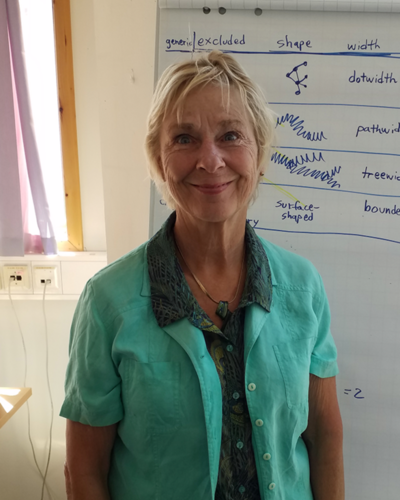 Frances A. Rosamond合作论文数University of Bergen2
 Giuseppe Liotta合作论文数Computer Science2
 Vida Dujmovic合作论文数School of Computer Science and Electrical Engineering, Faculty of Engineering, University of Ottawa2
 Prabhakar Ragde合作论文数School of Computer Science, University of Waterloo2
 Michael Ralph Fellows合作论文数Department of Informatics, University of Bergen2
 Matthew Suderman合作论文数Bristol Medical School, University of Bristol2
 Catherine Mccartin合作论文数* Lecturer in Computer Science2Alan Yen合作论文数1Sheila A. McIlraith合作论文数1
 Amanda Jane Kobelt合作论文数1Eric I. Hsu合作论文数1
 Mike Hallett合作论文数Centre for Structural and Functional Genomics, Department of Biology, Concordia University;Department of Biochemnistry, Western University1




