The Deep Space Optical Communication (DSOC) project will demonstrate free-space optical communication at almost 3 AU, or 3 orders of magnitude further than any previous attempt. DSOC will utilize the 5m Palomar Hale Telescope to receive the downlink signal, which will couple the downlink light onto an optical table and into a superconducting nanowire single photon detector (SNSPD). The output of the SNSPD is digitized by the Ground Laser Receiver Signal Processing Assembly (GSPA) using a high throughput streaming time to digital converter (TDC). The GSPA is a scalable FPGA-based receiver which demodulates and decodes the DSOC downlink signal through novel signal processing algorithms implemented on Xilinx UltraScale+ FPGAs, as well as Python-based software monitor and control routines. Exploiting the unique TDC-based architecture, the GSPA supports over four orders of magnitude of downlink data rates across multiple orders of magnitude of signal and background powers. In this paper we present an overview of the hardware, firmware and software architectures to implement this system, as well as performance analysis for links ranging from near-Earth to 2.8 AU.
The Lunar Laser Communications Demonstration Project undertaken by MIT Lincoln Laboratory and NASA's Goddard Space Flight Center will demonstrate high-rate laser communications from lunar orbit to the Earth. NASA's Jet Propulsion Laboratory is developing a backup ground station supporting a data rate of 39 Mbps that is based on a non-real-time software post-processing receiver architecture. This approach entails processing sample-rate-limited data without feedback in the presence high uncertainty in downlink clock characteristics under low signal flux conditions. In this paper we present a receiver concept that addresses these challenges with descriptions of the photodetector assembly, sample acquisition and recording platform, and signal processing approach. End-to-end coded simulation and laboratory data analysis results are presented that validate the receiver conceptual design.
In this paper, we leverage the long range end-to-end scenarios envisioned for lunar and beyond voice conversations by allowing non-traditional additional processing delay for quasi-real-time voice conversations. The concept of improving the quality of end-to-end voice conversations for long delay environments is considered by utilizing Luby transforms on the conjugate-structure algebraic-code-excited linear-prediction (CS-ACELP) codec. In addition, this paper also examines the use of automated speech recognition software as a means of generating a quantifiable metric for speech intelligibility in the spirit of the diagnostic rhyme test (DRT).
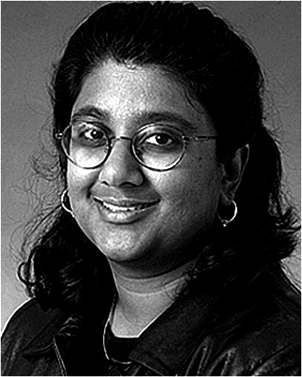 Meera Srinivasan合作论文数2
 Clayton Okino合作论文数2
 Daniel Cho合作论文数1
 Hua Xie合作论文数1
 Sam Nguyen合作论文数1P. Tsao合作论文数1Kevin M. Birnbaum合作论文数1
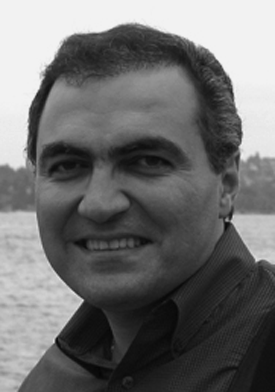 Edwin Grigorian合作论文数1
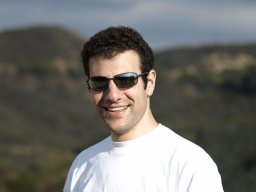 Zaid J. Towfic合作论文数Electrical Engineering Department, University of California, Los Angeles1
 Ryan Rogalin合作论文数University of Southern California1
 Kevin J. Quirk合作论文数1
 Andre Tkacenko合作论文数Dept . of Electrical Engineering;California Institute of Technology;Dept . of Electrical Engineering, California Institute of Technology1




