Diplodocoidea is one of the most iconic clades of the giant sauropod dinosaurs, known for their elongated necks and tails, and distinctive skull morphology. This group, existing from the Middle Jurassic to the early Late Cretaceous, encompasses three main families: Rebbachisauridae, Dicraeosauridae, and Diplodocidae. These sauropods were globally distributed, demonstrating significant diversity in body plans, feeding strategies, and ecological niches. Diplodocoid paleontology has been marked by extensive studies focusing on skeletal morphology, biomechanics, histology, and evolutionary relationships. Significant research has also explored their ontogeny and niche partitioning, suggesting that diplodocoids had specialized adaptations for low-to midlevel browsing. This contribution is the introduction to a special volume that aims to synthesize current research on Diplodocoidea, offering insights into their evolutionary success, with subsequent contributions addressing their phylogenetic relationships, ontogeny, and morphological variation.
Although many casts have been made of the Carnegie Museum’s iconic Diplodocus, initially in plaster and more recently in various plastics, one stands alone as having been cast in concrete. This skeleton, made from the original Carnegie molds starting in 1956–1957, was unveiled at the Utah Field House of Natural History in Vernal, Utah, in 1957, and stood outside the museum for three decades. The fate of the molds after this casting is uncertain. The concrete Diplodocus was the museum’s icon for 32 years until the weather damage became too great. The cast was then taken down and repaired, and fresh molds made from it by Dinolab in Salt Lake City. From these molds, a new replica was cast in water-expanded polyester and mounted inside the Field House. This cast was moved to the Field House’s new location in 2004 and was remounted in the atrium, but the old concrete cast could not be easily remounted and was instead transferred to the Prehistoric Museum at Price, Utah. It has, however, yet to be remounted there, as it awaits a new building for the museum. Meanwhile, the new molds have been used to create more Diplodocus casts that are mounted in Japan and elsewhere, and have also furnished missing parts of the iconic rearing Barosaurus skeleton in the atrium of the American Museum of Natural History in New York City. Thus, the concrete Diplodocus of Vernal has become one of the most influential of all Diplodocus specimens, second only to the Carnegie original.
Pneumatic dorsal ribs are known for many sauropods, but to date costal pneumaticity has received relatively little attention. In particular, the pneumatic ribs of the holotype specimen of Brachiosaurus altithorax have been largely overlooked, although they present a unique configuration of pneumatic features. One rib, with a pneumatic foramen some distance down the shaft, was briefly described and illustrated in the early 20th century by Elmer S. Riggs. A second rib with a pneumatic foramen in the tuberculum of the rib has not previously been described or illustrated. This previously undescribed foramen is similar in location to those in some dorsal ribs of Brontosaurus excelsus and Giraffatitan brancai, but differs from them in both size and shape. The contrasting sites of costal pneumaticity in the holotype individual of Brachiosaurus altithorax emphasize the generally opportunistic mode of postcranial pneumatization, in both sauropods and other ornithodirans, but conform to models of pneumatization following vascularization.
"The reasonable man adapts himself to the world;the unreasonable one persists in trying to adapt the world to himself.Therefore all progress depends on the unreasonable man." —Maxims for Revolutionists,George Bernard Shaw(1903). In the twenty years since the Budapest Open Access Initiative(BOAI,2002)defined the term"open access"(OA)and laid out the unanswerable case in its favour,the growth of OA has been inexorable.Legacy publishers,dependent on the revenue stream provided by subscriptions,have repeatedly attempted to stem this tide,and have certainly succeeded in delaying it—to no-one's benefit but their own.But OA progresses despite this rearguard action,especially in recent years through the adoption by many major research funders of the Plan S declaration(Plan S,2018),that open-access publication is a condition of grant funding.At the time of writing,over half of all newly published papers are open access either immediately or within a few months(Piwowar,Priem,&Orr,2019),and the proportion continues to increase rapidly.
Sauropods are familiar dinosaurs, immediately recognisable by their great size and long necks. However, their necks are much less well known than is often assumed. Surprisingly few complete necks have been described in the literature, and even important specimens such as the Carnegie Diplodocus and Apatosaurus, and the giant Berlin brachiosaur, in fact have imperfectly known necks. In older specimens, missing bone is often difficult to spot due to over-enthusiastic restoration. Worse still, even those vertebrae that are complete are often badly distorted-for example, in consecutive cervicals of the Carnegie Diplodocus CM 84, the aspect ratio of the posterior articular facet of the centrum varies so dramatically that C14 appears 35% broader proportionally than C13. And even in specimens where the cervicodorsal sequence is preserved, it is often difficult or impossible to confidently identify which vertebra is the first dorsal. Widespread incompleteness and distortion are both inevitable due to sauropod anatomy. large size made it almost impossible for whole individuals to be preserved because sediment cannot be deposited quickly enough to cover a giant carcass on land; and distortion of presacral vertebrae is common due to their lightweight hollow construction. This ubiquitous incompleteness and unpredictable distortion compromise attempts to mechanically analyze necks, for example to determine habitual neck posture and range of motion by modelling articulations between vertebrae.
Continental rifting is a critical component of the plate tectonic paradigm, and occurs in more than one mode, phase, or stage. While rifting is typically facilitated by abundant magmatism, some rifting is not. We aim to develop a better understanding of the fundamental processes associated with magma-poor (dry) rifting. Here, we provide an overview of the NSF-funded Dry Rifting In the Albertine-Rhino graben (DRIAR) project, Uganda. The project goal is to apply geophysical, geological, geochemical, and geodynamic techniques to investigate the Northern Western Branch of the East African Rift System in Uganda. We test three hypotheses: (1) in magma-rich rifts, strain is accommodated through lithospheric weakening from melt, (2) in magma-poor rifts, melt is present below the surface and weakens the lithosphere such that strain is accommodated during upper crustal extension, and (3) in magma-poor rifts, there is no melt at depth and strain is accommodated along pre-existing structures such as inherited compositional, structural, and rheological lithospheric heterogeneities. Observational methods in this project include: passive seismic to constrain lithospheric structure and asthenospheric flow patterns; gravity to constrain variations in crustal and lithospheric thickness; magnetics to constrain the thermal structure of the upper crust; magnetotellurics to constrain lithospheric thickness and the presence of melt; GNSS to constrain surface motions, extension rates, and help characterize mantle flow; geologic mapping to document the geometry and kinematics of active faults; seismic reflection analyses of intra-rift faults to document temporal strain migration; geochemistry to identify and quantify mantle-derived fluids in hot springs and soil gases; and geodynamic modeling to develop new models of magma-poor rifting processes. Fieldwork will begin in January 2022 and the first DRIAR field school is planned for summer 2022. Geodynamic modeling work and morphometric analyses are already underway.
North of the Himalayas is the Tibetan plateau—the largest physiographic feature on Earth related to intercontinental collision. Here, we study the rugged Gangdese Range along the southern drainage divide of the Tibetan plateau using a synthesis of geologic, thermochronologic, and interseismic geodetic observations that reveal that southern Tibet’s Gangdese Range is undergoing active surface uplift at present-day rates rivaling the Himalaya. Uplift has likely been sustained since the early Miocene, and we hypothesize that surface uplift of the Gangdese Mountains led to the development of Tibet’s internally drained plateau, as well as potentially reversed the course of the paleo Yarlung River, in tandem with exhumation of the Himalayan gneiss domes. We suggest the data are consistent with active thrust duplexing, balanced by upper crustal extension, effectively extending the active décollement between the underthrusting Indian plate and the Eurasian upper plate more than 200 km north of the High Himalayas.
In illustrating vertebrae, it is important to consistently depict their orientation, so we can objectively assess and compare the slope of the neural arch, neural canal, or articular surfaces. However, differing vertebral shapes across taxa and across regions of the spinal column make it difficult to maintain consistency, or even define what we mean by the directions “cranial” and “caudal”. Consequently, characters such as “Neural arch slopes cranially 30° relative to the vertical” are disputable rather than objective measurements. Cranial and caudal are defined as directed along the horizontal axis, but several different notions of “horizontal” are possible: 1. Long axis of centrum is horizontal. This is appealing for elongate vertebrae such as sauropod cervicals, but is not always well defined, and is difficult to determine for craniocaudally short vertebrae such as most caudals. 2. Articular surfaces of centrum are vertical. Difficult to determine when dealing with facets that are concave or (worse) convex; and ambiguous for “keystoned” vertebrae in which the facets are not parallel. 3. Neural canal is horizontal. Anatomically informative, but difficult to determine in vertebrae that have not been fully prepared or CT-scanned, and impossible to see in lateral view. Ambiguous for vertebrae where the dorsal and ventral margins of the canal are not straight or not parallel. 4. Similarity in articulation (“horizontal” is defined as a line joining the same point on two similarly oriented copies of the same vertebra when optimally articulated). This is less intuitive than definitions 1–3, but takes the entire vertebra into account. We advocate explicitly stating a definition and using it consistently. In most cases, definition 3 (“Neural canal is horizontal”) best reflects anatomical and developmental realities, and it is therefore preferred. Low-tech techniques can be used to determine neural canal orientation with adequate precision for most purposes.
Having spent much of the last few days playing with the cervical vertebrae of a subadult apatosaur, and trying to make sense of those of the mounted adult, neck ontogeny is much on our minds. Here’s an example from the less charismatic half of Saurischia.
In the 1970s, Jim Jensen excavated multiple gigantic sauropod dinosaurs from Dry Mesa Quarry (DMQ), Colorado. In 1985, he formally named Supersaurus, Ultrasaurus (later Ultrasauros), and Dystylosaurus based on these specimens. Later, Brian Curtice and coauthors referred the holotype vertebrae of Ultrasauros and Dystylosaurus to Supersaurus, and the referred scapulocoracoid of Ultrasauros to Brachiosaurus. In 2016, we determined that a large cervical vertebra referred to Supersaurus in fact belongs to Barosaurus. Either Supersaurus is synonymous with Barosaurus, or it is distinct but some Barosaurus material has been incorrectly referred. The holotype of Dystylosaurus, an anterior dorsal vertebra, cannot belong to Barosaurus due to its unsplit neural spine, but no shared apomorphies support its referral to Supersaurus and the convenient referral of all large diplodocid material from DMQ to Supersaurus is no longer supportable in light of the Barosaurus cervical. Nomenclatural issues pertaining to Supersaurus must be resolved by reference to its holotype scapulocoracoid. Jensen assigned two scapulocoracoids to Supersaurus, but his vague descriptions, and pervasive confusion around published specimen numbers, make it uncertain which of the two is the type. The two elements have subtle differences and may not belong to the same animal. This is unfortunate, since Supersaurus is the most complete, phylogenetically informative, and nomenclaturally stable of the “Big Three” Dry Mesa sauropods — or at least it was until now. Finally, while the scapulocoracoid referred to Ultrasauros is probably from a titanosauriform, its coracoid does not closely resemble that of the holotype of Brachiosaurus, nor its scapulae those of Giraffatitan. In summary, the DMQ material includes at least three giant sauropods: a titanosauriform that may not be Brachiosaurus, and two diplodocids: Barosaurus and Supersaurus – but the diagnosis of the latter is muddied both by possible confusion with Barosaurus, and by definite confusion regarding the holotype.
Xenoposeidon proneneukos is a sauropod dinosaur represented by a single partial dorsal vertebra, NHMUK R2095, which consists of the centrum and the base of a tall neural arch. Despite its fragmentary nature, it is recognisably distinct from all other sauropods, and is here diagnosed with five unique characters. One character previously considered unique is here recognised as shared with Rebbachisaurus garasbae: an “M”-shaped arrangement of laminae on the lateral face of the neural arch. Following the more complete Rebbachisaurus garasbae, these laminae are now interpreted as ACPL and lateral CPRL, which intersect anteriorly; and PCDL and CPOL, which intersect posteriorly. Similar arrangements are also seen in some other rebbachisaurid specimens (though not all, possibly due to serial variation), but never in non-rebbachisaurid sauropods. Xenoposeidon is therefore referred to Rebbachisauridae. Due to its elevated parapophysis, the holotype vertebra is considered a posterior dorsal despite its elongate centrum. Since Xenoposeidon is from the from the Berriasian–Valanginian (earliest Cretaceous) Ashdown Beds Formation of the Wealden Supergroup of southern England, it is the earliest known rebbachisaurid by some 10 million years. Electronic 3D models were invaluable in determining Xenoposeidon's true affinities: descriptions of complex bones such as sauropod vertebrae should always provide them where possible.
We investigate segmentation of High Himalayan strain by cross-orogen structures separating western and eastern obliquely convergent sectors from a central orthogonally convergent sector, and evaluate the relationship be-tween the size of regions accumulating strain, their proximity to the toe of the thrust wedge, and recurrence of M w >7 earthquakes. We present a map of river channel steepness ( k sn )—a proxy for rock-uplift rate over 10 5 yr, for the Himalayan arc—and evaluate the strength of its correlation with Main Hima-layan thrust (MHT) coupling (–0.6), earthquake density (0.6), topography (0.6), lithotectonic units (0.5), and precipitation (–0.3) along 40 profiles spanning the Himalaya from 78°E to 92°E. We interpret the k sn map to be foremost a function of recent strain accumulation. This reveals prominent offsets of hinterland strain accumulation collocated with cross-orogen strike-slip and extensional fault systems. Clusters of high-k sn rivers are located near the boundary be-tween the strongly and weakly coupled portions of the MHT, where fault behavior changes from seismogenic to sliding at the rheologic brittle-to-plastic transition (BPT). We propose that the rate at which major MHT earthquakes repeat is related to four parameters: convergence rate (nearly uniform); spatial dimensions of the high-k sn cluster (proxy for volume of material accumulating strain); the high k sn clusters distance from the toe of thrust wedge (fault surface area over which static friction must be overcome); and the degree of obliquity between India-Asia convergence and the local trend of the orogen (proxy for the magnitude of strain partitioning).
Kansas, like other parts of the central U.S., has experienced a recent increase in seismicity. Correlation of these events with brine disposal operations suggests pore fluid pressure increases are reactivating preexisting faults, but rigorous evaluation at injection sites is lacking. Here we determine the suitability of CO2 injection into the Cambrian‐Ordovician Arbuckle Group for long‐term storage and into a Mississippian reservoir for enhanced oil recovery in Wellington Field, Sumner County, Kansas. To determine the potential for injection‐induced earthquakes, we map subsurface faults and estimate in situ stresses, perform slip and dilation tendency analyses to identify well‐oriented faults relative to the estimated stress field, and determine the pressure changes required to induce slip at reservoir and basement depths. Three‐dimensional seismic reflection data reveal 12 near‐vertical faults, mostly striking NNE, consistent with nodal planes from moment tensor solutions from recent earthquakes in the region. Most of the faults cut both reservoirs and several clearly penetrate the Precambrian basement. Drilling‐induced fractures (N = 40) identified from image logs and inversion of earthquake moment tensor solutions (N = 65) indicate that the maximum horizontal stress is approximately EW. Slip tendency analysis indicates that faults striking <020° are stable under current reservoir conditions, whereas faults striking 020°–049° may be prone to reactivation with increasing pore fluid pressure. Although the proposed injection volume (40,000 t) is unlikely to reactive faults at reservoir depths, high‐rate injection operations could reach pressures beyond the critical threshold for slip within the basement, as demonstrated by the large number of injection‐induced earthquakes west of the study area.
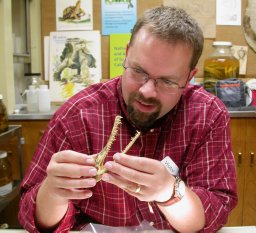 Mathew Wedel合作论文数School of Natural Sciences;University of California Merced;School of Natural Sciences, University of California Merced16
 Darren Naish合作论文数School of Earth and Environmental Sciences, University of Portsmouth5
 Richard Styron合作论文数University of Kansas Lawrence, University of Kansas4
 Andrew Katumwehe合作论文数3
 Asenath Kwagalakwe合作论文数3Hillary Mwongyera合作论文数3
 Megan A. Mueller合作论文数Dept Earth & Space Sci, Univ Washington3
 Alexis Licht合作论文数Centre de Recherche et d'Enseignement de Géosciences de l'Environnement3
 Andreas Moeller合作论文数University of Kansas Lawrence, University of Kansas3
 Robin Evans合作论文数Department of Electrical and Electronic Engineering, The University of Melbourne;Victoria Research Laboratory of National ICT Australia, The University of Melbourne3
 D. Sarah Stamps合作论文数3
 Estella A. Atekwana合作论文数Dept . of Geology and Geophysics;University of Missouri-Rolla;Dept . of Geology and Geophysics, University of Missouri-Rolla3
 Clay Campbell合作论文数2
 Daniel D. Mongovin合作论文数Dept Geol, Univ Kansas2
 Gabriel Veloza合作论文数Hocol SA2
 Suzan van der Lee合作论文数Department of Earth and Planetary Sciences, Weinberg College of Arts and Sciences, Northwestern University2
 Paul Upchurch合作论文数Earth Sciences, Faculty of Mathematical & Physical Sciences, University College London2
 Kurt E. Sundell合作论文数University of Kansas Lawrence, University of Kansas2Andres Mora合作论文数Ecopetrol2
 Wray Buntine合作论文数College of Engineering and Computer Science, VinUniversity2Pauline Coster合作论文数Institut International de Paléoprimatologie, Université de Poitiers2
 Faruk Ocakoğlu合作论文数Department of Geological Engineering, Osmangazi University2
 K Christopher Beard合作论文数Section of Vertebrate Paleontology, Carnegie Museum of Natural History2
 Gregoire Metais合作论文数Section of Vertebrate Paleontology, Carnegie Museum of Natural History2Steven D. Sroka合作论文数1Jann Vendetti合作论文数1Kelechi Okoronkwo合作论文数1Drew R. Schwab合作论文数1at mccallister合作论文数1
 T.A. Rajaonarison合作论文数1
 John Matthew Cannon合作论文数1
 Emmanuel Njinju合作论文数VA Tech, Dept Geosci, Blacksburg, VA 24060 USA1
 Tandis S. Bidgoli合作论文数Department of Geological Sciences, California State University San Bernardino1
 Andrew K. Laskowski合作论文数Dept Earth Sci, Montana State Univ1
 Folarin Kolawole合作论文数Department of Earth and Environmental Sciences, Columbia University1
 Jean-Philippe Avouac合作论文数Department of Mechanical and Civil Engineering, Division of Engineering and Applied Science, California Institute of Technology;Center for Geomechanics and Mitigation of Geohazards, California Institute of Technology;Center for Autonomous Systems and Technologies, California Institute of Technology1
 Philip Mannion合作论文数Earth Sciences, Faculty of Mathematical & Physical Sciences, University College London1
 Richard L. Cifelli合作论文数Department of Biology, Dodge Family College of Arts and Sciences, University of Oklahoma1
 De-Liang Liu合作论文数Chinese Academy of Sciences, Chinese Academy of Sciences1
 Jeffrey A G Oalmann合作论文数University of Kansas Lawrence, University of Kansas1
 Michael A. Murphy合作论文数University of Houston, Univ of Houston1
 McLean Noah M合作论文数Dept Earth Atmospher & Planetary Sci, MIT1
 Neil J. Gostling合作论文数School of Biological Sciences, Faculty of Environmental and Life Sciences, University of Southampton1
 Adam M. Forte合作论文数1
 Lin Ding (丁林)合作论文数Institute of Tibetan Plateau Research, Chinese Academy of Sciences1
 Georg Rumpker合作论文数Inst Geosci, Goethe Univ Frankfurt1Heather K. Handley合作论文数Department of Earth and Planetary Sciences, Macquarie University1
 Andrew A. Farke合作论文数Raymond M. Alf Museum of Paleontology1Leslie F. Noe合作论文数1




