The Swin Transformer has attracted attention in the field of medical image analysis since its introduction in 2021 owing to its computational efficiency and long-range modeling capabilities. Because of these characteristics, the Swin Transformer can establish distant relationships between corresponding voxels at distant locations for complex abdominal image registration tasks. Transformer-based registration methods model the features of multiple fused voxels and output coarse-grained features of the same size. To enable the Transformer to output fine-grained information and strengthen the contribution of the Transformer in the registration model, we propose the recover feature resolution network (RFRNet), which converts the features outputted by the Transformer into fine-grained spatial information. In addition, fixed-window partitioning restricts the Transformer from modeling the global connection of semantic information with uncertain distances. Therefore, we proposed a weighted window attenuation (WWA) mechanism to achieve automatic global-scale interaction of window information after a window partitioning operation. Based on these improvements, we proposed a single-modal unsupervised deformable abnormal image registration model called RFR-WWANet. Qualitative and quantitative results showed that RFR-WWANet achieved significant improvements compared with the current state-of-the-art methods. Ablation experiments demonstrated the effectiveness of the RFRNet and WWA designs. Our code is available at https://github.com/MingR-Ma/RFR-WWANet.
Background: Detecting programmed death ligand 1 (PD-L1) expression based on immunohistochemical (IHC) staining is an important guide for the treatment of lung cancer with immune checkpoint inhibitors. However, this method has problems such as high staining costs, tumor heterogeneity, and subjective differences among pathologists. Therefore, the application of deep learning models to segment and quantitatively predict PD-L1 expression in digital sections of Hematoxylin and eosin (H&E) stained lung squamous cell carcinoma is of great significance. Methods: We constructed a dataset comprising H&E-stained digital sections of lung squamous cell carcinoma and used a Transformer Unet (TransUnet) deep learning network with an encoder-decoder design to segment PD-L1 negative and positive regions and quantitatively predict the tumor cell positive score (TPS). Results: The results showed that the dice similarity coefficient (DSC) and intersection overunion (IoU) of deep learning for PD-L1 expression segmentation of H&E-stained digital slides of lung squamous cell carcinoma were 80 and 72%, respectively, which were better than the other seven cutting-edge segmentation models. The root mean square error (RMSE) of quantitative prediction TPS was 26.8, and the intra-group correlation coefficients with the gold standard was 0.92 (95% CI: 0.90-0.93), which was better than the consistency between the results of five pathologists and the gold standard. Conclusion: The deep learning model is capable of segmenting and quantitatively predicting PD-L1 expression in H&E-stained digital sections of lung squamous cell carcinoma, which has significant implications for the application and guidance of immune checkpoint inhibitor treatments. And the link to the code is https://github.com/Baron-Huang/PD-L1-prediction-via-HE-image.
Webshell, as the "culprit" behind numerous network attacks, is one of the research hotspots in the field of cybersecurity. However, the complexity, stealthiness, and confusing nature of webshells pose significant challenges to the corresponding detection schemes. With the rise of Artificial Intelligence (AI) technology, researchers have started to apply different intelligent algorithms and neural network architectures to the task of webshell detection. However, the related research still lacks a systematic and standardized methodological process, which is confusing and redundant. Therefore, following the development timeline, we carefully summarize the progress of relevant research in this field, dividing it into three stages: Start Stage, Initial Development Stage, and In-depth Development Stage. We further elaborate on the main characteristics and core algorithms of each stage. In addition, we analyze the pain points and challenges that still exist in this field and predict the future development trend of this field from our point of view. To the best of our knowledge, this is the first review that details the research related to AI-based webshell detection. It is also hoped that this paper can provide detailed technical information for more researchers interested in AI-based webshell detection tasks.
Medical image registration is an essential topic in medical image analysis. In this paper, we propose a method for medical image registration using a pretrained large language model. We find that using the pretrained large language model to encode deep features of the medical images in the registration model can effectively improve image registration accuracy, indicating the great potential of the large language model in medical image registration tasks. We use dual encoders to perform deep feature extraction on image pairs and then input the features into the pretrained large language model. To adapt the large language model to our registration task, the weights of the large language model are frozen in the registration model, and an adapter is utilized to fine-tune the large language model, which aims at (a) mapping the visual tokens to the language space before the large language model computing, (b) project the modeled language tokens output from the large language model to the visual space. Our method combines output features from the fine-tuned large language model with the features output from each encoder layer to gradually generate the deformation fields required for registration in the decoder. To demonstrate the effectiveness of the large prediction model in registration tasks, we conducted experiments on knee and brain MRI and achieved state-of-the-art results.
The challenge of Multimodal Deformable Image Registration (MDIR) lies in the conversion and alignment of features between images of different modalities. Generative models (GMs) cannot retain the necessary information enough from the source modality to the target one, while non-GMs struggle to align features across these two modalities. In this paper, we propose a novel coarse-to-fine MDIR framework,LLM-Morph, which is applicable to various pre-trained Large Language Models (LLMs) to solve these concerns by aligning the deep features from different modal medical images. Specifically, we first utilize a CNN encoder to extract deep visual features from cross-modal image pairs, then we use the first adapter to adjust these tokens, and use LoRA in pre-trained LLMs to fine-tune their weights, both aimed at eliminating the domain gap between the pre-trained LLMs and the MDIR task. Third, for the alignment of tokens, we utilize other four adapters to transform the LLM-encoded tokens into multi-scale visual features, generating multi-scale deformation fields and facilitating the coarse-to-fine MDIR task. Extensive experiments in MR-CT Abdomen and SR-Reg Brain datasets demonstrate the effectiveness of our framework and the potential of pre-trained LLMs for MDIR task. Our code is availabel at: https://github.com/ninjannn/LLM-Morph.
The frequent occurrence of cyber-attacks has made webshell attacks and defense gradually become a research hotspot in the field of network security. However, the lack of publicly available benchmark datasets and the over-reliance on manually defined rules for webshell escape sample generation have slowed down the progress of research related to webshell escape sample generation strategies and artificial intelligence-based webshell detection algorithms. To address the drawbacks of weak webshell sample escape capabilities, the lack of webshell datasets with complex malicious features, and to promote the development of webshell detection technology, we propose the Hybrid Prompt algorithm for webshell escape sample generation with the help of large language models. As a prompt algorithm specifically developed for webshell sample generation, the Hybrid Prompt algorithm not only combines various prompt ideas including Chain of Thought, Tree of Thought, but also incorporates various components such as webshell hierarchical module and few-shot example to facilitate the LLM in learning and reasoning webshell escape strategies. Experimental results show that the Hybrid Prompt algorithm can work with multiple LLMs with excellent code reasoning ability to generate high-quality webshell samples with high Escape Rate (88.61 VIRUSTOTAL detection engine) and Survival Rate (54.98
Segmenting regions of interest in histopathology images is a critical prerequisite for biomedical applications. CNN-based models have advanced medical image segmentation, yet accurately delineating boundaries is still challenging. This challenge arises from the loss of spatial resolution due to downsampling and the complexity of capturing contextual information when upsampling to the original resolution. To address these issues, we design U-HRMLP, a U-shaped network based on a hybrid combination of HRNet and Multi-Layer Perceptron (MLP). Specifically, we propose a multi-scale feature fusion module to avoid the loss of image resolution in the encoding stage as much as possible. Simultaneously, we propose an MLP-based decoding block to recover image details and resolution progressively, alleviating the issues related to the inadequate segmentation of smaller objects and the blurring of tissue boundaries. Results on the MoNuSeg and GlaS datasets demonstrate that U-HRMLP outperforms conventional or transformer-based methods and achieves state-of- the-art performance.
Transformer, as one of the most advanced neural network models in Natural Language Processing (NLP), exhibits diverse applications in the field of anomaly detection. To inspire research on Transformer-based anomaly detection, this review offers a fresh perspective on the concept of anomaly detection. We explore the current challenges of anomaly detection and provide detailed insights into the operating principles of Transformer and its variants in anomaly detection tasks. Additionally, we delineate various application scenarios for Transformer-based anomaly detection models and discuss the datasets and evaluation metrics employed. Furthermore, this review highlights the key challenges in Transformer-based anomaly detection research and conducts a comprehensive analysis of future research trends in this domain. The review includes an extensive compilation of over 100 core references related to Transformer-based anomaly detection. To the best of our knowledge, this is the first comprehensive review that focuses on the research related to Transformer in the context of anomaly detection. We hope that this paper can provide detailed technical information to researchers interested in Transformer-based anomaly detection tasks.
Medical image registration can establish the spatial consistency of the corresponding anatomical structures between different medical images, which is important in medical image analysis. In recent years, with the rapid development of deep learning, the image registration methods based on deep learning greatly improve the speed, accuracy, and robustness of registration. Regrettably, these methods typically do not work well for large deformations and complex deformations in the image, and neglect to preserve the topological properties of the image during deformation. Aiming at these problems, we propose a new network TS-Net that learns deformation from coarse to fine and transmits information of different scales in the two stages. Two-stage network learning deformation from coarse to fine can gradually learn the large and complex deformations in images. In the second stage, the feature maps downsampled in the first stage for skip connection can expand the local receptive field and obtain more local information. The smooth constraints function used in the past is to impose the same restriction on the global, which is not targeted. In this paper, we propose a new smooth constraints function for each voxel deformation, which can better ensure the smoothness of the transformation and maintain the topological properties of the image. The experiments on brain datasets with complex deformations and heart datasets with large deformations show that our proposed method achieves better results while maintaining the topological properties of deformations compared to existing deep learning-based registration methods.
In the context of big data, if the task of multivariate time series data anomaly detection cannot be performed efficiently and accurately, it will bring great security risks to industrial systems. However, fast model inference requirements, unlabeled datasets and excessively long time series make it a challenging problem to build an accurate and fast anomaly detection model. In this paper, we propose an unsupervised Bi-Transformer anomaly detection method (BTAD) for multivariate time series data, which uses Bi-Transformer structure to extract dataset association features, and uses an improved adaptive multi-head attention mechanism to infer trends in each meta-dimension of multivariate time series data in parallel. The modified Decoder structure prevents the reconstructed output of BTAD from being disturbed by the input information. Self-conditioning mechanism could enhance the robustness to noisy data, and improve model’s generalization ability. Experiments show that BTAD could outperform other models in detection performance and training efficiency. Taking NAB dataset as an example, the AUC and F1 of BTAD are increased by more than 4.78% and 1.40% separately. Finally, we look forward to the future development trend of BTAD, and put forward the corresponding improvement ideas.
The tumor grading of laryngeal cancer pathological images needs to be accurate and interpretable. The deep learning model based on the attention mechanism-integrated convolution (AMC) block has good inductive bias capability but poor interpretability, whereas the deep learning model based on the vision transformer (ViT) block has good interpretability but weak inductive bias ability. Therefore, we propose an end-to-end ViT-AMC network (ViT-AMCNet) with adaptive model fusion and multiobjective optimization that integrates and fuses the ViT and AMC blocks. However, existing model fusion methods often have negative fusion: 1). There is no guarantee that the ViT and AMC blocks will simultaneously have good feature representation capability. 2). The difference in feature representations learning between the ViT and AMC blocks is not obvious, so there is much redundant information in the two feature representations. Accordingly, we first prove the feasibility of fusing the ViT and AMC blocks based on Hoeffding's inequality. Then, we propose a multiobjective optimization method to solve the problem that ViT and AMC blocks cannot simultaneously have good feature representation. Finally, an adaptive model fusion method integrating the metrics block and the fusion block is proposed to increase the differences between feature representations and improve the deredundancy capability. Our methods improve the fusion ability of ViT-AMCNet, and experimental results demonstrate that ViT-AMCNet significantly outperforms state-of-the-art methods. Importantly, the visualized interpretive maps are closer to the region of interest of concern by pathologists, and the generalization ability is also excellent. Our code is publicly available at https://github.com/Baron-Huang/ViT-AMCNet.
The widespread use of sensors has resulted in an unprecedented amount of time series data. Time series mining has experienced a particular surge of interest, among which, subsequence matching is one of the most primary problem that serves as a foundation for many time series data mining techniques, such as anomaly detection and classification. In literature there exist many works to study this problem. However, in many real applications, it is uneasy for users to accurately and clearly elaborate the query intuition with a single query sequence. Consequently, in this paper, we address this issue by allowing users to submit a small query set, instead of a single query. The multiple queries can embody the query intuition better. In particular, we first propose a novel probability-based representation of the query set. A common segmentation is generated which can approximate the queries well, in which each segment is described by some features. For each feature, the corresponding values of multiple queries are represented as a Gaussian distribution. Then, based on the representation, we design a novel distance function to measure the similarity of one subsequence to the multiple queries. Also, we propose a breadth-first search strategy to find out similar subsequences. We have conducted extensive experiments on both synthetic and real datasets, and the results verify the superiority of our approach.
Computer-aided diagnosis has been widely used in the medical field, and one of the current research hotspots for aiding diagnosis is how to effectively fuse heterogeneous data such as image data and metadata. Most recent multi-modal skin cancer diagnosis models are only fused at the feature level or decision level and have not yet paid attention to the differential influence of metadata on image features under dynamic guidance, which has limited the ability of metadata to improve the predictive performance of the model. Therefore, this paper proposed a multi-level dynamic fusion network (MLDF-Net) based on metadata guidance, which attempted to dynamically fuse relevant metadata features in the image feature extraction stage to achieve the purpose of metadata-guided image features. Firstly, we designed a feature selection block (FS Block) to suppress the influence of noise in metadata and enhance the metadata feature representation associated with images. Secondly, the filtered metadata and images are fused in the feature extractor at multiple levels, and the metadata dynamically guides the network to extract more representative image features. Lastly, the experimental results showed that MLDF-Net achieved 81.3% accuracy compared with other classification studies using the same dataset, which verified the feasibility and advancement of the multi-level dynamic fusion strategy based on metadata guidance.
The Swin transformer has recently attracted attention in medical image analysis due to its computational efficiency and long-range modeling capability. Owing to these properties, the Swin Transformer is suitable for establishing more distant relationships between corresponding voxels in different positions in complex abdominal image registration tasks. However, the registration models based on transformers combine multiple voxels into a single semantic token. This merging process limits the transformers to model and generate coarse-grained spatial information. To address this issue, we propose Recovery Feature Resolution Network (RFRNet), which allows the transformer to contribute fine-grained spatial information and rich semantic correspondences to higher resolution levels. Furthermore, shifted window partitioning operations are inflexible, indicating that they cannot perceive the semantic information over uncertain distances and automatically bridge the global connections between windows. Therefore, we present a Weighted Window Attention (WWA) to build global interactions between windows automatically. It is implemented after the regular and cyclic shift window partitioning operations within the Swin transformer block. The proposed unsupervised deformable image registration model, named RFR-WWANet, detects the long-range correlations, and facilitates meaningful semantic relevance of anatomical structures. Qualitative and quantitative results show that RFR-WWANet achieves significant improvements over the current state-of-the-art methods. Ablation experiments demonstrate the effectiveness of the RFRNet and WWA designs. Our code is available at .
Medical image registration is a fundamental and critical task in medical image analysis. With the rapid development of deep learning, convolutional neural networks (CNNs) have dominated the medical image registration field. Due to the disadvantage of the local receptive field of CNNs, some recent registration methods have focused on using transformers for nonlocal registration. However, the standard transformer has a vast number of parameters and high computational complexity, which means that it can only be applied at the bottom of registration models. As a result, only coarse information is available at the lowest resolution, limiting the contribution of the transformer in these models. To address these challenges, we propose a convolution-based efficient multihead self-attention (CEMSA) block, which reduces the number of parameters of the traditional transformer and captures local spatial context information to reduce semantic ambiguity in the attention mechanism. Based on the proposed CEMSA, we present a novel symmetric transformer-based model (SymTrans). SymTrans employs the transformer blocks in the encoder and the decoder to model the long-range spatial cross-image relevance. We apply SymTrans to the displacement field and diffeomorphic registration. Experimental results show that our proposed method achieves state-of-the-art performance in image registration. Our code is publicly available at https://github.com/MingR-Ma/SymTrans .
Objective To investigate the value of preoperative prediction of breast cancer axillary lymph node metastasis based on intratumoral and peritumoral dynamic contrast enhancement magnetic resonance imaging (DCE-MRI) radiomics nomogram. Material and Methods. In this study, a radiomics model was developed based on a training cohort involving 250 patients with breast cancer (BC) who had undergone axillary lymph node (ALN) dissection between June 2019 and January 2021. The intratumoral and peritumoral radiomics features were extracted from the second postcontrast images of DCE-MRI. Based on filtered radiomics features, the radiomics signature was built by using the least absolute shrinkage and selection operator method. The Support Vector Machines (SVM) learning algorithm was used to construct intratumoral, periatumoral, and intratumoral combined periatumoral models for predicting axillary lymph node metastasis (ALNM) in BC. Nomogram performance was determined by its discrimination, calibration, and clinical value. Multivariable logistic regression was adopted to establish a radiomics nomogram. Results The intratumoral combined peritumoral radiomics signature, which was composed of fifteen ALN status-related features, showed the best predictive performance and was associated with ALNM in both the training and validation cohorts (P < 0.001). The prediction efficiency of the intratumoral combined peritumoral radiomics model was higher than that of the intratumoral radiomics model and the peritumoral radiomics model. The AUCs of the training and verification cohorts were 0.867 and 0.785, respectively. The radiomics nomogram, which incorporated the radiomics signature, MR-reported ALN status, and MR-reported maximum diameter of the lesion, showed good calibration and discrimination in the training (AUC = 0.872) and validation cohorts (AUC = 0.863). Conclusion The intratumoral combined peritumoral radiomics model derived from DCE-MRI showed great predictive value for ALNM and may help to improve clinical decision-making for BC.
Medical image registration is a fundamental and vital task in medical image analysis. Deformable medical image registration generates a dense nonlinear transformation from the moving image to the fixed image. Current learning-based image registration methods utilize U-shaped networks, concatenate moving and fixed images as one input, and then impose a global regularization to ensure smooth deformation fields. However, existing deformable image registration approaches concatenate image pairs as one input to their model and may ignore independent anatomical relevance of the images. Moreover, the global regularization causes over/underconstraining, affecting their model registration accuracy and over/under enforcing the deformation field's smoothness. To address these two problems, we propose a twinning network, consisting of two subnetworks. The first subnetwork is the proposed separate encoding neural network (SEN) for predicting high-accuracy deformation fields, and the second subnetwork is a folding correction block (FCB) to correct the deformation fields to achieve folding reduction. Comparing our experimental results to the state-of-the-art displacement and diffeomorphic methods, the proposed method provides superior registration accuracy and reduces the folding numbers. Moreover, we utilize the FCB to correct the baselines' output deformation fields, proving that the FCB outperforms global regularization.
As one of the most effective methods of vulnerability mining, fuzzy testing has scalability and complex path detection ability. Fuzzy testing sample generation is the key step of fuzzy testing, and the quality of sample directly determines the vulnerability mining ability of fuzzy tester. At present, the known sample generation methods focus on code coverage or seed mutation under a critical execution path, so it is difficult to take both into account. Therefore, based on the idea of ensemble learning in artificial intelligence, we propose a fuzzy testing sample generation framework named CVDF DYNAMIC, which is based on genetic algorithm and BI-LSTM neural network. The main purpose of CVDF DYNAMIC is to generate fuzzy testing samples with both code coverage and path depth detection ability. CVDF DYNAMIC generates its own test case sets through BI-LSTM neural network and genetic algorithm. Then, we integrate the two sample sets through the idea of ensemble learning to obtain a sample set with both code coverage and vulnerability mining ability for a critical execution path of the program. In order to improve the efficiency of fuzzy testing, we use heuristic genetic algorithm to simplify the integrated sample set. We also innovatively put forward the evaluation index of path depth detection ability (pdda), which can effectively measure the vulnerability mining ability of the generated test case set under the critical execution path of the program. Finally, we compare CVDF DYNAMIC with some existing fuzzy testing tools and scientific research results and further propose the future improvement ideas of CVDF DYNAMIC.
Medical image registration is a fundamental task in computer-aided medical diagnosis. Recently, researchers have begun to use deep learning methods based on convolutional neural networks (CNN) for registration, and have made remarkable achievements in medical image registration. Although CNN based methods can provide rich local information on registration, their global modeling ability is weak to carry out the long distance information interaction and restrict the registration performance. The Transformer is originally used for sequence-to-sequence prediction. Now it also achieves great results in various visual tasks, due to its strong global modeling capability. Compared with CNN, Transformer can provide rich global information, in contrast, Transformer lacks of local information. To address Transformer lacks local information, we propose a hybrid network which is similar to U-Net to combine Transformer and CNN, to extract global and local information (at each level). Specifically, CNN is first used to obtain the feature maps of the image, and the Transformer is used as encoder to extract global information. Then the results obtained by Transformer encoding are connected to the upsampling process. The upsampling uses CNN to integrate local information and global information. Finally, the resolution is restored to the input image, and obtain the displacement field after several convolution layers. We evaluate our method on brain MRI scans. Experimental results demonstrate that our method improves the accuracy by 1% compared with the state-of-the-art approaches.
Breast cancer is a malignant tumor with the highest incidence rate in women. Current diagnostic methods are time-consuming, costly, and dependent on physician experience. In this study, we used serum Raman spectroscopy combined with multiple classification algorithms to implement an auxiliary diagnosis method for breast cancer, which will help in the early diagnosis of breast cancer patients. We analyzed the serum Raman spectra of 171 invasive ductal carcinoma (IDC) and 100 healthy volunteers; The analysis showed differences in nucleic acids, carotenoids, amino acids, and lipid concentrations in their blood. These differences provide a theoretical basis for this experiment. First, we used adaptive iteratively reweighted penalized least squares (airPLS) and Savitzky-Golay (SG) for baseline correction and smoothing denoising to remove the effect of noise on the experiment. Then, the Principal component analysis (PCA) algorithm was used to extract features. Finally, we built four classification models: support vector machine (SVM), decision tree (DT), linear discriminant analysis (LDA), and Neural Network Language Model (NNLM). The LDA, SVM, and NNLM achieve 100% accuracy. As supplementary, we added the classification experiment of the raw data. By comparing the experimental results of the two groups, We concluded that the NNLM was the best model. The results show the reliability of the combination of serum Raman spectroscopy and classification models under large sample conditions.
 Guixia Liu (刘桂霞)合作论文数School of Pharmacy, East China University of Science and Technology6
 Lei Song合作论文数5陈诚合作论文数College of Textile and Clothing, Xinjiang University5
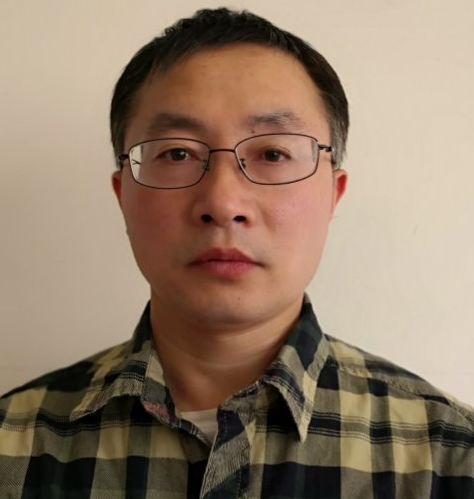 Lansheng Han (韩兰胜)合作论文数School of Cyber Science and Engineering, Huazhong University of Science and Technology5
 Xiaojian Ma合作论文数4
 Chunjie Zhou (周纯杰)合作论文数School of Artifical Intelligence and Automation, Huazhong University of Science and Technology4Tao Wang合作论文数3
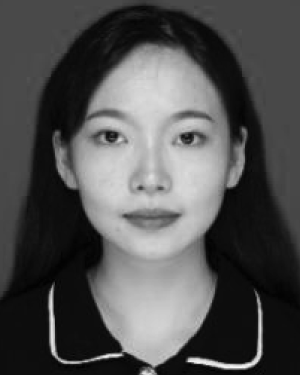 Ziwei Yan合作论文数3
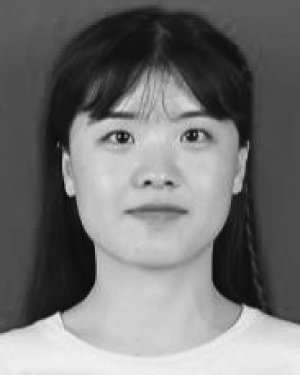 Fangfang Chen合作论文数3
 Weijie Wang合作论文数Tianjin University3Min Zhu合作论文数2Dan Yang合作论文数2Xiaogang Dong合作论文数2
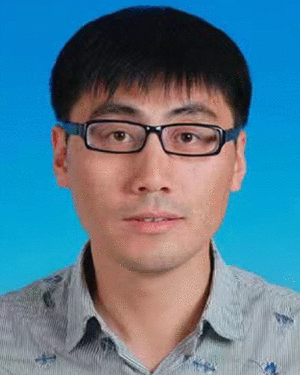 Xu Yu合作论文数2Xu Yuanbo合作论文数Jilin Univ, Coll Comp Sci & Technol, Changchun 130012, Peoples R China2
 Pan Huang合作论文数Coll Optoelect Engn, Chongqing Univ2
 Peng Feng (冯鹏)合作论文数College of Optoelectronic Engineering, Chongqing University2
 Peng He (何鹏)合作论文数College of Optoelectronic Engineering, Chongqing University2
 Xiaoyi Lv (吕小毅)合作论文数College of Information Science and Engineering (School of Cyber Science and Engineering), Xinjiang University2Hualiang Xiao (肖华亮)合作论文数Army Medical Center of PLA2
 Zhiqiang Xie (谢志强)合作论文数School of Computer Science and Technology, Harbin University of Science and Technology2Ye Zhang合作论文数1
 Yushuai Yuan合作论文数1Xuecong Tian合作论文数1Jie Ming合作论文数1Qinggang Zeng合作论文数1
 ZHOU Panyun (周盼运)合作论文数1Zhiwei Zhao合作论文数1Jiajia Chen合作论文数1
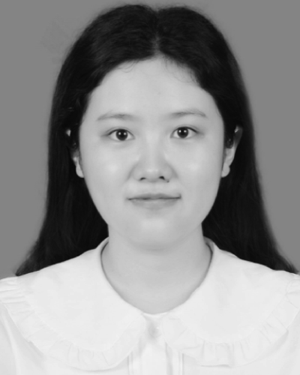 Liu Wen合作论文数1Yan Chen合作论文数1Yang Yu合作论文数1
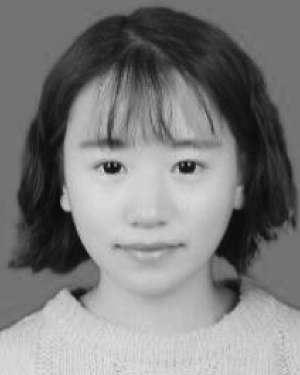 Yujie Bai合作论文数1Yuhua Ma合作论文数1Wenjia Guo合作论文数Xinjiang Med Univ, Canc Affiliated Hosp, Dept Canc Res Inst, Urumqi City, Xinjiang Provin, Peoples R China1Yunling Wang合作论文数1
 Shuailei Zhang合作论文数Beihang Univ, Sch Instrumentat & Optoelect Engn, Beijing 100191, Peoples R China1Qiushi Wang合作论文数1Bing Cai合作论文数1Peng Zhong合作论文数1
 Chen Chen合作论文数1
 Min Li合作论文数1Wei Wu合作论文数1
 Enguang Zuo合作论文数College of Information Science and Engineering, Xinjiang University1
 Sukun Tian合作论文数Nanjing Univ Aeronaut & Astronaut, Coll Mech & Elect Engn, Nanjing 210016, Jiangsu, Peoples R China1
 Shuang Yu (于爽)合作论文数School of Software, Faculty of Computing, Harbin Institute of Technology1Tuan Wang (汪湍)合作论文数1




