This workshop at Robophilosophy 2016 will explore approaches for designing robots for children that incorporate the needs and preferences of children, themselves. An interdisciplinary panel of child-robot interaction (CRI) researchers will introduce workshop participants to projects in Denmark, Russia and the United States of America that have used differing approaches for collecting children's attitudes and ideas about robots, including speculative co-design, quantitative survey-scales, linguistic analysis, and long-term research studies in educational contexts. Workshop participants will also engage in a group, roboethics imaginative exercise with the International Archive of Children's Robot Designs housed at the Center for Children's Speculative Design (a concurrent exhibition on display at Robophilosophy 2016). The published outcomes of this workshop will inform an evolving draft of recommendations and responsible strategies to be shared with scholars, robotics industry thought leaders and international policy makers concerned with the ethical implications of social robots designed to specifically target and impact the lives of children worldwide.
Current human-robot-interaction research methods could benefit from an age-appropriate scale that measures children's attitudes towards robots. This paper presents the design process and evidence for the validity of the Children's Openness to Interacting with a Robot Scale (COIRS). We report findings from a pilot test on a diverse population of 172 U.S. students between the ages of 8-11. High average scores on the COIRS suggested that children in this sample were highly open to interacting with a robot.
We present the theoretical framework and design of a technologically-mediated informal learning experience aimed at assisting students of all ages playfully engage in a language game for fun. The game's activities center around rhyming over a beat with a robotic companion. We ground the work in developmental psychology literature on the importance of early rhyming skills for children and provide technical details of a working prototype. Our work advances an informal learning intervention for children at-risk of developing reading disabilities. We propose a study using validated, evaluation measures and conclude with a detailed report on extensions to the system currently in progress.
w hen we were first approached to write about creativity and computer science, we hesitated at the prospect of having much to say on such a complicated subject. We see creativity as an imaginative exploration of an artistic domain or medium. But what is most interesting is not just blind exploration of a domain, but rather, an intentional message or a direction of the art. How the artist and creator step through the process is in itself informative of the kinds of decisions that the artist makes at critical points in the creation of the piece. Taking a broad view of creativity, we are interested in how computers aid us in realizing creative expression across various mediums. The research highlighted within this issue is an attempt at understanding this broad view. From a computational perspective, it is still an active area of research—for a computer to coordinate and produce a piece of narrative art, we must know what kinds of component parts are needed for this collaboration. Even top scientists in decision theory wrestle with these types of problems. Furthermore, it is a challenge to coordinate art or communication across multiple modes of expression. Observational analysis may be the key to understanding how the process of creative expression operates and evolves. For the first time, the science of integrating computers into our daily lives has offered us the prospect of fluidly bringing together many mediums in a cohesive way. By capturing a wide variety of images and data, we are for the first time allowed to quickly prototype new mixtures of creative artifacts. For instance, suppose an artist sketched an idea with a sharpie, scanned it, modeled it in into CAD to produce a three dimensional version, printed that into plastic, painted it with acrylic, physically animated it, and finally added special effects to make a short film; this is an example of utilizing many classic creative techniques as well as placing the computer central to the creative process. Allowing young people and adults in an educational and free environment to explore new ideas quickly may help us better observe this in vivo process as it is evolving and being expressed. In many ways the tools that we use or produce for creative ends can enable or hinder artists, making it our job to listen. We have tried to cover both sides of the debate on tools for artists , …
We present the theoretical framework and design of a technologically-mediated informal learning experience aimed at assisting students of all ages playfully engage in a language game for fun. The game's activities center around rhyming over a beat with a robotic companion. We ground the work in developmental psychology literature on the importance of early rhyming skills for children and provide technical details of a working prototype. Our work advances an informal learning intervention for children at-risk of developing reading disabilities. We propose a study using validated, evaluation measures and conclude with a detailed report on extensions to the system currently in progress.
We present the idea and formative design of a blended reality character, a new class of character able to maintain visual and kinetic continuity between the fully physical and fully virtual. The interactive character's embodiment fluidly transitions from an animated character on-screen to a small, alphabet block-shaped mobile robot designed as a platform for informal learning through play. We present the design and results of our study with thirty-four children aged three and a half to seven conducted using non-reactive, unobtrusive observational methods and a validated evaluation instrument. Our claim is that young children have accepted the idea, persistence and continuity of blended reality characters. Furthermore, we found that children are more deeply engaged with blended reality characters and are more fully immersed in blended reality play as co-protagonists in the experience, in comparison to interactions with strictly screen-based representations. As substantiated through the use of quantitative and qualitative analysis of drawings and verbal utterances, the study shows that young children produce longer, detailed and more imaginative descriptions of their experiences following blended reality play. The desire to continue engaging in blended reality play as expressed by children's verbal requests to revisit and extend their play time with the character positively affirms the potential for the development of an informal learning platform with sustained appeal to young children.
The idea and formative design of a blended reality character, a new class of character able to maintain visual and kinetic continuity between the fully physical and fully virtual; the technical underpinnings of its unique blended physical and digital play context and the evaluation of its impact on children's play are the contents of this thesis. A play test study with thirty-four children aged three and a half to seven was conducted using non-reactive, unobtrusive observational methods and a validated evaluation instrument. Our claim is that young children have accepted the idea, persistence and continuity of blended reality characters. Furthermore, we found that children are more deeply engaged with blended reality characters and are more fully immersed in blended reality play as co-protagonists in the experience, in comparison to interactions with strictly screen-based representations. As substantiated through the use of quantitative and qualitative analysis of drawings and verbal utterances, the study showed that young children produce longer, detailed and more imaginative descriptions of their experiences following blended reality play. The desire to continue engaging in blended reality play as expressed by children's verbal requests to revisit and extend their play time with the character positively affirms the potential for the development of an informal learning platform with sustained appeal to young children. Thesis Supervisor: Professor Cynthia Breazeal Associate Professor of Media Arts and Sciences Program in Media Arts and Sciences Imaginative Play with Blended Reality Characters
In interactive storytelling systems, we see common challenges of artistic expression that pertains to presentation, standing apart from narrative structure. We believe this expression can be achieved computationally, which is a core challenge in using procedurally-generated worlds in interactive storytelling. This computational expression so is what we call dynamic dramaturgy. We intend dynamic dramaturgy as a complement to interactive narrative systems, particularly drama management, and as a fundamentally distinct task from plot-level narrative construction, yet it is still a basic medium for artistic expression by an author. It is, in effect, an art of presentation in interactive storytelling.
We describe an interactive, mixed reality (MR) robot gaming platform in which the user controls a tangible, physically embodied character. Miso, an expressive tele-operated robot plays with its virtual peers by passing a graphical object back and forth seamlessly through an integrated physical and virtual environment. Special emphasis is placed on the importance of maintaining perceptual continuity by closely coupling the simulated world's physical laws to our material reality. We present our implemented MR robot gaming environment and describe the design of an interreality portal at the boundary of the physical and virtual realities.
This brief deals with the adaptation of a real-time controller's sampling period to account for the available computing resource variations. The design of such controllers requires a parameter-dependent discrete-time model of the plant, where the parameter is the sampling period. A polytopic approach for linear parameter varying (LPV) systems is then developed to get an H ∞ sampling period dependent controller. A reduction of the polytope size is here performed which drastically reduces the conservatism of the approach and makes easier the controller implementation. Some experimental results on a T-inverted pendulum are provided to show the efficiency of the approach.
This paper deals with the adaptation of a real-time controller's sampling period to account for the available computing resource variations. The design of such controllers requires a parameter-dependent discrete-time model of the plant, where the parameter is the sampling period. A polytopic approach for LPV (Linear Parameter Varying) systems is then developed to get an H∞ sampling period dependent controller. A reduction of the polytope size is here performed which drastically reduces the conservatism of the approach and makes easier the controller implementation. Some experimental results on a T inverted pendulum are provided to show the efficiency of the approach.
This study comes within the context of the adaptation to processor/network load variations. We develop first a parameterized discrete-time plant representation w.r.t. the sampling period. An H∞ approach is then considered such that the bandwidth of the weighting functions depends on the sampling period. The linear parameter-varying (LPV) design of Apkarian et al. (1995) is then used to get a sampling period dependent discrete-time controller. An academical example illustrates the proposed approach.
Control systems running on a computer are subject to timing disturbances coming from implementation constraints. Fortunately closed-loop systems behave robustly w.r.t. modelling errors and disturbances, and the controller design can be performed to explicitly enhance robustness against specific uncertainties. On one hand robustness in process controllers can be used to comply with weakly modelled timing uncertainties. On the other hand the principle of robust closed-loop control can also be applied to the real-time scheduler to provide on-line adaption of some scheduling parameters, with the objective of controlling the computing resource allocation. The control performance specification may be set according to both control and implementation constraints. The approach is illustrated through several examples using simulation and an experimental feedback scheduler is briefly described.
 Ramon Carbó-Dorca Carré合作论文数Section of Quantum and Mathematical Chemistry, Institut de Química Computacional, Universitat de Girona22
 Xavier Girones合作论文数12
 Olivier Sename合作论文数GIPSA-lab, Department of Control Systems, Grenoble Institute of Technology9Lluis Amat合作论文数9
 Daniel I. Simon合作论文数The Department of Physiology and Biophysics, School of Medicine, Case Western Reserve University;Division of Cardiovascular Medicine, University Hospitals Case Medical Center;Heart & Vascular Institute, University Hospitals Cleveland7Emili Besalú合作论文数Institute of Computational Chemistry Campus Montilivi, University of Girona7van den Bergh, V.合作论文数3
 Cynthia Breazeal合作论文数Massachusetts Institute of Technology3
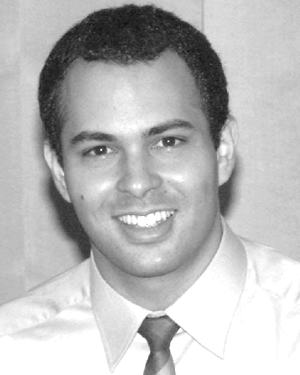 Mongi Ben Gaid合作论文数Institut Francais du Petrole;Control Systems Department;Control Systems Department, Institut Francais du Petrole|3Peter Schmitt合作论文数2
 Alex Olwal合作论文数Department of Computer Science;Columbia University;Department of Computer Science, Columbia University2
 Nick DePalma合作论文数Stack AV2
 Nadezhda Zilberman合作论文数Faculty of Philosophy, Tomsk State University1Alexandre Seuret合作论文数CNRS1Daniel Simon合作论文数1Ryan Wistort合作论文数1
 Angela Chang合作论文数TinkerStories;Synesthesia Muse Team1Jesse Gray合作论文数School Website1
 Ana Gallegos合作论文数1M. Ben Gaid合作论文数1
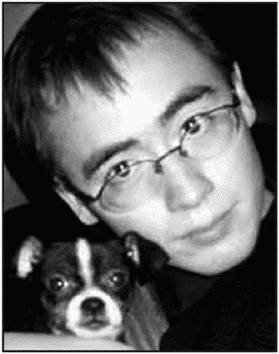 Jason B. Alonso合作论文数MIT Media Laboratory, Personal Robots, Cambridge, USA MA 021391




