Two species of the encrusting calcitic sclerobiont Allonema have been identified for the first time in the Ordovician. Allonema moniliforme and A. botellus were originally known only from the Silurian but are here recorded from the Katian (Upper Ordovician) of Estonia. A. moniliforme reappears in the Rhuddanian-Aeronian of Estonia, and A. botellus emerges again in the Sheinwoodian of Gotland. Both species are unknown in the Hirnantian (latest Ordovician), and both survived the end-Ordovician extinction. Both species lived in similar, calm, muddy environments during their Ordovician and Silurian appearances. During the Silurian, Allonema was a much more common and widespread encruster than in the Ordovician, occurring on a broad range of biogenic hard substrates. This difference may reflect ecological and evolutionary shifts following the Late Ordovician mass extinction, which reorganized marine ecosystems and opened new niches. A. botellus maintained astable morphology across the Ordovician-Silurian boundary, A. moniliforme underwent a narrowing of its morphological variability, possibly reflecting evolutionary canalization or shifts in ecological pressures over time. (c) 2026 Nanjing Institute of Geology and Palaeontology. Published by Elsevier B.V. All rights are reserved, including those for text and data mining, AI training, and similar technologies.
In all modern seas, empty mollusc shell interiors are often heavily encrusted by cryptic invertebrates, whereas globally in the Cambrian, all shell interiors of molluscs and other invertebrates remained free of encrustation, though cryptic organisms themselves occurred in other types of cavities. The colonization of cryptic surfaces within empty shells constitutes a global event and an important ecological innovation in Ordovician benthic marine ecosystems, marking the beginning of a new ecological niche. The earliest colonization in mollusc shells by cryptic invertebrates occurred in the Middle Ordovician, while heavily encrusted shell interiors are known since the Late Ordovician. The taxonomic composition of Ordovician cryptic communities in gastropod, bivalve, and nautiloid shells is generally similar, though substrate architecture influenced encruster abundance and body size rather than overall community structure. The major expansion of cryptic ecological niches occurred during the Ordovician biodiversification, driven by the increase in predation pressure, the diversification of encrusting organisms, and a general increase in the size of mollusc shells.
The world's oldest encrusting calcareous Foraminifera are here described from the Sheinwoodian of Saaremaa Island, Estonia. The encrusting Foraminifera represents a new species of the genus Earlandia, and E. giga n.sp. is characterized by a slightly conical and huge bilocular test. The foraminifera encrust gastropod shells in a gregarious manner. The Estonian material suggests that early calcareous Foraminifera had already experimented with a range of life strategies, including large body size and attachment to hard substrates. Our findings challenge the traditional narrative of early calcareous Foraminifera as exclusively soft-substrate dwellers, indicating a more complex ecological differentiation during the early Palaeozoic.
The Middle Ordovician cryptic encrusting community was numerically dominated by bryozoans (66.7%), followed by cornulitids (26.7%) and graptolites (6.6%). Bryozoans also occupied the largest encrustation area. Similarly, the Late Ordovician cryptic encrusting community was dominated by bryozoans (60%), while cornulitids (30%), brachiopods (8%), and graptolites (2%) formed a minor part of the community. In the studied samples, the disparity of Upper Ordovician cryptic encrusting fauna (including Bryozoa, Brachiopoda, Tentaculita, and Hemichordata) was greater than that of the Middle Ordovician, which consisted of Bryozoa, Hemichordata, and Tentaculita. There appears to be an increase in the maximum encrustation density within nautiloid shell interiors from the Darriwilian to the Katian. Additionally, a statistically significant increase in the percentage of encrusted nautiloid interiors from the Darriwilian to the Katian suggests a growing prevalence of cryptic encrusters over time. The increase was likely driven more by the evolutionary diversification of encrusting taxa than by the warming climate during the Katian in Baltica. (c) 2025 Elsevier Masson SAS. All rights are reserved, including those for text and data mining, AI training, and similar technologies.
Six new symbiotic associations between erect branching bryozoan colonies and tentaculitoid tubewormlike organisms have been described from argillaceous carbonate rocks of the Ludfordian of Saaremaa Island, Estonia. Several symbiotic associations occur in the Kuressaare Formation: Conchicolites sp.- Fistulipora sp. A and Fistulipora sp. B, Palaeoconchus sp. - Fistulipora sp. A, Conchicolites sp. - ?Eridotrypella sp., Conchicolites sp.- ?Anisotrypa proavus, Conchicolites sp. -?Leptotrypella versimilis and Monotrypa sp. - unknown endozoobiont association. The colonization of bryozoans by cornulitids and microconchids likely occurred because the former provided a suitable hard substrate on an otherwise soft clay sea floor. Most cornulitids had endobiotic life modes and were completely intergrown with their host bryozoans. There is no evidence of how cornulitids might have provided some advantage to the bryozoan host. However, given the likelihood of feeding competition, these associations are more appropriately qualified as mildly parasitic. (c) 2025 Elsevier Masson SAS. All rights are reserved, including those for text and data mining, AI training, and similar technologies.
The calcareous siltstones within the Ordovician section of the Takche Formation near Takche, Spiti region of Tethyan Himalaya, India, contain numerous specimens of non-calcified marine macroalgae in association with brachiopods, gastropods, tentaculitoids, and few trace fossils. The algal remains, representing five genera, are preserved as black or dark brown carbonaceous compression fossils, interpreted as warm-water marine macroalgae, namely, Inocladus sp., Callisphenus? sp., Algites sp. (siphonous algae), Fisherites sp., and Mastopora sp. (non-siphonous). Callisphenus is characterised by a radially symmetrical short pyriform thallus, with a central axis surrounded by short laterals whereas Inocladus sp. is characterised by an unsegmented simple thallus with internal parallel medullary siphons and cortical tubes. These algal remains, probably transported from a more near-shore living niche, co-occur with Cyclocrinitids, Tentaculitoids tube worms, trace fossils and brachiopods, suggesting that deposition of the studied units took place in low energy hydrodynamic conditions influenced by intermittent storm events. The study represents the first diversified macroalgal records from the Ordovician strata in the Tethyan realm of Indian subcontinent.
The Vasalemma Formation, late Sandbian, Late Ordovician in Estonia contains a previously unknown flora of noncalcified dasyclad algae. The Vasalemma Formation is a locally restricted limestone unit, which is predominantly composed of an echinoderm grainstone. The formation, in its central areas, contains bryozoa- and echinoderm-rich reefs, and associated with these reefs, small patches of dolomitic lime-mudstone with an algal-Lagerstätte occur. The macroalgae are preserved as thin carbonaceous film associated with pyrite without any micro-structures evident. Three taxa could be distinguished: Chaetocladus vasalemmense Kröger, et Tinn spec. nov., Chaetocladus sp., Eocladus estoniense Kröger, et Tinn spec. nov. All three taxa have simple monopodial morphologies and delicate laterals. Remarkable is the occurrence of branched laterals in E. estoniense, which to our knowledge, is among the earliest occurrence of this morphotype. The Vasalemma algae flora can be compared with roughly contemporaneous occurrences in North America, which show similarities in depositional environments and associated fauna but differ in morphological and taxonomical diversity.
Valves of the strophomenid brachiopod Sowerbyella tenera are often encrusted by trepostome bryozoan colonies in the lower Katian of Estonia. In some cases, the encrustation of Sowerbyella likely took place syn vivo. A single Sowerbyella tenera contains three Palaeosabella prisca borings that were bored post mortem into the interface between the encrusting trepostome colony and the ventral valve of Sowerbyella. The encrusting trepostome colonies contain a large bioclaustration in a tubular outgrowth of the bryozoan colony, Anoigmaichnus- like bioclaustrations, Kuckerichnus- like bioclaustrations, A. zapalskii, A. bretti, and a symbiotic conulariid. The bioclaustrated soft- bodied organisms and the conulariid colonized living bryozoans.
The anatomy of a dorsal head shield of an agnathan fossil Kalanaspis delectabilis, belonging to class Osteostraci from the Aeronian (early Silurian) Kalana Lagerstatte of Estonia was studied using the X-ray computer-tomography. Scanning exposed shallow superficial relief on the dorsal surface of the head shield, which unmasked the internal anatomy of the specimen. The Kalanaspis fossil displays a mosaic of morphological characters: the overall shape of the cephalothoracic head shield and the main structures, like lateral fields, are typical for the group, but instead of the open pineal foramen, common to most osteostracans, the organs in the pineal region are concealed by the shield. A combination of characters that are common to osteostracans, along with unique features known among other early vertebrates, refer to the position of K. delectabilis within the stem group of Osteostraci. The carbonaceous mode of preservation of the head shield of the Kalanaspis fossil, previously undocumented among vertebrate fossils, contradicts the conventional fossilization pattern and refers to an unusual taphonomic history. This anomalous type of preservation appears to be the key to unlock its fossilization history and the complex taphonomic conditions of the whole Kalana Lagerstatte. The main processes for the atypical fossilization of the specimen of K. delectabilis are most likely related to the microbially controlled dissolution of apatitic bone tissues and replacement with microbial biofilms, possibly by the invasion of collagenolytic bacteria.
The Late Ordovician Baltic Palaeobasin (BPB) offered a favourable environment for a diverse and abundant ostracod fauna to thrive across the basin. A short period of unstable environmental conditions at the end of the Ordovician, the Hirnantian glaciation, and the concurrent extinction event completely rearranged the ostracod associations. Statistical analyses reveal temporal (diverse pre-glacial, more uniform glacial and poorly diverse post-glaciation faunas) and geographical (upper shelf and middle shelf faunas) separation of ostracod associations in the BPB. The geographical division applies to the pre-glacial and glacial faunas only; the scanty post-glacial fauna found in deeper-water sections is uniform. Ostracod associations are distinct both in a temporal and geographical sense. Juxtaposing ostracod data with delta C-13 curves shows that the typical Hirnantian Harpabollia harparum fauna in the BPB appeared near the peak of a delta C-13 excursion. This might explain why the H. harparum fauna seems to appear first in deeper-water sections and is absent or appears later in shallower-water sections. The majority of the nearshore sections in Estonian and Lithuanian shelves lack most or all of the Hirnantian strata. The lowermost Hirnantian is preserved in only a few sections (e.g. Mannamaa and Puhmu in Estonia). The appearance of the post-glacial ostracod fauna, which most probably was a survival fauna rather than a recovery fauna, is related to the falling limb of the delta C-13 curve. The appearance of this fauna was previously considered as a marker of the Ordovician-Silurian boundary in the region but, according to the present understanding, took place in the late Hirnantian.
Ostracods of the Ordovician and Silurian transition interval in the Jūrmala section, Latvia, were studied. The diverse pre Hirnantian ostracod assemblage is replaced by the Harpabollia harparum association that has been recorded across the Baltoscandian region and northwestern Poland and is confined to the Hirnantian. The first complete ostracod succession throughout the Kuldīga and Saldus formations reveals a remarkable diversity decline and rise of dominance of ostracods in this interval. The appearance level of the H. harparum association in other sections is drawn distinctly above the range of Spinachitina taugourdeaui, nearly coinciding with the appearance of Conochitina scabra and Noixodontus girardeauensis. The transition from the Saldus Formation into the Stačiunai Formation marks a complete ostracod turnover. The newly appearing assemblage, dominated by Longiscula smithii, is of low diversity. Slow diversity rise may in part be ascribed to the overall low recovery rate of postglaciation faunal assemblages. The shape of the stable carbon isotopic curve in the Jūrmala core suggests that this section is one of the most complete successions across the Ordovician–Silurian boundary in the Baltoscandian area. The correlation of this curve with that of the Monitor Range, Nevada, and comparison with other curves of Latvia and Estonia suggest that the wellknown appearance level of the ‘Silurian faunas’ is confined to the upper M. persculptus graptolite Zone. Judging from the chemostratigraphic correlation, the latter zone ranges for more than 10 m into the Stačiūnai Formation in the Jūrmala core.
The Middle Darriwilian Isotopic Carbon Excursion (MDICE) is a global isotopic event described in sections from different palaeocontinents. Here we present new stable carbon isotopic data from carbonates of ten sections in different parts of the Baltoscandian Palaeobasin (Estonia, Latvia, Lithuania, Sweden, NW Russia). The definition of the MDICE as a chemostratigraphic unit is discussed, as well as the subdivision of its peak into two distinct peaks. The MDICE is one of the longest carbon isotopic events in the Palaeozoic. It was preceded by the L-chondritic cosmic dust flow event, which may have been responsible for cooling through the Darriwilian and the initiation of the Great Ordovician Biodiversification Event. High-resolution chemostratigraphic analyses show that the time interval between these environmental events and the base of the MDICE is up to one million years. Due to the long duration of the MDICE the modelling of this excursion should address more complex scenarios than a simple response of the carbon cycle to rapid climatic perturbations.
On the basis of detailed SEMEDS study and computer tomography scanning, the single specimen of the enigmatic Martsaphyton moxi from the Aseri Stage (Darriwilian; Middle Ordovician) of Estonia was identified as a member of the phylum Cnidaria and subphylum Medusozoa, with unspecified (incertae sedis) class placement.Our results confirm a number of similarities in the morphology and chemical composition with previously described Sphenothallus Hall 1847 and Torellella Holm 1893, also interpreted as cnidarians.All three show tubiculous morphology, lamellar skeleton structure and calcium phosphatic composition.The new species differs from the previously described members in its unique rootlike appendages, widened apertural chamber and lack of a laterally thickened skeleton wall.The element analysis revealed an unexpected chemical composition -high content of silica, iron, aluminium, potassium and sodium -of the rock matrix surrounding the specimen, which suggests possible involvement of material of volcanic origin in the sediment.
During the Silurian, shallow seas covered the margins of continental landmasses, the largest of these was the Gondwana supercontinent, which extended from the South Pole to the Equator. In addition, several smaller continents, including Laurussia in the equatorial region and Siberia in the Northern Hemisphere, occupied the globe. All oceans were inhabited by a rich and highly diverse marine biota in which all modern phyla occurred. The most iconic Paleozoic animals living in these oceans—trilobites—were the first invertebrates with complex eyes, and we could try to imagine seeing life as they may have experienced it. Other contemporary members of the arthropod phylum include eurypterids ("sea scorpions"), some of which developed immense body sizes and were among the first animals leaving their footprints on land. Large areas of sea floor were covered with brachiopods—bivalved lophophorates that superficially resemble clams—who were among the most common invertebrates in the Paleozoic oceans. Among the planktonic organisms, stunning colonial hemichordates, called graptolites, thrived alongside radiolarians (single-celled protozoa), early planktonic arthropods, and diverse phytoplankton*. We also encounter the largest reefs in the Earth's history, which were different from extant counterparts. These reef complexes were built by extinct tabulate and rugose corals, peculiar sponges (stromatoporoids), and a wide diversity of bryozoans (moss animals), together with calcified algae and bacteria. As time travellers, we will be impressed by the abundance of fishes (mainly those we call agnathans—those without jaws) living alongside the first fishes with true jaw structures. And last, but not least, all these animals thrived in the most fascinating surroundings of algal "forests" of those times. Finally, we are going to witness one of the Big Five mass extinction events, which exterminated the great reef systems along with what was once a thriving fish fauna.
A metre-scale thick siltstone–sandstone lobe is described within the Dapingian outer ramp argillaceous limestone facies of the Baltoscandian palaeobasin. This bed is referred to as the Volkhov Oil Collector in previous studies due to its hydrocarbon accumulation potential. It formed on the palaeoslope of the regional Jelgava Depression, which represents an elongated axial region of the deepest part of the Ordovician Baltoscandian sedimentary basin. Sedimentological and petrological analysis of this siliciclastic bed in core sections shows that it was deposited as a result of a single event of turbidite flow. The internal structure of the turbidite bed follows the classical Bouma divisions of the turbidite sequence model. The triggers of this single siliciclastic turbidite bed within a tectonically inactive shallow carbonate basin are analysed. It is concluded that a rare tsunami might have eroded and transported sediments in suspension from land to shallow sea. Suspension fallout would have evolved into a density flow and later into a turbidity current that travelled into the deeper parts of the basin, depositing siliciclastic material at the slope of the Jelgava Depression. The occurrence of the Volkhov Oil Collector turbidite bed on the tectonically relatively stable and flat-bottomed Baltoscandian palaeobasin suggests that turbidite events can take place in rare cases also in epicontinental environments.
Abstract. The Kalana Lagerstätte of early Aeronian (Llandovery, Silurian) age in central Estonia preserves a diverse shallow marine biota dominated by non-calcified algae. This soft-tissue flora and decalcified and calcified crinoids are preserved in situ, in a lens of microlaminated, dolomitized micrite interbedded in a sequence of dolomitized packstones and wackestones. Although the Lagerstätte is dominated by non-calcified algae, crinoids (together with brachiopods and gastropods) are among the most common organisms that were originally comprised of a carbonate skeleton. Two new crinoids are described from this unit, Kalanacrinus mastikae n. gen. n. sp. (large camerate) and Tartucrinus kalanaensis n. gen. n. sp. (small disparid). Interestingly, these two crinoids display contrasting preservation, with the more common large camerate preserved primarily as a decalcified organic residue, whereas the smaller disparid is preserved primarily in calcite. Preservation was assessed using elemental mapping of C, Ca, S, and Si. Columns have the highest portion of Ca, once living soft tissue is indicated by C, S was dispersed as pyrite or associated with organics, and Si is probably associated with clay minerals in the matrix. This new fauna increases our understanding of the crinoid radiation on Baltica following Late Ordovician extinctions.
The Osteostraci are an early clade of jawless vertebrates widely regarded as the sister group of all jawed vertebrates. Despite their prominent role in the Silurian to Devonian marginal marine ecosystems, the early evolutionary history of this subclass remains poorly understood. Here we report the discovery of a head shield (part with broken right margin and counterpart) of Kalanaspis delectabilis gen. et sp. nov. from the Kalana Quarry in Central Estonia. Reliably dated to the Pranognathus tenuis Conodont Zone, Raikkula Regional Stage, mid-Aeronian, mid-Llandovery, the specimen is about 10 million years older than the previously known oldest record of the Osteostraci. Kalanaspis delectabilis gen. et sp. nov. is identified as belonging to the new Family Kalanaspididae fam. nov., Order Ateleaspidiformes. It has a relatively large dorsal head shield, which is somewhat wider than long, with very small and very closely placed orbits, short prepineal length, one pair of notably long lateral fields, and gently undulating posterior margin. It lacks a posteromedian dorsal ridge as well as cornual processes and pectoral sinuses. No impressions of nasohypophyseal and pineal features were detected. The preservation of the specimen is unusual; the energy-dispersive spectroscopy (EDS) elemental analysis revealed that calcium phosphate, the original major constituent of the dermal skeleton of vertebrates, has disappeared and has been substituted by carbonaceous matter.
We review the enigmatic Leveilleites hartnageli, a noncalcified algal fossil tentatively assigned to red algae, which was first described from the Ordovician of southern Ontario, Canada, and more recently discovered as a significant part of the exceptionally preserved algal flora of the Kalana Lagerstätte from the Silurian (Aeronian, Llandovery) of Estonia. The morphology of L. hartnageli is described, including morphological changes during different growth phases of the thallus. The new collection from two quarries and several drill cores complements the material from North America and reveals the geographical extent of the species, showing that the species inhabited large areas in both sides of the Iapetus ocean — the epicontinental seas of Laurentia and Baltica. Because the original specimen on which the species was erected is lost and the paratypes are in poor condition, a neotype is designated here.
The Kalana quarry in central Estonia is known for its exceptionally well-preserved non-calcified algal and other fossils. The interval with the fossil Konservat Lagerstatte in the Kalana section has previously been tentatively dated as early Aeronian. Recent findings of graptolites now enable more precise dating of these beds. The strata yielding the Lagerstatte are not older than the mid-Aeronian and correspond to the Pribylograptus leptotheca graptolite Biozone. In terms of conodont biostratigraphy they correlate with the middle of the Pranognathus tenuis conodont Biozone. It has also become evident that the uppermost Jogeva Beds of the Nurmekund Formation, and probably also the uppermost Ikla Member of the Saarde Formation, are younger than previously thought and correlate with the Pribylograptus leptotheca graptolite Biozone. Our data additionally indicate that the conodont genus Aulacognathus had appeared by the mid-Aeronian.
 Tonu Meidla合作论文数26
 Leho Ainsaar合作论文数Institute of Geology, University of Tartu21
 viirika mastik合作论文数5
 Olev Vinn合作论文数Institute of Geology;University of Tartu;Institute of Geology, University of Tartu5Philippe Gerrienne合作论文数Paléontologie, Université de Liège5Borja Cascales-Minana合作论文数4
 Ursula Toom合作论文数Dept Geol, Tallinn Univ Technol3
 A. V. Dronov合作论文数Institute of Earth Sciences, Uppsala Universitet3
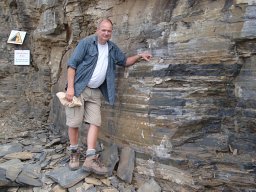 Lars E Holmer合作论文数Department of Earth Sciences, Uppsala University3
 Mark A. Wilson合作论文数Department of Geology, The College of Wooster3Tõnu Pani合作论文数3Mare Isakar合作论文数3Storme Jean-Yves合作论文数Département de Géologie, Université de Namur2
 Emmanuelle Javaux合作论文数Laboratoire Early Life Traces & Evolution-Astrobiology, Département de Géologie, Faculté des Sciences, Université de Liège2
 Tiiu Marss合作论文数2
 Kalle Kirsimäe合作论文数Institute of Ecology and Earth Sciences, University of Tartu2
 Peep Mannik合作论文数Institute of Geology at Tallinn;University of Technology;Institute of Geology at Tallinn, University of Technology2
 Andrej Ernst合作论文数Institut für Geowissenschaften, Christian-Albrechts-Universität zu Kiel2
 Thomas Servais合作论文数FRE 3298 du CNRS, Géosystèmes, Université de Lille1, SN5, USTL, F-59655 Villeneuve d'Ascq, France2
 Magdy El-Hedeny合作论文数College of Teachers, King Saud University2Ester M. Jolis合作论文数1tatiana tolmacheva合作论文数1Kersti Kihno合作论文数1
 Husain Shabbar合作论文数Dept Earth Sci, Sambalpur Univ1
 Liisa Lang合作论文数1
 Karin Truuver合作论文数1
 Suyash Gupta合作论文数Birbal Sahni Inst Palaeosci, Gondwana Palaeobiol Grp1
 Girts Stinkulis合作论文数1
 Kairi Poldsaar合作论文数1
 Tonu Martma合作论文数Dept Geol, Tallinn Univ Technol1
 Gerard Versteegh合作论文数Fachbereich Geowissenschaften, Universitat Bremen1
 Anju Saxena合作论文数Department of Geology;Lucknow University;Department of Geology, Lucknow University1Koen Sabbe合作论文数1Jan Bergström合作论文数1
 Mark Williams合作论文数School of Geography, Geology and the Environment, University of Leicester1Sigitas Radzevicius合作论文数Department of Geology and Mineralogy, Vilnius University1Olga Izokh合作论文数1
 Olle Hints合作论文数Division of Bedrock Geology and Collections, Tallinn University of Technology;Department of Geology, Tallinn University of Technology1
 Maria Jose Salas合作论文数1
 David K Loydell合作论文数1
 Mansour Almansour合作论文数1Yves Candela合作论文数LKB - Lhomond1
 Jouko Rikkinen合作论文数Department of Biological and Environmental Sciences;University of Helsinki;Department of Biological and Environmental Sciences, University of Helsinki1
 Dimitri Kaljo合作论文数Department of Geology, Tallinn University of Technology1
 Jaak Nõlvak合作论文数Institute of Geology at Tallinn;University of Technology;Institute of Geology at Tallinn, University of Technology1
 Elena G. Raevskaya合作论文数1
 Philippe Steemans合作论文数Paléopalynologie et Micropaléontologie, Université de Liège1Maris Rattas合作论文数1
 Wenhui Wang (王文卉)合作论文数School of Geosciences and Info-physics, Central South University1




