Target thermal capabilities are one of the major key points for CANS (Compact Accelerator-based Neutron Source) developments. Indeed, high energy (few MeV) and high average current (few tens of mA) proton or deuteron beams are required to produce high thermal neutron flux of 1013 n.cm-2.s-1 or greater. The targets must therefore absorb and dissipate a high thermal power. In order to make progress on their designs without deuteron or proton beams, we developed a compact electron beamline based on an Electron Cyclotron Resonance (ECR) source that permits testing of targets under relevant thermal conditions at power densities up 3 kW. cm -2.
Normandy Hadrontherapy (NHa) is developing, in collaboration with Ion Beam Applications (IBA), a full hadrontherapy treatment solution based on a new multiparticle cyclotron. C-12(6+) and He-4(2+) ions will be accelerated up to 400 MeV/u and (H-2)(+) up to 260 MeV/u. Three different ion sources will be carried out for each accelerated particle: the mono-charged ion source (H-2)(+) and low charged ion source He2+ are provided by the Polygon Physics (PP) company. The carbon ion source is under development at NHa in collaboration with IBA and PP. The (H-2)(+) ion source is an industrial Tubular ECR Source (TES) fitted for the needs of the NHa C400 cyclotron (30 mu A of (H-2)(+)). The He2+ ion source is a classic 10 GHz ECR type with a new concept because the complete source is set inside a vacuum chamber and it runs under 106 mbar of gas residual pressure. The 12C6+ ion source is also an ECR type ion source operating at 14.5 GHz frequency, its design is under progress to produce a beam providing stability and reproducibility levels compatible with clinical use. The article will present the External Injection System of the NHa C400 cyclotron hence it will focus on the experimental results obtained with the (H-2)(+) ion source and preliminary outputs from the He2+ ECRIS. A presentation of the multicharged ECRIS design dedicated to the C-12(6+) production will be done.
The classical PHOENIX 28 GHz electron cyclotron resonance ion Source (ECRIS) has been developed to prospect high pulsed multi charged lead ion (MCI lead) beams for the Large Hadron Collider (LHC) [1,2]. The goal of the experiment is to reach 1 emA pulses of Pb during 0.4 ms with a 10 Hz repetition rate. This high beam current is one order of magnitude higher than the ones available nowadays. The strategy to take up this challenge is based on an increase of the radio frequency (RF) to 28 GHz and an increase of the RF power density. A new high acceptance, high resolution analysing beam line has been coupled to PHOENIX in order to study efficiently the intense beams delivered by the source. Thus, 0.6 emA of Xe has been measured in the afterglow (AFG) among 9 emA analysed in the Faraday Cup (FC). The lead production is under study and a preliminary beam of 0.6 emA of Pb AFG has already been obtained. The cross check of a 3D beam simulation program and measured beam characteristics enables to estimate the beam emittance to be ~ 200π mm.mrad. 1 THE CLASSICAL PHOENIX 28 GHZ SOURCE The PHOENIX 28 GHz ECRIS has already been presented [3,4]. For completeness, a summary of its specifications are recalled here. See Fig.1 For an overall view of the ECRIS. The PHOENIX source is based on an extrapolation of ECR4 performances at 14 GHz RF injection [5]. ECR4 provides ~100 eμA of Pb 27+ in AFG mode at CERN. The LHC project needs to increase beam luminosity and 1 emA is required for Pb 27+ AFG. The PHOENIX strategy to increase the ion beam by a factor of 10 has been developed in [4]. Fig. 1 : PHOENIX General Structure. A first factor of 3 to 4 in total ionic current is expected through the frequency doubling from 14 to 28 GHz. A second multiplication factor comes from a medium magnetic confinement structure that increases plasma leakages and hence total ionic current (see the large bold B=1 Tesla line in Fig. 2). In parallel, to maintain the charge state distribution in a weak magnetic confinement, a high RF power density is required to feed the plasma with energetic electrons. Here, the 1.2 litre volume of PHOENIX plasma chamber enables to launch up to 8 kW/litre of RF with the present gyrotron. 0 Z [mm] 320 -35 R [mm] 35 Fig. 2 : iso B surfaces in PHOENIX plasma chamber (B=1 Tesla is the bold line). 2 THE NEW HIGH CURRENT ANALYSING BEAM LINE 2.1 The new beam line A new, high acceptance, high resolution beam line has been designed and installed during winter 2001 to analyse the high currents provided by PHOENIX (see Fig. 3). Ions are extracted at 60 kV via a movable monogap puller and, due to the space charge, expands rapidly into the ∅ 100 mm line.
Received 21 June 2016DOI:https://doi.org/10.1103/PhysRevAccelBeams.19.079901This article is available under the terms of the Creative Commons Attribution 3.0 License. Further distribution of this work must maintain attribution to the author(s) and the published article’s title, journal citation, and DOI.© 2016 American Physical Society
In the frame of the MiMAC project, the LPSC (Laboratoire de Physique Subatomique et de Cosmologie) has developed COMIMAC, a miniaturized and transportable table-top beam line, producing ions or electrons to make measurements of the “quenching” factor in ionization and detector calibration. The energy range of the COMIMAC beam facility starts from a few tens of eV up to 50keV.
Different ion species (rare gases, alkali, metallic) have been injected on the axis of the MINIMAFIOS 10 GHz Electron Cyclotron Resonance Ion Source which is the basics of the 1+ → n+ method, special attention have been paid to the optics of the incoming beam for the validation of the 1+ → n+ method for the SPIRAL project (Radioactive Ion Beam facility). The capture of the incoming ion beam by the ECR plasma depends, first, on the relative energy of the incoming ions with respect to the average ion energy in the plasma, and secondly, on the optics of the injection line. The efficiency of the process when varying the potential Vn+ of the MINIMAFIOS source with respect to the potential V1+ applied to the 1+ source (∆V = Vn+ -V1+) is an image of the energy dispersion of the 1+ beam. 1+ → n+ spectra efficiencies, ∆V efficiency dependence for the most efficient charge state obtained, and measured primary beam emittances are given for the Ar, Cr, Pb, S. Highest efficiencies obtained are respectively Ar 1+ → Ar 8+ : 8.7 %, Rb 1+ → Rb 15+ : 5.5 %, Pb 1+ → Pb 22+ : 4.8 % , Cr 1+ → Cr 12+ : 3.5 %. Last results obtained are given for Sulfur.
We will present recent basic developments about possible extension of the COMIC (for COmpact MIcrowave and Coaxial) devices up to 5.8 GHz in place of the present 2.45 GHz operation [P. Sortais, T. Lamy, J. Médard, J. Angot, L. Latrasse, and T. Thuillier, Rev. Sci. Instrum. 81, 02B314 (2010)]. New applications associating multiple COMIC devices for thin film deposition will be described and we will explain why an increase of the current density delivered by each individual ion source could lead to the increase of the deposition rate. For this purpose, we will present results of about two devices working at 5.8 GHz. The first one is a tiny ion source, the world smallest microwave ion source, exactly similar to COMIC but operating at 5.8 GHz with a quarter wave cavity structure and a few watts microwave power consumption. We will show that the frequency scaling effect is effective inside such small machines. The second one is a more ambitious ion source designed around a three quarter wave structure that works with a few tens of watts at 5.8 GHz.
The PHOENIX ECR charge breeder characteristics (efficiency and charge breeding time) were measured at CERN-ISOLDE and at the Laboratoire de Physique Subatomique et de Cosmologie (LPSC), they were considered as sufficient to allow its setup on various facilities (TRIUMF Canada / GANIL SPIRAL2 and SPIRAL1 – France / SPES/INFN). The developments performed at the Argonne National Laboratory (ANL) have shown that the ECR charge breeder efficiencies could be much higher than the ones obtained with the LPSC PHOENIX, without major differences between the two devices. We have tried to study the possible reasons of such different results in order to improve the PHOENIX charge breeder characteristics. The transmission value of the n+ beam line has been measured to be as low as 30%. Emittances of the total beam extracted from the source and of some analysed beams (after the magnetic spectrometer) have been measured and will be presented. Simulations have shown a too low vertical acceptance at the center of the magnetic spectrometer. Simulations and experimental results will be presented, they show how an additional Einzel lens, inserted just before the dipole, has drastically improved the beam transmission. The impact of this new beam transport on charge breeding efficiencies will be presented. ANL AND LPSC CHARGE BREEDERS CHARACTERISTICS The ANL charge state breeder has been extensively described in [1]. It is a modified ECRIS allowing the injection and slowing down of an ion beam close to the axis, through a 25.4 mm internal diameter movable transfer tube. Like performed at LPSC, the injection plug has been modified in order to symmetrize the magnetic field at the injection side [2]. The recent configuration and results are presented in [3]. The pressure in this charge state breeder is about 2x10 mb, the axial magnetic field values at the injection, in the middle plane and at the extraction of the source, are respectively Binj = 1.16 T, Bmin = 0.27 T and Bext = 0.83T. Concerning the LPSC PHOENIX charge state breeder a few modifications have been performed since 2008. For example, the plasma chamber was modified in order to have the possibility to insert a liner (no internal diameter change) and has been equipped with two waveguide ports. The magnetic field, at the injection, has been slightly increased and fully symmetrized by the addition of iron parts around the plasma chamber [4]; finally, the grounded transfer tube has been removed allowing a more stable operation of the source. The pressure at the injection is about 6x10 mb and the axial magnetic field values are equal to Binj = 1.21T, Bmin = 0.42T and Bext = 0.82T. Both the ANL and LPSC charge breeders have two waveguide ports, at ANL the plasma is excited by a 2kW, 10.44GHz klystron plus a 500W, 11 to 13GHz TWTA. At LPSC we use a 2kW, 14GHz klystron and performed experiments (in collaboration with the INFN Laboratori Nazionali di Legnaro, Padova-Italy) with an additional 500W, 13.75 to 14.5 GHz TWTA [5]. This description of the two charge breeders shows that their characteristics are very close, some results presented in 2011 by both laboratories [3], [6] are compared in Table 1 below. Table 1: Some Performances of the ANL and LPSC Charge Breeders Laboratory Ion Yield (%) Global yield (%)
"Beta beams" produce collimated pure electron (anti) neutrino beams by accelerating beta active ions to high energies and having them decay in a racetrack shaped storage ring of 7 km circumference, the decay ring. EUROnu beta beams are based on CERN infrastructures and existing machines. Using existing machines may be an advantage for the cost evaluation, but will also constrain the physics performance. The isotope pair of choice for the beta beam is He-6 and Ne-18. However, before the EUROnu studies one of the required isotopes, Ne-18, could not be produced in rates that satisfy the needs for physics of the beta beam. Therefore, studies of alternative beta emitters, Li-8 and B-8, with properties interesting for a beta beam have been proposed and have been studied within EUROnu. These alternative isotopes could be produced by using a small storage ring, in which the beam traverses a target, creating the Li-8 and B-8 isotopes. This production ring, the injection linac and the target system have been evaluated. Measurements of the cross section of the reactions to produce the beta beam isotopes show interesting results. A device to collect the produced isotopes from the target has been developed and tested. However, the yields of Li-8 and B-8, using the production ring for production of Li-8 and B-8, is not yet, according to simulations, giving the rates of isotopes that would be needed. Therefore, a new method of producing the Ne-18 isotope has been developed and tested giving good production rates. A 60 GHz ECRIS prototype, the first in the world, was developed and tested for ion production with contributions from EUROnu. The decay ring lattices for the Li-8 and B-8 have been developed and the lattice for He-6 and Ne-18 has been optimized to ensure the high intensity ion beam stability.
The EUROnu project has studied three possible options for future, high intensity neutrino oscillation facilities in Europe. The first is a Super Beam, in which the neutrinos come from the decay of pions created by bombarding targets with a 4 MW proton beam from the CERN High Power Superconducting Proton Linac. The far detector for this facility is the 500 kt MEMPHYS water Cherenkov, located in the Fréjus tunnel. The second facility is the Neutrino Factory, in which the neutrinos come from the decay of μ+ and μ- beams in a storage ring. The far detector in this case is a 100 kt Magnetised Iron Neutrino Detector at a baseline of 2000 km. The third option is a Beta Beam, in which the neutrinos come from the decay of beta emitting isotopes, in particular 6He and 18Ne, also stored in a ring. The far detector is also the MEMPHYS detector in the Fréjus tunnel. EUROnu has undertaken conceptual designs of these facilities and studied the performance of the detectors. Based on this, it has determined the physics reach of each facility, in particular for the measurement of CP violation in the lepton sector, and estimated the cost of construction. These have demonstrated that the best facility to build is the Neutrino Factory. However, if a powerful proton driver is constructed for another purpose or if the MEMPHYS detector is built for astroparticle physics, the Super Beam also becomes very attractive.
The EUROnu project has studied three possible options for future, high intensity neutrino oscillation facilities in Europe. The first is a Super Beam, in which the neutrinos come from the decay of pions created by bombarding targets with a 4 MW proton beam from the CERN High Power Superconducting Proton Linac. The far detector for this facility is the 500 kt MEMPHYS water Cherenkov, located in the Frejus tunnel. The second facility is the Neutrino Factory, in which the neutrinos come from the decay of mu(+) and mu(-) beams in a storage ring. The far detector in this case is a 100 kt magnetized iron neutrino detector at a baseline of 2000 km. The third option is a Beta Beam, in which the neutrinos come from the decay of beta emitting isotopes, in particular He-6 and Ne-18, also stored in a ring. The far detector is also the MEMPHYS detector in the Frejus tunnel. EUROnu has undertaken conceptual designs of these facilities and studied the performance of the detectors. Based on this, it has determined the physics reach of each facility, in particular for the measurement of CP violation in the lepton sector, and estimated the cost of construction. These have demonstrated that the best facility to build is the Neutrino Factory. However, if a powerful proton driver is constructed for another purpose or if the MEMPHYS detector is built for astroparticle physics, the Super Beam also becomes very attractive. DOI: 10.1103/PhysRevSTAB.16.021002
The injection of a 1+ beam into an electron cyclotron resonance (ECR) charge breeder is classically performed through a grounded tube placed on its axis at the injection side. This tube presents various disadvantages for the operation of an ECR charge breeder. First experiments without a grounded tube show a better use of the microwave power and a better charge breeding efficiency. The optical acceptance of the charge breeder without decelerating tube allows the injection of high intensity 1+ ion beams at high energy, allowing metals sputtering inside the ion source. The use of this method for refractory metallic ion beams production is evaluated.
There is considerable experimental effort dedicated to the directional detection of particle dark matter. Gaseous mu TPC detectors present the privileged features of being able to reconstruct the track and the energy of the recoil nucleus following the interaction. A precise measurement of the recoil energy is a key point for the directional search strategy. Quenching has to be taken into account, i.e. only a certain fraction of the recoil energy is deposited in the ionization channel. Measurements of the ionization quenching factor for different gas mixture at room temperature have been made with a dedicated ion beam facility at the LPSC of Grenoble.
Due to the very small size of a COMIC (Compact MIcrowave and Coaxial) device [P. Sortais, T. Lamy, J. Médard, J. Angot, L. Latrasse, and T. Thuillier, Rev. Sci. Instrum. 81, 02B31 (2010)] it is possible to install such plasma or ion source inside very different technical environments. New applications of such a device are presented, mainly for industrial applications. We have now designed ion sources for highly focused ion beam devices, ion beam machining ion guns, or thin film deposition machines. We will mainly present new capabilities opened by the use of a multi-beam system for thin film deposition based on sputtering by medium energy ion beams. With the new concept of multi-beam sputtering (MBS), it is possible to open new possibilities concerning the ion beam sputtering (IBS) technology, especially for large size deposition of high uniformity thin films. By the use of multi-spots of evaporation, each one corresponding to an independent tuning of an individual COMIC ion source, it will be very easy to co-evaporate different components.
Neutrino oscillations have implications for the Standard Model of particle physics. The CERN Beam has outstanding capabilities to contribute to precision measurements of the parameters governing neutrino oscillations. The FP7 collaboration EUROnu (2008-2012) is a design study that will review three facilities (Super-Beams, and Neutrino Factories) and perform a cost assessment that, coupled with the physics performance, will give means to the European research authorities to make decisions on future European neutrino oscillation facilities. Beta Beams produce collimated pure electron (anti)neutrinos by accelerating beta active ions to high energies and having them decay in a storage ring. Using existing machines and infrastructure is an advantage for the cost evaluation; however, this choice is also constraining the Beams. Recent work to make the Beam facility a solid option will be described: production of Beam isotopes, the 60 GHz pulsed ECR source development, integration into the LHC-upgrades, insure the high intensity ion beam stability, and optimizations to get high neutrino fluxes. The costing approach will also be described.
As the most ambitious concept of isotope separation on line (ISOL) facility, EURISOL aims at producing unprecedented intensities of post-accelerated radioactive isotopes. Charge breeding, which transforms the charge state of radioactive beams from 1+ to an n+ charge state prior to post-acceleration, is a key technology which has to overcome the following challenges: high charge states for high energies, efficiency, rapidity and purity. On the roadmap to EURISOL, a dedicated R&D is being undertaken to push forward the frontiers of the present state-of-the-art techniques which use either electron cyclotron resonance or electron beam ion sources. We describe here the guidelines of this R&D.
The discovery that the neutrino changes flavor as it travels through space has implications for the Standard Model of particle physics (SM)[1]. To know the contribution of neutrinos to the SM, needs precise measurements of the parameters governing the neutrino oscillations. This will require a high intensity beam-based neutrino oscillation facility. The EUROν Design Study will review three currently accepted methods of realizing this facility (the so-called Super-Beams, Beta Beams and Neutrino Factories) and perform a cost assessment that, coupled with the physics performance, will give means to the European research authorities to make a decision on the lay-out and construction of the future European neutrino oscillation facility. ”Beta Beams” produce collimated pure electron neutrino and antineutrino beams by accelerating beta active ions to high energies and letting them decay in a race-track shaped storage ring. EUROν Beta Beams are based on CERNs infrastructure and the fact that some of the already existing accelerators can be used. To use existing machines is a strong advantage for the cost evaluation, however this choice is also constraining the Beta Beams. In this article we describe recent work that has made the Beta Beam facility a solid option for neutrino production: new ideas and developments to produce and collect different Beta Beam isotopes, the 60 GHz pulsed ECR source development, the integration of Beta Beams in the upgrade program for LHC, work to ensure the very high intensity ion beam stability in the different machines, and optimizations of the decay ring to get high neutrino flux at a gamma boost of 100.
 Thierry Lamy合作论文数48
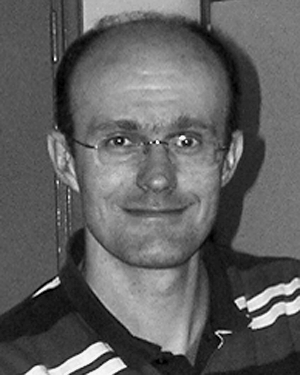 Thomas Thuillier合作论文数29Richard Geller合作论文数22Curdy, J.C.合作论文数19p sole合作论文数17j y pacquet合作论文数17R. Leroy合作论文数17J.L. Vieux-Rochaz合作论文数17A. C. C. Villari合作论文数GANIL17
 Laurent Maunoury合作论文数16J. Obert合作论文数13
 Vadim Skalyga合作论文数Institute of Applied Physics13Nathalie Lecesne合作论文数13
 Marek Lewitowicz合作论文数12
 I. V. Izotov合作论文数Institute of Applied Physics, Russian Academy of Sciences12e robert合作论文数11C. Bieth合作论文数11C. F. Liang合作论文数11Nicolas Chauvin合作论文数10J.-L. Bouly合作论文数10Marc Loiselet合作论文数10P. Foury合作论文数10M. Ducourtieux合作论文数10l latrasse合作论文数9Jc Angelique合作论文数9Francois Debray合作论文数9J.C. Putaux合作论文数9C. Marry合作论文数8j mandin合作论文数8M. Hass合作论文数8
 Said Kantas合作论文数8Mg Saintlaurent合作论文数8m mariejeanne合作论文数8G. Collazuol合作论文数8T. Marchi合作论文数Lab Nazl Legnaro LNL, Ist Nazl Fis Nucl8G. de Angelis合作论文数8Pascal Jardin合作论文数8B. Blank合作论文数8Th. Delbar合作论文数8M. P. Bourgarel合作论文数8Elena Wildner合作论文数8N. Orr合作论文数8Dan Berkovits合作论文数8Thierry Stora合作论文数8F. Gramegna合作论文数8Tsviki Y. Hirsh合作论文数8G. Prete合作论文数8V. L. Kravchuk合作论文数8
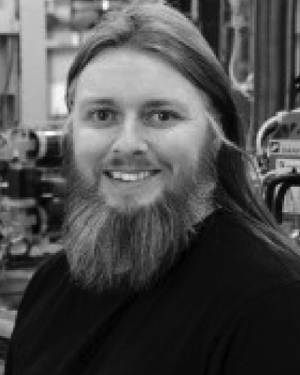 Graeme Burt合作论文数7




