We present a new method to check the frequency stability and absolute frequency value of a frequency doubled Nd:YAG laser at 563,5 THz locked to hyperfine components of an I2 line. This method consists in producing a second laser beam the frequency of which is shifted by an acousto-optic modulator driven by a voltage controlled oscillator. This second beam passes through the I 2 cell parallel to the main beam. Using two independent lock-in amplifiers we lock the frequency of each laser beam to two different, closely spaced, hyperfine components of the same I 2 line. The difference between the two laser frequencies is then measured by a heterodyne technique with an accuracy of a few kilohertz, thereby ensuring that the system remains locked robustly at the correct frequency. In this way, the long term smooth running of the French Kibble balance is guaranteed.
Le kilogramme est la dernière unité du Système international d'unités (SI) encore définie par un artefact : le prototype international du kilogramme (International Prototype of the Kilogram ou IPK).En 100 ans, des comparaisons entre l'IPK, ses copies officielles et les prototypes nationaux ont montré une variation relative de masse de l'ordre de 5 × 10 -8 .Après un bref rappel sur l'unité de masse, cet article expose la nécessité de redéfinir le kilogramme.Il explique le choix de la constante de Planck h comme base d'une définition telle qu'envisagée par la CGPM en 2018.L'article présente les derniers résultats obtenus avec les balances du watt qui permettent aujourd'hui d'établir un lien entre h et une masse macroscopique avec des incertitudes relatives de quelques 10 -8 .Enfin, l'article présente la position adoptée en France par le laboratoire national de métrologie pour la « mise en pratique » du kilogramme et sa dissémination après sa redéfinition en 2018.
This paper describes a transportable system based on synthetic wavelength interferometry for absolute distance measurement. The synthetic wavelength is generated by means of two frequency-doubled Nd:YAG lasers. A superheterodyne technique has been implemented to detect the synthetic phase, enabling a fringe interpolation of ∼2π/5 600. A ∼5 μm accuracy (1σ) is demonstrated over 25 m, based on an indoor comparison with a classical fringe counting interferometer. An outdoor comparison has been carried out on a 864 m-long standard baseline located in Finland (Nummela), yielding an uncertainty of 700 μm (1σ). This work was carried out within the framework of the “Long distance” EMRP project that ended on June 2011.
After separate developments of the different elements with continuous characterizations and improvements, the LNE watt balance has been assembled. This paper describes the system in detail and gives its first measurements of the Planck's constant h. The value determined in air is h = 6.626 068 8(20) x 10(-34) Js which differs in relative terms by -0.05 x 10(-7) from the h(90) value and by -1.1 x 10(-7) from that of the 2010 CODATA adjustment of h. The relative standard uncertainty associated is 3.1 x 10(-7).
Alignments of watt balance experiments are necessary to achieve a relative uncertainty at a level of few parts in 10(8). This paper briefly describes the LNE watt balance and concentrates on adjustments made to minimize the coil movements during weighing mode. The parasitic forces and torques involved in these movements are estimated by a mathematical model. Some of the calculated parasitic forces are compared with an evaluation done by studying the yaw movement of the beam.
High pressure turbine blades undergo heavy thermomechanical constraints which drive initiation and propagation of cracks. These cracks can be difficult to detect with the current control equipment. The aim of this study is to develop an active thermography process called flying spot (scanning laser heating) in the 1-2 μm range to inspect the blades. This work is funded by the French Ministry of Defense, DGA through the PhD scholarship program and the contract 2010.60.018.
We describe an efficient continuous-wave diode-pumped Nd:YLiF4 laser oscillating on the σ-polarized 4F3/2-4I13/2 transition at λω = 1312 nm. With a simple linear cavity laser, we reached an intracavity power of 310 W at λ = 1312 nm for 16 W of absorbed pump power (λp ~ 806 nm). A 0.25 W of tunable radiation (λ2ω = 656−658 nm) was obtained by intracavity second-harmonic generation (SHG) with a 5 × 5 × 7 mm3β-BaB2O4 crystal. Up to 10 mW of tunable single-frequency operation was observed using a 200 μm thin fused silica intracavity solid etalon. The optimal waist for a maximum conversion efficiency has been calculated theoretically using Boyd and Kleiman model. For the 1312–656 nm SHG, we found a walk-off parameter B = 8.99 and an optimal waist of 25 μm. Comparing to the experimental measurement of the optimal waist, we found a relative discrepancy of 2.84 × 10⁻². This laser is dedicated to the spectroscopic study of silver atoms trapped in a buffer-gas-free paraffin coated Pyrex cell that will be used in a compact atomic optical clock.
The LNE watt balance is in the final stage of assembly. Very first measurements of the magnetic field profile have been made and will be improved during the next months. Characterization of the force comparator has also been performed and leads to a type A uncertainty on the mass determination of some micrograms.
Magnetic-field sensors based on the Faraday effect in a Tb3Ga5O12 crystal are investigated in terms of sensitivity, accuracy and directionality. The possibility of an increased sensitivity due to the application of multipass sensitive elements is considered. Signal-to-noise measurements on a 5mm diameter×20mm long sample yield to a magnetic fields equivalent noise of 300nT/Hz1/2 (τ=1s). The sensor has a sensitivity of 5.457(1)rad/T. Using a spinning quarter waveplate ellipsometer, we can measure magnetic fields up to 1T. The data acquisition rate could be up to 80Hz. This sensor is used to check the homogeneity and the orientation of the field provided by the French watt balance magnetic circuit whose aim is to redefine the SI unit of mass in the near future.
High pressure turbine blades undergo heavy thermomechanical constraints which drive initiation and propagation of cracks. These cracks can be difficult to detect with the current control equipments. The aim of this study is to develop an active thermography process called flying spot (scanning laser heating) in the 1-2 μm range to inspect the blades. This work is funded by the French Ministry of Defense, DGA through the PhD scholarship program and the contract 2010.60.018.
We describe a transportable distance measurement system based on synthetic wavelength interferometry. Two frequency-doubled Nd:yttrium aluminum garnet lasers at 532 nm are used to generate a synthetic wavelength of approximately 2.5 cm. A nonpolarizing interferometric system has been set up to eliminate polarization cross-talk issue. A superheterodyne detection was performed to measure the synthetic phase and to determine absolute distances. The capability to achieve fringe interpolation of 2pi/5600 has been demonstrated and an agreement in distance measurement at the 4 microm level has been achieved, compared to an optical interferometric 3 m long displacement bench.
In watt balance experiments, the determination of the position and the velocity of a moving coil have a crucial contribution in the overall uncertainty. In this paper, we present optical devices that will be set up to measure the two above mentioned parameters.
The alignment of optical devices such as interferometers and laser position detectors is needed for the different adjustments of watt balances. This paper describes the optical apparatus and the numerical simulations developed to tune the alignment of experimental setup. A telescope coupled with a CCD camera and data processing are presented in detail.
This paper describes a transportable distance measurement system based on synthetic wavelength interferometry using two frequency-doubled Nd:YAG lasers. A non-polarizing system has been setup to eliminate polarization cross-talk issue. A partly software-implemented superheterodyne detection was performed to measure the synthetic phase. A fringe interpolation of 2π/5600 is demonstrated and an accuracy of ~4 μm is achieved over 3 m.
The e-MASS joint research project (JRP) supported by EURAMET gathers several European metrology institutes in the aim to improve existing watt balances and to contribute to a new definition of the mass unit. This paper describes the main technical tasks developed in the framework of the project
This paper describes our project of an optical refractometer. The targeted accuracy for air index measurement is below 10 -8 . It is based on an optical resonator whose mechanical distortion as a function of pressure will be calibrated using helium gas.
We propose and demonstrate a displacement control method at the subnanometric scale based on a Michelson interferometer combined with a polarimeter and a phase-locked loop electronic board. Step by step displacements with a step value of 5 nm are presented. A repeatability of 0.47 nm is obtained from back and forth displacements over 1 mum range. We show that a residual ellipticity of less than 10 degrees on the polarization state leads to a positioning error of less than 1 nm. Such system could be used over millimeter range displacements in a controlled surrounding environment leading to numerous applications in nanometrology.
The magnetic circuit built for the LNE watt balance experiment is now assembled and its characterization is in progress. We describe here the methods used and give the first results.
This paper describes the main progress on the LNE watt balance project since 2004. Development of different parts and structure of the watt balance including starting their assembly are presented.
 J. Pinard合作论文数42Hung T Duong合作论文数41JL Vialle合作论文数38S. Liberman合作论文数29T. Badr合作论文数27m d plimmer合作论文数27Robert Klapisch合作论文数25S. Büttgenbach合作论文数23P. Jacquinot合作论文数21A. Pesnelle合作论文数19
 M.E. Himbert合作论文数18
 Yasser Alayli合作论文数Laboratoire d’Ingénierie des Systèmes de Versailles (LISV),, Université de Versailles Saint Quentin18
 Sonay Topcu合作论文数18
 Luc Chassagne合作论文数LISV, University of Versailles Saint-Quentin18G. Huber合作论文数16Gerard Geneves合作论文数16Me Himbert合作论文数15C. Thibault合作论文数15F. Touchard合作论文数14Yann Louyer合作论文数13c thibault合作论文数11
 Wallerand, J.P.合作论文数10Y. Millerioux合作论文数10
 Patrick Pinot合作论文数9
 Jean Lermé合作论文数French National Centre for Scientific Research9Pierre Pillet合作论文数CNRS9A. Razet合作论文数9Rainer Neugart合作论文数8
 Stephane Guerandel合作论文数8H. Henry Stroke合作论文数The ISOLDE Collaboration, CERN geneva8
 Thomas Nilsson合作论文数Department of Physics, Chalmers University of Technology7Takashi Murayama合作论文数7
 Darine Haddad合作论文数7M. De Saint Simon合作论文数7O. Redi合作论文数7
 Feliciano Villar合作论文数Universitat de Barcelona7
 Alex C. Mueller合作论文数6M. Pellarin合作论文数6
 Rovera, G.D.合作论文数6H. Fang合作论文数6
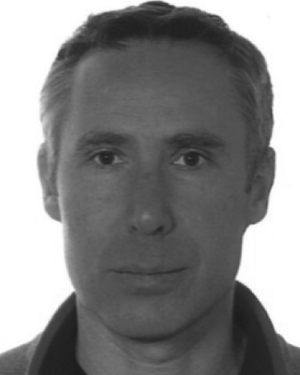 Pierre Gournay合作论文数Quantum Metrology Group, Laboratoire National de métrologie et dʼEssais, 29, avenue Roger-Hennequin, 78197 Trappes, France6
 Franck Pereira dos Santos合作论文数SYRTE6Tt Inamura合作论文数5J.M. Serre合作论文数5j d silver合作论文数5S. Matsuki合作论文数5
 Franck Bielsa合作论文数5
 Matthieu Thomas合作论文数LNE (Lab. Nat. de Metrol. et d'Essais), Trappes, France;c5




