SEISM is a unique ECR ion source operating at a frequency of 60 GHz. The prototype is based on a simple magnetic geometry, the cusp, allowing the use of polyhelix coils (developed with LNCMI, Grenoble) to generate the closed ECR surface at 2.14 T. The plasma is sustained by a high intensity HF pulse (up to 300kW). Previous experiments at LNCMI have successfully demonstrated the establishment of the nominal magnetic field and the extraction of ion beams with a current density up to 1 A cm(-2). The presence of afterglow peaks was also observed, proving the existence of ion confinement in a CUSP ECR source. An experimental campaign is carried out in 2021 using a new transport line designed to improve the transmission of the beam to the new detectors. Short and long-term research plans are presented to transform this high current density into a high intensity ion beam that can be used for accelerators of the future.
The 1+/n+ method, based on an ECRIS charge breeder (CB) originally developed at the LPSC laboratory, is now implemented at GANIL for the production of Radioactive Ion Beams (RIBs). Prior to its installation in the middle of the low energy beam line of the SPIRAL1 facility, the 1+/n+ system CB has been modified based on the experiments performed on the CARIBU Facility at Argone National Laboratory. Later, it has been tested at the 1+/n+ LPSC test bench to validate its operation performances. Charge breeding efficiencies as well as charge breeding times have been measured for noble gases and alkali elements. The commissioning phase started at GANIL in the second half-year of 2017. It consisted of a stepwise process to test the upgrade of the SPIRAL1 facility from simple validation [operation of Charge Breeder (CB) as a stand-alone source] up to the production of the first 1+/n+ RIB. Thus, this year, a 38mK/38K RIB has been successfully delivered to a physics experiment over a period of 1 week. The yields on the physics target were in the range of ∼2-4 × 10⁶ pps at 9 MeV/u. The target ion source system (TISS) was made of a FEBIAD ion source connected to a hot graphite target. This is the first time a RIB is accelerated with a cyclotron with the 1+/n+ method. Moreover, a production test with the FEBIAD TISS has confirmed the yields measured previously, which validates the extension of the GANIL/SPIRAL1 catalog for a number of isotopes. In parallel, R&D is being performed on new TISSs (e.g., a fast release one, using surface ionization source). Targets are also a subject of ongoing R&D for yield and release time optimization. This contribution will present the new acceleration scheme of the SPIRAL1 facility, which largely extends the palette of RIBs available for nuclear physicists. It will be compared to the ones used at similar ISOL facilities. This facility is more than a simple ISOL facility, and an overview of the new opportunities offered by the upgraded installation will be also discussed.
A project to design and construct an RF-driven long-lifetime volume production ion source producing 30 mA of H- with 50 Hz repetition rate and 1.5% duty factor at 35 keV energy for the ISIS Neutron and Muon Source has been started at Rutherford Appleton Laboratory. The development of the new ion source aims at replacing the caesiated Penning-type surface plasma ion source that has served the ISIS facility since 1980s. The design of the ion source is based on recent developments at CERN demonstrating 30 mA H- in volume mode with less than 50 kW of RE-power but at lower repetition rate of 0.8 Hz. This paper describes the physics design of the ion source and the status of the project. The magnetic field, extraction optics, RF system and preferred plasma ignition scheme are discussed in detail.
LPSC has developed the PHOENIX electron cyclotron resonance Charge Breeder since 2000. The performances have been improved over time acting on the 1+ and N+ beam optics, the base vacuum and the 1+ beam injection. A new objective is to update the booster design to enhance high charge state production and 1+ N+ efficiencies, reduce the co-extracted background beam and improve the ion source tunability. The first step, consisting in increasing the peak magnetic field at injection from 1.2 T to 1.6 T was implemented and significant improvement in 1+N+ efficiencies are reported: 129% of Na-23(8+), 24.2% of Ar-40(8+), 133% of (132)Xc(26+) and 13% of (CS26+)-C-133. The next steps of the upgrade are presented: modification of the axial magnetic structure, significant increase of the plasma chamber radius (72 to 90 mm), plasma heating at 18 GHz (instead of 14 (3Hz), reduction of chemical elements composing the plasma chamber wall and the surrounding beam line.
To qualify electron cyclotron resonance charge breeders, the method that is traditionally used to evaluate the charge breeding time consists in generating a rising edge of the injected beam current and measuring the time in which the extracted multicharged ion beam reaches 90% of its final current. It is demonstrated in the present paper that charge breeding times can be more accurately measured by injecting short pulses of 1+ ions and recording the time resolved responses of N+ ions. This method is used to probe the effect of the 1+ ion accumulation in the plasma known to disturb the buffer gas plasma equilibrium and is a step further in understanding the large discrepancies reported in charge breeding times. The experiments are conducted injecting a Rb-85(+) ion beam into the Laboratoire de Physique Subatomique et de Cosmologie (LPSC) charge breeder operated with helium as a buffer gas. The time needed for the extraction of 90% of the multicharged ions in short pulse mode is found slightly shorter (9%) than the charge breeding time measured with the traditional method. The charge breeding efficiency is identical with both methods. The pulse width and amplitude of the 1+ injection pulses have been varied to study their influence on the N+ response and temporal parameters are proposed to qualify the time response. The short pulse method can be used to study the influence of the ion source tuning parameters on the charge breeding temporal characteristics. For example, it is shown here that an increase of the minimum magnetic field strength of the LPSC charge breeder in the range 0.432-0.444 T improves the multicharged ion confinement in the electron cyclotron resonance plasma, and so increases the charge breeding efficiency. The short pulse method is also used to estimate the charge breeding efficiencies of radioactive Rb isotopes taking into account their half-lives and charge states. The neutron-rich heavy isotopes have short half-lives, which makes the charge state distributions shift to lower charge states and the estimated charge breeding efficiencies of high charge states being close to three times less in comparison to the stable ions.
Primary ion beams from metallic elements are routinely produced at GANIL using ECR4 and ECR4M 'room temperature' ECR ion sources. Ionization efficiency measurements, partially presented in the past, are summarized in this report together with updated and new results obtained with Cd, Mo and Ta. Preliminary results for Ni and Ca obtained with the room temperature Phoenix-V2 ECR ion source, under commissioning for SPIRAL 2, are also included. These ionization efficiencies are compared according to the production methods: oven, sputtering, MIVOC, gaseous compounds. The presently SPIRAL 2 heavy ion injector designed for ions Q/A=1/3 shows clear limitations in terms of intensity for metallic ions with mass higher than 60 (intensity <1 pμA). In order to choose the best ion source for a future Q/A=1/6, 1/7 injector, best world results have been compiled for different existing 'room temperature' and superconducting ECR ion sources.
In the framework of the SPIRAL1 upgrade under progress at the GANIL lab, the charge breeder based on a LPSC Phoenix ECRIS, first tested at ISOLDE* has been modified as to benefit of the last enhancements of this device from the 1+ / n+ community**. Prior to its installation in the middle of the low energy beam line of the SPIRAL1 facility, it has been tested at the 1+/n+ LPSC test bench to validate its operation performances. Charge breeding efficiencies as well as charge breeding times have been measured for noble gases and alkali elements. The experimental results demonstrated that the modifications done were on the right track leading the SPIRAL1 charge breeder to the top worldwide in terms of performances. The experimental outcomes have proved the strong interrelationship between the charge breeding efficiency and the charge breeding times which are still under active discussion.
Electron Cyclotron Resonance Ion Sources (ECRIS) deliver high intensities of multicharged heavy ions to accelerators; nowadays the evolution of science requires extremely intense ion beams. Since 1987, semi empirical scaling laws state that the ECR plasma density, in a minimum- B magnetic field configuration, varies like the square of the electromagnetic waves (EM) frequency or of the resonant magnetic induction. The present most performing ECRIS are operated at 28 GHz. In order to significantly increase the ion beam intensities, the use of EM with frequencies of the order of 60 GHz is evaluated worldwide. Conceptual studies based on superconductors are performed and different magnetic configurations accepting such a high ECR frequency are proposed by several groups. Since 2009, LPSC collaborates with IAPRAS (Russia) and LNCMI (CNRS) and has built the first ECRIS with a topologically closed 60 GHz ECR resonance zone, using radially cooled polyhelices. Unique ion beam intensities have been extracted from this prototype, like 1.1 mA of O3+ through a 1mm hole representing a current density of 140 mA/cm2. The worldwide high frequency ECRIS research status is presented along with a focus on the present LPSC-IAP-LNCMI strategy.
We will present recent basic developments about possible extension of the COMIC (for COmpact MIcrowave and Coaxial) devices up to 5.8 GHz in place of the present 2.45 GHz operation [P. Sortais, T. Lamy, J. Médard, J. Angot, L. Latrasse, and T. Thuillier, Rev. Sci. Instrum. 81, 02B314 (2010)]. New applications associating multiple COMIC devices for thin film deposition will be described and we will explain why an increase of the current density delivered by each individual ion source could lead to the increase of the deposition rate. For this purpose, we will present results of about two devices working at 5.8 GHz. The first one is a tiny ion source, the world smallest microwave ion source, exactly similar to COMIC but operating at 5.8 GHz with a quarter wave cavity structure and a few watts microwave power consumption. We will show that the frequency scaling effect is effective inside such small machines. The second one is a more ambitious ion source designed around a three quarter wave structure that works with a few tens of watts at 5.8 GHz.
 Julien Angot合作论文数11
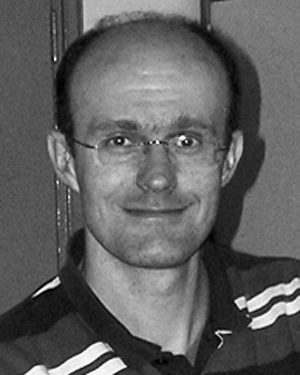 Thomas Thuillier合作论文数6
 Laurent Maunoury合作论文数6
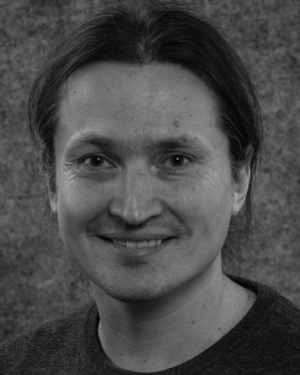 Olli Tarvainen合作论文数Department of Physics, University of Jyvaskyla5Maud Baylac合作论文数4Pascal Jardin合作论文数4O. Bajeat合作论文数4Alain Savalle合作论文数3Francois Debray合作论文数3Jacob Josua合作论文数3P. Delahaye合作论文数CERN3C. Peaucelle合作论文数2Myriam Migliore合作论文数2R Frigot合作论文数2Benoit Osmond合作论文数2Blaise-Mael Retailleau合作论文数2Bertrand Jacquot合作论文数2Romain Frigot合作论文数2Arun Annaluru合作论文数2M Marttinen合作论文数2
 Pascal Sortais合作论文数2Osmond B合作论文数2
 Ville Toivanen合作论文数2Jean-Charles Thomas合作论文数2Thierry Lamy合作论文数2
 Predrag Ujić合作论文数Institute of Nuclear Sciences “Vinča”,2
 Thomas Andre合作论文数Hôpital Tenon, APHP2
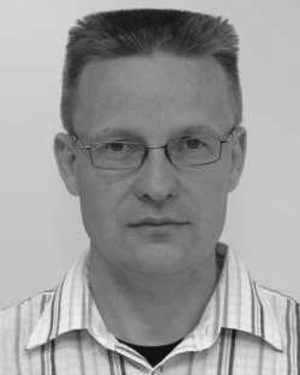 Hannu Koivisto合作论文数2M. Bakulin合作论文数1A. Galata合作论文数1B. Z. Movshevich合作论文数1c tamburella合作论文数1Jean-Baptiste Lallement合作论文数1Omar Kamalou合作论文数1Robert Abel合作论文数1Scott Lawrie合作论文数1
 Marc Dubois合作论文数1J. Lettry合作论文数1Trevor Wood合作论文数1John Macgregor合作论文数1Lecomte P合作论文数1Nicolas Chauvin合作论文数1Curdy, J.C.合作论文数1Bouat Sophie合作论文数1Barué C合作论文数1
 M. Baylac合作论文数1
 Mark Whitehead合作论文数Inst Geog & Earth Sci, Aberystwyth Univ1
 Gabriel Gaubert合作论文数1




