The use of energy dispersive X-ray diffraction (EDXRD) to produce 1 D maps of the phases present inside both an alumina-aluminum test specimen and a 1.0 cm diameter cylinder of type I portland cement paste is discussed. The surface of the cement paste sample was found to be rich in calcium carbonate and deficient in portlandite relative to the bulk. After 7 days exposure to 1000 ppm Na2SO4 there was no evidence for the formation of a surface layer rich in crystalline sulfate containing phases. EDXRD appears to be a powerful tool for the study of sulfate attack on portland cements.
Sea urchin's teeth from four families of order Echinoida and from orders Temnopleuroida, Arbacioida and Cidaroida were studied with synchrotron X-ray diffraction. The high and very high Mg calcite phases of the teeth, i.e. the first and second stage mineral constituents, respectively, have the same crystallographic orientations. The co-orientation of first and second stage mineral, which the authors attribute to epitaxy, extends across the phylogenic width of the extant regular sea urchins and demonstrates that this is a primitive character of this group. The range of compositions Δx for the two phases of Ca1-xMgxCO3 is about 0.20 or greater and is consistent with a common biomineralization process.
AbstractThe temperature‐dependent unit cell volume and phase behavior of ScF3 is investigated by powder XRD.
The dry thermal transformation of 2-line ferrihydrite to hematite was investigated using combinations of thermogravimetric (TG) and differential scanning calorimetric (DSC) analysis, along with in situ DSC and pair distribution function (PDF) analysis of X-ray total scattering data and in situ temperature controlled infrared (IR) spectroscopy. TG data show a 25.6 +/- 0.1% weight loss below 300 degrees C, ascribed to the removal of surface water since PDF analysis shows no change in the structure of ferrihydrite up to this temperature. The transformation to hematite occurs at around 415 +/- 1 degrees C (peak temperature) at a heating rate of 10 degrees C/min, with no obvious weight change during or after the transformation. In situ PDF analysis indicates that the ferrihydrite bulk structure remained intact up to the direct transition to crystalline hematite, with no intermediate phases, crystalline or amorphous, formed. In situ IR data shows the extent of absorption attributable to OH stretching in ferrihydrite at 215 degrees C dropped to 10% of its room-temperature value. These results suggest ferrihydrite contains very little structural OH: the molar ratio of OH/Fe is 0.18 +/- 0.01. A recently proposed akdalaite-like ferrihydrite model has an OH/Fe equal to 0.2, consistent with this result. The 3-phase model proposed by Drits et al. (1993) has an average formula close to FeOOH, with an OH/Fe equal to 1.0, far more than suggested by our experiments. Based on the constraints set by the estimated water content and the PDF signatures, we examined possible anion packing types and local structural motifs in ferrihydrite, and demonstrate that ABAC is the only feasible packing type and that a peak at 3.44(2) angstrom in PDF provides indirect evidence for the presence of tetrahedral Fe.
Process operability can be defined as the ability of a process to reject disturbances at a specified operating point and/or to move quickly and smoothly from one operating point to another operating point using a feedback control system. Unlike linear processes, the properties of nonlinear processes (e.g., stability, minimum phase condition, etc.) are different around different equilibria. Most existing operability analysis for nonlinear systems focuses on one particular operating point of interest. This paper addresses the issues of dynamic process operability at various operating points, including the reachability of all equilibrium points or output trajectories in an operating region, regardless of initial conditions. In this work, a nonlinear analysis approach is developed based on the concept of incremental stability. Conditions for incremental stability are derived based on incremental dissipativity. The links between input and output multiplicities and incremental dissipativity are explored. The dynamic control performance achievable in terms of the speed of the response of the closed-loop system and offset minimization is studied. A method for determination of incremental dissipativity using Linear Differential Inclusion (LDI) is also presented, to facilitate the dissipativity based operability analysis. (C) 2011 Elsevier Ltd. All rights reserved,
The effects of high pressures on the structure of silica glass have been elucidated using high-energy x-ray diffraction up to 43.5 GPa. A decrease in the first two peak positions in the real-space pair-distribution functions up to 15 GPa indicates an initial shrinkage of the tetrahedral units. Above this threshold pressure the Si-O bond peak shape becomes asymmetric and the average Si-O bond length and coordination number both increase linearly with pressure. Also, strained geometries in the O-O correlations lead a pronounced topological rearrangement of the second and third nearest neighbors.
OBJECTIVE:To investigate whether the reduction of discoidin domain receptor 2 (DDR-2), a cell membrane tyrosine kinase receptor for native type II collagen, attenuates the progression of articular cartilage degeneration in mouse models of osteoarthritis (OA). METHODS:Double-heterozygous (type XI collagen-deficient [Col11a1(+/-)] and Ddr2-deficient [Ddr2(+/-)]) mutant mice were generated. Knee joints of Ddr2(+/-) mice were subjected to microsurgical destabilization of the medial meniscus. Conditions of the articular cartilage from the knee joints of the double-heterozygous mutant and surgically treated mice were examined by histology, evaluated using a modified Mankin scoring system, and characterized by immunohistochemistry. RESULTS:The rate of progressive degeneration in knee joints was dramatically reduced in the double-heterozygous mutant mice compared with that in the type XI collagen-deficient mice. The progression in the double-heterozygous mutant mice was delayed by ∼6 months. Following surgical destabilization of the medial meniscus, the progressive degeneration toward OA was dramatically delayed in the Ddr2(+/-) mice compared with that in their wild-type littermates. The articular cartilage damage present in the knee joints of the mice was directly correlated with the expression profiles of DDR-2 and matrix metalloproteinase 13. CONCLUSION:Reduction of DDR-2 expression attenuates the articular cartilage degeneration of knee joints induced either by type XI collagen deficiency or by surgical destabilization of the medial meniscus.
A combination of two synchrotron X-ray techniques, X-ray absorption spectroscopy (XAS). and pair distribution function analysis (FTIR) with complementary Fourier transform infrared (FTIR) spectroscopy measurement, was used to characterize the composition distributions of PdAu and PtCu bimetallic particles after treatment in H(2) or CO and in the presence of these gases. This is the first reported application of PDF to the study of supported bimetallic nanoparticles. We found that XAS was informative in determining the component distribution of an initial sample, but PDF was better suited to following changes in the distribution upon changing the gas environment. Thus. the surface of a PtCu bimetallic particle of about 2.5 rim after treatment was found 10 be enriched in Cu, while the core was bimetallic. There was no evidence or a component-segregated core shell structure. Treatment in CO caused enrichment of Pt to the surface layer, with a concomitant migration of Cu to the core. The average particle size remained the smile. For the PdAu bimetallic particles, the surface and core compositions we re. similar after H(2) treatment, and Pd was enriched in the surface alter CO treatment. The X-ray results compared favorably to infrared spectroscopy results. The results demonstrated that the two X-ray techniques in combination can generate new information ran available either technique alone or other techniques, about the elemental distribution of bimetallic particles under conditions relevant to catalysis. They could provide new insight inn) structure function relationships and time-on-stream behavior of bimetallic catalysts.
Presentations / Osteoarthritis and Cartilage 18, Supplement 2 (2010) S9-S44 S15 ferences were found in the percentages of the immune cell populations studied between these tissues, luminex analyses of fat-conditioned media revealed significantly higher concentrations of IL-6, TNFα, adipsin and adiponectin from IFP than Sc adipose tissue.Similar differences were found in adipocyte-conditioned media from these two adipose tissues.Moreover, a positive correlation between TNFα release from fat-conditioned medium and body mass index was found in IFP (r = 0.338, p = 0.046).Conclusions: We show profound differences in inflammatory factors secreted from IFP compared to Sc adipose tissue.Moreover, our data indicate an influence of BMI on the inflammatory mediators released by IPF.In summary, these data suggest that IFP is qualitatively different from Sc adipose tissue and IFP-derived soluble mediators could contribute to pathophysiological processes in the OA knee joint.
Scandium trifluoride maintains a cubic ReO(3) type structure down to at least 10 K, although the pressure at which its cubic to rhombohedral phase transition occurs drops from >0.5 GPa at ∼300 K to 0.1-0.2 GPa at 50 K. At low temperatures it shows strong negative thermal expansion (NTE) (60-110 K, α(l) ≈ -14 ppm K(-1)). On heating, its coefficient of thermal expansion (CTE) smoothly increases, leading to a room temperature CTE that is similar to that of ZrW(2)O(8) and positive thermal expansion above ∼1100 K. While the cubic ReO(3) structure type is often used as a simple illustration of how negative thermal expansion can arise from the thermally induced rocking of rigid structural units, ScF(3) is the first material with this structure to provide a clear experimental illustration of this mechanism for NTE.
The temperature dependences of the crystal structure and intensities of the (113) and (211) reflections in calcite, CaCO3, were studied using Rietveld structure refinements based on synchrotron powder X-ray diffraction data. Calcite transforms from $$ R\overline{3} c $$ to $$ R\overline{3} m $$ at about T c = 1,240 K. A CO3 group occupies, statistically, two positions with equal frequency in the disordered $$ R\overline{3} m $$ phase, but with unequal frequency in the partially ordered $$ R\overline{3} c $$ phase. One position for the CO3 group is rotated by 180° with respect to the other. The unequal occupancy of the two orientations in the partially ordered $$ R\overline{3} c $$ phase is obtained directly from the occupancy factor, x, for the O1 site and gives rise to the order parameter, S = 2x − 1. The a cell parameter shows a negative thermal expansion at low T, followed by a plateau region at higher T, then a steeper contraction towards T c, where the CO3 groups disorder in a rapid process. Using a modified Bragg–Williams model, fits were obtained for the order parameter S, and for the intensities of the (113) and (211) reflections.
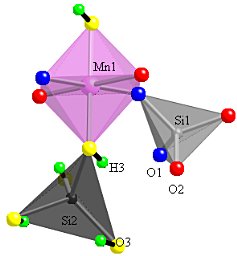
Zr2(MoO4)(PO4)2 is orthorhombic (Sc2W3O12 structure) from 9 to at least 400K, and shows anisotropic volume negative thermal expansion (αa=−8.35(4)×10−6K−1; αb=3.25(3)×10−6K−1; αc=−8.27(5)×10−6K−1 in the range 122–400K) similar in magnitude to A2M3O12 (M—Mo or W) with large A3+. The contraction on heating is associated with a pattern of Zr–O–Mo/P bond angle changes that is somewhat similar, but not the same as that for Sc2W3O12. On heating, the most pronounced reductions in the separation between the crystallographic positions of neighboring Zr and P are not associated with significant reductions in the corresponding Zr–O–P crystallographic bond angles, in contrast to what was seen for Sc2W3O12.
The high-pressure (HP) behavior of nano-crystalline mackinawite (n-FeS) with particle sizes of 6, 7, and 8 nm has been investigated by high-energy X-ray total scattering and pair distribution function analysis. An irreversible first-order structural phase transition from tetragonal mackinawite to orthorhombic FeS-II was observed at about 3 GPa. The transition is induced by the closure of the van-der-Waals gap in the layered mackinawite structure. A grain size effect on the transition pressure and the compressibility was observed. The n-FeS study is an example of a broad class of nano-crystalline minerals where the total scattering (TS) approach provides significant new information on local-, intermediate- and long-range structure. Under extreme conditions, of pressure in this case, straightforward modifications allow quantitative descriptions of the transformations mechanisms.
It has been understood for decades that process operability does not depend entirely upon the control system but also on the inherent properties of the process itself. For example, the decision on the size of equipment or the use of a highly integrated process may have a significant impact on the overall operability. Ignoring operability during process design may lead to a very difficult to control process. In this paper, a dynamic operability analysis of a Methyl Tertiary Butyl Ether (MTBE) reactive distillation column is presented. The effects of two design parameters, i.e. the reboiler duty and the reflux ratio, on the operability of the reactive distillation system are studied. Process operability is defined as the ability of the process to return to the steady-state in spite of unknown but bounded disturbances. The nonlinearity of the process is represented using a Hammerstein model, which can be easily obtained during process design from the steady-state model combined with some limited information on the process dynamics. The recent operability analysis method proposed by Rojas et al. (2007) is extended such that it can be implemented conveniently as one extra step after the flowsheet simulation using a process simulator. Based on this approach, an optimal controller for this highly nonlinear process is determined by solving a linear matrix inequality (LMI) optimization problem.
The high-pressure behavior of nanocrystalline mackinawite (FeS) with particle sizes of 6, 7 and 8 nm has been investigated by high-energy X-ray total scattering and pair distribution function analysis. An irreversible first-order structural phase transition from tetragonal mackinawite to orthorhombic FeS-II was observed at about 3 GPa. The transition is induced by the closure of the van der Waals gap in the layered mackinawite structure. A grain size effect on the transition pressure and the compressibility was observed.
The temperature dependences of the crystal structure and superstructure intensities in sodium nitrate, mineral name nitratine, NaNO, were studied using Rietveld structure refinements based on synchrotron powder X-ray diffraction. Nitratine transforms from at = 552(1) K. A NO group occupies, statistically, two positions with equal frequency in the disordered phase, but with unequal frequency in the partially ordered phase. One position for the NO group is rotated by 60° or 180° with respect to the other. The occupancy of the two orientations in the phase is obtained from the occupancy factor, , for the O1 site and gives rise to the order parameter, = 2 − 1, where is 0 at and 1 at 0 K. The NO groups rotate in a rapid process from about 541 to , where the axis contracts. Using a modified Bragg–Williams model, a good fit was obtained for the normalized intensities (that is, normalized, NI) for the (113) and (211) reflections in and indicates a second-order transition. Using the same model, a reasonable fit was obtained for the order parameter, , and also supports a second-order transition.
 Peter Chupas合作论文数Department of Chemistry, Stony Brook University26
 Jie Bao合作论文数School of Chemical Engineering, Faculty of Engineering, The University of New South Wales21
 Angus Wilkinson合作论文数School of Chemistry and Biochemistry, Georgia Institute of Technology21
 Sarvjit Shastri合作论文数Advanced Photon Source;Argonne National Laboratory;Argonne National Laboratory19
 Sytle Antao合作论文数Argonne National Laboratory Advanced Photon Source17
 John B. Parise合作论文数Department of Geosciences, Stony Brook University;Department of Chemistry, Stony Brook University15Yuegang Zhang合作论文数10Richard L. Harlow合作论文数School of Chemical Sciences, University of East Anglia10Ishmael Hassan合作论文数10
 Karena Chapman合作论文数Department of Chemistry, College of Arts and Sciences, Stony Brook University9
 Philip Coppens合作论文数Department of Chemistry, University at Buffalo9
 Stuart R. Stock合作论文数Department of Cell and Developmental Biology, Feinberg School of Medicine, Northwestern University9
 Willem H. Mulder合作论文数Department of Chemistry, University of the West Indies9
 Matthew Kramer合作论文数College of Engineering, Iowa State University;Division of Materials Sciences and Engineering, Ames National Laboratory9
 F. Marc Michel合作论文数Stanford Synchrotron Radiation Lightsource, SLAC National Accelerator Laboratory9
 Brian H. Toby合作论文数Argonne National Laboratory8
 Herry Santoso合作论文数School of Chemical Sciences and Engineering, The University of New South Wales8
 T. S. Toellner合作论文数8Brian F. Woodfield合作论文数8Jacob Hormadaly合作论文数Department of Chemistry, Brown University7
 Kimberly E. Kurtis (Kimberly Kurtis)合作论文数School of Civil and Environmental Engineering, College of Engineering, Georgia Institute of Technology;School of Materials Science and Engineering, College of Engineering, Georgia Institute of Technology7
 George S. Nolas合作论文数Department of Physics, College of Arts and Sciences, University of South Florida;Novel Materials Laboratory, University of South Florida7Andrew C. Jupe合作论文数7
 Jeffrey W Lynn (Fed)合作论文数Center for Neutron Research, National Institute of Standards and Technology;Quantum Materials Center, University of Maryland7Juliana Boerio-Goates合作论文数7
 Clare Grey合作论文数Yusuf Hamied Department of Chemistry, University of Cambridge6Garry L. Jennings合作论文数6Osvaldo J. Rojas合作论文数6
 E. E. Alp合作论文数Argonne National Laboratory Advanced Photon Source Argon6N. Yang合作论文数6
 Parisa A. Bahri合作论文数School of Engineering, Murdoch University6D. R. Haeffner合作论文数6Pa Montano合作论文数5
 K. W. Dennis合作论文数5Ma Beno合作论文数5
 Jonathan C. Hanson合作论文数Brookhaven National Laboratory5
 Martin Schoonen合作论文数Brookhaven National Laboratory;Stony Brook University;Montana State Astrobiology Research Center5Yan Gao合作论文数5Wen Z. Zhang合作论文数5
 Michael K. Crawford合作论文数5
 Lars Ehm合作论文数Department of Geosciences;Stony Brook University;Department of Geosciences, Stony Brook University5Deming Shu合作论文数5
 Dong Shu (舒东)合作论文数School of Chemistry, South China Normal University5n n naik合作论文数4P Bush合作论文数4
 Lin Xu合作论文数Department of Developmental Biology, Faculty of Medicine, Harvard University;Harvard School of Dental Medicine4
 Weibiao Zhou (周维彪)合作论文数Department of Food Science and Technology, National Univeristy of Singapore4
 Robert A. Fisher合作论文数Transplant Institute, Beth Israel Deaconess Medical Center, Harvard Medical School;Division of Transplantation, Beth Israel Deaconess Medical Center, Harvard Medical School4
 Rebecca Stevens合作论文数4




