A chemist given a compound would be interested in knowing the experiments performed using the compound, journals containing the compound and also molecular properties of the compound. If there is a way to integrate this data, it would enhance the chemist's knowledge about a given compound. The Object Reuse and Exchange (ORE) specification may provide a solution to this problem. ORE is a model proposed by the digital libraries community to aggregate resources on the web. OREChem is a research project funded by Microsoft External Research that aims to apply and extend ORE to enable the integration of experimental, bibliographical and molecular properties data. OREChem targets crystallography as its primary application domain. This effort will design a prototypical, semantic-based eScience infrastructure for chemistry and chemical informatics. In this paper we describe how we have used REST as well as SOAP web services, TeraGrid cyberinfrastructure and Semantic Web technologies, such as RDF and triple stores, to facilitate the metadata integration.
We describe our distributed systems research efforts to build the “cyberinfrastructure” components that constitute a geophysical Grid, or more accurately, a Grid of Grids. Service-oriented computing principles are used to build a distributed infrastructure of Web accessible components for accessing data and scientific applications. Our data services fall into two major categories: archival, database-backed services based around Geographical Information System (GIS) standards, and streaming services that can be used to filter and route real-time data sources such as Global Positioning System data streams. Execution support services include application execution management services and services for transferring remote files. These data and execution service families are bound together through metadata information and workflow services for service orchestration. Users may access the system through the QuakeSim scientific Web portal, which is built using a portlet component approach.
The vast increase of pertinent information available to drug discovery scientists means that there is strong demand for tools and techniques for organizing and intelligently mining this information for manageable human consumption. At Indiana University, we are developing techniques for “smart mining” of this information, based on web services, workflows, and a variety of client interfaces. In this paper, we introduce our model and describe how workflows of web services can be used to achieve the first steps of this vision, including bridging chemical and biological information.
Portlet-based Grid portals have become a crucial part of the cyberinfrastructure by providing component-based problem solving environments for scientists. Although portals aim to provide user-friendly environments with easy-to-use interfaces, the development of portals and their portlet components are time consuming. We aim to provide reusable components for rapid portlet development. Our approach, Grid Tag Libraries and Beans (GTLAB), encapsulates common Grid operations with reusable XML tags. GTLAB also provides a way for creating composite tasks that models the requirements of computational science portals. In previous work, we have introduced Grid tags libraries for the Globus toolkit. In this study, we extend GTLAB to support widely used Condor DAGMan and Taverna workflows for the Grid community. These extended tags demonstrate that large workflows can be integrated within Grid portlets without burdening of developers.
Most of the Grid services are accessible by using command-line tools or Web services clients. GCE Shell [4] supports Grid services by using command-line tool. GCE Shell and Grid portlets implements Java Cog abstractions [5] that wrap Grid services to support additional client programming layer on top of Grid services. As a result, we use Java Cog to develop Grid portlets. These portlets also need to present powerful Web interface.
The Open Geospatial Consortium (OGC) defines a number of standards (both for data models and for online services) that have been widely adopted in the Geographical Information System (GIS) community. In this paper we will describe our group's efforts to implement GIS services according to OGC standard specifications in accordance with the Web Services approach. This paper focuses on the Web Map Service (WMS), which we are coupling to problems in computational geophysics. Through the use of Web Services, we are able to integrate GIS services with other families of services, including information, data management, and remote application execution and management. We also describe WMS client building efforts that are suitable for integration with computational Web portals.
Computational scientists often develop large models and codes intended to be used by larger user communities or for repetitive tasks such as parametric studies. Lowering the barrier of entry for access to these codes is often a technical and sociological challenge. Portals help bridge the gap because they are well known interfaces enabling access to a large variety of resources, services, applications, and tools for private, public, and commercial entities, while hiding the complexities of the underlying software systems to the user. This paper presents an overview of the current state-of-the-art in grid portals, based on a component approach that utilizes portlet frameworks and the most recent Grid standards, the Web Services Resource Framework and a summary of current DOE portal efforts.
We designed eSports - a collaborative and synchronous video annotation platform, which is to be used in Internet scale cross-platform grid computing environment to facilitate computer supported cooperative work (CSCW) in education settings such as distance sport coaching, distance classroom etc. Different from traditional multimedia annotation systems, eSports provides the capabilities to collaboratively and synchronously play and archive real time live video, to take snapshots, to annotate video snapshots using whiteboard and to play back the video annotations synchronized with original video streams. eSports is designed based on the grid based collaboration paradigm $the shared event model using NaradaBrokering, which is a publish/subscribe based distributed message passing and event notification system. In addition to elaborate the design and implementation of eSports, we analyze the potential use cases of eSports under different education settings. We believed that eSports is very useful to improve the online collaborative coaching and education.
Interactive Data Language (IDL) is an array-oriented data analysis and visualization application, which is widely used in research, commerce, and education. It is meaningful to make user IDL applications collaborative between computers over networks, using a common message broker as the underlying communication system. In order to achieve the global collaboration, we have brought together in the research a Grid-based collaboration paradigm, a shared event model, different implementing structures, methodologies and technologies. We have succeeded in our prototype codes, and we are currently working on a real life IDL application package to make it collaborative. At the same time, we are trying to find better structures and methods for the collaboration in general user IDL applications.
In this paper we describe the architecture and initial performance analysis results of the SERVOGrid Complexity Computational Environments (CCE). The CCE architecture is based on a lightly coupled, Service Oriented Architecture approach that is suitable for distributed applications that are tolerant of Internet latencies. CCE focuses on integrating diverse Web and Grid Services for coupling scientific applications to Geographical Information systems. The services and coupling/orchestrating infrastructure are mapped to problems in geophysical data mining, pattern informatics, and multiscale geophysical simulation.
Many large semantic systems can be described as Semantic Grids of Semantic Grids with large amounts of relatively static services and associated semantic information combined with multiple dynamic regions (sessions or subgrids) where the semantic information is changing rapidly. We design a hybrid Information Service supporting both the scalability of large amounts of relatively slowly varying data and a high performance rapidly updated Information Service for dynamic regions. We use the two web service standards UDDI and WS-Context in our system. We report initial results from a prototype that is applied to sensor and collaboration grids.
 Geoffrey Fox合作论文数Department of Physics, College of Arts and Sciences, Indiana University;Department of Intelligent Systems Engineering, Indiana University;Community Grid Laboratory, Indiana University;Digital Science Center of Pervasive Technology Institute;School of Engineering and Applied Science, University of Virginia50
 Shrideep Pallickara合作论文数Department of Computer Science, Colorado State University13
 Harshawardhan Gadgil合作论文数Affirm7
 Mehmet Sıddık AKTAŞ合作论文数Computer Engineering Department, Faculty of Electrical & Electronics, Computer Engineering, Yildiz Technical University7
 Galip Aydin合作论文数* VLab: Collaborative Grid Services and Portals to Support Computational Material Science[ pdf ]6
 Choonhan Youn合作论文数University of California, San Diego
5
Choonhan Youn合作论文数University of California, San Diego
5 Beth Plale合作论文数Luddy School of Informatics, Computing, and Engineering, Indiana University Bloomington4Ozgur Balsoy合作论文数Florida State University
400 Dirac Science Library4
Beth Plale合作论文数Luddy School of Informatics, Computing, and Engineering, Indiana University Bloomington4Ozgur Balsoy合作论文数Florida State University
400 Dirac Science Library4 Ahmet E. Topcu合作论文数3
 Ali Can Kaplan合作论文数3
 Craig A. Stewart合作论文数Indiana University3Jungkee Kim合作论文数3
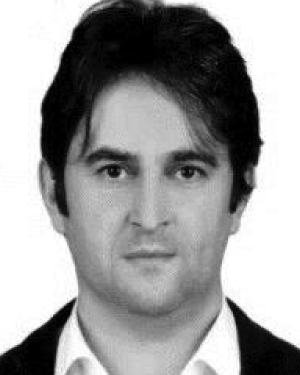 Ahmet Sayar合作论文数Indiana University3Dennis Gannon合作论文数Department of Computer Science at Indiana University;Indiana Pervasive Technology Labs3
 Hasan Bulut合作论文数2
 Wenjun Wu (吴文峻)合作论文数School of Artificial Intelligence, Beihang University2
 Gordon Erlebacher合作论文数Department of Scientific Computing, Florida State University;Department of Mathematics, College of Arts and Sciences, Florida State University;Visualization Laboratory, School of Computational Science & Information Technology, Florida State University;Department of Computer Science, Courtesy Appointment, Florida State University2Yi Huang合作论文数2Von Welch合作论文数Center for Supercomputing Applications, National;University of Illinois;National Center for Supercomputing Applications, University of Illinois2
 Dennis Mcleod合作论文数Computer Science Department, University of Southern California;Semantic Information Research Laboratory2
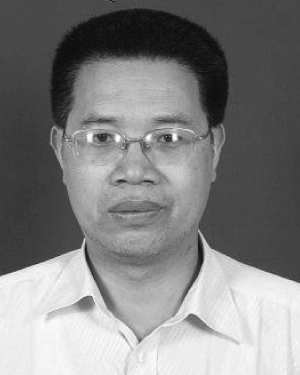 Xiaohong Qiu合作论文数2
 G. Von Laszewski合作论文数Indiana University2Mary Thomas合作论文数San Diego State University2Mehmet A. Nacar合作论文数2Ahmet Uyar合作论文数department of Computer Engineering
Mersin University2
G. Von Laszewski合作论文数Indiana University2Mary Thomas合作论文数San Diego State University2Mehmet A. Nacar合作论文数2Ahmet Uyar合作论文数department of Computer Engineering
Mersin University2 Sangmi Lee Pallickara合作论文数Computer Science Department, Colorado State University2
 Andrea Donnellan合作论文数Jet Propulsion Laboratory, Pasadena, CA, USA2z q lu合作论文数1J. Boisseau合作论文数1G. Rodgers合作论文数1D. A. Yuen合作论文数1DY Hancock合作论文数1Ben F. Chao合作论文数1Xi Rao合作论文数1
 Eric Roberts合作论文数Mol Biophys & Integrated Bioimaging Div, Lawrence Berkeley Natl Lab1Xiao Dong合作论文数Center for Clinical and Translational Science, University of Illinois College of Medicine1John Ries合作论文数1Robert Granat合作论文数1
 Charles R. Severance合作论文数School of Information, University of Michigan1Ying Jin合作论文数1
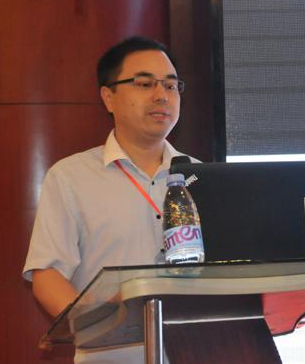 Zhigang Qi (齐志刚)合作论文数Department of Radiology,Xuanwu Hospital of Capital Medical University1
 John Rundle合作论文数Department of Physics and Astronomy, University of California, Davis;The Santa Fe Institute1D Middleton合作论文数1
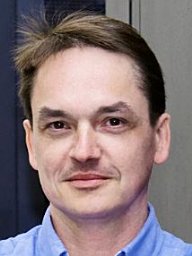 Matthias Müller合作论文数RWTH Aachen University1
 Jeremy Bloxham合作论文数Department of Earth and Planetary Sciences, Faculty of Arts and Sciences, Harvard University1
 David B. Leake合作论文数Department of Computer Science, The Luddy School of Informatics, Computing, and Engineering, Indiana University1Reagan Moore合作论文数San Diego Supercomputer Center;Data Intensive Computing 1Sashikiran Challa合作论文数Indiana University1Gang Zhai (翟刚)合作论文数1




