Diffusion language models have recently emerged as a leading alternative to standard language models, due to their ability for bidirectional attention and parallel text generation. In this work, we explore variants for their use in speech recognition. Specifically, we introduce a comprehensive guide to incorporating masked diffusion language models (MDLM) and uniform-state diffusion models (USDMs) for rescoring ASR hypotheses. Additionally, we design a new joint-decoding method that combines CTC and USDM by integrating the framewise probability distributions derived from CTC with the labelwise probability distributions computed by USDM at each decoding step, thereby generating new candidates that combine strong language knowledge from USDM and acoustic information from CTC. Our findings reveal that USDM, as well as MDLM, can significantly improve the accuracy of recognized text. We publish all our code and recipes.
Language model (LM) perplexity (PPL) has historically been used as a proxy for automatic speech recognition (ASR) word error rate (WER), with prior work reporting an approximately linear relation in log-log space. Modern end-to-end ASR systems challenge this assumption because they already contain internal language modeling capacity, are often evaluated without external language models, and can now be combined with neural LMs and large language models (LLMs) through different recognition strategies. This paper revisits the relation between PPL and WER for modern ASR systems. We study whether external LMs still improve current end-to-end ASR systems, whether the PPL-WER relation remains linear in log-log space, how encoder context length affects this relation, and how LLM perplexities fit into the trend observed for standard neural LMs. We further investigate internal language modeling (ILM) in attention-based encoder-decoder systems and show that ILM subtraction changes the observed PPL-WER relation, indicating that the decoder's internal LM must be considered when interpreting the effect of external LM quality.
This paper investigates efficient methods for utilizing text-only data to improve speech recognition, focusing on encoder-dominated models that facilitate faster recognition. We provide a comprehensive comparison of techniques to integrate text-only data, including modality matching and dynamic downsampling to reach text-level representations within the encoder. Our experiments on the LibriSpeech corpus show that a larger encoder with a smaller decoder can equal or surpass the performance of architectures with larger decoders. We demonstrate that simple configurations, such as random duration models, are often more effective than complex alternatives, significantly simplifying the training pipeline. All code and recipes are made publicly available.
Unsupervised speech recognition is a task of training a speech recognition model with unpaired data. To determine when and how unsupervised speech recognition can succeed, and how classification error relates to candidate training objectives, we develop a theoretical framework for unsupervised speech recognition grounded in classification error bounds. We introduce two conditions under which unsupervised speech recognition is possible. The necessity of these conditions are also discussed. Under these conditions, we derive a classification error bound for unsupervised speech recognition and validate this bound in simulations. Motivated by this bound, we propose a single-stage sequence-level cross-entropy loss for unsupervised speech recognition.
BEST-RQ is a simple and effective self-supervised training method for speech representation learning that performs well on automatic speech recognition (ASR) tasks. It generates pseudolabels using a fixed online quantization scheme, which simplifies training but provides weaker supervision than HuBERT-style models that iteratively refine pseudo-labels. In this work, we improve online pseudo-label generation while preserving simplicity. We propose three modifications: replacing the quantizer's linear projection with Principal Component Analysis (PCA), updating the codebook via iterative codebook refinement, and introducing an additional codebook updated via codebook distillation. We pre-train on the LibriSpeech 960-hour dataset and fine-tune using 100 hours of supervised LibriSpeech data. With all three modifications enabled, we achieve a 12
The recently published Loquacious dataset aims to be a replacement for established English automatic speech recognition (ASR) datasets such as LibriSpeech or TED-Lium. The main goal of the Loquacious dataset is to provide properly defined training and test partitions across many acoustic and language domains, with an open license suitable for both academia and industry. To further promote the benchmarking and usability of this new dataset, we present additional resources in the form of n-gram language models (LMs), a grapheme-to-phoneme (G2P) model and pronunciation lexica, with open and public access. Utilizing those additional resources we show experimental results across a wide range of ASR architectures with different label units and topologies. Our initial experimental results indicate that the Loquacious dataset offers a valuable study case for a variety of common challenges in ASR.
In this work, we study how to best utilize pre-trained LLMs for automatic speech recognition. Specifically, we compare the tight integration of an acoustic model (AM) with the LLM ("speech LLM") to the traditional way of combining AM and LLM via shallow fusion. For tight integration, we provide ablations on the effect of different label units, fine-tuning strategies, LLM sizes and pre-training data, attention interfaces, encoder downsampling, text prompts, and length normalization. Additionally, we investigate joint recognition with a CTC model to mitigate hallucinations of speech LLMs and present effective optimizations for this joint recognition. For shallow fusion, we investigate the effect of fine-tuning the LLM on the transcriptions using different label units, and we compare rescoring AM hypotheses to single-pass recognition with label-wise or delayed fusion of AM and LLM scores. We train on Librispeech and Loquacious and evaluate our models on the HuggingFace ASR leaderboard.
Speech-to-text alignment means finding the temporal boundaries of each word in the audio. Some models provide such an alignment directly and others do not. Connectionist temporal classification (CTC) and transducer models have an alignment by construction, whereas attention-based encoder-decoders (AED) and speech large language models (LLMs) do not, and their word timings are usually read off the attention weights instead. All of these signals live on the encoder frame grid, which bounds their temporal precision. We study a generic gradient-based alignment that applies to any differentiable ASR model. We take the gradient of each teacher-forced token log probability with respect to the input, reduce it to a per-frame saliency, and decode the resulting matrix into word boundaries with a single dynamic-programming pass. The method needs no training, no model modification and no alignment heads, works across all model families including the speech LLMs, and aligns on the input grid rather than on the coarser encoder grid. We evaluate it on sixteen models from four families, on read (TIMIT) and spontaneous (Buckeye) speech, each against the model's own native or attention-based alignment. We find that the gradient yields a usable alignment for every model, that it is usually somewhat behind a strong native aligner but better where the native alignment is weak, as for the streaming models, and that its main disadvantage is the cost of one backward pass per token.
Memristors provide a new chance for resource-efficient computation of neural models for natural language processing by enabling analog execution of vector-matrix-multiplication. Yet, computations on these devices are currently subject to larger distortion, both in weight programming and execution. In this work, we identify large output values of transformed positional encodings to cause major degradation within analog-to-digital conversion (ADC) as part of memristor-based computation. By adjusting the proportion of weight and precision bits of the ADC of specific memristor layers, we reduce the degradation of the execution by 50
Denoising language models (DLMs) have been proposed as a powerful alternative to traditional language models (LMs) for automatic speech recognition (ASR), motivated by their ability to use bidirectional context and adapt to a specific ASR model's error patterns. However, the complexity of the DLM training pipeline has hindered wider investigation. This paper presents the first independent, large-scale empirical study of DLMs. We build and release a complete, reproducible pipeline to systematically investigate the impact of key design choices. We evaluate dozens of configurations across multiple axes, including various data augmentation techniques (e.g., SpecAugment, dropout, mixup), different text-to-speech systems, and multiple decoding strategies. Our comparative analysis in a common subword vocabulary setting demonstrates that DLMs outperform traditional LMs, but only after a distinct compute tipping point. While LMs are more efficient at lower budgets, DLMs scale better with longer training, mirroring behaviors observed in diffusion language models. However, we observe smaller improvements than those reported in prior character-based work, which indicates that the DLM's performance is conditional on factors such as the vocabulary. Our analysis reveals that a key factor for improving performance is to condition the DLM on richer information from the ASR's hypothesis space, rather than just a single best guess. To this end, we introduce DLM-sum, a novel method for decoding from multiple ASR hypotheses, which consistently outperforms the previously proposed DSR decoding method. We believe our findings and public pipeline provide a crucial foundation for the community to better understand, improve, and build upon this promising class of models. The code is publicly available at https://github.com/rwth-i6/2025-denoising-lm/.
ASR systems are deployed across diverse environments, each with specific hardware constraints. We use supernet training to jointly train multiple encoders of varying sizes, enabling dynamic model size adjustment to fit hardware constraints without redundant training. Moreover, we introduce a novel method called OrthoSoftmax, which applies multiple orthogonal softmax functions to efficiently identify optimal subnets within the supernet, avoiding resource-intensive search. This approach also enables more flexible and precise subnet selection by allowing selection based on various criteria and levels of granularity. Our results with CTC on Librispeech and TED-LIUM-v2 show that FLOPs-aware component-wise selection achieves the best overall performance. With the same number of training updates from one single job, WERs for all model sizes are comparable to or slightly better than those of individually trained models. Furthermore, we analyze patterns in the selected components and reveal interesting insights.
Spoken Named Entity Recognition (NER) aims to extracting named entities from speech and categorizing them into types like person, location, organization, etc. In this work, we present VietMed-NER - the first spoken NER dataset in the medical domain. To our best knowledge, our real-world dataset is the largest spoken NER dataset in the world in terms of the number of entity types, featuring 18 distinct types. Secondly, we present baseline results using various state-of-the-art pre-trained models: encoder-only and sequence-to-sequence. We found that pre-trained multilingual models XLM-R outperformed all monolingual models on both reference text and ASR output. Also in general, encoders perform better than sequence-to-sequence models for the NER task. By simply translating, the transcript is applicable not just to Vietnamese but to other languages as well. All code, data and models are made publicly available here: https://github.com/leduckhai/MultiMed
Combination approaches for speech recognition (ASR) systems cover structured sentence-level or word-based merging techniques as well as combination of model scores during beam search. In this work, we compare model combination across popular ASR architectures. Our method leverages the complementary strengths of different models in exploring diverse portions of the search space. We rescore a joint hypothesis list of two model candidates. We then identify the best hypothesis through log-linear combination of these sequence-level scores. While model combination during first-pass recognition may yield improved performance, it introduces variability due to differing decoding methods, making direct comparison more challenging. Our two-pass method ensures consistent comparisons across all system combination results presented in this study. We evaluate model pair candidates with varying architectures and label topologies and units. Experimental results are provided for the Librispeech 960h task.
Architecture design is inherently complex. Existing approaches rely on either handcrafted rules, which demand extensive empirical expertise, or automated methods like neural architecture search, which are computationally intensive. In this paper, we introduce DMAO, an architecture optimization framework that employs a grow-and-drop strategy to automatically reallocate parameters during training. This reallocation shifts resources from less-utilized areas to those parts of the model where they are most beneficial. Notably, DMAO only introduces negligible training overhead at a given model complexity. We evaluate DMAO through experiments with CTC on LibriSpeech, TED-LIUM-v2 and Switchboard datasets. The results show that, using the same amount of training resources, our proposed DMAO consistently improves WER by up to similar to 6% relatively across various architectures, model sizes, and datasets. Furthermore, we analyze the pattern of parameter redistribution and uncover insightful findings.
We sometimes observe monotonically decreasing cross-attention weights in our Conformer-based global attention-based encoder-decoder (AED) models, negatively affecting performance compared to monotonically increasing attention weights. Further investigation shows that the Conformer encoder reverses the sequence in the time dimension. We analyze the initial behavior of the decoder cross-attention mechanism and find that it encourages the Conformer encoder self-attention to build a connection between the initial frames and all other informative frames. Furthermore, we show that, at some point in training, the self-attention module of the Conformer starts dominating the output over the preceding feed-forward module, which then only allows the reversed information to pass through. We propose methods and ideas of how this flipping can be avoided and investigate a novel method to obtain label-frame-position alignments by using the gradients of the label log probabilities w.r.t. the encoder input frames.
Although connectionist temporal classification (CTC) has the label context independence assumption, it can still implicitly learn a context-dependent internal language model (ILM) due to modern powerful encoders. In this work, we investigate the implicit context dependency modeled in the ILM of CTC. To this end, we propose novel context-dependent ILM estimation methods for CTC based on knowledge distillation (KD) with theoretical justifications. Furthermore, we introduce two regularization methods for KD. We conduct experiments on Librispeech and TED-LIUM Release 2 datasets for in-domain and cross-domain evaluation, respectively. Experimental results show that context-dependent ILMs outperform the context-independent priors in cross-domain evaluation, indicating that CTC learns a context-dependent ILM. The proposed label-level KD with smoothing method surpasses other ILM estimation approaches, with more than 13% relative improvement in word error rate compared to shallow fusion.
Neural front-ends are an appealing alternative to traditional, fixed feature extraction pipelines for automatic speech recognition (ASR) systems since they can be directly trained to fit the acoustic model. However, their performance often falls short compared to classical methods, which we show is largely due to their increased susceptibility to overfitting. This work therefore investigates regularization methods for training ASR models with learnable feature extraction front-ends. First, we examine audio perturbation methods and show that larger relative improvements can be obtained for learnable features. Additionally, we identify two limitations in the standard use of SpecAugment for these front-ends and propose masking in the short time Fourier transform (STFT)-domain as a simple but effective modification to address these challenges. Finally, integrating both regularization approaches effectively closes the performance gap between traditional and learnable features.
Neural front-ends represent a promising approach to feature extraction for automatic speech recognition (ASR) systems as they enable to learn specifically tailored features for different tasks. Yet, many of the existing techniques remain heavily influenced by classical methods. While this inductive bias may ease the system design, our work aims to develop a more generic front-end for feature extraction. Furthermore, we seek to unify the front-end architecture contrasting with existing approaches that apply a composition of several layer topologies originating from different sources. The experiments systematically show how to reduce the influence of existing techniques to achieve a generic front-end. The resulting 2D convolutional front-end is parameter-efficient and suitable for a scenario with limited computational resources unlike large models pre-trained on unlabeled audio. The results demonstrate that this generic unified approach is not only feasible but also matches the performance of existing supervised learnable feature extractors.
Meeting transcription is a field of high relevance and remarkable progress in recent years. Still, challenges remain that limit its performance. In this work, we extend a previously proposed framework for analyzing leakage in speech separation with proper sensitivity to temporal locality. We show that there is significant leakage to the cross channel in areas where only the primary speaker is active. At the same time, the results demonstrate that this does not affect the final performance much as these leaked parts are largely ignored by the voice activity detection (VAD). Furthermore, different segmentations are compared showing that advanced diarization approaches are able to reduce the gap to oracle segmentation by a third compared to a simple energy-based VAD. We additionally reveal what factors contribute to the remaining difference. The results represent state-of-the-art performance on LibriCSS among systems that train the recognition module on LibriSpeech data only.
We analyze automatic speech recognition (ASR) modeling choices under domain mismatch, comparing classic modular and novel sequence-to-sequence (seq2seq) architectures. Across the different ASR architectures, we examine a spectrum of modeling choices, including label units, context length, and topology. To isolate language domain effects from acoustic variation, we synthesize target domain audio using a text-to-speech system trained on LibriSpeech. We incorporate target domain n-gram and neural language models for domain adaptation without retraining the acoustic model. To our knowledge, this is the first controlled comparison of optimized ASR systems across state-of-the-art architectures under domain shift, offering insights into their generalization. The results show that, under domain shift, rather than the decoder architecture choice or the distinction between classic modular and novel seq2seq models, it is specific modeling choices that influence performance.
 Hermann Ney合作论文数RWTH Aachen University265
 Albert Zeyer合作论文数RWTH Aachen University44
 Zoltán Tüske合作论文数AppTek34
 Georg Heigold合作论文数Google27
 Simon Wiesler合作论文数Computer Science Dept;RWTH Aachen University;Computer Science Dept, RWTH Aachen University21
 Markus Nussbaum-Thom合作论文数Apple Technology Services B.V. & Co. Kg20
 Eugen Beck合作论文数Her20
 Mohammad Zeineldeen合作论文数18
 Pavel Golik合作论文数RWTH Aachen University18
 David Rybach合作论文数Apple18
 wilfried michel合作论文数RWTH Aachen University17
 Kazuki Irie合作论文数Gershman Computational Cognitive Neuroscience Lab, Department of Psychology, Harvard University17David Nolden合作论文数16
 Amr El-Desoky Mousa合作论文数Dept Comp Sci, Human Language Technol & Pattern Recognit, Rhein Westfal TH Aachen16
 Wei Zhou合作论文数Meta15M. Ali Basha Shaik合作论文数14
 Bjorn Hoffmeister合作论文数Science Department, Computer;Aachen University;Computer Science Department, Aachen University14
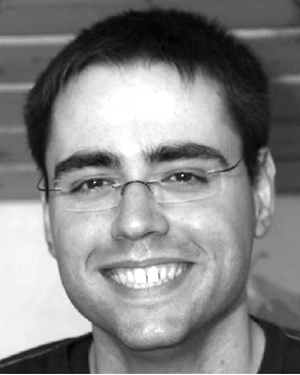 Stefan Hahn合作论文数13Christian Plahl合作论文数12
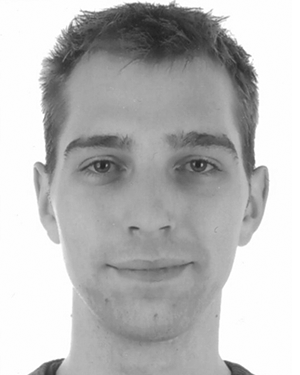 Patrick Doetsch合作论文数Human Language Technol & Pattern Recognit Grp, Rhein Westfal TH Aachen11Christoph Lüscher合作论文数10
 Nick Rossenbach合作论文数RWTH Aachen University10
 Martin Sundermeyer合作论文数Google10
 Muhammad Ali Tahir合作论文数Chair of Computer Science;Science Department, Computer;RWTH Aachen University;Computer Science Department, RWTH Aachen University10
 Christian Gollan合作论文数10Markus Kitza合作论文数RWTH Aachen University8
 Tina Raissi合作论文数RWTH Aachen University8Jonas Loeoef合作论文数7Peter Vieting合作论文数7Jingjing Xu合作论文数7
 Tobias Menne合作论文数RWTH Aachen University7
 Reinhold Häb-Umbach合作论文数Heinz Nixdorf Institute, Department of Electrical Engineering and Information Technology, Faculty of Computer Science, Electrical Engineering and Mathematics, Paderborn University7András Zolnay合作论文数7Simon Berger合作论文数6André Merboldt合作论文数6
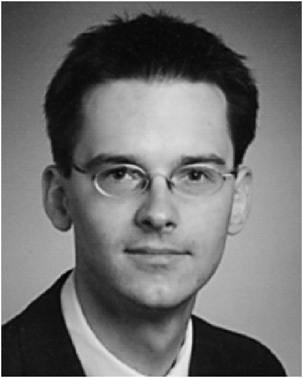 Frank Wessel合作论文数Lehrstuhl fur Informatik;University of Technology6
 Wolfgang Macherey合作论文数Google Research6
 Parnia Bahar合作论文数Human Language Technology and Pattern Recognition Group, RWTH Aachen University.5Friedhelm R. Drepper合作论文数5
 Patrick Lehnen合作论文数5Alexander Gerstenberger合作论文数Rhein Westfal TH Aachen, Human Language Technol & Pattern Recognit Grp, Comp Sci Dept, D-52074 Aachen, Germany4Zijian Yang合作论文数Rhein Westfal TH Aachen, Comp Sci Dept, Human Language Technol & Pattern Recognit Grp, Aachen, Germany4
 Christoph Boeddeker合作论文数University of Paderborn4Xiaodong Cui合作论文数4
 Alexander Richard合作论文数Meta4
 Thomas Deselaers合作论文数Apple Switzerland4
 Jahn Heymann合作论文数Amazon4
 Stephan Kanthak合作论文数Science Department, Computer;Aachen University;Computer Science Department, Aachen University4M Nussbaum-Thom合作论文数3