In this paper, we aim to create weak alignment supervision from an existing hybrid system to aid the end-to-end modeling of automatic speech recognition. Towards this end, we use the existing hybrid ASR system to produce triphone alignments of the training audios. We then create a cross-entropy loss at a certain layer of the encoder using the derived alignments. In contrast to the general one-hot cross-entropy losses, here we use a cross-entropy loss with a label smoothing parameter to regularize the supervision. As a comparison, we also conduct the experiments with one-hot cross-entropy losses and CTC losses with loss weighting. The results show that placing the weak alignment supervision with the label smoothing parameter of 0.5 at the third encoder layer outperforms the other two approaches and leads to about 5\% relative WER reduction on the TED-LIUM 2 dataset over the baseline. We see similar improvements when applying the method out-of-the-box on a Tagalog end-to-end ASR system.
AppTek participated in the subtitling and formality tracks of the IWSLT 2023 evaluation.This paper describes the details of our subtitling pipeline -speech segmentation, speech recognition, punctuation prediction and inverse text normalization, text machine translation and direct speech-to-text translation, intelligent line segmentation -and how we make use of the provided subtitling-specific data in training and fine-tuning.The evaluation results show that our final submissions are competitive, in particular outperforming the submissions by other participants by 5% absolute as measured by the SUBER subtitle quality metric.For the formality track, we participated with our En-Ru and En-Pt production models, which support formality control via prefix tokens.Except for informal Portuguese, we achieved near perfect formality level accuracy while at the same time offering high general translation quality.
The goal of spoken language understanding (SLU) systems is to determine the meaning of the input speech signal, unlike speech recognition which aims to produce verbatim transcripts. Advances in end-to-end (E2E) speech modeling have made it possible to train solely on semantic entities, which are far cheaper to collect than verbatim transcripts. We focus on this set prediction problem, where entity order is unspecified. Using two classes of E2E models, RNN transducers and attention based encoder-decoders, we show that these models work best when the training entity sequence is arranged in spoken order. To improve E2E SLU models when entity spoken order is unknown, we propose a novel data augmentation technique along with an implicit attention based alignment method to infer the spoken order. F1 scores significantly increased by more than 11% for RNN-T and about 2% for attention based encoder-decoder SLU models, outperforming previously reported results.
We investigate the impact of aggressive low-precision representations of weights and activations in two families of large LSTM-based architectures for Automatic Speech Recognition (ASR): hybrid Deep Bidirectional LSTM - Hidden Markov Models (DBLSTM-HMMs) and Recurrent Neural Network - Transducers (RNN-Ts). Using a 4-bit integer representation, a na\"ive quantization approach applied to the LSTM portion of these models results in significant Word Error Rate (WER) degradation. On the other hand, we show that minimal accuracy loss is achievable with an appropriate choice of quantizers and initializations. In particular, we customize quantization schemes depending on the local properties of the network, improving recognition performance while limiting computational time. We demonstrate our solution on the Switchboard (SWB) and CallHome (CH) test sets of the NIST Hub5-2000 evaluation. DBLSTM-HMMs trained with 300 or 2000 hours of SWB data achieves $<$0.5% and $<$1% average WER degradation, respectively. On the more challenging RNN-T models, our quantization strategy limits degradation in 4-bit inference to 1.3%.
We present a comprehensive study on building and adapting RNN transducer (RNN-T) models for spoken language understanding(SLU). These end-to-end (E2E) models are constructed in three practical settings: a case where verbatim transcripts are available, a constrained case where the only available annotations are SLU labels and their values, and a more restrictive case where transcripts are available but not corresponding audio. We show how RNN-T SLU models can be developed starting from pre-trained automatic speech recognition (ASR) systems, followed by an SLU adaptation step. In settings where real audio data is not available, artificially synthesized speech is used to successfully adapt various SLU models. When evaluated on two SLU data sets, the ATIS corpus and a customer call center data set, the proposed models closely track the performance of other E2E models and achieve state-of-the-art results.
In our previous work we demonstrated that a single headed attention encoder-decoder model is able to reach state-of-the-art results in conversational speech recognition. In this paper, we further improve the results for both Switchboard 300 and 2000. Through use of an improved optimizer, speaker vector embeddings, and alternative speech representations we reduce the recognition errors of our LSTM system on Switchboard-300 by 4% relative. Compensation of the decoder model with the probability ratio approach allows more efficient integration of an external language model, and we report 5.9% and 11.5% WER on the SWB and CHM parts of Hub5'00 with very simple LSTM models. Our study also considers the recently proposed conformer, and more advanced self-attention based language models. Overall, the conformer shows similar performance to the LSTM; nevertheless, their combination and decoding with an improved LM reaches a new record on Switchboard-300, 5.0% and 10.0% WER on SWB and CHM. Our findings are also confirmed on Switchboard-2000, and a new state of the art is reported, practically reaching the limit of the benchmark.
Customization of automatic speech recognition (ASR) models using text data from a target domain is essential to deploying ASR in various domains. End-to-end (E2E) modeling for ASR has made remarkable progress, but the advantage of E2E modeling, where all neural network parameters are jointly optimized, is offset by the challenge of customizing such models. In conventional hybrid models, it is easy to directly modify a language model or a lexicon using text data, but this is not true for E2E models. One popular approach for customizing E2E models uses audio synthesized from the target domain text, but the acoustic mismatch between the synthesized and real audio can be problematic. We propose a method that avoids the negative effect of synthesized audio by (1) adding a mapping network before the encoder network to map the acoustic features of the synthesized audio to those of the source domain, (2) training the added mapping network using text and synthesized audio from the source domain while freezing all layers in the E2E model, (3) training the E2E model with text and synthesized audio from the target domain, and (4) removing the added mapping network when decoding real audio from the target domain. Experiments on customizing RNN Transducer and Conformer Transducer models demonstrate the advantage of the proposed method over encoder freezing, a popular customization method for E2E models.
We investigate a set of techniques for RNN Transducers (RNN-Ts) that were instrumental in lowering the word error rate on three different tasks (Switchboard 300 hours, conversational Spanish 780 hours and conversational Italian 900 hours). The techniques pertain to architectural changes, speaker adaptation, language model fusion, model combination and general training recipe. First, we introduce a novel multiplicative integration of the encoder and prediction network vectors in the joint network (as opposed to additive). Second, we discuss the applicability of i-vector speaker adaptation to RNN-Ts in conjunction with data perturbation. Third, we explore the effectiveness of the recently proposed density ratio language model fusion for these tasks. Last but not least, we describe the other components of our training recipe and their effect on recognition performance. We report a 5.9% and 12.5% word error rate on the Switchboard and CallHome test sets of the NIST Hub5 2000 evaluation and a 12.7% WER on the Mozilla CommonVoice Italian test set.
Transformer networks and self-supervised pre-training have consistently delivered state-of-art results in the field of natural language processing (NLP); however, their merits in the field of spoken language understanding (SLU) still need further investigation. In this paper we introduce a modular End-to- End (E2E) SLU transformer network based architecture which allows the use of self-supervised pretrained acoustic features, pre-trained model initialization and multi-task training. Several SLU experiments for predicting intent and entity labels/values using the ATIS dataset are performed. These experiments investigate the interaction of pre-trained model initialization and multi-task training with either traditional filterbank or self-supervised pre-trained acoustic features. Results show not only that self-supervised pre-trained acoustic features outperform filterbank features in almost all the experiments, but also that when these features are used in combination with multi-task training, they almost eliminate the necessity of pre-trained model initialization.
End-to-end spoken language understanding (SLU) systems that process human-human or human-computer interactions are often context independent and process each turn of a conversation independently. Spoken conversations on the other hand, are very much context dependent, and dialog history contains useful information that can improve the processing of each conversational turn. In this paper, we investigate the importance of dialog history and how it can be effectively integrated into end-to-end SLU systems. While processing a spoken utterance, our proposed RNN transducer (RNN-T) based SLU model has access to its dialog history in the form of decoded transcripts and SLU labels of previous turns. We encode the dialog history as BERT embeddings, and use them as an additional input to the SLU model along with the speech features for the current utterance. We evaluate our approach on a recently released spoken dialog data set, the HARPERVALLEYBANK corpus. We observe significant improvements: 8% for dialog action and 30% for caller intent recognition tasks, in comparison to a competitive context independent end-to-end baseline system.
When recurrent neural network transducers (RNNTs) are trained using the typical maximum likelihood criterion, the prediction network is trained only on ground truth label sequences.This leads to a mismatch during inference, known as exposure bias, when the model must deal with label sequences containing errors.In this paper we investigate approaches to reducing exposure bias in training to improve the generalization of RNNT models for automatic speech recognition (ASR).A label-preserving input perturbation to the prediction network is introduced.The input token sequences are perturbed using SwitchOut and scheduled sampling based on an additional token language model.Experiments conducted on the 300-hour Switchboard dataset demonstrate their effectiveness.By reducing the exposure bias, we show that we can further improve the accuracy of a high-performance RNNT ASR model and obtain state-of-the-art results on the 300-hour Switchboard dataset.
An essential component of spoken language understanding (SLU) is slot filling: representing the meaning of a spoken utterance using semantic entity labels. In this paper, we develop end-to-end (E2E) spoken language understanding systems that directly convert speech input to semantic entities and investigate if these E2E SLU models can be trained solely on semantic entity annotations without word-for-word transcripts. Training such models is very useful as they can drastically reduce the cost of data collection. We created two types of such speech-to-entities models, a CTC model and an attention-based encoder-decoder model, by adapting models trained originally for speech recognition. Given that our experiments involve speech input, these systems need to recognize both the entity label and words representing the entity value correctly. For our speech-to-entities experiments on the ATIS corpus, both the CTC and attention models showed impressive ability to skip non-entity words: there was little degradation when trained on just entities versus full transcripts. We also explored the scenario where the entities are in an order not necessarily related to spoken order in the utterance. With its ability to do re-ordering, the attention model did remarkably well, achieving only about 2% degradation in speech-to-bag-of-entities F1 score.
We present a beam decoding strategy for recurrent neural network transducers which has the characteristic that all competing hypotheses within the beam have the same alignment length (number of output symbols plus BLANK symbols). We contrast the proposed technique with time-synchronous decoding where the competing hypotheses within the beam correspond to the same input frames (but can have different length output sequences). Experiments on the Switchboard 2000 hours corpus show that alignment-length synchronous decoding (ALSD) is 25% faster than time-synchronous decoding (TSD) for the same accuracy because ALSD performs 42% fewer joint network evaluations and hypothesis expansions during the search. Additionally, we discuss the benefit of caching and batching the prediction and joint network evaluations, of using prefix trees instead of full output vocabulary expansions, and of performing hypothesis recombination after pruning. With open beam decoding, we reach a 6.2% / 10.9% word error rate on the Switchboard and CallHome Hub5 2000 evaluation testsets which compares favorably to other published single-model results on this corpus.
It is generally believed that direct sequence-to-sequence (seq2seq) speech recognition models are competitive with hybrid models only when a large amount of data, at least a thousand hours, is available for training. In this paper, we show that state-of-the-art recognition performance can be achieved on the Switchboard-300 database using a single headed attention, LSTM based model. Using a cross-utterance language model, our single-pass speaker independent system reaches 6.4% and 12.5% word error rate (WER) on the Switchboard and CallHome subsets of Hub5'00, without a pronunciation lexicon. While careful regularization and data augmentation are crucial in achieving this level of performance, experiments on Switchboard-2000 show that nothing is more useful than more data. Overall, the combination of various regularizations and a simple but fairly large model results in a new state of the art, 4.7% and 7.8% WER on the Switchboard and CallHome sets, using SWB-2000 without any external data resources.
In this paper we present a comprehensive study on building and adapting deep neural network based speech recognition systems for automatic closed captioning. We develop the proposed systems by first building base automatic speech recognition (ASR) systems that are not specific to any particular show or station. These models are trained on nearly 6000 hours of broadcast news data using conventional hybrid and more recent attention based end-to-end acoustic models. We then employ various adaptation and data augmentation strategies to further improve the trained base models. We use 535 hours of data from two independent BN sources to study how the base models can be customized. We observe up to 32% relative improvement using the proposed techniques on test sets related to, but independent of the adaptation data. At these low word error rates (WERs), we believe the customized BN ASR systems can be used effectively for automatic closed captioning.
Prior work has shown that connectionist temporal classification (CTC)-based automatic speech recognition systems perform well when using bidirectional long short-term memory (BLSTM) networks unrolled over the whole speech utterance. This is because whole-utterance BLSTMs better capture long-term context. We hypothesize that this also leads to overfitting and propose soft forgetting as a solution. During training, we unroll the BLSTM network only over small non-overlapping chunks of the input utterance. We randomly pick a chunk size for each batch instead of a fixed global chunk size. In order to retain some utterance-level information, we encourage the hidden states of the BLSTM network to approximate those of a pre-trained whole-utterance BLSTM. Our experiments on the 300-hour English Switchboard dataset show that soft forgetting improves the word error rate (WER) above a competitive wholeutterance phone CTC BLSTM by an average of 7-9% relative. We obtain WERs of 9.1%/17.4% using speaker-independent and 8.7%/16.8% using speaker-adapted models respectively on the Hub5-2000 Switchboard/CallHome test sets. We also show that soft forgetting improves the WER when the model is used with limited temporal context for streaming recognition. Finally, we present some empirical insights into the regularization and data augmentation effects of soft forgetting.
The paper presents our endeavor to improve state-of-the-art speech recognition results using attention based neural network approaches. Our test focus was LibriSpeech, a well-known, publicly available, large, speech corpus, but the methodologies are clearly applicable to other tasks. After systematic application of standard techniques – sophisticated data augmentation, various dropout schemes, scheduled sampling, warm-restart –, and optimizing search configurations, our model achieves 4.0% and 11.7% word error rate (WER) on the test-clean and testother sets, without any external language model. A powerful recurrent language model drops the error rate further to 2.7% and 8.2%. Thus, we not only report the lowest sequence-tosequence model based numbers on this task to date, but our single system even challenges the best result known in the literature, namely a hybrid model together with recurrent language model rescoring. A simple ROVER combination of several of our attention based systems achieved 2.5% and 7.3% WER on the clean and other test sets.
We present a simple noise injection algorithm for training end-to-end ASR models which consists in adding to the spectra of training utterances the scaled spectra of random utterances of comparable length. We conjecture that the sequence information of the "noise" utterances is important and verify this via a contrast experiment where the frames of the utterances to be added are randomly shuffled. Experiments for both CTC and attention-based models show that the proposed scheme results in up to 9% relative word error rate improvements ( depending on the model and test set) on the Switchboard 300 hours English conversational telephony database. Additionally, we set a new benchmark for attention-based encoder-decoder models on this corpus.
There has been huge progress in speech recognition over the last several years. Tasks once thought extremely difficult, such as SWITCHBOARD, now approach levels of human performance. The MALACH corpus (LDC catalog LDC2012S05), a 375-Hour subset of a large archive of Holocaust testimonies collected by the Survivors of the Shoah Visual History Foundation, presents significant challenges to the speech community. The collection consists of unconstrained, natural speech filled with disfluencies, heavy accents, age-related coarticulations, un-cued speaker and language switching, and emotional speech - all still open problems for speech recognition systems. Transcription is challenging even for skilled human annotators. This paper proposes that the community place focus on the MALACH corpus to develop speech recognition systems that are more robust with respect to accents, disfluencies and emotional speech. To reduce the barrier for entry, a lexicon and training and testing setups have been created and baseline results using current deep learning technologies are presented. The metadata has just been released by LDC (LDC2019S11). It is hoped that this resource will enable the community to build on top of these baselines so that the extremely important information in these and related oral histories becomes accessible to a wider audience.
 Ralf Schlüter合作论文数Department of Computer Science, Faculty of Computer Science, Mathematics and Natural Sciences, RWTH Aachen University34
 Hermann Ney合作论文数RWTH Aachen University27
 Brian Kingsbury合作论文数IBM T. J. Watson Research Center17
 George Saon合作论文数IBM16
 Pavel Golik合作论文数RWTH Aachen University11
 Kartik Audhkhasi合作论文数Google10
 Samuel Thomas合作论文数Thomas J. Watson Research Center, IBM Research AI9
 Michael Picheny合作论文数Department of Computer Science, New York University;Center for Data Science, New York University8
 Péter Mihajlik合作论文数Department of Telecommunications and Media Informatics;Budapest University of Technology and Economics;Department of Telecommunications and Media Informatics, Budapest University of Technology and Economics8
 Tibor Fegyó合作论文数TSP Laboratory;Department of Telecommunications;Budapest University of Technology;TSP Laboratory, Budapest University of Technology7
 Markus Nussbaum-Thom合作论文数Apple Technology Services B.V. & Co. Kg5
 Xiaodong Cui合作论文数5
 Kazuki Irie合作论文数Gershman Computational Cognitive Neuroscience Lab, Department of Psychology, Harvard University5
 Hong-Kwang Jeff Kuo合作论文数T. J. Watson Research Center, IBM5M. Ali Basha Shaik合作论文数4
 Yinghui Huang合作论文数Google DeepMind4Gakuto Kurata合作论文数4
 Albert Zeyer合作论文数RWTH Aachen University3Friedhelm R. Drepper合作论文数3David Nolden合作论文数3
 Muhammad Ali Tahir合作论文数Chair of Computer Science;Science Department, Computer;RWTH Aachen University;Computer Science Department, RWTH Aachen University3Zoltán Tobler合作论文数3
 Patrick Doetsch合作论文数Human Language Technol & Pattern Recognit Grp, Rhein Westfal TH Aachen3
 Tobias Menne合作论文数RWTH Aachen University2
 wilfried michel合作论文数RWTH Aachen University2
 Martin Sundermeyer合作论文数Google2
 Wei Zhang合作论文数Programming Technologies Department, IBM T.J.Watson Research Center2Simon Wiesler合作论文数Computer Science Dept;RWTH Aachen University;Computer Science Dept, RWTH Aachen University2Bottyán Németh合作论文数2
 Ron Hoory合作论文数IBM Research - Haifa2
 Balazs Tarjan合作论文数Department of Telecommunications and Media Informatics, Budapest University of Technology and Economics2
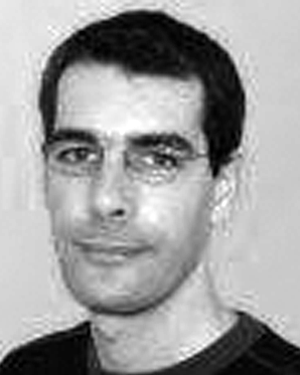 Zvi Kons合作论文数IBM Haifa Research Center2
 David Haws合作论文数1st year Graduate Student at U.C. Davis department of Mathematics2
 Masayuki Suzuki合作论文数Univ Tokyo2
 Kailash Gopalakrishnan合作论文数EnCharge AI1Ellen Kislal合作论文数1Larry Sansone合作论文数1
 Daniel Willett合作论文数1
 Georg Heigold合作论文数Google1
 Parnia Bahar合作论文数Human Language Technology and Pattern Recognition Group, RWTH Aachen University.1Bern Samko合作论文数Appen, Sydney, NSW, Australia1Alice Kaiser-Schatzlein合作论文数Appen, Sydney, NSW, Australia1Tom Dibert合作论文数Appen, Sydney, NSW, Australia1Markus Kitza合作论文数RWTH Aachen University1
 Mohammad Zeineldeen合作论文数1
 Mattia Antonino Di Gangi合作论文数University of Trento1
 Bhuvana Ramabhadran合作论文数Google;Columbia University1
 Anton Ragni合作论文数Department of Computer Science, Faculty of Engineering, The University of Sheffield1YingBo Gao合作论文数Human Language Technology and Pattern Recognition Group, Computer Science Department RWTH Aachen University1




