This paper presents two units of Y-band (325-500 GHz) and two units of D-band (110-170 GHz) all-pole inline Chebyshev band-pass filters (BPFs) using high-precision computer numerically controlled milling. The filters are based on six-coupled resonant cavities and are designed for a 20 dB return loss in a 10 GHz bandwidth centered around 470 GHz and 160 GHz with two taper sections at the input and output. Statistical analyses of the design parameters are performed to estimate the manufacturing tolerance. Microscope measurements are done and it is seen that machine tolerance on cavity lengths of about 3.5 microns causes a 2 GHz center frequency shift in Y-band. Measurements validate the analyses. The fabrication repeatability in the D-band is more consistent than in the Y-band. Indeed, two Y-band BPF units have a center frequency shift difference of 6 GHz while the the D-band BPF units have almost identical responses.
The paper introduces a novel dual-port dual-polarized magneto-electric dipole (MED) antenna with orthogonal Gamma and inverted-Gamma shape probes, which was fabricated by means of an additive 3D metal printing process. Electromagnetic wave simulation and RF measurement report a resonance bandwidth from 3 GHz to 4 GHz at both MED's ports with respect to a standing wave ratio of less than 2. The cross-polarization isolation (XPI) between the MED's ports was also measured to be greater than 50 dB across its entire resonance bandwidth. The paper also thoroughly examines the impact of misalignments in the polarization of the MED probes on the XPI level. The broadband resonance and excellent isolation between the MED ports make it a strong candidate for a full-duplex wireless transceiver in network infrastructure.
The paper showcases a real-time demonstration of an ultra-broadband (4 GHz) integrated sensing and communications (ISAC) operating in the upper D-band at 160 GHz. The demonstration illustrates quasi-monostatic sensing by measuring and estimating delay-Doppler maps, while also maintaining a 4.9 Gbit/s communication link to a remote receiver located 4 meters away, utilizing a single carrier quadrature amplitude modulation (16-QAM) signal. The results of the demonstration indicate that the D-band is suitable for ISAC applications in future mobile communications, especially in the context of 6 G technologies.
This paper presents channel measurements and modeling at 28 and 160 GHz in an industrial-style open office environment with angular information at the receiver. Channel impulse response snapshots are captured at 135 measurement positions for both frequencies and are evaluated in terms of power metrics, delay, and angular characteristics. Frequencydependent models for path loss, delay, and angular spread of arrival and K-factor are estimated, and large-scale parameter cross-correlations are evaluated. The results show that delay and angle spread are not frequency dependent in this environment although twice as many multi-path components were identified at 28 GHz compared to 160 GHz.
This paper compares the sub-THz radio channel characteristics at 158 GHz and 300 GHz in a shopping mall scenario by extracting three different path loss models and various channel parameters. The path loss models extracted are two single frequency models, that include the close-in (CI) and floating-intercept (FI) model, and the alpha-beta-gamma (ABG) model being a multi frequency model. The extracted channel parameters include K-factor, delay spread and angular spread. The extraction of mentioned models and parameters is based on two measurement campaigns executed at the mentioned center frequencies in the same shopping mall like environment with a time-domain correlative channel sounder. The subsequent comparison gives an assessment on the extracted path loss models and the multipath behaviour of the sub-THz radio channel. The paper presents for the first time a comparison between a D-band and H/J-band channel measurements taken both in the same shopping mall environment.
Sensing plays a crucial role in autonomous and assisted vehicular driving, as well as in the operation of autonomous drones. The traditional segregation of communication and onboard sensing systems in mobility applications is due to be merged using Joint Communication and Sensing (JCAS) in the development of the 6G mobile radio standard. The integration of JCAS functions into the future road traffic landscape introduces novel challenges for the design of the 6G system architecture. Special emphasis will be placed on facilitating direct communication between road users and aerial drones. In various mobility scenarios, diverse levels of integration will be explored, ranging from leveraging communication capabilities to coordinate different radars to achieving deep integration through a unified waveform. In this paper, we have identified use cases and derive five higher-level Tech Cases (TCs). Technical and functional requirements for the 6G system architecture for a device-oriented JCAS approach will be extracted from the TCs and used to conceptualize the architectural views.
This paper presents measurements in the D-band at 160 GHz in an indoor industrial-like environment in the presence of a metal reflector as emulated reconfigurable intelligent surface (RIS). Based on several measurements in non-line-of-sight condition with and without an emulated RIS in place, the impact of the reflector on path loss, delay spread and angle spread of arrival is evaluated. The results suggest high gains in terms of coverage extension using a RIS in the D-band with a mean reduction in path loss of 11.9 dB.
The authors present a W-band Rotman lens (RL) beamformer with WR-10 waveguide interfaces. Radio frequency characteristics, such as phase relationships and insertion losses, including the beamforming capabilities of the RL were simulated and measured to validate the performance of generating four RF beams with +/- 60 degrees field of view. Subsequently, the RL as beamformer was integrated into a transmitter setup in conjunction with the array antenna, in addition to a receiver setup that was constructed from off-the-shelf components. Both W-band transmitter and receiver were used to demonstrate a wireless link transmission in an outdoor urban - mobile user access or mobile backhauling - deployment scenario; over 85 GHz carrier frequency. The demonstration used a 5G-NR Release-15 conform waveform with 400 MHz of bandwidth and up to 256 quadrature amplitude modulation (QAM). The demonstration trial was conducted including line-of-sight (LOS), obstructed line-of-sight (OLoS), and none-line-of-sight (NLoS) scenarios; and reported a successful 16QAM over 184 meters OLoS link and 16QAM over 116 meters NLoS link. The work provides experimental evidence of the potential for high-frequency bands like the W-band to be utilized in future (6G and beyond) wireless communication networks.
This article presents a novel D-band (sub-THz) wireless transceiver developed in two consecutive phases: a waveguide-based discrete component phase, and a microstrip integrated structure phase. In fact, the wireless transceiver from the second development phase was recorded in 2022 as the world's first long-range and analog beamforming- capable D-band transceiver, specifically operating from 150 GHz to 175 GHz. In technical terms, the transmitter reports an effective isotropic radiated power (EIRP) of 48 dBm in the boresight beam, and it supports eight RF beams based on a Rotman lens (RL) as a beamforming network solution. This is a significant improvement over a 31 dBm EIRP measured over the transmitter's boresight beam developed in the first phase (2021), which supported a waveguide-based RL with four beamforming configurations. A receiver prototype was also developed in phase two with eight beams and eight antenna uniform linear phased arrays similar to its transmitter counterpart. Monolithic microwave integrated circuit (MMIC) power amplifiers, low-noise amplifiers, and switches were designed and fabricated for the front-ends based on indium gallium arsenide (InGaAs) technology. This article also reports on 6G demonstration trials in indoor and outdoor scenarios. A transmission experiment over a 9-meter distance in an indoor environment was conducted using 5G-NR-compliant -- orthogonal frequency division multiplexing (OFDM) -- waveforms with 400 MHz bandwidth and 64 quadrature amplitude modulation (QAM) for the data symbols. In the same indoor setup, beam alignment and tracking, based on modified 5G NR synchronization blocks, were successfully tested. Furthermore, long-range outdoor trials based on the 5G NR waveform are reported for a distance of 320 meters, utilizing a 16QAM for the data symbols. Additionally, a generic OFDM waveform transmission trial was conducted outdoors for links up to 500 meters, 500 MHz bandwidth, and with various modulation schemes up to 64QAM constellations.
In this paper, we introduce a novel time domain (TD) correlation based channel sounder that operates in the D-band (110 GHz to 170 GHz) with which we performed dual-polarized sub-THz channel measurements in an industrial environment. The channel measurements cover all four channel polarization components: two co-polar channels and two cross-polar channels. This was achieved by changing the antenna polarization both at the transmitter (TX) and receiver (RX). To evaluate the impact of the antenna type, two different antennas at the RX side were used: On the one hand, a WR-06 waveguide probe antenna and on the other hand, a WR-06 waveguide pyramidal horn antenna with a higher gain and a narrower half-power beam width (HPBW). The collected channel impulse responses (CIRs) of 8 measurement positions were evaluated with regards to the path loss and the cross-polarization ratio (CPR). The measurements report, that the cross-polarization isolation (CPI) in average is around 30 dB and the average CPR is around -24.4 dB. Further, the antenna's HPBW has a strong impact on the CPR leading to deviations of around 4 dB.
The D-band, spanning 110 GHz to 170 GHz, has emerged as a relevant frequency range for future mobile communications and radar sensing applications, particularly in the context of 6G technologies. This demonstration presents a high-bandwidth, real-time integrated sensing and communication (ISAC) platform operating in the upper D-band at 160 GHz. The platform comprises a software-defined intermediate frequency transceiver and a D-band radio frequency module. Its flexible software design allows for rapid integration of signal processing algorithms. Highlighting its potential for advanced research in ISAC systems, the platforms’s efficacy is showcased through a live demonstration with an algorithm implementing human target tracking and activity classification.
This paper reports the development outcomes of the world's first integrated analog beamforming - transmit and receive - wireless front-ends operating in the D-band (a sub-THz band), particularly designed to operate within 150 GHz to 170 GHz frequency range. Front-end hardware development includes monolithic microwave integrated circuit (MMIC) chips of the multichannel power amplifier, multichannel low-noise amplifier, and RF switches. Moreover, the development includes an analog beamforming RF network and a low-profile microstrip 1-by-8 uniform linear antenna array, which were both developed on a resistive silicon substrate. The paper also features a successful long-range (320-meter) line-of-sight unidirectional point-to-point wireless transmission experiment, utilizing a 5G-NR orthogonal frequency division multiplexing (OFDM) waveform over a 160-GHz carrier frequency. The experiment demonstrated a successful transmission of OFDM waveforms using up to a 16-QAM (quadrature amplitude modulation) scheme in the D-band.
This paper presents first results of channel measurements conducted at 300 GHz in a shopping mall scenario. For understanding the radio channel's behaviour in such scenarios within the sub-THz and THz domain, a measurement campaign in the atrium of a large company building was carried out. Angleresolved channel impulse responses were analysed with regards to channel parameters such as delay and angular spread. A novelty of this work is the analysis of mentioned parameters with regards to synthetic beamwidth of the receiver and various signal-tonoise ratio (SNR) conditions. The analysis shows that with a decreasing receiver (RX) antenna directivity and an increasing SNR the number of multipath components increases rapidly.
The article discusses a radio-frequency-based self-interference cancellation (SIC) technique to handle the self-interference signal segment associated with the self-interference caused by antennas’ mutual coupling, particularly for dedicated-transmit-and-receive antenna configurations. The technique is a novel SIC technique based on antenna decoupling utilizing a lossless network in the radio frequency domain. At first, the authors present a fundamental physical and mathematical description of the self-interference radio channel, employing antenna scattering matrix representation and spherical vector wave expansion. Then, the article presents the experimental results of two antenna mutual coupling measurements – including a single-input-single-output setup and a $2\times 2$ dual-polarized multiple-input-multiple-output (MIMO) setup. Afterward, the authors discuss the lossless network decoupling technique for MIMO full-duplex wireless transceivers. Finally, the authors present a generalized- $\Pi $ synthesizing topology of the lossless decoupling network and empirically evaluate its SIC performance by leveraging the conducted antenna mutual coupling measurement results. The empirical evaluation validates the effectiveness of the lossless decoupling network in canceling the self-interference entirely for a specific design frequency – narrowband systems. Moreover, the evaluation reveals the degradation of the network SIC performance with respect to system bandwidth and the deviation of antennas’ separation distance from its nominal design value.
This paper presents the results of several over-the-air (OTA) transmission experiments utilizing fifth-generation new-radio (5G-NR) waveforms in the W-Band (75 GHz – 110 GHz) – a candidate frequency band for the sixth-generation (6G) mobile network in the near-sub-terahertz region. These experiments were conducted in an outdoor environment, including line-of-sight, non-line-of-sight, and obstructed-line-of-sight scenarios. To perform these experiments, we constructed transmit front-end and receive front-end prototypes operating in the W-band. In addition, the components of these front-ends prototypes were developed, including a Rotman lens, power divider/combiner, sector horn antenna array, and an antenna feeder in our transmitter setup. The carrier frequency was 85 GHz, and the transmitted signal bandwidth was up to 400 MHz. The experiment reported in the line-of-sight scenario a successfully transmitted 5G-NR downlink waveforms over a 600 meters distance with 64 quadrature amplitude modulation (64 QAM) for the data channel. The experiment outcome demonstrates the W-band’s potential as a frequency band for mobile access in future 6G mobile networks.
Integrated sensing and communication (ISAC) has recently emerged as a key paradigm for future wireless networks. In ISAC, sensing and communication functionalities are jointly optimized, and the same communication infrastructure is used to provide various communication and sensing services. In ISAC, some form of full-duplex operation is necessary to support monostatic sensing applications, where the transmission of the sensing signal and reception of the reflected signal are performed by the same node. Thereby, a key challenge is the issue of self-interference, which, if not handled properly, may severely limit the sensing performance. This paper addresses the self-interference problem in full duplex operation by leveraging an intelligent reflecting surface (IRS) to provide spatial separation of the transmitted and the received (i.e. reflected) signal in a monostatic sensing setting. By strategically deploying an IRS in the system, we demonstrate its effectiveness in mitigating self-interference and enabling simultaneous sensing and communication operations. Specifically, we present numerical results that showcase the potential of IRS-assisted sensing to extend the sensing range or, alternatively, to reduce the hardware requirements for self-interference suppression in certain scenarios.
Knowledge of the wireless channel remains crucial for the development of applications such as joint communication and sensing, intelligent reflective surfaces or terahertz communications that are currently discussed as fundamental part of the sixth generation of mobile systems. To benefit from synergies, a uniform and collaborative data evaluation of measurement sets from two different time-domain channel sounders is presented in this paper. Based on a common signal processing that extracts discrete multipath components, the properties of the propagation channel are analyzed. The channels show a great variety of characteristics depending on the scenario, the line-of-sight condition and the signal-to-noise ratio requirements of the prospective communication system. Considering the impact of a realistic antenna array, the radio channel that is ultimately relevant for the communication system is examined. Having less impact due to the spatial filtering, the different characteristics of multipath propagation still emphasize the brought range of terahertz channels. The extracted multipath components are published as research data to serve the community for future analytical studies and simulations in relevant scenarios for the sixth generation of mobile systems.
This paper reports the measurement results of self-interference radio channels in a street-parallel lamppost scenario. This scenario is an envisioned deployment scenario for the integrated-access-and-backhaul use case. To emulate the access and backhaul air interfaces of an integrated-access-and-backhaul node, we perform measurements by means of two $8 \times 8$ phased arrays and a 20-dBi standard horn antenna. Additionally, the measurement setup comprised a vector network analyzer that was used to sweep 2 GHz bandwidth centered around 27.5 GHz carrier frequency. Each phased array emitted 50 dBm equivalent isotropically radiated power and swept an azimuth 120° plane by 21 beams (6° beam spatial resolution). The measured self-interference channel power-delay profiles have revealed the dependency of the backscatter self-interference channel with respect to beamforming direction – in azimuth and elevation – between the access and the backhaul air interfaces. Furthermore, we experimentally observed from measurements that the phased array beamforming drastically impacts the self-interference radio channel mutual-coupling-based segment.
We investigate adaptive projected subgradient method (APSM) and neural network (NN) machine learning techniques to address the challenge of digital self-interference cancellation in full-duplex communications. To this end, we compare both approaches in terms of their interference suppression capabilities, their computational complexity, and discuss their potential of continual training. Both approaches can take advantage of massively parallel processing in the digital domain, resulting in a significantly reduced end-to-end latency. Moreover, adaptive online training allows for tracking changes in dynamic wireless environments while compensating various practical impairments such as transceiver non-linearities. Our dedicated hardware setup enables us to study multiple scenarios and demonstrates the practicability of the algorithms in actual over-the-air deployments.
This paper presents a kernel-based adaptive filter that is applied for the digital domain self-interference cancellation (SIC) in a transceiver operating in full-duplex (FD) mode. In FD, the benefit of simultaneous transmission and receiving of signals comes at the price of strong self-interference (SI). In this work, we are primarily interested in suppressing the SI using an adaptive filter namely adaptive projected subgradient method (APSM) in a reproducing kernel Hilbert space (RKHS) of functions. Using the projection concept as a powerful tool, APSM is used to model and consequently remove the SI. A low-complexity and fast-tracking algorithm is provided taking advantage of parallel projections as well as the kernel trick in RKHS. The performance of the proposed method is evaluated on real measurement data. The method illustrates the good performance of the proposed adaptive filter, compared to the known popular benchmarks. They demonstrate that the kernel-based algorithm achieves a favorable level of digital SIC while enabling parallel computationbased implementation within a rich and nonlinear function space, thanks to the employed adaptive filtering method.
 Wilhelm Keusgen合作论文数Fraunhofer Heinrich Hertz Inst24
 Michael Peter合作论文数Fraunhofer Heinrich Hertz Inst19
 Thomas Haustein合作论文数Fraunhofer Institute for Telecommunications13
 Mathis Schmieder合作论文数Heinrich Hertz Institute, Fraunhofer Institute for Telecommunications9
 Slawomir Stanczak合作论文数Technische Universität Berlin;Wireless Communications and Networks Department, Fraunhofer Institute for Telecommunications, Heinrich-Hertz-Institut;Airpuls GmbH8
 Alper Schultze合作论文数Fraunhofer Institute for Telecommunications, Heinrich Hertz Institute, HHI, Berlin, Germany7
 Mehrnoosh Mazhar Sarmadi合作论文数Heinrich Hertz Inst Nachrichtentech Berlin GmbH, Fraunhofer Inst Telecommun6
 Sven Wittig合作论文数Fraunhofer Heinrich Hertz Institute, Berlin (Germany)5
 Benjamin Schubert合作论文数University of Tübingen5
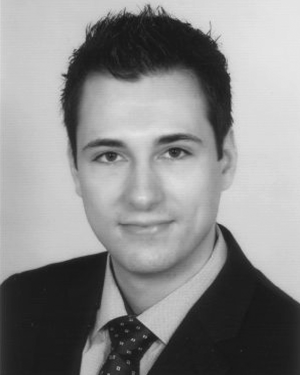 Fabian Undi合作论文数4
 Rodrigo Hernangomez合作论文数Fraunhofer Heinrich Hertz Inst3
 Taro Eichler合作论文数Rohde & Schwarz, Munich, Germany3
 Laurenz John合作论文数Fraunhofer IAF, Fraunhofer Institute for Applied Solid State Physics2
 Dirk Schwantuschke合作论文数2
 Thomas Merkle合作论文数2
 Thomas Kaiser合作论文数Department of Digital Signal Processing, University of Duisburg-Essen2
 Benjamin Baumann合作论文数1Zhiheng Guo合作论文数1Julia Beuster合作论文数1
 Rodrigo Rezende合作论文数1
 Jacob Kochems合作论文数1
 Tobias Doeker合作论文数Institute for Communications Technology, Technische Universität Braunschweig;e 22, Braunschweig, Germany;Institute for Communications Technology, Technische Universität Braunschweig1
 Matthias Mehlhose合作论文数Fraunhofer Institute for Telecommunications, Heinrich Hertz Institute (HHI),1
 Sanket Partani合作论文数Chair for Wireless Communication, University of Kaiserslautern;Navigation;Chair for Wireless Communication & Navigation, University of Kaiserslautern1
 Guillermo Marcus合作论文数NVIDIA1
 Norman Franchi合作论文数Tech Univ Dresden, Vodafone Chair Mobile Commun Syst, Dresden, Germany1
 Johannes Eckhardt合作论文数Institut für Nachrichtentechnik, Technische Universität Braunschweig, Braunschweig, Germany1Michael Karrenbauer合作论文数Technische Universität Kaiserslautern1
 Maximilian Lubke合作论文数University of Erlangen Nuremberg1
 Sebastian Cammerer合作论文数Institute of Telecommunications, University of Stuttgart1
 Omid Taghizadeh合作论文数Institute for Theoretical Information Technology, RWTH Aachen University1
 Ehsan Tohidi合作论文数1
 Nidal Zarifeh合作论文数1
 Alex Keller合作论文数NVIDIA1
 Hans D. Schotten合作论文数University of Kaiserslautern;Deutsches Forschungszentrum für Künstliche Intelligenz GmbH1
 Oliver Blume合作论文数Radio System Optimization Department, Alcatel-Lucent Bell Labs Wireless Access Research Domain1
 Reiner S. Thomä合作论文数Fachgebiet Elektronische Messtechnik und Signalverarbeitung, Fakultät für Elektrotechnik und Informationstechnik, Technische Universität Ilmenau1
 Thomas Kürner合作论文数Mobile Radio Systems Group, Institute for Communications Technology, Technische Universitat Braunschweig1
 Zoran Utkovski合作论文数Institute of Information Technology, University of Ulm1
 Stefan Köpsell合作论文数Dresden University of Technology1Hyun Soo Ko合作论文数1




