In this paper we combine video compression and modern image processing methods. Iterative filter methods for prediction signals based on classic inpainting methods are introduced and extensive parameter tests are described. In order to construct an alternative prediction filter for video coding, techniques originally employed for inpainting are applied. Thereby, the structures of the underlying prediction were incorporated into the filter construction making it signal adaptive. The resulting optimization problem is solved using the so-called Alternating Direction Method of Multipliers (ADMM). The undertaken novel parameter tests are described and it is shown that they improve the coding efficiency of the tool. The suggested filter is embedded into a software based on HEVC with additional QTBT (Quadtree plus Binary Tree) and MTT (Multi-Type-Tree) block structure. Overall, the proposed filter method obtains average bitrate savings of 1.35% at an average encoder runtime increase of 28% and decoder runtime increase of 38%. UHD test sequences achieve bitrate savings of up to 3.66% for Random Access.
In this paper we combine video compression and modern image processing methods. We construct novel iterative filter methods for prediction signals based on Partial Differential Equation (PDE) based methods. The mathematical framework of the employed diffusion filter class is given and some desirable properties are stated. In particular, two types of diffusion filters are constructed: a uniform diffusion filter using a fixed filter mask and a signal adaptive diffusion filter that incorporates the structures of the underlying prediction signal. The latter has the advantage of not attenuating existing edges while the uniform filter is less complex. The filters are embedded into a software based on HEVC with additional QTBT (Quadtree plus Binary Tree) and MTT (Multi-Type-Tree) block structure. In this setting, several measures to reduce the coding complexity of the tool are introduced, discussed and tested thoroughly. The coding complexity is reduced by up to 70% while maintaining over 80% of the gain. Overall, the diffusion filter method achieves average bitrate savings of 2.27% for Random Access having an average encoder runtime complexity of 119% and 117% decoder runtime complexity. For individual test sequences, results of 7.36% for Random Access are accomplished.
In this paper, we describe a video coding design that enables a higher coding efficiency than the HEVC standard. The proposed video codec follows the design of block-based hybrid video coding, but includes a number of advanced coding tools. A part of the incorporated advanced concepts was developed by the Joint Video Exploration Team, while others are newly proposed. The key aspects of these newly proposed tools are the following. A video frame is subdivided into rectangles of variable size using a binary partitioning with variable split ratios. Three new approaches for generating spatial intra prediction signals are supported: A line-wise application of conventional intra prediction modes, coupled with a mode-dependent processing order, a region-based template matching prediction method and intra prediction modes based on neural networks. For motion-compensated prediction, a multi-hypothesis mode with more than two motion hypotheses can be used. In transform coding, mode dependent combinations of primary and secondary transforms are applied. Moreover, scalar quantization is replaced by trellis-coded quantization and the entropy coding of the quantized transform coefficients is improved. The intra and inter prediction signals can be filtered using an edge-preserving diffusion filter or a non-linear DCT-based thresholding operation. The video codec includes an adaptive in-loop filter for which one of three classifiers can be chosen on a picture basis. We also incorporated an optional encoder control, which adjusts the quantization parameters based on a perceptually motivated distortion measure. In a random access scenario, our proposed video codec achieves luma BD-rate savings between 32.5% for HDR HLG UHD and 39.6% for SDR UHD over the HEVC (HM software) anchor for different categories of test sequences.
In this paper we compare two different methods to filter prediction signals in video coding: The anisotropic diffusion filter modeled using a (modified) heat equation and the ADMM (Alternating Direction Method of Multipliers) filter using directional total variation. The two methods are based on the same idea, namely using the structures in the underlying prediction signal to control the direction of the smoothing. It is shown here, that mathematically, in a continuous setting for a certain choice of parameters, the solutions of the two problem formulations are the same.Both filters are compared in the setting of a software based on HEVC (High Efficiency Video Coding). While the results for the diffusion filter method involve the testing of four different filters of uniform and signal adaptive type, the ADMM filter results feature only one type of filter configuration that can be en- or disabled in a block-wise manner. Despite the fact that both methods rely on the same idea, it is illustrated that the overall gains of the combination are higher than the RD gains of the individual tools. In particular, it is demonstrated that this is still the case if the filters are combined in an exclusive way. This proves that there is an additional value for each of the filter methods.
In this paper we combine video compression and modern image processing methods. We construct novel iterative filter methods for prediction signals based on Partial Differential Equation (PDE)-based methods. The central idea of the signal adaptive filters is explained and demonstrated geometrically. The meaning of particular parameters is discussed in detail. Furthermore, thorough parameter tests are introduced which improve the overall bitrate savings. It is shown that these filters enhance the rate-distortion performance of the state-of-the-art hybrid video codecs. In particular, based on mathematical denoising techniques, two types of diffusion filters are constructed: a uniform diffusion filter using a fixed filter mask and a signal adaptive diffusion filter that incorporates the structures of the underlying prediction signal. The latter has the advantage of not attenuating existing edges while the uniformfilter is less complex. The filters are embedded into a software based on HEVC with additional QTBT (Quadtree plus Binary Tree) and MTT (Multi-Type-Tree) block structure. Overall, the diffusion filter method achieves average bitrate savings of 2.27% for Random Access having an average encoder runtime increase of 19% and 17% decoder runtime increase. For UHD (Ultra High Definition) test sequences, bitrate savings of up to 7.36% for Random Access are accomplished.
Hyperspectral imaging is a cutting-edge type of remote sensing used for mapping vegetation properties, rock minerals and other materials. A major drawback of hyperspectral imaging devices is their intrinsic low spatial resolution. In this paper, we propose a method for increasing the spatial resolution of a hyperspectral image by fusing it with an image of higher spatial resolution that was obtained with a different imaging modality. This is accomplished by solving a variational problem in which the regularization functional is the directional total variation. To accommodate for possible mis-registrations between the two images, we consider a non-convex blind super-resolution problem where both a fused image and the corresponding convolution kernel are estimated. Using this approach, our model can realign the given images if needed. Our experimental results indicate that the non-convexity is negligible in practice and that reliable solutions can be computed using a variety of different optimization algorithms. Numerical results on real remote sensing data from plant sciences and urban monitoring show the potential of the proposed method and suggests that it is robust with respect to the regularization parameters, mis-registration and the shape of the kernel.
In this paper we combine state of the art video compression and Partial Differential Equation (PDE) based image processing methods. We introduce a new signal adaptive method to filter the predictions of a hybrid video codec using a system of PDEs describing a diffusion process. The method can be applied to intra as well as inter predictions. The filter is embedded into the framework of HEVC. The efficiency of the HEVC video codec is improved by up to -2.76% for All Intra and -3.56% for Random Access measured in Bjøntegaard delta (BD) rate. Coding gains of up to -8.76% can be observed for individual test sequences.
In this paper we combine state of the art video compression with inpainting methods. We introduce a new signal adaptive method to filter the predictions of a hybrid video codec using a constrained optimization approach. The filter is embedded into the framework of HEVC. The efficiency of the HEVC video codec is improved by up to -6.14% Bj Ø ntegaard delta (BD) rate for All Intra.
This paper presents a thresholding method for processing the predicted samples in the state-of-the-art High Efficiency Video Coding (HEVC) standard. The method applies an integer-based approximation of the discrete cosine transform to an extended prediction block and sets transform coefficients beneath a certain threshold to zero. Transforming back into the sample domain yields the improved prediction signal. The method is incorporated into a software implementation that is conforming to the HEVC standard and applies to both intra and inter predictions. Consequently, bit-rate savings ranging from 2.3% to 8.0% have been measured in terms of the Bjøntegaard-Delta bit rate (BD-rate).
Three experiments addressing the assessment of perceived image quality in a patch-based manner are compared for HEVC compression artifacts. It is shown that image patches of a size small as 128×128 pixel are large enough to evaluate the perceived image quality in a Degradation Category Rating (DCR) setting. Ratings obtained with 128×128 pixel sized images patches and 512×512 pixel sized images of the same spatial statistics show a correlation of r=0.99. Based on this finding, image quality assessment of 128×128 pixel sized image patches degraded by HEVC compression is compared for controlled lab environment and uncontrolled crowdsourcing settings. Although we find high overall correlation between the quality ratings obtained in the two environments, observers tend to give worse ratings in the crowdsourcing setting and for conditions of higher quality a reduction of correlation is observed. These findings have implications for choosing controlled vs. uncontrolled viewing conditions for image quality assessment for real-life applications.
The idea behind the marine cloud-brightening (MCB) geoengineering technique is that seeding marine stratocumulus clouds with copious quantities of roughly monodisperse sub-micrometre sea water particles might significantly enhance the cloud droplet number concentration, and thereby the cloud albedo and possibly longevity. This would produce a cooling, which general circulation model (GCM) computations suggest could-subject to satisfactory resolution of technical and scientific problems identified herein-have the capacity to balance global warming up to the carbon dioxide-doubling point. We describe herein an account of our recent research on a number of critical issues associated with MCB. This involves (i) GCM studies, which are our primary tools for evaluating globally the effectiveness of MCB, and assessing its climate impacts on rainfall amounts and distribution, and also polar sea-ice cover and thickness; (ii) high-resolution modelling of the effects of seeding on marine stratocumulus, which are required to understand the complex array of interacting processes involved in cloud brightening; (iii) microphysical modelling sensitivity studies, examining the influence of seeding amount, seed-particle salt-mass, air-mass characteristics, updraught speed and other parameters on cloud-albedo change; (iv) sea water spray-production techniques; (v) computational fluid dynamics studies of possible large-scale periodicities in Flettner rotors; and (vi) the planning of a three-stage limited-area field research experiment, with the primary objectives of technology testing and determining to what extent, if any, cloud albedo might be enhanced by seeding marine stratocumulus clouds on a spatial scale of around 100×100 km. We stress that there would be no justification for deployment of MCB unless it was clearly established that no significant adverse consequences would result. There would also need to be an international agreement firmly in favour of such action.
Using an interactive aerosol‐climate model we find that absorbing anthropogenic aerosols, whether coexisting with scattering aerosols or not, can significantly affect the Indian summer monsoon system. We also show that the influence is reflected in a perturbation to the moist static energy in the sub‐cloud layer, initiated as a heating by absorbing aerosols to the planetary boundary layer. The perturbation appears mostly over land, extending from just north of the Arabian Sea to northern India along the southern slope of the Tibetan Plateau. As a result, during the summer monsoon season, modeled convective precipitation experiences a clear northward shift, coincidently in general agreement with observed monsoon precipitation changes in recent decades particularly during the onset season. We demonstrate that the sub‐cloud layer moist static energy is a useful quantity for determining the impact of aerosols on the northward extent and to a certain degree the strength of monsoon convection.
 Thomas Wiegand合作论文数Fraunhofer Heinrich Hertz Institute;Department of Electrical Engineering and Computer Science, Technical University of Berlin9
 Jonathan Pfaff合作论文数Heinrich Hertz Inst Nachrichtentech Berlin GmbH, Fraunhofer Inst Telecommun, Video Coding & Analyt Dept, Einsteinufer 37, D-10587 Berlin, Germany8
 Heiko Schwarz合作论文数Freie Universitat Berlin;Fraunhofer Heinrich Hertz Institute8
 Detlev Marpe合作论文数Video Coding & Analytics Department, Fraunhofer Heinrich Hertz Institute7
 Michael Schäfer合作论文数Heinrich Hertz Inst Nachrichtentech Berlin GmbH, Fraunhofer Inst Telecommun, Video Coding & Analyt Dept, Einsteinufer 37, D-10587 Berlin, Germany5
 Mischa Siekmann合作论文数3
 Victor Warno合作论文数2
 Tung Nguyen合作论文数2
 Martin Winken合作论文数Fraunhofer Inst Telecommun, Heinrich Hertz Inst2
 Anastasia Henkel合作论文数2
 Tobias Hinz合作论文数Dept Informat Knowledge Technol, Univ Hamburg2
 Caren Tischendorf合作论文数Mathematical Institute, University of Cologne2WQ Lim合作论文数1Qin Wang合作论文数1Lee Galbraith合作论文数1John Rush合作论文数1Jack Foster合作论文数1Tom Stevenson合作论文数1David Johnston合作论文数1
 Gayathri Venugopal合作论文数1
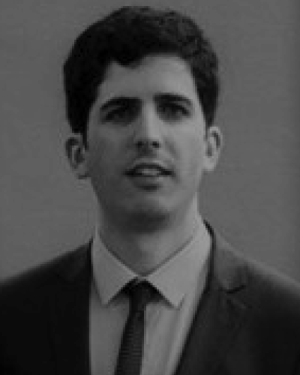 Santiago De-Luxán-Hernández合作论文数Fraunhofer Heinrich Hertz Inst HHI, Video Coding & Analyt Dept, Berlin, Germany1
 Jackie Ma合作论文数1
 Adam Wieckowski合作论文数Fraunhofer HHI, Video Coding & Analyt, Berlin, Germany1
 Leon Bungert合作论文数Univ Erlangen Nurnberg, Dept Math, Cauerstr 11, D-91058 Erlangen, Germany1Rafael Reisenhofer合作论文数Univ Bremen, Ctr Ind Math, D-28359 Bremen, Germany1Keith Bower合作论文数Centre for Atmospheric Science, School of Earth, Atmospheric and Environmental Sciences, The University of Manchester1
 Paul J. Connolly合作论文数Department of Pure and Applied Physics, The University of Manchester1
 Hugh Coe合作论文数Centre for Atmospheric Science, The University of Manchester;Department of Earth and Environmental Sciences, School of Natural Sciences, The University of Manchester1
 Ben Parkes合作论文数Department of Mechanical, Aerospace and Civil Engineering, The University of Manchester1
 Brian Launder合作论文数The University of Manchester1
 Hector Iacovides合作论文数Department of Mechanical, Aerospace and Civil Engineering, School of Engineering, Faculty of Science and Engineering, The University of Manchester1Neukermans, A.合作论文数1
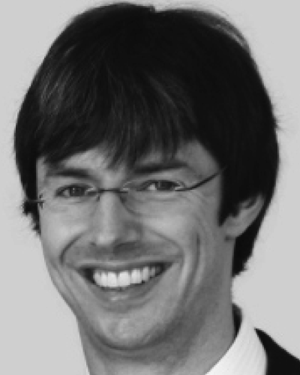 Christian R. Helmrich合作论文数1
 Dongchul Kim合作论文数1
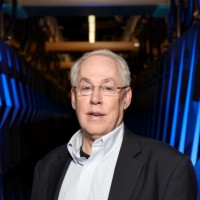 James Hack合作论文数Oak Ridge National Laboratory1Ormond Bob合作论文数1Cooper Gary合作论文数1
 Hailong Wang合作论文数Pacific Northwest National Laboratory1Timothy Craft合作论文数Department of Mechanical, Aerospace & Civil Engineering, Dalton Nuclear Institute, University of Manchester1John Latham合作论文数1
 Minghua Zhang (张明华)合作论文数School of Marine and Atmospheric Sciences, Stony Brook University1
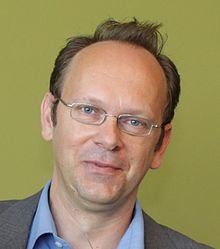 Matthias Ehrhardt合作论文数Weierstrass Institute for Applied Analysis and Stochastics1
 Annica Ekman合作论文数Department of Meteorology, Stockholm University1
 Carola Bibiane Schönlieb合作论文数Department of Applied Mathematics and Theoretical Physics, University of Cambridge;Alan Turing Institute1
 Chris Bretherton合作论文数Department of Atmospheric Sciences, College of the Environment, University of Washington;Department of Applied Mathematics, College of Arts and Sciences, University of Washington;Vulcan Inc1
 Philipp Helle合作论文数1
 Mary Barth合作论文数National Center for Atmospheric Research1
 Alan Gadian合作论文数National Centre for Atmospheric Science1
 David A. Coomes合作论文数Department of Plant Sciences, University of Cambridge1




