The pinto bean is one of widely consumed legume crop that constitutes over 42% of the U.S dry bean production. However, limited studies have been conducted in past to assess its quantitative and qualitative yield potentials. Emerging remote sensing technologies can help in such assessment. Therefore, this study evaluates the role of ground-based multispectral imagery derived vegetation indices (VIs) for irrigated the pinto bean stress and yield assessments. Studied were eight cultivars of the pinto bean grown under conventional and strip tillage treatments and irrigated at 52% and 100% of required evapotranspiration. Imagery data was acquired using a five-band multispectral imager at early, mid and late growth stages. Commonly used 25 broadband VIs were derived to capture crop stress traits and yield potential. Principal component analysis and Spearman’s rank correlation tests were conducted to identify key VIs and their correlation (rs) with abiotic stress at each growth stage. Transformed difference vegetation index, nonlinear vegetation index (NLI), modified NLI and infrared percentage vegetation index (IPVI) were consistent in accounting the stress response and crop yield at all growth stages (rs > 0.60, coefficient of determination (R2): 0.50–0.56, P < 0.05). Ten other VIs significantly accounted for crop stress at early and late stages. Overall, identified key VIs may be helpful to growers for precise crop management decision making and breeders for crop stress response and yield assessments.
ABSTRACTAlfalfa (Medicago sativa L.) was the first perennial crop genetically engineered (GE) to resist glyphosate herbicide. Since alfalfa is insect pollinated, the potential for transgene flow and occurrence of adventitious presence (AP) in conventional varieties is a concern, especially for organic and export producers. In response, the industry developed seed production isolation distances. However, no landscape‐scale studies have been conducted to validate industry standards. Our objective was to quantify the extent of gene movement from GE seed fields to commercial conventional seed fields on a landscape level to provide the industry with information to support coexistence strategies. Alfalfa seed fields were mapped in the Touchet area, Walla Walla Valley, Washington, during spring 2013. Fourteen conventional seed fields located at various distances from GE sources were identified, harvested, and tested for the presence of the GE trait. Although other variables affect gene flow, this article focuses on geographic distance, since this variable can be easily controlled by growers and industry. Using distance as the predictor variable, we modeled the relationship between AP proportion and distance to GE source fields at 0.1, 0.5, and 0.9% AP threshold levels using quadratic regression. As distance increased, transgene flow generally decreased. At a threshold level of 0.9% AP, an isolation distance of 330 m between conventional and GE fields is needed to ensure that at least 95% of the samples fall below this threshold level. Spatial prediction maps were consistent with our statistical analysis. At an average distance of 2.2 km, AP was 0.05%, and this decreased to 0.03% at an average distance of 8.8 km from GE seed fields.
Drought stress is a major factor limiting yield of dry bean (Phaseolus vulgaris) and drought tolerant cultivars are being developed. Reducing tillage in row crops has advantages of conserving moisture and increasing water infiltration, and may alter the response of dry bean cultivars to drought stress. The goal of this study was to evaluate the response of eight pinto bean cultivars to deficit irrigation when grown under conventional (CT) vs strip tillage (ST). Drought was imposed to one half of the plots approximately 30 days after emergence by reducing irrigation by 48% [deficit irrigation (DI)] compared to full replacement of estimated evapotranspiration (FI = full irrigation). DI reduced bean seed yields 48 and 46% in 2015 and 2016, respectively. Dry bean cultivars varied in their response to drought stress by year. ST improved bean stands both years and moderated the decline in soil water, particularly in the upper 0-15 cm of the soil profile under DI when compared to CT. Mid-season shoot length, top biomass, leaf area index, and canopy cover were generally greater, and light transmittance through the plant canopy lower in ST compared to CT. ST increased bean seed yield 9% in one of two years over CT. ST improvements in crop stand, shoot and canopy development, and seed yield were consistent across irrigation levels and cultivars. Pinto bean growth and yield responses to ST were generally either favorable or neutral when compared to CT suggesting that implementing ST could benefit dry bean performance under both favorable and limited water conditions.
Although seed meal from yellow mustard (Sinapis alba L.) is a potential tool for controlling weeds as a consequence of produced phytotoxic products, use is limited by batch-to-batch variability and logistical constraints. Our objective was to develop an efficacious bioherbicide by extracting and identifying the active ingredients in S. alba seed meal that demonstrate phytotoxicity to greenhouse-grown Powell amaranth (Arnaranthus powellii) and green foxtail (Setaria viridis). Companion bioassays with separate potential active ingredient solutions containing ionic thiocyanate (SCN-), 4-(hydroxymethyl)phenol (4-OH), or 2-(4-hydroxyphenyl)acetonitrile (Nitrile) at concentrations approximating those in the extract were performed. When applied pre- (PRE) or postemergence (POST), SCN- and extracts were the most active solutions on both weed species. The highest rate tested of SCN- of 2.8 kg ha(-1) controlled Powell amaranth 98% and green foxtail 84% compared to the highest rate of extract (2.8 kg SCN- ha(-1)) that controlled Powell amaranth 97% and green foxtail 82%. POST application of the extract was less effective as compared to SCN- solutions, with SCN- showing 97% control of Powell amaranth and 71% control of green foxtail as compared to the extract displaying only 46% control of Powell amaranth and 23% control of green foxtail. Little or no herbicidal activity was observed on both weed species following PRE or POST application of 4-OH or Nitrile. Development of a bioherbicide based on extracting and concentrating SCN- from S. alba seed meal is feasible, especially if scale up activities focus on eliminating the need for alcoholic extractants and yield higher active ingredient products.
Chickpea producers currently have no POST applied herbicides labeled for broadleaf weed control and rely heavily on PRE herbicides to manage weeds. Severe crop losses from broadleaf weed competition and harvest losses from weeds impeding harvest can occur when PRE herbicides perform poorly. Chickpea tolerance to POST applications of acifluorfen at 0.42 kg ai ha(-1) and fomesafen at 0.28 kg ai ha(-1) was tested at two sites in 2015. In 2016, both herbicides were tested on chickpeas when applied alone and in combination with pyridate at three sites. Acifluorfen and fomesafen injured chickpeas from 8 to 25% at 1 week after treatment (WAT) and 3 to 8% at 4 WAT in 2015 and from 16 to 40% at 1 WAT and 2 to 36% at 4 WAT in 2016. Pyridate applied POST at 1.00 kg ai ha(-1) did not injure chickpeas or reduce yields. When pyridate was tank mixed with either acifluorfen or fomesafen, chickpea injury increased, but chickpeas recovered and yielded similar to nontreated checks or pyridate-treated plots. A low rate of metribuzin at 0.06 kg ai ha(-1) tank mixed with pyridate had little impact on chickpea injury or weed control. In 2015, Russian thistle was controlled 100% by acifluorfen and fomesafen at Prosser at 28 DAT and both herbicides controlled the weed only 63% at Wilbur at 25 DAT. In 2016, all herbicide treatments reduced broadleaf weed densities equally ranging from 95 to 100% at Paterson, 50 to 100% at Prosser, and 78 to 98% at Wilbur. Chickpea yield was similar among POST herbicide treatments in all site-years. Acifluorfen, fomesafen, and pyridate have potential to improve control of susceptible broadleaf weeds that escape PRE herbicides chickpea production, but the potential for crop injury with acifluorfen and fomesafen warrant further evaluation.
Early potatoes are typically produced using less nitrogen than a full season potato crop as high rates of nitrogen may delay tuber set and lead to excessive vine growth that is difficult to terminate prior to harvest. Bintje and Ciklamen potato cultivars were grown with preplant soil nitrogen levels of 34 to 38, 67, and 101 kg N ha -1 in 2013 and 2014 near Paterson, Washington. Nitrogen rate had little impact on the number of tubers and stems per plant of both cultivars, but increasing nitrogen rate tended to increase leaf area of both cultivars. Vine desiccation of Bintje with diquat was less complete as nitrogen rate increased, while Ciklamen vine kill was reduced by higher nitrogen in 1 of 2 years. Tuber skinning injury, tuber weight loss, and tuber size distribution were not affected by nitrogen rate. Tuber skinning injury and tuber weight loss were reduced in both cultivars by harvesting at 4 weeks after initial vine kill compared to harvesting at 2 weeks after vine kill. Total tuber yield was lower for both Bintje and Ciklamen in 1 of 2 years at the 34 to 38 kg N ha -1 rate. Tuber nitrogen and zinc levels tended to increase with increasing nitrogen rates, while most other nutrients, vitamin C, total phenolics, and antioxidant capacity showed little response. It appears that 67 kg N ha -1 provides adequate nitrogen to produce a good tuber set and yield of small tubers while not producing excessive vine growth that may be more difficult to kill.
Image-based evaluation of phenotypic traits has been applied for plant architecture, seed, canopy growth/vigor, and root characterization. However, such applications using computer vision have not been exploited for the purpose of assessing the coleoptile length and herbicide injury in seeds. In this study, high-throughput phenotyping using digital image analysis was applied to evaluate seed/seedling traits. Images of seeds or seedlings were acquired using a commercial digital camera and analyzed using custom-developed image processing algorithms. Results from two case studies demonstrated that it was possible to use image-based high-throughput phenotyping to assess seeds/seedlings. In the seedling evaluation study, using a color-based detection method, image-based and manual coleoptile length were positively and significantly correlated (p < 0.0001) with reasonable accuracy (r = 0.69–0.91). As well, while using a width-and-color-based detection method, the correlation coefficient was also significant (p < 0.0001, r = 0.89). The improvement of the germination protocol designed for imaging will increase the throughput and accuracy of coleoptile detection using image processing methods. In the herbicide study, using image-based features, differences between injured and uninjured seedlings can be detected. In the presence of the treatment differences, such a technique can be applied for non-biased symptom rating.
Mustard seed meal (MSM) derived from Sinapis alba controls weeds for several weeks following application to soil, but also has potential to injure the planted crop. Producers of certified organic potatoes typically utilize a combination of cover crops, soil hilling, harrowing, and cultivation for weed control. Once the potato canopy nears row closure, most late emerging weeds are suppressed by the dense potato canopy. MSM may have value for early season weed suppression in potato, but has not been previously tested. Our objectives were to determine the weed control efficacy and potato tolerance to MSM. We evaluated response of potatoes and weeds to MSM applied at 1.1, 2.2, and 4.5 MT ha-1 applied in a band on the potato hill just after a shallow harrowing and prior to potato emergence as part of an integrated weed management program in potatoes. MSM applied at 2.2 and 4.5 MT ha-1 reduced early season grass and broadleaf weed density 73 to 99% and 54 to 98%, respectively, in potato and reduced late season broadleaf weed biomass 71 to 94% in all three years tested. Early season grass weed density in potato was reduced by MSM at 2.2 and 4.5 MT ha-1. Late season grass weed biomass was reduced by the highest rate of 4.5 MT ha-1. MSM at 4.5 MT ha-1 caused minor injury to potato (3 to 15%) at 3 weeks after emergence, but did not reduce total tuber yields or percentage of US No.1 tubers. MSM could be a component of an integrated weed control program in potato.
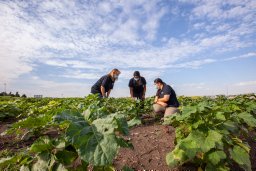
Site-specific crop management is a promising approach to maximize crop yield with optimal use of rapidly depleting natural resources. Availability of high resolution crop data at critical growth stages is a key for real-time data-driven decisions during the production season. The goal of this study was to evaluate the possibility of using small unmanned aerial system (UAS)-based remote sensing technologies to monitor the crop stress of irrigated pinto beans (Phaseolus vulgaris L.) with varied irrigation and tillage treatments. A small UAS with onboard multispectral and infrared thermal imaging sensors was used to collect data from bean field plots on three growth stages in 2015 and 2016, respectively. Indicators including green normalized vegetation index (GNDVI), canopy cover (CC, ratio of ground covered by crop canopy to the total plot area) and canopy temperature (CT, °C) of crops were extracted from imaging data and correlated with ground-reference crop yield and leaf area index (LAI) estimated with a handheld ceptometer. Results show that GNDVI, CC and CT were able to differentiate crops with full and deficit irrigation treatments at each of the three growth stages in both years. Developed indicators were strongly correlated with to the crop yield with Pearson correlation coefficients (r) of approximate 0.71 and 0.72 for GNDVI and CC, respectively, in the early growth stage (54 days after planting) in both years. Canopy temperature showed even stronger correlation (r > 0.8) with yield at early growth stage. Performance of small UAS-based imagery-based indicators in crop stress monitoring and crop yield estimation was better than or comparable to that of the ground-based LAI estimates, indicating the potential of such remote sensing tool in rapid crop stress monitoring and management.
An abstract is not available for this content so a preview has been provided. As you have access to this content, a full PDF is available via the ‘Save PDF’ action button.
An abstract is not available for this content so a preview has been provided. As you have access to this content, a full PDF is available via the ‘Save PDF’ action button.
Fall-planted cover crops offer many benefits including weed suppressive residues in spring sown crops when controlled and left on the soil surface. However, vegetable growers have been slow to adopt direct-seeding (no-till) into cover crop residues. Field studies were conducted in 2009 and 2010 near Paterson, WA and Urbana, IL to evaluate mortality of rye and common vetch (WA) hairy vetch (IL) cover crops, weed density and biomass, and snap bean growth and yield following four cover crop control methods utilizing a roller-crimper. Rye had higher mortality than common and hairy vetch by roller-crimping, and carfentrazone applied after roller crimping only slightly increased vetch mortality. Heavy residues of rye and escaped vetch were difficult to plant into, often resulting in lower snap bean populations. Rye and hairy vetch residues suppressed final weed biomass, while common vetch reduced weed biomass 1 of 2 years. Escaped plants of both vetch species became a weed. Snap bean yields were inconsistent and often lower following cover crops compared with a fallow treatment. Being able to completely control cover crops and to plant, manage escaped weeds and mechanically harvest in the presence of heavy residues are challenges that deter vegetable growers from readily adopting these systems.
Field dodder is an important weed in alfalfa grown for seed, and stringent control is required to keep the alfalfa seed from becoming contaminated with dodder seed. Pendimethalin has been the primary tool used to control dodder in alfalfa seed production for more than 25 yr. Flumioxazin was recently registered in alfalfa seed and forage crops, but its activity on field dodder was unknown. Control of field dodder with flumioxazin and pendimethalin was compared in greenhouse trials in a loamy sand soil. The number of emerged dodder seedlings able to twine on a simulated host were counted weekly for a 4-wk period following herbicide application. Flumioxazin applied at the alfalfa field use rate of 0.14 kg ai ha−1completely controlled dodder over the initial 4-wk period. Dodder either failed to emerge or emerged and died without twining on the simulated host in the 4-wk period. When dodder was reseeded after 4 wk in flumioxazin-treated soil, the number of twined dodder seedlings was reduced by 56% in one trial but was unaffected in a second trial compared with nontreated checks. In the initial 4-wk period following herbicide application, flumioxazin controlled field dodder similar to pendimethalin applied at 2.2 and 4.4 kg ai ha−1in both trials. However, after additional dodder seed was planted at 4 wk after treatment, dodder was suppressed more by pendimethalin than flumioxazin in the additional 4-wk period. Flumioxazin offers alfalfa seed and forage producers a new mode of action to manage early-emerging field dodder.
Weed control in organic production systems can be a labor intensive and expensive process. Mustard seed meal (MSM) is phytotoxic and a potential pre-emergent and preplant-incorporated organic herbicide for controlling germinating and emerging weed seedlings: unfortunately, MSM may also adversely impact seedling survival of certain direct-seeded vegetable crops. Field research was conducted in southeast Oklahoma (Lane, OK) to determine the phytotoxic impact of MSM on indigenous weeds and seedling establishment of cantaloupe (Cucumis melo L.) var. ‘PMR-45’, cucumber (Cucumis sativus L.) var. ‘Marketmore 76’, yellow squash (Cucurbita pepo L.) var. ‘Crookneck’, and watermelon (Citrullus lanatus L.) var. ‘Dixie’. The factorial experiment included 2 MSM incorporation levels (no incorporation and incorporation), 2 MSM application rates (2.25 and 4.5 mt/ha), 2 application patterns (banded and solid), 2 experimental control treatments (1 for each incorporation method) and four replications. The soil [Bernow fine sandy loam, 0-3% slope (fine-loamy, siliceous, thermic Glossic Paleudalf)] was prepared for planting by plowing, fertilizing, and forming raised beds. MSM was applied to raised beds 3 m-long on 0.76 m-centers. The banded application produced a 10.2 cm-wide MSM-free area in the bed center where the crop would later be direct-seeded. The MSM was then either left on the surface or incorporated into the top 2.5-5.0 cm and then direct-seeded with cantaloupe, cucumber, yellow squash, and watermelon. Plant stands and weed control ratings were collected during the experimental period. Twenty-eight days after planting, the entire plot was harvested and the fresh and dry plant weights determined. Although applications of MSM provided sufficient broadleaf, grass, and total weed control, cucurbit establishment and development, the application of MSM at 2.25 and 4.5 mt/ha severely reduced crop establishment of direct-seeded cucurbits. Further research should address banded applications of MSM with either established direct-seeded or transplanted cucurbits and other vegetable crops in the same manner as others have done with corn gluten meal.
An abstract is not available for this content so a preview has been provided. As you have access to this content, a full PDF is available via the ‘Save PDF’ action button.
Weed management in potato and mint rely heavily on two Group 5 photosystem II–inhibiting herbicides, metribuzin and terbacil, respectively. Seed from weed escapes was collected in 2010 from 69 potato and mint production fields in Washington State and tested for resistance to metribuzin and terbacil. Of the seed screened, 26 of 51 Powell amaranth and redroot pigweed accessions and 8 of 23 common lambsquarters accessions tested expressed at least some degree of resistance to one or both herbicides. A Ser264Gly mutation in the chloroplastpsbA gene was present in all but three resistant accessions. Herbicides with other mechanisms of action registered in potato and mint controlled all identified photosystem II–resistant accessions when applied at typical labeled rates.
In this study, three different sensing technologies were evaluated for their performance in monitoring pinto beans crop stress at early stages. Treatments involved replicate pinto bean field plots with 50% and 100% irrigation throughout the season. Eight different pinto bean cultivars were seeded on the plots prepared with either strip or conventional tillage method. Evaluated technologies were a handheld linear ceptometer, and multi-spectral proximal and aerial remote sensing technologies. Spatial resolutions of the aerial remote sensing images acquired from 100 m above ground level (AGL) and the proximal sensing images acquired at 6.7 m AGL were 35.2 and 5.6 mm·pixel-1, respectively. Crop indictors of leaf area index (LAI), green normalized difference vegetation index (GNDVI) and canopy cover (CC) were extracted from the data of ceptometer and multispectral sensors collected at the early stages of pinto beans on July of 2015. Results show that spatial coverage of aerial remote sensing was thus 700 times larger than that of proximal remote sensing utilized in this study. GNDVI and CC data from both aerial and proximal remote sensing was able to discriminate crops with different irrigation and tillage treatment significantly at 5% level. Similarly, leaf area index (LAI) from ground sensor (ceptometer) was also able to distinguish effects of different irrigations, but could not differentiate tillage treatments. Correlation trends showed that the aerial remote sensing and ground sensing based indicators were strongly related with crop yield compared to proximal remote sensing based indicators. Although data were collected for natural light variations, possibly latter sensing module had more predominant light variation effect on image quality at different imaging times on given imaging day.
Feral populations of cultivated crops have the potential to function as bridges and reservoirs that contribute to the unwanted movement of novel genetically engineered (GE) traits. Recognizing that feral alfalfa has the potential to lower genetic purity in alfalfa seed production fields when it is growing in the vicinity of foraging pollinators in alfalfa seed fields, industry has established production standards to control feral plants. However, with the commercialization of GE glyphosate-resistant (GR) alfalfa and the need to support the coexistence of both GE and conventional production, effective methods to control transgenic feral alfalfa need to be developed. Therefore, a study was conducted in 2012, 2013, and 2014 to determine the effect of several synthetic auxin herbicides on seed development in GR alfalfa. GR alfalfa, var. Genuity (R44BD16), was treated with dicamba, 2,4-D, triclopyr, and aminopyralid when alfalfa plants contained green seed pods. Two weeks after herbicide application, plants were harvested, air dried, and seed yield, seed germination, and seedling emergence from the soil were determined. In 2013, dicamba, triclopyr, and 2,4-D decreased alfalfa seed yield per plant compared wih nontreated plants, whereas in 2014, all four herbicides decreased alfalfa seed yield per plant 24 to 49% (by weight) compared with nontreated plants. The same trend was evident in 2012, but seed yield was variable and was not significantly different among treatments. Seed germination averaged 43, 50, and 72% in 2012, 2013, and 2014, respectively, and was not affected by the four herbicides applied at early pod-fill stage. However, seeds harvested from plants treated with dicamba, 2,4-D, and triclopyr often produced deformed and abnormal seedlings, and when planted in soil, frequently failed to emerge. The combined effects of dicamba, 2,4-D, and triclopyr in reducing seed yield, seedling emergence, and seedling growth could contribute to managing feral alfalfa populations.
This study evaluated the petiole uptake of nitrogen, phosphorus, potassium, and sulfur (N, P, K, and S) by the potato from two seed meals, mint compost, and five commercially available organic fertilizers under an irrigated certified organic production system. Available soil nitrate (NO3-N) and ammonium (NH4-N) from each amendment averaged 115 kg N ha(-1) at application and 25 kg N ha(-1) 30 d after planting through harvest, with minor differences between fertilizers. Petiole N declined from an average of 25,000 mg N kg(-1), 4 wk after emergence to 3,000 mg N kg(-1) prior to harvest. Petiole P and K concentrations were maintained above 4,000 mg P kg(-1) , 10,000 mg K kg(-1), and 2,000 mg S kg(-1) tissue, respectively, throughout the growing season in all treatments. Tuber yields were not different between fertilized treatments averaging 53 Mg ha(-1) . This study provides organic potato growers baseline information on the performance of a diverse array of organic fertilizers and amendments.
 Martin Williams合作论文数Global Change and Photosynthesis Research, Agricultural Research Service, U.S. Department of Agriculture17
 Harold P. Collins合作论文数17
 A. K. Alva合作论文数University of Florida;Citrus Research and Education Center;Citrus Research and Education Center, University of Florida16
 Kassim Al-Khatib合作论文数Department of Agronomy, Kansas State University14Steven F. Vaughn合作论文数7
 Hassan Mojtahedi合作论文数6E. Riga合作论文数5Anderson T L合作论文数5
 Joel Felix合作论文数5Tim Miller合作论文数4Ed Peachey合作论文数4Brad Hanson合作论文数4Phillip N. Miklas合作论文数4
 Charles Brown合作论文数4
 Lav R. Khot合作论文数School of Environment, Resources and Development, Asian Institute of Technology4
 Adam Samuel Davis合作论文数Department of Crop Sciences, University of Illinois Urbana-Champaign4
 Lyndon Porter合作论文数Vegetable and Forage Crops Research Unit, USDA-ARS4J. M. Crosslin合作论文数4Tracy Candelaria合作论文数3Bernardo Chaves-Cordoba合作论文数3
 Jianfeng Zhou (周建锋)合作论文数3Pe Thomas合作论文数3
 Sandya Kesoju合作论文数Columbia Basin Coll, Dept Agr, Pasco, WA 99301 USA3
 Amber Moore合作论文数Dept Crop & Soil Sci, Oregon State Univ3Charles L III I Webber合作论文数3Stephanie L. Greene合作论文数National Temperate Forage Legume Germplasm Resources Unit, USDA-Agricultural Research Service3
 Scott A Senseman合作论文数Department of Soil and Crop Sciences, Texas A&M University3
 Martin M. Williams合作论文数U. S. Department of Agriculture-Agricultural Research Service;Invasive Weed Management Research;University of Illinois;U. S. Department of Agriculture-Agricultural Research Service, University of Illinois3Ian C. Burke合作论文数3B. Chaves-Cordoba合作论文数2T. Hodges合作论文数2c libbey合作论文数2GS SANTO合作论文数2MARCUS D. SEYMOUR合作论文数2Mj Hattendorf合作论文数2Jr Davenport合作论文数2Rg Evans合作论文数2ed peachey合作论文数2Cammy D. Willett合作论文数2
 Haitham Y. Bahlol合作论文数Dept Mech Engn, Middle Tech Univ2charles r brown合作论文数2
 Mark Bernards合作论文数Department of Biology, Faculty of Science, Western University2
 Matthew J. Morra合作论文数Division of Soil & Land Resources, University of Idaho2Daniel O. Stephenson合作论文数2
 Darren Robinson合作论文数University of Guelph Ridgetown Campus2Paul M. White合作论文数2
 Nadav Nitzan合作论文数2
 Philip B. Hamm合作论文数Hermiston Agricultural Research and Extension Center, Oregon State University2
 Kevin W. Bradley合作论文数Faculty of the;Virginia Polytechnic Institute, State University;Faculty of the ;, Virginia Polytechnic Institute and State University2




