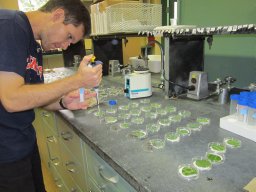
On Hawai'i Island, an increase in human neuroangiostrongyliasis cases has been primarily associated with the accidental ingestion of Angiostrongylus cantonensis L3 in snails or slugs, or potentially, from larvae left behind in the slug's slime or feces. We evaluated more than 40 different treatments in vitro for their ability to kill A. cantonensis larvae with the goal of identifying a safe and effective fruit and vegetable wash in order to reduce the risk of exposure. Our evaluation of treatment lethality was carried out in two phases; initially using motility as an indicator of larval survival after treatment, followed by the development and application of a propidium iodide staining assay to document larval mortality. Treatments tested included common household products, consumer vegetable washes and agricultural crop washes. We found minimal larvicidal efficacy among consumer-grade fruit and vegetable washes, nor among botanical extracts such as those from ginger or garlic, nor acid solutions such as vinegar. Alkaline solutions, on the other hand, as well as oxidizers such as bleach and chlorine dioxide, did show larvicidal potential. Surfactants, a frequent ingredient in detergents that lowers surface tension, had variable results, but dodecylbenzene sulfonic acid as a 70% w/w solution in 2-propanol was very effective, both in terms of the speed and the thoroughness with which it killed A. cantonensis L3 nematodes. Thus, our results suggest promising directions for future investigation.
Since its recent establishment in Hawaii, the coffee berry borer (CBB), Hypothenemus hampei (Coleoptera: Curculionidae), threatens yields, quality, and price of coffee production. A limited number of insecticides (primarily Beauveria bassiana) are used to control CBB with minimal disruption in this agroecosystem. We evaluated two insecticide spray strategies across eight coffee farms in the Kona and Ka‘u districts of Hawaii Island. Coffee growers sprayed insecticides approximately monthly (calendar basis) or else in response to CBB field monitoring data (threshold based). Overall, farms adopting spray thresholds performed more insecticide applications early in the season (May to July), but significantly fewer overall, when compared with calendar-based strategies (i.e., 4–5 vs. 7–11 seasonal sprays, respectively). Generalized linear models assessing the variability in CBB infestation rates, berry penetration, and infection by B. bassiana indicated that threshold-based sprays provided equivalent CBB control compared with calendar ones. When corrected for yield, there were economic savings for threshold- vs. calendar-based spray programs (i.e., cost 5.4 vs. 11.8% of gross yield). Total defects in processed coffee after harvest were statistically similar between the two spray regimes, i.e., 8.5 ± 1.0% and 10.4 ± 1.7%, respectively. We hypothesize that B. bassiana applied early in the season is more effective, since the fungus targets initial CBB infestations when the prolonged location of founder females in the outer berry endosperm favors its infection. Our study suggests that spray timing for CBB based on field monitoring data can reduce costs; however, additional measures, such as field and post-harvest sanitation, are necessary to achieve sustainable CBB control in the Islands.
Flowering plants in gardens and along roadsides on the Big Island of Hawaii were sampled for thrips and anthocorid predators of thrips. A total of 171 plant samples, comprising 859 plant sample units (e.g. flowers or flower clusters) were collected from 56 species of plants in 25 families. Adult thrips were found on 43 plant species, and 32 of these also had larval thrips of the same species, indicating the plant species was a breeding host for thrips. Five different species of anthocorids – Orius persequens, Orius tristicolor, Paratriphleps laeviusculus, Montandoniola confusa, and Blaptostethus pallescens – were collected on 22 different plant species in 10 plant families. The plants with the highest numbers of anthocorid adults and nymphs present were Macaranga tanarius (Blush Macaraga), Verbesina encelioides (Golden Crownbeard), Tithonia diversifolia (Tree Marigold), Acalypha hispida (Chenille bush), and Coreopsis lanceolata (Lance-leaf Coreopsis). Macaranga tanarius was found to be the best host plant for anthocorids, with an average of 25.5 adult and 21.1 larval anthocorids per plant sample. Orius persequens was the most abundant anthocorid on M. tanarius with average adult and larval densities of 24.1 and 17.3 per plant sample, respectively. None of the insects found in association with M. tanarius are known pests. Macaranga tanarius has great potential as a banker plant to help suppress thrips populations in greenhouse crops with anthocorid predators.
Coffee berry borer (CBB, Hypothenemus hampei) (Coleoptera: Curculionidae: Scolytinae) is the most destructive pest of coffee worldwide. Information on CBB development times can be used to predict the initiation of new infestation cycles early in the coffee-growing season and thus inform the timing of insecticide applications. While laboratory estimates of CBB development under constant conditions exist, they have not been applied under the heterogeneous environmental conditions that characterize many coffee-growing regions. We measured CBB development times and abundance in commercial coffee farms across an elevational gradient on Hawai'i Island and applied thermal accumulation models from previous laboratory studies to test their fit to field data. Artificial lures were used to infest coffee berries at five farms ranging in elevation from 279-792 m, and weather variables were monitored at macro (farm-level) and micro (branch-level) scales. CBB development was followed in the field from the time of initial berry infestation by the founding female through the development of F1 mature adults. Mean development time from egg to adult across all sites was 38.5 ± 3.46 days, while the mean time required for the completion of a full life cycle (from time of infestation to presence of mature F1 females) was 50.9 ± 3.35 days. Development time increased with increasing elevation and decreasing temperature. Using macro-scale temperature data and two different estimates for the lower temperature threshold (14.9°C and 13.9°C), we estimated a mean requirement of 332 ± 14 degree-days and 386 ± 16 degree-days, respectively, from the time of berry infestation to the initiation of a new reproductive cycle in mature coffee berries. Similar estimates were obtained using micro-scale temperature data, indicating that macro-scale temperature monitoring is sufficient for life-cycle prediction. We also present a model relating elevation to number of CBB generations per month. Our findings suggest that CBB development times from laboratory studies are generally applicable to field conditions on Hawai'i Island and can be used as a decision support tool to improve IPM strategies for this worldwide pest of coffee.
Coffee berry borer, Hypothenemus hampei Ferrari (Coleoptera: Curculionidae: Scolytinae), is the most damaging insect pest of coffee worldwide. Old coffee berries (raisins) are widely acknowledged as coffee berry borer reservoirs, yet few studies have attempted to quantify coffee berry borer populations in raisins remaining on farms postharvest. We collected ground and tree raisins at six coffee farms on Hawai'i Island to assess raisin density, infestation, coffee berry borer abundance, and adult mortality in three areas of each farm: trees, driplines (ground below the tree foliage), and center aisles (ground between tree rows). We also assessed infestation of the new season's crop by conducting whole-tree counts of infested green berries. Mean raisin density was significantly higher in the dripline compared to the center aisle and trees (131 vs 17 raisins per m2 and 12 raisins per tree, respectively). Raisin infestation was significantly higher in samples from trees (70%) relative to those from the dripline (22%) and center aisle (18%). Tree raisins had significantly higher coffee berry borer abundance compared to both areas of the ground (20 vs 3-5 coffee berry borer per raisin). Adult mortality was significantly higher on the ground (63-71%) compared to the trees (12%). We also observed a significant positive correlation between ground raisin density and infestation of the new season's crop. Across all farms, we estimated that 49.5% of the total coffee berry borer load was present in dripline raisins, 47.3% in tree raisins, and 3.2% in center aisle raisins. Our findings confirm the importance of whole-farm sanitation in coffee berry borer management by demonstrating the negative impact that poor postharvest control can have on the following season's crop.
Coffee berry borer (CBB) is the most devastating insect pest for coffee crops worldwide. We developed a scientific monitoring protocol that is aimed at capturing and quantifying the dynamics and impact of this invasive insect pest as well as the development of its host plant across a heterogeneous landscape. The cornerstone of this comprehensive monitoring system is timely georeferenced data collection on CBB movement, coffee berry infestation, mortality by the fungus Beauveria bassiana, and coffee plant phenology via a mobile electronic data recording application. This electronic data collection system allows field records to be georeferenced through built-in global positioning systems, and is backed by a network of weather stations and records of farm management practices. Comprehensive monitoring of CBB and host plant dynamics is an essential part of an area-wide project in Hawaii to aggregate landscape-level data for research to improve management practices. Coffee agroecosystems in other parts of the world that experience highly variable environmental and socioeconomic factors will also benefit from implementing this protocol, in that it will drive the development of customized integrated pest management (IPM) to manage CBB populations.
The coffee berry borer (CBB), Hypothenemus hampei Ferrari, a recent invader to Hawaii, is impacting coffee growers by reducing yields and quality and increasing production costs. Monitoring strategies are needed to assess infestations and where control operations are warranted, and evaluate their effectiveness. To develop and validate a fixed-precision sequential sampling plan, an intensive CBB sampling programme was conducted in 17 small farms in Kona and Kau districts in the Big Island in 2016/17. At each location, 30 trees/ha were monitored at 2–4 week intervals. Results show that the CBB has an aggregated spatial distribution based on Taylor’s power law parameters. According to Green’s stop line formula, between 6 and 50 coffee branches per ha (sample unit) are required to estimate infestation rates of 1.5–2.5% infested green berries (suggested economic threshold) with a precision fixed at 10 to 25%. Concurrently, a modified strategy was tested on 14 farms, in which only infested green berries (not total) was counted. The standard and modified sampling methods were highly correlated ( R 2 > 0.98), while the modified approach required on average only 35 min (27% less time) to complete, with an additional 24 min taken to observe the position of the CBB inside the berry. Our data also show that berry infestation rates of CBB prior to harvest were a good predictor of the total defects resulting in processed green coffee from these farms (Pearson’s r coefficient of 0.82). Our findings support improved sampling for the CBB under Hawaiian conditions using a simpler and faster monitoring strategy based on counting green infested berries.
The coffee berry borer (CBB), Hypothenemus hampei Ferrari (Coleoptera: Curculionidae: Scolytinae) is a recent invader to Hawaii. To date, limited information regarding the seasonal phenology of this pest on the islands limits the implementation of integrated control strategies. As part of a coffee farmer training program, we monitored CBB flight activity in 15 coffee plantations (Kona and Kau Districts) over 10 mo with methanol-ethanol (3:1 ratio) baited traps. Concurrently, we quantified CBB infestation and penetration rates inside developing coffee berries through the end of harvest. Approximately 1 million CBB were captured, with the highest activity (e.g., >500 CBB/trap/wk) in December through February, coinciding with end of main regional harvesting periods. Relatively high activity (>250 CBB/trap/wk) was also observed during berry development, in May and June (Kona) and June and July (Kau). Field infestation rates were higher overall in Kau (9.6 ± 1.1%) compared with coffee plantations in Kona (4.7 ± 0.4%). Linear regression investigated relationships between CBB trap data and berry infestation rates. Trap catch data generally correlated better with the proportion of shallow entries (AB position) compared with deeper penetrations (CD position) or total infestation. Pearson correlation coefficients based on different parameters (i.e., region, altitude, and berry phenology) revealed positive and mostly significant correlations between these variables (R values 0.410 to 0.837). Timing peak flight activity of CBB with insecticide applications will help coffee growers improve pest control. The ability of trap data to calculate reliable economic (action) thresholds for the CBB is discussed.
The coffee berry borer (CBB), Hypothenemus hampei, is the most significant insect pest of coffee worldwide. Since CBB was detected in Puerto Rico in 2007 and Hawaii in 2010, coffee growers from these islands are facing increased costs, reduced coffee quality, and increased pest management challenges. Here, we outline the CBB situation, and summarize the findings of growers, researchers, and extension professionals working with CBB in Hawaii. Recommendations for the Integrated Pest Management (IPM) program for CBB in Hawaiian Islands and Puerto Rico include: (1) establish a CBB monitoring program, (2) synchronize applications of insecticides with peak flight activity of CBB especially during the early coffee season, (3) conduct efficient strip-picking as soon as possible after harvest and perform pre-harvest sanitation picks in CBB hotspots if needed, (4) establish protocols to prevent the escape of CBB from processing areas and when transporting berries during harvest, and (5) stump prune by blocks. Progress achieved includes the introduction of the mycoinsecticide Beauveria bassiana to coffee plantations, the coordination of area-wide CBB surveys, the establishment and augmentation of native beetle predators, and an observed reduction of CBB populations and increased coffee quality where IPM programs were established. However, CBB remains a challenge for coffee growers due to regional variability in CBB pressures, high costs, and labor issues, including a lack of training and awareness of CBB management practices among growers.
The horticultural trade is an important pathway for the introduction and spread of invasive gastropods because potted plants are essentially portable microhabitats, which protect snails and slugs, especially buried eggs and juveniles, from desiccation and molluscicides. The identification of a drench or dip treatment would therefore be an important development in helping to manage this pathway. We assessed the potential of using eleven essential oils and one terpene against the eggs and juveniles of the quarantine snail pest, Cornu aspersum. Clove bud oil was most efficacious and based on Lethal Concentration 50 (LC50) values it was 22 times more toxic than the commercially available product Snail and Slug Away® which has cinnamon oil as its active ingredient. Importantly, at a concentration of 0.116 %, clove bud oil caused 100 % mortality of C. asperum eggs and juveniles in potted plants after 24 h and was not phytotoxic. Although more expensive than a widely used metaldehyde product (Slug-Fest All Weather Formula) clove bud oil causes rapid mortality, is pleasant smelling, is non-toxic to humans and is exempt from pesticide registration requirements and pesticide residue tolerance requirements under federal law in the United States. This exemption would decrease the time and costs associated with bringing a new molluscicide to market, which has clove bud oil as its active ingredient.
Papaya ringspot virus (PRSV) is a devastating disease that has a detrimental impact on both commercial papaya production and Caricaceae germplasm conservation. Transgenic line 55-1 and derived progeny 'SunUp' and 'Rainbow' are resistant to PRSV and have saved the papaya industry in Hawaii. In small scale replicated field plots we were able to protect susceptible Caricaceae germplasm using PRSV resistant transgenic papayas as border plantings in the presence of both the aphid vector and PRSV-infected plants. Currently we are testing this concept in commercial field sites by combining aphid vector monitoring and early detection of PRSV with the hopes that this may serve as a model for coexistence of conventional and genetically modified crops.
Edible coatings comprised of antimicrobial polymers based on chitosan are promising technologies to preserve post-harvest fruit quality. In this study, we investigated the potential utility of a coating made from chitosan modified by N-acylation with fatty acid to preserve post-harvest papaya quality. Peppermint essential oil (EO) was added to the chitosan-based coatings as an antifungal agent. A formulation which contained a high concentration of peppermint EO (1.0%) without chitosan apparently damaged the peel, resulting in higher peel discolouration, less colour development and lower marketability. The most promising treatment was unmodified chitosan (1%) in combination with peppermint EO (0.2%). The fruits treated with this formulation showed less peel discolouration than the experimental control and 100% of the fruits were marketable. The modified chitosan apparently increased the hydrophobicity of the coating resulting in a loss of firmness and delayed colour development of coated fruits during ripening.
Slugs and snails (class Gastropoda) are the obligate intermediate hosts of the rat lungworm, Angiostrongylus cantonensis. This nematode is the causative agent of human angiostrongyliasis and the most common cause of human eosinophilic meningoencephalitis. Humans can become infected by accidental consumption of slugs or snails and possibly flatworms (or a portion of one of these animals) in fresh produce, but the slime from these animals can contain nematodes and may also constitute a disease risk. Gastropod carriers in Hawa'i include, among other species, giant African snails, veronicellid slugs, and the semi-slug Parmarion martensi. This latter species was first discovered on the island of Hawa'i in 2004 and is now common in the area where the majority of the state's documented cases of human angiostrongyliasis occurred between 2005 and 2011. This species is considered a high risk carrier of A. cantonensis because of its climbing behavior, abundance around human dwellings, and high worm burdens. One individual collected from east Hawa'i Island contained >6,800 infective third stage A. cantonensis larvae. Common and efficient control methods for slugs and snails include sanitation (eg, removal of objects that serve as hiding places) and the use of poison food baits, such as those containing metaldehyde and iron. An iron-containing bait that is relatively safe to non-target organisms was effective in controlling semi-slugs in cage experiments, although it killed more slowly than a metaldehyde-containing bait and the majority of slugs affected did not die until 1-2 weeks following ingestion.
ABSTRACT Coffee berry borer, Hypothenemus hampei (Ferrari) is the most serious insect pest of coffee around the world. Although it is already present in most of the world's major coffee growing regions, it is important to delay further spread and to prevent reintroductions that might include hyperparasites or improve the genetic base of existing populations. Green coffee is shipped around the world for custom blending and roasting and such shipments carry the risk of spreading H. hampei. We used heavily infested coffee berries as a surrogate for green coffee to test the freezing tolerance of H. hampei. After freezing, all life stages of H. hampei were dissected from coffee berries and mortality was assessed. Counting all life stages, >15,000 insects were measured in this study. A temperature of approximately -15°C (range, -13.9 to -15.5) for 48 h provided 100% control of all life stages. A logit regression model predicted ≤1 survivor in a million for treatments of -20°C for 5 d or -15°C for 6 d. A freezing treatment for green coffee might be more economical and acceptable compared with fumigation with methyl bromide, especially for small-scale and organic growers and millers in Hawaii who ship green coffee beans to other islands for custom roasting. Freezing treatments could also be used to kill H. hampei in coffee seeds before export with minimal effects on seed germination if coffee seeds are first dried to critical water content levels in accordance with published methods.
Dichromothrips smithi (Zimmermann 1990), a thrips species native to SE Asia that feeds on orchids, was first detected in Hawaii in 2007. At the time it was detected, it was already widespread on bamboo orchids in the Puna district of the island of Hawaii. The build-up of the pest in bamboo orchids threatens adjacent commercial orchid farms, several of which have reported this species as a pest. A survey on bamboo orchids in the Puna District showed that adults were highly aggregated in flowers. In an unsprayed planting of dendrobium orchids in E. Hawaii, D. smithi was the dominant thrips species present over a two-year period. Higher numbers of D. smithi adults and larvae were found on bamboo orchids growing as volunteers within this planting, suggesting that bamboo orchids could be used as a trap crop to protect more valuable types of orchids.
Eight essential oils [0.125-1.0% (vol:vol) in acetone] were separately deposited on leaf disks to evaluate their potential to repel western flower thrips, Frankliniella occidentalis (Pergande) (Thysanoptera: Thripidae), adult females. Two of the best-performing essential oils were incorporated into polymer matrices of methyl cellulose or alginate [0.5 or 1% (wt:vol)] to verify the potential of the polymer to extend repellency of oils over time (24-120 h). Results showed that at a concentration of 0.5%, Thymus vulgaris L. (common thyme) and Satureja montana L. (winter savory) were the most repellent essential oils. For these two treatments, no western flower thrips were counted on treated leaf disks 60 min after the start of the test. T. serpyllum and O. compactum also showed repellency values > or = 90% at this concentration. With both the alginate and methyl cellulose polymers, the incorporation of polymers into treatment solutions containing 0.5% concentrations of S. montana and T. serpyllum resulted in higher repellency compared with treatment solutions lacking these polymers for a minimum of 3 d. For the alginate polymer, differences associated with polymer concentrations were most dramatic. High repellency was maintained for 4 d when a 0.5% concentration of the alginate was used in combination with a 0.5% concentration of S. montana. The use of repellent oils with polymers that extend their repellency may prove useful for both pre- and postharvest applications in flower crops.
 Peter A. Follett合作论文数Daniel K. Inouye U.S. Pacific Basin Agricultural Research Center, Agricultural Research Service, U.S. Department Of Agriculture10
 Fred P. Hain合作论文数7Donald C Steinkraus合作论文数6Aristizábal Luis Fernando合作论文数5Gabor Neumann合作论文数5
 Monique Lacroix合作论文数Institut National De La Recherche Scientifique5Henry S. Bishop合作论文数5
 Alexandre da Silva合作论文数Food and Drug Administration, Rockville, United States5Arnold H. Hara合作论文数4Kelvin T. Sewake合作论文数4
 Suzanne Shriner合作论文数4j w armstrong合作论文数4
 Melissa A. Johnson合作论文数4Steven Arthurs合作论文数Mid-Florida Research and Education Center;Department of Entomology and Nematology;University of Florida;Mid-Florida Research and Education Center, University of Florida4Yvonne Qvarnstrom合作论文数4G. O. Boys合作论文数4
 Nicholas C. Manoukis合作论文数National Institute of Allergy and Infectious Diseases, National Institutes of Health4Isabelle Picard合作论文数3Stephane Salmieri合作论文数3Susan I. Jarvi合作论文数3S. Salmieri合作论文数2Samuel Fortna合作论文数2John W Armstrong合作论文数2Roxana Y Myers合作论文数2
 Gabriel Moura Mascarin合作论文数EMBRAPA Rice and Beans2
 Steven Jacquier合作论文数2Howe Kathleen M合作论文数2Russell Messing合作论文数Kauai Agricultural Research Center, Department of Plant and Environmental Protection Science, University of Hawaii at Manoa2
 Marshall W. Johnson合作论文数Department of Entomology, College of Natural & Agricultural Sciences, University of California, Riverside2
 John Teem合作论文数2Diane E. Ullman合作论文数2Jesse H. De León合作论文数2Eric B. Jang合作论文数Agricultural Research Service2Earl Campbell合作论文数2William C. Pitt合作论文数2Tracie K. Matsumoto合作论文数2James J. Sullivan合作论文数2
 Marisa Wall合作论文数Daniel K. Inouye U.S. Pacific Basin Agricultural Research Center, U. S. Department of Agriculture, Agricultural Research Service2
 Bruce E. Tabashnik合作论文数Department of Entomology, College of Agriculture, Life & Environmental Sciences, University of Arizona2p n takala合作论文数1D Tau合作论文数1P. H. Slaymaker合作论文数1L Leweniqila合作论文数1Rw Mcnew合作论文数1Ina H Klasner合作论文数1
 Francis Tsatsia合作论文数1Np Tugwell合作论文数1Savarni Tripathi合作论文数1
 David N. Showalter合作论文数Department of Plant and Microbial Biology, University of Minnesota1




