A method of calculating probability values from a system of marginal constraints is presented. Previous systems for finding the probability of a single attribute have either made an independence assumption concerning the evidence or have required, in the worst case, time exponential in the number of attributes of the system. In this paper a closed form solution to the probability of an attribute given the evidence is found. The closed form solution, however does not enforce the (non-linear) constraint that all terms in the underlying distribution be positive. The equation requires O(r^3) steps to evaluate, where r is the number of independent marginal constraints describing the system at the time of evaluation. Furthermore, a marginal constraint may be exchanged with a new constraint, and a new solution calculated in O(r^2) steps. This method is appropriate for calculating probabilities in a real time expert system
This paper presents an investigation of odor localization by groups of autonomous mobile robots using principles of Swarm Intelligence. First, we describe a distributed algorithm by which groups of agents can solve the full odor localization task more efficiently than a single agent. Next, we demonstrate that a group of real robots under fully distributed control can successfully traverse a real odor plume, and that an embodied simulator can faithfully reproduce these real robots experiments. Finally, we use the embodied simulator combined with a reinforcement learning, algorithm to optimize performance across group size, showing that it can be useful not only for improving real world odor localization, but also for quantitatively characterizing the influence of group size on task performance.
This paper presents an investigation of odor localization by groups of autonomous mobile robots. First, we describe a distributed algorithm by which groups of agents can solve the full odor localization task. Next, we establish that conducting polymer-based odor sensors possess the combination of speed and sensitivity necessary to enable real world odor plume tracing and we demonstrate that simple local position, odor, and flow information, tightly coupled with robot behavior, is sufficient to allow a robot to localize the source of an odor plume. Finally, we show that elementary communication among a group of agents can increase the efficiency of the odor localization system performance.
This paper presents a scalable threshold-based algorithm for allocating workers to a given task whose demand evolves dynamically over time. The algorithm is fully distributed and solely based on the local perceptions of the individuals. Each agent decides autonomously and deterministically to work only when it "feels" that some work needs to be done based on its sensory inputs. In this paper, we applied the worker allocation algorithm to a collective manipulation case study concerned with the gathering and clustering of initially scattered small objects. The aggregation experiment has been studied at three different experimental levels by using macroscopic and microscopic probabilistic models, and embodied simulations. Results show that teams using a number of active workers dynamically controlled by the allocation algorithm achieve similar or better performances in aggregation than those characterized by a constant team size, while using a considerably reduced number of agents over the whole aggregation process. Since this algorithm does not imply any form of explicit communication among agents, it represents a cost-effective solution for controlling the number of active workers in embedded systems consisting of a few to thousands of units.
Two feed-forward neural-network hardware implementations are presented. The first uses analog synapses and neurons with a digital serial weight bus. The chip is trained in loop with the computer performing control and weight updates. By training with the chip in the loop, it is possible to learn around circuit offsets. The second neural network also uses a computer for the global control operations, but all of the local operations are performed on chip. The weights are implemented digitally, and counters are used to adjust them. A parallel perturbative weight update algorithm is used. The chip uses multiple, locally generated, pseudorandom bit streams to perturb all of the weights in parallel. If the perturbation causes the error function to decrease, the weight change is kept; otherwise, it is discarded. Test results from a very large scale integration (VLSI) prototype are shown of both networks successfully learning digital functions such as AND and XOR.
A VLSI feedforward neural network is presented that makes use of digital weights and analog multipliers. The network is trained in a chip-in-loop fashion with a host computer implementing the training algorithm. The chip uses a serial digital weight bus implemented by a long shift register to input the weights. The inputs and outputs of the network are provided directly at pins on the chip. The training algorithm used is a parallel weight perturbation technique. Training results are shown for a 2 input, 1 output network trained with an AND function, and for a 2 input, 2 hidden unit, I output network trained with an XOR function
We extend a class of analog CMOS circuits that can be used to perform many analog computational tasks. The circuits utilize MOSFET's in their subthreshold region as well as capacitors and switches to produce the computations. We show a few basic current-mode building blocks that perform squaring, square root, and multiplication/division which should be sufficient to gain understanding of how to implement other power law circuits. We then combine the circuit building blocks into a more complicated circuit that normalizes a current by the square root of the sum of the squares (vector sum) of the currents. Each of these circuits have switches at the inputs of their floating gates which are used to dynamically set and restore the charges at the floating gates to proceed with the computation.
This paper presents an investigation of odor localization by groups of autonomous mobile robots using principles of swarm intelligence. We describe a distributed algorithm by which groups of agents can solve the full odor localization task more efficiently than a single agent. We then demonstrate that a group of real robots under fully distributed control can successfully traverse a real odor plume. Finally, we show that an embodied simulator can faithfully reproduce the real robots experiments and thus can be a useful tool for off-line study and optimization of odor localization in the real world.
We present an integrated chemical sensor array fabricated using a CMOS process followed by post-processing. The sensor presented in this paper incorporates 324 individually addressable sensing nodes. Post processing involves an electroless nickel and gold plating step to fabricate sensing contacts, and the deposition of a carbon black based polymer sensor material. The operation of the integrated sensor is confirmed. This sensor technology will allow the creation of large arrays of chemically diverse sensors
This paper presents an experiment in collective robotics in which a group of autonomous robots searches for an infrared target beacon placed. in a corner of the exploration area. This task is a more experimentally tractable version of the plume tracing problem, in which robots search for the source of an odor plume. Two different exploration strategies (collaborative and non-collaborative) are implemented and compared on the basis of several team performance metrics. The collaborative strategy uses a simple, binary signaling schema among robots. The experiment is implemented at three different levels: in a physical setup composed of groups of 1 to 8 Moorebot robots, in Webots, a 3D sensor-based, kinematic simulator, and with probabilistic simulations. Results show that the collaborative approach drastically improves the search across several metrics. Furthermore, the probabilistic model qualitatively and quantitatively reproduces the enhanced team performance via collaboration. Additional investigations using the probabilistic model indicate that the optimal number of robots is a function of the ratio between target and exploration areas.
One model of human learning involves choosing an action based on past experiences in similar situations. The chosen action is typically modified to compensate for any discrepancies with the current situation. After sufficient experience has been obtained, at least in a particular regime, the experiences are conceptualized into a general response mechanism. This thesis presents an algorithm that formalizes this hybrid reasoning process and applies it to control of a nonlinear physical system. Experiences are stored as vectors of variables known as cases in a set called a casebase. Vector norms are used to select an appropriate case from the casebase which is then modified using an adaptation routine. Once the modified action is applied to the system and the resulting outcome is observed, the casebase is augmented to include the new experience for improved future performance. A gated expert neural network is eventually trained on subsets of the casebase to create local inverse model approximations for regions of the input space where sufficient data is available to support generalization. The gate network selects one of the experts if appropriate or otherwise defaults back to casebased reasoning. The applicability of the hybrid algorithm is demonstrated on a nonlinear control problem, setpoint regulation in a ball and beam system.
We develop a rule-based system for the purpose of analyzing musical examples to extract probabilistic rules of harmony; these rules are then used to generate new harmony in response to a melody input in real-time. A representation of music derived from the figured bass is developed which is suitable for embodying the harmonic content of a piece of music in a format suitable for machine learning. Algorithms are developed to convert music between this representation and standard MIDI files. An efficient algorithm for extracting raw rules from examples is presented, along with a comparison of its behavior to alternative methods such as hashing and hybrid algorithms. Processes to refine the rules produced by the previous algorithm into a more compact representation are shown, including considerations for weighting rules based on the types of errors they make in addition to their accuracy. Psychophysics experiments are performed to measure the perception of harmonic errors. The results of these experiments allow the development of new algorithms to generate rules which make less noticeable errors. The techniques developed above are used to build a rule-based system for real-time accompaniment.
We describe a system for learning J. S. Bach's rules of musical harmony. These rules are learned from examples and are expressed as rule-based neural networks. The rules are then applied in realtime to generate new accompanying harmony for a live performer. Real-time functionality imposes constraints on the learning and harmonizing processes, including limitations on the types of information the system can use as input and the amount of processing the system can perform. We demonstrate algorithms for generating and refining musical rules from examples which meet these constraints. We describe a method for including a priori knowledge into the rules which yields significant performance gains. We then describe techniques for applying these rules to generate new music in real-time. We conclude the paper with an analysis of experimental results.
The goal of this project is a first attempt to achieve active drag reduction using a large-scale integrated MEMS system. Previously, we have reported the successful development of a shear-stress imager which allows us to "see" surface vortices (1996). Here we present the promising results of the interaction between micro flap actuators and vortices. It is found that microactuators can actually reduce drag to values even lower than the drag associated with pure laminar flow, and that the microactuators can reduce shear stress values in turbulent flow as well. Based on these results, we have attempted the first totally integrated system that consists of 18 shear stress sensors, 3 magnetic flap-type actuators and control electronics for use in turbulent boundary layer control studies.
A new MEMS shear stress sensor imager has been developed and its capability of imaging surface shear stress distribution has been demonstrated. The imager consists of multi-rows of vacuum-insulated shear stress sensors with a 300 /spl mu/m pitch. This small spacing allows it to detect surface flow patterns that could not be directly measured before. The high frequency response (30 kHz) of the sensor under constant temperature bias mode also allows it to be used in high Reynolds number turbulent flow studies. The measurement results in a fully developed turbulent flow agree well with the numerical and experimental results previously published.
 Padhraic Smyth合作论文数Department of Computer Science, School of Information and Computer Sciences, University of California, Irvine11
 Alcherio Martinoli合作论文数Distributed Intelligent Systems and Algorithms Laboratory, Environmental Engineering Institute, School of Architecture, Civil and Environmental Engineering, Ecole Polytechnique Fédérale de Lausanne6
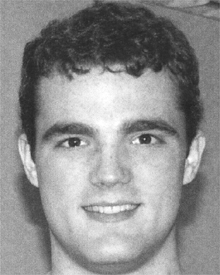 Adam T. Hayes合作论文数5
 Vincent F. Koosh合作论文数4
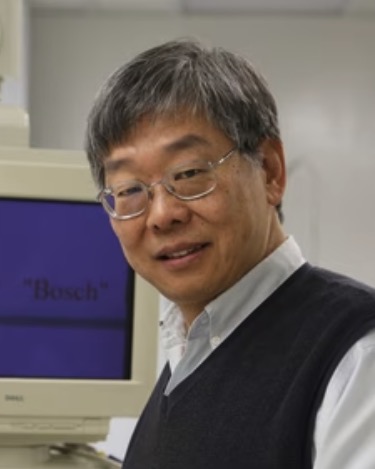 Yu-Chong Tai (戴聿昌)合作论文数Division of Engineering and Applied Science, California Institute of Technology3
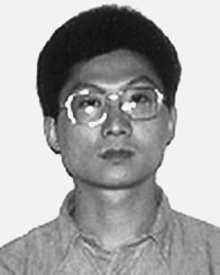 Fukang Jiang合作论文数3
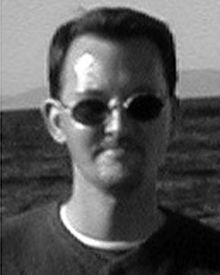 Charles M. Higgins合作论文数Electrical and Computer Engineering/ARL Division of Neurobiology, University of Arizona3Bhusan Gupta合作论文数3John W. Miller合作论文数2
 Tzi-Dar Chiueh (闕志達)合作论文数Department of Electrical Engineering, National Taiwan University2
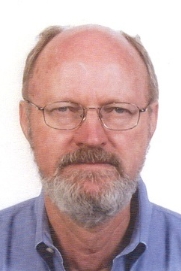 Robert H. Grubbs (罗伯特·格拉布斯)合作论文数Division of Chemistry and Chemical Engineering, California Institute of Technology2
 Chih-Ming Ho (何志明)合作论文数Department of Mechanical and Aerospace Engineering, Samueli School of Engineering, University of California, Los Angeles;Department of Bioengineering, Samueli School of Engineering, University of California, Los Angeles2Masahiro Sayano合作论文数2B. E. Ambrose合作论文数2Steve Tung合作论文数2Greenspan, H.K.合作论文数1WILLIAM AGASSOUNON合作论文数1
 Thomas Tsao合作论文数1
 Nathan S. (Nate) Lewis合作论文数Division of Chemistry and Chemical Engineering, California Institute of Technology1
 Hayit Greenspan合作论文数Department of Bio-Medical Engineering, Faculty of Engineering, Tel Aviv University;Graduate School of Biomedical Sciences, Icahn School of Medicine at Mount Sinai1Sayano, M.合作论文数1
 John W Miller合作论文数Department of Neurology, University of Washington1
 Thomas Fuja合作论文数iNDustry Labs, University of Notre Dame;Department of Electrical Engineering, College of Engineering, University of Notre Dame1David S. Babcock合作论文数1Chris Heegard合作论文数the School of Electrical Engineering, Cornell University, Ithaca, NY1
 Robert J Mceliece合作论文数Division of Engineering and Applied Science, California Institute of Technology;Jet Propulsion Laboratory, California Institute of Technology1Randall Richard Spangler合作论文数1Zheng Zeng合作论文数1Randall R. Spangler合作论文数1Edward C. Posner合作论文数1Jim Hawkins合作论文数1Gamze Erten Salam合作论文数1




