In this work, we revisit the problem of power-constrained transmission over continuous-time (CT) linear, time-invariant (LTI) channels with additive colored Gaussian noise, where channel output feedback is available at the transmitter. Although this model has been studied by several authors, previous work has primarily relied on a stochastic processes framework, which yields explicit achievable rates and capacity characterizations only for a limited class of channel models. Here, we adopt the control-theoretic framework, introduced by Elia in 2004 for the study of discrete-time feedback channels, and extend it to CT settings. We show how CT communications channels can be represented within this formulation, and illustrate the resulting coding scheme with an explicit example. It is observed that the rate achieved by the proposed feedback scheme is 30% higher than the capacity of the channel without feedback, attained by the waterfilling scheme. This work suggests a promising direction for developing communication schemes for additional important CT channel models that have not been studied previously.
We study the rate-distortion function (RDF) for sampled cyclostationary Gaussian processes with memory, representing, e.g., the sampling of communications signals for the subsequent application of digital processing. Accounting for the inherent random jitter in local oscillators and keeping the sampling interval smaller than the memory length of the continuous-time (CT) source process to facilitate reliable modeling, induce a discrete-time (DT) wide-sense almost cyclostationary (WSACS) process with memory model upon the sampled signals. The main challenge follows from the information-instability of DT WSACS processes, which renders conventional information-theoretic approaches inapplicable. We use the information-spectrum framework to study the compression of incoming source sequences in two settings: when processing starts immediately upon reception and when a bounded delay exists between consecutive source sequences. Our analysis provides novel insights relating source memory, sampling frequency synchronization, and achievable compression rates.We show that, contrary to the sampled stationary case, the RDF for sampled cyclostationary processes is very sensitive to sampling rate synchronization. We also demonstrate that the RDF is not a monotonically decreasing function for the sampling rate and how introducing delay simplifies the compression scheme and lowers the rates.
In this paper, we derive upper bounds on the capacity of bandlimited linear time-invariant channels with additive white Gaussian noise, where the input signal is subject to a peak-amplitude constraint. It has been shown that when the channel impulse response is square-integrable, unit processes are sufficient to achieve the supremum of the achievable rate for this channel (Ozarow et al., 1988). However, because the characterization of such processes, originally obtained by McMillan (1955) and Shepp (1967), is computationally intractable to evaluate explicitly, the capacity of these channels has not been explicitly computed. To circumvent this difficulty, several works have considered the derivation of lower and upper bounds on the capacity of these channels, expressing such bounds via a scaling factor that multiplies the signal-to-noise ratio (SNR) in the capacity expression for bandlimited Gaussian channels under an average power constraint. While recent works have focused on the lower bound, we focus on deriving upper bounds on the capacity using Gaussian input processes. We utilize a characterization of the autocorrelation function for unit processes derived by Quintanilla (2008), which, following the approach of Shamai and Bar-David (1989), is expressed as spectral constraints on the input power spectral density. The resulting optimization problem is still difficult to solve, so we resort to bounding the SNR scaling factor from above and below. The upper bound on the scaling factor is obtained by restricting the optimization to a finite-dimensional representation and the lower bound is obtained using an explicit construction of a unit process. Combined, these results characterize the upper bound on the SNR scaling factor that can be obtained using Gaussian input processes within a 1.84% relative gap.
We study the rate-distortion function (RDF) for the lossy compression of discrete-time (DT) wide-sense almost cyclostationary (WSACS) Gaussian processes with memory, arising from sampling continuous-time (CT) wide-sense cyclostationary (WSCS) Gaussian source processes. The importance of this problem arises as such CT processes represent communications signals, and sampling must be applied to facilitate the DT processing associated with their compression. Moreover, the physical characteristics of oscillators imply that the sampling interval is incommensurate with the period of the autocorrelation function (AF) of the physical process, giving rise to the DT WSACS model considered. In addition, to reduce the loss, the sampling interval is generally shorter than the correlation length, and thus, the DT process is correlated as well. The difficulty in the RDF characterization follows from the information-instability of WSACS processes, which renders the traditional information-theoretic tools inapplicable. In this work we utilize the information-spectrum framework to characterize the RDF when a finite and bounded delay is allowed between processing of subsequent source sequences. This scenario extends our previous works which studied settings without processing delays or without memory. Numerical evaluations reveal the impact of scenario parameters on the RDF with asynchronous sampling.
Complexity of non-orthogonal multiple access (NOMA) digital signal processing schemes is particularly relevant in mobile environments because of the varying channel conditions of every single user. In contrast to legacy modulation and coding schemes (MCSs), NOMA MCSs typically have irregular symbol constellations with asymmetric symbol decision regions affecting synchronization at the receiver. Research papers investigating signal processing in this emerging field usually lack sufficient details for facilitating software-defined radio (SDR) implementation. This work presents a new symbolic framework approach for simulating signal processing functions in SDR transmit–receive paths in a dynamic NOMA downlink use case. The proposed framework facilitates simple and intuitive implementation and testing of NOMA schemes and can be easily expanded and implemented on commercially available SDR hardware. We explicitly address several important design and measurement parameters and their relationship to different tasks, including variable constellation processing, carrier and symbol synchronization, and pulse shaping, focusing on quadrature amplitude modulation (QAM). The advantages of the proposed approach include intuitive symbolic modeling in a dynamic framework for NOMA signals; efficient, more accurate, and less time-consuming design flow; and generation of synthetic training data for machine-learning models that could be used for system optimization in real-world use cases.
High clock synchronization accuracy across the nodes in wireless networks is a prerequisite for facilitating high-rate data transmission. Accurate clock synchronization is a particularly challenging goal in networks implementing time division multiple access (tdma) via half-duplex (hd) communications, as in such networks the updates are temporally sparse, and consequently, clock frequency differences induce significant phase drifts between subsequent updates. Thus, accurate clock synchronization in hd tdma networks requires synchronizing both clock phases and clock frequencies across the nodes, which is the focus of this work. We consider pulse-coupling (pc)-based distributed clock synchronization, where each node implements its synchronization processing independently, based on its own received clock phases and power measurements. These measurements are then weighted to generate the phase and the frequency correction signals. We first analyze this synchronization framework and motivate decoupling the phase and frequency updates. We then analyze the resulting decoupled structure and derive the asymptotic synchronization accuracy, which is shown to be a function of the weighting coefficients and the unknown propagation delays. This motivates on-line learning of the optimal weights. To that aim, we introduce a novel initialization scheme with unsupervised online training. Simulation results show that the new scheme exhibits excellent synchronization accuracy, which is significantly better than previously proposed schemes, as well as robustness to clock resets and to node mobility.
In this paper we consider the upper bound on the capacity of bandlimited linear, time-invariant (LTI) channels with additive white Gaussian noise (AWGN) in which the input signal is subject to a peak amplitude constraint. It has been shown that when the channel impulse response (CIR) is square-integrable, unit processes attain the largest achievable rate for this channel, [Ozarow et al., 1988], yet the characterization of such processes is associated with a high numerical complexity. In this work we use a characterization of the autocorrelation function for unit processes derived in [Quintanilla, 2008], which facilitates a simpler and structured numerical evaluation of necessary condition for the autocorrelation function of unit processes, originally characterized in [Mcmillan, 1955] and [Shepp, 1967]. We translate this characterization into spectral constraints on the input power spectral density (PSD), following the approach applied in [Shamai and Bar-David, 1989], to tighten their bound on the capacity of such channels.
We study the rate-distortion function (RDF) for lossy compression of discrete-time (DT) processes obtained by sampling continuous-time (CT) wide-sense cyclostationary (WSCS) Gaussian processes with memory. This problem was previously studied for the case in which the sampling interval is commensurate with the period of the cyclostationary statistics (referred to as synchronous sampling), hence we focus on the situation in which these parameters are incommensurate, referred to as asynchronous sampling. The sampling interval is also assumed to be smaller than the maximal autocorrelation length of the CT source process, which results in a DT process with memory, such that the overall DT process is modeled as a Gaussian wide-sense almost cyclostationary (WSACS) process with memory. This problem is motivated by the fact that communications signals are modelled as CT WSCS processes, thus, to facilitate DT processing, e.g., as in compress-and-forward relaying and in recording systems, sampling has to be applied first. The main challenge follows as DT WSACS processes are not information-stable which renders conventional information-theoretic arguments irrelevant, and hence, the characterization of the RDF is carried out within the information-spectrum framework. This work expands upon our previous work which addressed the special case in which the DT process is memoryless. The existence of dependence between the samples requires a new approach for characterizing the RDF.
Supporting increasingly higher rates in wireless networks requires highly accurate clock synchronization across the nodes. Motivated by this need, in this work we consider distributed clock synchronization for half-duplex (HD) TDMA wireless networks. We focus on pulse-coupling (PC)-based synchronization as it is practically advantageous for high-speed networks using low-power nodes. Previous works on PC-based synchronization for TDMA networks assumed full-duplex communications, and focused on correcting the clock phase at each node, without synchronizing clocks' frequencies. However, as in the HD regime corrections are temporally sparse, uncompensated clock frequency differences between the nodes result in large phase drifts between updates. Moreover, as the clocks determine the processing rates at the nodes, leaving the clocks' frequencies unsynchronized results in processing rates mismatch between the nodes, leading to a throughput reduction. Our goal in this work is to synchronize both clock frequency and clock phase across the clocks in HD TDMA networks, via distributed processing. The key challenges are the coupling between frequency correction and phase correction, and the lack of a computationally efficient analytical framework for determining the optimal correction signal at the nodes. We address these challenges via a DNN-aided nested loop structure in which the DNN are used for generating the weights applied to the loop input for computing the correction signal. This loop is operated in a sequential manner which decouples frequency and phase compensations, thereby facilitating synchronization of both parameters. Performance evaluation shows that the proposed scheme significantly improves synchronization accuracy compared to the conventional approaches.
Handling peak-to-average power ratio is a major challenge in the design of communications systems, as current signal designs constrain the power of the generated signal and therefore its peak amplitude is considered as an uncontrolled outcome of the power-constrained signal generation scheme. An alternative signal design approach would be to restrict the peak of the signal's amplitude. The capacity of continuous-time bandlimited linear channels with additive Gaussian noise and peak input amplitude constraint is unknown to date; however, if the channel impulse response has finite energy, then any rate achieved by peak-amplitude constrained waveforms can be achieved by binary waveforms (unit processes). This fact is the basis for the two major previous works that have derived lower bounds on the achievable rate of this channel for the ideal bandlimited case. In this work we propose a different approach for obtaining lower bounds on the capacity of this channel, particularly relevant for linear, time-invariant channels with non-ideal frequency responses. Our approach is based on modulating a subset of the Walsh basis functions and using a fundamental relationship between the peak amplitude and the power of such signals. This approach yields achievable rates for general linear channels.
In this work we study the capacity of interference-limited channels with memory. These channels model non-orthogonal communications scenarios, such as the non-orthogonal multiple access (NOMA) scenario and underlay cognitive communications, in which the interference from other communications signals is much stronger than the thermal noise. Interference-limited communications is expected to become a very common scenario in future wireless communications systems, such as 5G, WiFi6, and beyond. As communications signals are inherently cyclostationary in continuous time (CT), then after sampling at the receiver, the discrete-time (DT) received signal model contains the sampled desired information signal with additive sampled CT cyclostationary noise. The sampled noise can be modeled as either a DT cyclostationary process or a DT almost-cyclostationary process, where in the latter case the resulting channel is not information-stable. In a previous work we characterized the capacity of this model for the case in which the DT noise is memoryless. In the current work we come closer to practical scenarios by modelling the resulting DT noise as a finite-memory random process. The presence of memory requires the development of a new set of tools for analyzing the capacity of channels with additive non-stationary noise which has memory. Our results show, for the first time, the relationship between memory, sampling frequency synchronization and capacity, for interference-limited communications. The insights from our work provide a link between the analog and the digital time domains, which has been missing in most previous works on capacity analysis. Thus, our results can help improving spectral efficiency and suggest optimal transceiver designs for future communications paradigms.
We consider the problem of dynamic spectrum access (DSA) in cognitive wireless networks, consisting of primary users (PUs) and secondary users (SUs), where only partial observations are available at the SUs due to narrowband sensing and transmissions. The network operates in a time-slotted regime, where the traffic patterns of the PUs are modeled as finite-memory Markov chains, that are unknown to the SUs. Since observations are partial, then both channel sensing and access actions affect the throughput. Focusing on the case in which there is a single SU, our objective is to maximize the SU’s long-term throughput. To that aim, we develop a novel algorithm that learns both access and sensing policies via deep Q-learning, dubbed Double Deep Q-network for Sensing and Access (DDQSA). To the best of our knowledge, this is the first work that jointly optimizes both sensing and access policies for DSA via deep Q-learning. Next, we consider wireless networks with access policy which implements a fixed channel hopping dynamics, for which we analytically determine the optimal SU sensing and access policy and its associated throughput. Then, we demonstrate that indeed, the proposed DDQSA algorithm can achieve near-optimal performance for the considered network. Our results show that the proposed DDQSA algorithm learns a policy that implements both sensing and channel access, which significantly outperforms existing approaches, and can achieve the optimal performance in certain scenarios.
One of the major factors which limits the throughput in wireless communications networks is the accuracy of time synchronization between the nodes in the network. Synchronization methods based on pulse-coupled oscillators (PCOs) have the advantage of simple implementation and achieve high accuracy when the nodes are closely located. However, such schemes tend to have poor synchronization performance for distant nodes, as well as in the presence of clock frequency offsets between the nodes. In this paper we present a novel PCO-based Deep neural network (DNN)-Aided Synchronization Algorithm coined DASA. We design DASA as a novel low-complexity and interpretable architecture by converting classic PCO-based synchronization into a trainable discriminative model . To enable DASA to operate in dynamic settings, we propose a novel, unsupervised, distributed, fast online training scheme which is able to train DASA within a few sampling instances, locally , thereby avoiding the need for information exchange between the nodes or for a central node for coordination. DASA is demonstrated to achieve an improvement by a factor greater than ten compared to the classic reference scheme. Lastly, we propose another novel, distributed offline training scheme for DASA, which is demonstrated to offer a tradeoff between performance and simplicity of deployment compared to the online training scheme, yet, at the same time, DASA with offline training still achieves superior performance compared to the classic reference scheme.
This paper is eligible for the Jack Keil Wolf ISIT Student Paper Award. In this paper we study dynamic spectrum access (DSA) in cognitive wireless networks, consisting of primary users (PUs) and a secondary user (SU) which has only partial observations. The traffic patterns of the PUs are modeled as finite-memory Markov chains, and are unknown to the SU. It is noted that as observations are partial, then both channel sensing and channel access actions affect the throughput. Our objective in this work is to design a DSA algorithm such that the SU’s long-term throughput is maximized. To that aim, we show theoretically that the DSA problem can be formulated as a single-agent problem with a single policy for both sensing and access, and propose a novel algorithm that learns both the optimal access policy and the optimal sensing policy via deep Q-learning, which is referred to as Double Deep Q-network for Sensing and Access (DDQSA). To the best of our knowledge, this is the first instance of a deep Q-learning-based DSA algorithm, which learns both sensing and access policies. Our results show that the DDQSA algorithm learns a policy that implements both sensing and channel access, and achieves significantly better performance compared to existing approaches.
Man-made communications signals are typically modelled as continuous-time (CT) wide-sense cyclostationary (WSCS) processes. As modern processing is digital, it is applied to discrete-time (DT) processes obtained by sampling the CT processes. When sampling is applied to a CT WSCS process, the statistics of the resulting DT process depends on the relationship between the sampling interval and the period of the statistics of the CT process: When these two parameters have a common integer factor, then the DT process is WSCS. This situation is referred to as synchronous sampling. When this is not the case, which is referred to as asynchronous sampling, the resulting DT process is wide-sense almost cyclostationary (WSACS). The sampled CT processes are commonly encoded using a source code to facilitate storage or transmission over wireless networks, e.g., using compress-and-forward relaying. In this work, we study the fundamental tradeoff between rate and distortion for source codes applied to sampled CT WSCS processes, characterized via the rate-distortion function (RDF). We note that while RDF characterization for the case of synchronous sampling directly follows from classic information-theoretic tools utilizing ergodicity and the law of large numbers, when sampling is asynchronous, the resulting process is not information stable. In such cases, the commonly used information-theoretic tools are inapplicable to RDF analysis, which poses a major challenge. Using the information-spectrum framework, we show that the RDF for asynchronous sampling in the low distortion regime can be expressed as the limit superior of a sequence of RDFs in which each element corresponds to the RDF of a synchronously sampled WSCS process (yet their limit is not guaranteed to exist). The resulting characterization allows us to introduce novel insights on the relationship between sampling synchronization and the RDF. For example, we demonstrate that, differently from stationary processes, small differences in the sampling rate and the sampling time offset can notably affect the RDF of sampled CT WSCS processes.
This paper presents a novel low-complexity sequential, blind, pilot-assisted estimator for the sampling frequency offset (SFO) and the carrier frequency offset (CFO), for orthogonal frequency-division multiplexing (OFDM) communications. The proposed algorithm processes the received subcarriers to obtain a cost function which depends only on a single unknown parameter at a time, either the SFO or the CFO, as well as on a specifically designed auxiliary parameter, while ignoring the noise. Then, by computing the cost function at a few selected values of the auxiliary parameter, an explicit estimator for each unknown parameter is derived, thereby avoiding the need for a search. To the best of our knowledge, this is the first time such a deterministic approach is applied to the joint estimation of the SFO and the CFO. Moreover, the proposed estimator does not require knowledge of the channel coefficients at the pilot subcarriers, and achieves good performance with a relatively small number of pilot symbols, which results in a low computational complexity. Simulation results show that at low computational complexity, there are many scenarios in which the new estimator achieves smaller estimation errors compared to other existing methods.
Non-orthogonal communications play an important role in future digital communication architectures. In such scenarios, the received signal is corrupted by an interfering communications signal, which is much stronger than the thermal noise, and is often modeled as a cyclostationary process in continuous-time. To facilitate digital processing, the receiver typically samples the received signal synchronously with the symbol rate of the information signal. If the period of the statistics of the interference is synchronized with that of the information signal, then the sampled interference is modeled as a discrete-time (DT) cyclostationary random process. However, in the common interference scenario, the period of the statistics of the interference is not necessarily synchronized with that of the information signal. In such cases, the DT interference may be modeled as an almost cyclostationary random process. In this work we characterize the capacity of DT memoryless additive noise channels in which the noise arises from a sampled cyclostationary Gaussian process. For the case of synchronous sampling, capacity can be obtained in closed form. When sampling is not synchronized with the symbol rate of the interference, the resulting channel is not information stable, thus classic information-theoretic tools are not applicable. Using information spectrum methods, we prove that capacity can be obtained as the limit of a sequence of capacities of channels with additive cyclostationary Gaussian noise. Our results allow to characterize the effects of changes in the sampling rate and sampling time offset on the capacity of the resulting DT channel. In particular, it is demonstrated that minor variations in the sampling period, such that the resulting noise switches from being synchronously-sampled to being asynchronously-sampled, can substantially change the capacity.
Identifying the start time of a sequence of symbols received at the receiver, commonly referred to as frame synchronization, is a critical task for achieving good performance in digital communications systems employing time-multiplexed transmission. In this work we focus on frame synchronization for linear channels with memory, in which the channel impulse response is periodic and the additive Gaussian noise is correlated and cyclostationary. Such channels appear in many communications scenarios, including narrowband power line communications and interference-limited wireless communications. We derive frame synchronization algorithms based on simplifications of the optimal likelihood-ratio test, assuming the channel impulse response is unknown at the receiver, which is applicable to many practical scenarios. The computational complexity of each of the derived algorithms is characterized, and a procedure for selecting nearly optimal synchronization sequences is proposed. The algorithms derived in this work achieve better performance than the noncoherent correlation detector, and, in fact, facilitate a controlled tradeoff between complexity and performance.
Interference-limited communications plays an important role in future digital communication architectures. In such scenarios, the received signal is corrupted by an interfering communications signal, which is typically modeled as a cyclostationary process in continuous-time. To facilitate digital processing, the receiver typically samples the received signal synchronously with the symbol rate of the information signal. The sampled received signal thus contains an interference component which is either cyclostationary or almost cyclostationary in discrete-time (DT), depending on whether the symbol rate of the interference is synchronized with the sampling rate, or it is not. In this work we characterize the capacity of DT interference-limited communications channels, in which the interference is modeled as an additive sampled cyclostationary Gaussian noise. For the case of synchronous sampling, capacity can be obtained in closed form as a direct application of our previous work. When sampling is asynchronous, the resulting channel is not information stable, thus classic information-theoretic tools are not applicable. Using information spectrum methods, we prove that capacity can be obtained as the limit of a sequence of capacities of DT channels with additive cyclostationary noise. Our results facilitate the characterization of the impact of variations in the sampling rate and sampling time offset on the capacity of the resulting DT channel. In particular, it is demonstrated that minor variations in the sampling period can have a notable effect on capacity.
Sampling frequency synchronization in orthogonal frequency division multiplexing (OFDM) communications is critical for achieving the full advantages offered by this modulation scheme. In this paper, we propose a novel and efficient, blind, cyclostationarity-based sampling frequency synchronization (CB-SFS) algorithm for estimating the sampling frequency offset (SFO) in OFDM communications by exploiting the relationship between the sampling frequency and the cyclostationary properties of the sampled received signal. The proposed scheme is ignorant of the channel coefficients and does not require pilots. These two properties are rather unique in this context and are not possessed by previous schemes which achieve comparable estimation performance. These properties also make the proposed CB-SFS scheme suitable for a wide range of communications scenarios. The main novelty of the new scheme is the understanding that SFO alters the cycle frequencies at the receiver, yet these frequencies are a priori known for the discrete-time (DT) transmitted signal, as they result from the periodic operation of the DT signal generation scheme at the transmitter. We show that the mismatch between the measured and the expected cycle frequencies is directly related to the SFO. Complexity analysis and numerical simulations are carried out and demonstrate the superiority of the proposed CB-SFS algorithm compared to the existing approaches. It is illustrated that the proposed algorithm can achieve a smaller estimation error at the same complexity order of current algorithms while providing a higher spectral efficiency and robustness to additive stationary noise and to multipath.
 Nir Shlezinger合作论文数Department of Electrical & Computer Engineering, Ben-Gurion University of the Negev;School of Electrical and Computer Engineering, Faculty of Engineering Sciences, Ben-Gurion University of the Negev16
 Yonathan Murin合作论文数Dept. of Electr. & Comput. Eng., Ben-Gurion Univ.;c15
 Andrea Goldsmith合作论文数Department of Electrical and Computer Engineering, School of Engineering and Aplied Science, Princeton University;Stanford University11
 Sergio D. Servetto合作论文数School of Electrical and Computer Engineering, Cornell University7
 Ivana Maric合作论文数Prematurity Research Center, School of Medicine, Stanford University7
 Daniel Zahavi合作论文数6
 Deniz Guenduez合作论文数5
 Emeka Abakasanga合作论文数5
 Harold Vincent Poor (文森特·珀尔)合作论文数Department of Electrical and Computer Engineering, School of Engineering and Applied Science, Princeton University;Center for Statistics and Machine Learning, Princeton University;High Meadows Environmental Institute, Princeton University5Yonatan Kaspi合作论文数Dept. of Electr. Eng., Technion - Israel Inst. of Technol.;c;Dept. of Electr. Eng., Technion - Israel Inst. of Technol.5
 Deniz Gunduz合作论文数Department of Electrical and Electronic Engineering, Faculty of Engineering, Imperial College London;Information Processing and Communications Lab, Imperial College London4
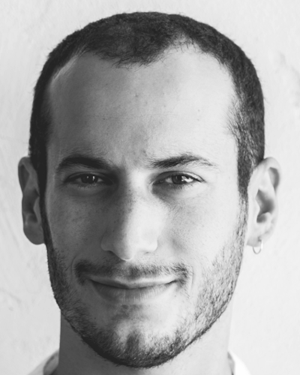 Roee Shaked合作论文数Ben Gurion Univ Negev, Dept Elect & Comp Engn, Beer Sheva, Israel3
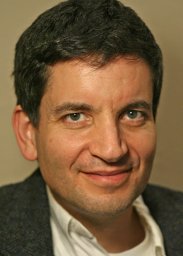 Jason Goldberg合作论文数School of Computing and Mathematics;Deakin University3
 Yonina Eldar合作论文数Signal Acquisition Modeling Processing and Learning Lab, Department of Computer Science and Applied Mathematics, Faculty of Mathematics and Computer Science, Weizmann Nstitute of Science3
 Yoel Bokobza合作论文数2
 Hagit Messer-Yaron合作论文数School of Electrical Engineering, The Iby and Aladar Fleischman Faculty of Engineering, Tel Aviv University2
 Gill R. Tsouri合作论文数Rochester Institute of Technology2
 Kobi Cohen合作论文数School of Engineering, Bar-Ilan university2
 Dov Wulich合作论文数School of Electrical and Computer Engineering, Ben-Gurion University of the Negev2
 Koby Todros合作论文数Ben Gurion University of the Negev2
 Manish Kumar合作论文数1
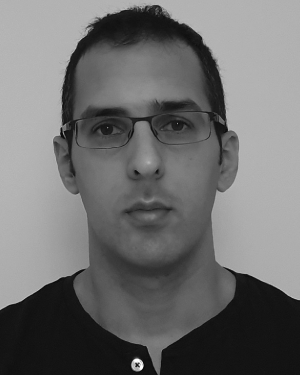 Oren Kolaman合作论文数1
 Vladimir Mladenovic合作论文数Eng. & Comput. Sci. Sch., Hebrew Univ. of Jerusalem;c;Eng. & Comput. Sci. Sch., Hebrew Univ. of Jerusalem1Peer, N.合作论文数1
 Shuguang Cui (崔曙光)合作论文数School of Science and Engineering, The Chinese University of Hong Kong (Shenzhen)1
 Hagit Messer合作论文数Sch Elect Engn, Tel Aviv Univ1Lili Zhang (张力力)合作论文数Wireless Information Network Laboratory, University of Science and Technology of China1
 Shlomo Shamai (Shitz)合作论文数Department of Electrical Engineering, Technion Israel Institute of Technology1
 Dr. Asutosh Kar合作论文数National Institute of Technology1S. Servetto合作论文数1
 Osnat Keren合作论文数Bar Ilan University1Boaz Ghelber合作论文数1
 Michael Peleg合作论文数Miami1




