Nonlinear modeling of mitigation of the edge localized mode (ELM) with resonant magnetic perturbation (RMP) is performed for the HL-2A tokamak, utilizing the three-dimensional (3D) magnetohydrodynamic code JOREK. Based on the 3D equilibrium established after application of the n=1 ( n is the toroidal mode number) RMP at 4.9kAt coil current with odd parity, ELM mitigation is successfully simulated consistent with the experimental result. Nonlinear simulations show strong mode coupling among toroidal Fourier harmonics, allowing redistribution of the magnetic energy such that the most unstable toroidal mode saturates at a lower level. This magnetic energy cascade offers an explanation of the RMP-induced ELM mitigation achieved in HL-2A. Detailed examination of the simulation results shows persistent resonant field screening even during the ELM mitigation phase. Finite plasma resistivity however does enable partial penetration of the resonant field thus modifying the edge magnetic topology and characteristics of the edge transport. Plasma radial profiles undergo pronounced changes around the pedestal region, when the magnetic energy of the most unstable toroidal mode reaches the maximum value. Systematic scans of the applied RMP coil current with the JOREK simulations find a threshold value of around 4.5kAt required for achieving the ELM mitigation on HL-2A.
The n = 1 ( n is the toroidal mode number) resistive wall mode (RWM) stability is numerically investigated for two DIII-D high- β _N discharges 176440 and 172461, utilizing the MARS-F (Liu et al 2000 Phys. Plasmas 7 3681) and MARS-K (Liu et al 2008 Phys. Plasmas 15 112503) codes. Systematic validation efforts are attempted, for the first time, for discharges with very slow or vanishing toroidal flow for a large fraction of the plasma volume. While gaining physics insights in accessing stable operation regime at β _N exceeding the Troyon no-wall limit in these slow-rotation experiments, the predictive capability of fluid and non-perturbative magnetohydrodynamic-kinetic hybrid models for the RWM is further confirmed. The MARS-F fluid model, with a strong but numerically tunable viscosity mimicking ion Landau damping of parallel sound waves, finds complete stabilization of the n = 1 RWM in the considered DIII-D plasmas under the experimental flow conditions. Similarly, either full stabilization (for discharge 176440) or marginal stability (for discharge 172461) of the mode is computed by the MARS-K hybrid model, which is first-principle based without free model parameters. In particular, all drift kinetic resonances, including those of thermal and energetic particles, are found to synergistically act to marginally stabilize the RWM in discharge 172461. These MARS-F/K modeling results explain the experimentally observed stable operational regime in DIII-D, as far as the RWM stability is concerned. Extensive numerical sensitivity studies, with respect to the plasma toroidal flow speed as well as the radial location of the resistive wall, are also carried out to further support the validation study.
Since the first plasma realized in 2020, a series of key systems on HL-3 (known as HL-2M before) tokamak have been equipped/upgraded, including in-vessel components (the first wall, lower divertor, and toroidal cryogenic/water-cooling/baking/glow discharge systems, etc.), auxiliary heating system of 11 MW, and 28 diagnostic systems (to measure the plasma density, electron temperature, radiation, magnetic field, etc.). Magnet field systems were commissioned firstly for divertor plasma discharges. During the 2nd experimental campaign of HL-3 tokamak, several great progresses have been achieved. Firstly, the successful operation with plasma current larger than 1 MA was achieved under a divertor configuration. Secondly, the advanced divertor concept with two distinct snowflake configurations was realized. It is found that the distribution of ion saturation current and heat flux on bottom plate becomes wide due to magnetic surface expansion, demonstrating the advantage of such configuration in the heat flux mitigation. In addition, using the combination of NBI, ECRH and LHCD, the standard sawtoothing high confinement mode of megampere plasma was firstly accessed on the HL-3. The successful commissioning of HL-3 is beneficial for the initial operation of ITER.
Losses of runaway electrons (REs) due to magnetohydrodynamic (MHD) perturbations in a recent HL-3 discharge are numerically modeled by a linear stability code combined with a relativistic particle guiding-center orbit tracing module. The MHD perturbation is identified as (predominantly) the n = 1 (n is the toroidal mode number) tearing mode (TM) with large 3/1 and 2/1 Fourier components. The 2/1 islands are found significantly larger than the 3/1 counterpart. As the perturbation level associated with the TM progressively increases, the 3/1 island chains disappear and transition to the edge field stochasticity occurs at about 10 G field perturbation, according to the modeling. The tendency of RE losses, due to the three consecutive TM bursts observed in the experiment, is qualitatively captured by test particle tracing. Modeling finds about 0.7%, 3% and 25% RE loss fractions associated with these three bursts, assuming that the corresponding TM perturbation levels match that of the Mirnov data. High-energy REs are subject to less losses at low perturbation levels, due to the stronger inward shift of the particle orbits. Only full field line (or drift orbit) stochasticity facilitates losses of high-energy (similar to 10 MeV) REs
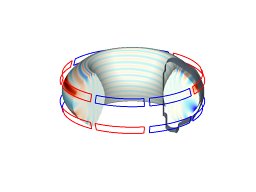
Reduction of both the plasma density and toroidal flow speed, due to application of the predominantly n = 1 ( n is the toroidal mode number) resonant magnetic perturbation (RMP) for controlling the edge localized mode in the HL-2A tokamak, is numerically investigated utilizing the quasi-linear initial-value code MARS-Q (Liu et al 2013 Phys. Plasmas 20 042503). Simulation results reveal that the neoclassical toroidal viscosity (NTV) due to three dimensional fields plays the key role in modifying the plasma momentum and particle transport in the HL-2A discharge. By comparing the modeling results with the measured density pump-out in the experiment, the electron NTV particle flux model, in combination with the free-boundary condition for the axisymmetric change of the density at the plasma edge, is found to yield the best agreement in terms of both the pump-out level and the overall time scale. Further sensitivity studies show that the simulated density pump-out level is reasonably robust against variations in the model assumptions, including the particle diffusion model and the non-ambipolar versus ambipolar NTV particle flux. The latter however affects the time scale for reaching the steady state solution. Finally, it is found that the plasma edge-peeling response, the NTV torque, as well as the plasma momentum and particle transport, all are sensitive to the toroidal phase difference between the upper and lower rows of the RMP coil currents in HL-2A, with the 30 ∘ coil phasing producing the minimal side effects on the plasma.
Externally applied resonant magnetic perturbations (RMPs), generated by magnetic coils located outside the plasma (referred to as RMP coils), provide an effective way to control the edge localized mode (ELM) in tokamak devices. Due to the discrete nature of the toroidal distribution of these window-frame coils, toroidal sidebands always exist together with the fundamental harmonics designed for ELM control. In this work, the MARS-F code (Liu et al 2000 Phys. Plasmas 7 3681) is applied to investigate the detailed features of the RMP spectra considering both the dominant harmonic (n = 2) and the associated sideband (n = 6), and the impact of the combined fields on magnetic footprints as well as on the fast ion losses for a reference double-null scenario in the HL-2M device. It is found that the sum of the n= 2 and n= 6 RMP fields splits the footprint and widens the footprint area, as compared to the single-n (n = 2) harmonic case. The resistive plasma response breaks the up-down symmetry of the footprint pattern on the outer divertor plates, which is otherwise symmetric assuming vacuum RMP fields. Considering fast ion losses, a threshold value exists for the initially launched radial position of test particles, as well as for the RMP coil current, before the loss occurs. When the threshold criterion is satisfied, the combined n= 2 and n= 6 RMP fields enhance the fast ion loss rate by similar to 20%, as compared to that of the n= 2 component alone. These results illustrate the important role of the sideband of RMP fields on the magnetic footprints and fast ion losses in tokamak plasmas.
The HL-2M tokamak is a new medium-sized tokamak at SouthWestern Institute of Physics. Two of its key missions are to achieve 10 keV ion temperature and investigate the behavior of energetic particles relevant to burning plasmas. A 6 MW ion cyclotron range of frequencies (ICRF) heating power is embedded in the next upgrade program of HL-2M. In order to facilitate the engineering design of the ICRF system, this paper analyses the main ICRF heating schemes for HL-2M, in terms of ion heating and energetic ion generation in particular. D(H) minority heating and the 2nd harmonic D will act as the main ion heating schemes, for which the optimal RF frequency range 27–33 MHz, antenna parallel wavenumber k // ∼ 8 m −1 are proposed and strong single pass absorption is expected under typical HL-2M plasma parameters. Full wave simulations carried out via TORIC/steady-state Fokker–Planck quasilinear solver and TRANSP codes suggest that by adopting three ion scheme or synergetic heating on neutral beam injection D ions by the 2nd harmonic D, energetic ions with energy at MeV level can be produced. This study shows that ICRF heating could play significant roles in ion heating, energetic ion generation in HL-2M.
The divertor biasing technique offers a promising alternative to control the edge localized mode (ELM) as well as the divertor heat load in tokamaks, as compared to the resonant magnetic perturbation (RMP) generated by magnetic coils. The linear resistive MHD code MARS-F (Liu et al 2000 Phys. Plasmas 7 3681) is employed to study the plasma response to the n = 2 ( n is the toroidal mode number) field perturbation in HL-2A, produced by the divertor biasing current filaments flowing in the scrape-off layer region. The response field due to biasing currents is compared with the RMP field utilized for ELM control in HL-2A. The strength of the radial resonant field perturbation, produced by the biasing currents of 100 A level, is found to be comparable with RMP generated by several kA of ELM control coil currents for the reference plasma. The plasma normal displacement near the X-point and the associated neoclassical toroidal viscosity torque are also computed to be similar between these two techniques. The modeling results thus strongly suggest that the biasing technique can be applied to control ELMs. Moreover, the biasing currents produce field perturbations, including the plasma response, that are localized more near the plasma edge (compared to the RMP counterpart), thus reducing the chance of mode locking associated with core perturbations. Particle orbit tracing also reveals that the biasing current produced magnetic perturbation tends to widen the heat deposition region and induce the strike point splitting of the ion saturation flow on the outer divertor surface, consistent with experimental observations in HL-2A. These toroidal modeling results confirm the possibility of ELM control and plasma exhaust solution by the divertor biasing technique.
A systematic investigation is carried out, studying the effect of the neutral beam injection induced energetic particles (EPs) on the n = 1 (n is the toroidal mode number) internal kink (IK) instability in the HL-2M tokamak, utilizing the MARS-F/K code [Liu et al., Phys. Plasmas 7, 3681 (2000) and 15, 112503 (2008)]. A high-beta sawteething HL-2M scenario, simulated by the TRANSP code [Breslau et al. Computer Software (2018)], is chosen for this study. Compared to the fluid model, non-perturbative magnetohydrodynamic (MHD)-kinetic hybrid computations with MARS-K show a generally stabilization effect on the IK, due to drift kinetic resonances associated with EPs. The bounce resonance of trapped EPs has minor influence on the mode stability. In the absence of the plasma equilibrium flow and with the assumed particle pitch distribution, the transit resonance of co-current (countercurrent) passing EPs destabilizes (stabilizes) the IK. With plasma flow, both co- and countercurrent passing EPs tend to stabilize the mode, but the effect is stronger with the countercurrent particles. These modeling results provide useful guidance for interpreting MHD instabilities in the future high-performance experiments in HL-2M.
Plasma Position Reflectometry (PPR) is planned to provide plasma position and shape information for plasma operation in future fusion reactors. Its primary function is to calibrate the drift of the magnetic signals due to the integral nature of magnetic measurement. Here, we attempt to measure plasma position using ordinary mode (O-mode) and extraordinary mode (X-mode) reflectometry systems on two tokamaks. A new physical model based on the phase shift is proposed to deduce the relative movement of the cut-off layer without density inversion. We demonstrate the plasma position measurements by absolute measurement from density profile inversion and relative measurement from phase shift. The combination of X-mode and O-mode reflectometers can minimize the limitations of single polarization reflectometry and further increase the accuracy of plasma position measurement. These results could provide an important technical basis for the further development of a real-time control system based on PPR.
Effects of three-dimensional (3D) perturbations due to an unstable n = 1 (n is the toroidal mode number) internal kink (IK) on the energetic particles (EPs) are systematically investigated for the HL-2M tokamak, utilizing the MARS-F/K code [Liu et al., Phys. Plasmas 7, 3681–3690 (2000)] and a recently developed test particle tracing module. A high-beta sawteething HL-2M scenario, simulated by the TRANSP code [Breslau et al., Transp Computer Software (2018)], is chosen for this study. In general, the 3D perturbation associated with an unstable IK is found to affect the EP drift orbit, confinement, and loss in HL-2M. The instability-induced EP loss fraction is found to be typically less than 10%, without counting for the prompt orbit loss associated with the 2D equilibrium field for counter-current particles. The latter reaches about 16% in HL-2M. For co-current EPs, a 100 G 3D magnetic field (inside the plasma) due to the IK does not induce any EP loss assuming a static perturbation. A sawtooth-like time-varying perturbation field, with the peak amplitude reaching 1000 G, can however produce about 30% loss for the co-current EPs in HL-2M. The majority of lost EPs tend to strike the lower divertor region, with a small fraction of particles striking the low-field side mid-plane region of the limiting surface.
Artificial neural networks (NNs) are trained, based on the numerical database, to predict the no-wall and ideal-wall β N limits, due to onset of the n = 1 (n is the toroidal mode number) ideal external kink instability, for the HL-2M tokamak. The database is constructed by toroidal computations utilizing both the equilibrium code CHEASE (Lütjens et al 1992 Comput. Phys. Commun. 69 287) and the stability code MARS-F (Liu et al 2000 Phys. Plasmas 7 3681). The stability results show that (1) the plasma elongation generally enhances both β N limits, for either positive or negative triangularity plasmas; (2) the effect is more pronounced for positive triangularity plasmas; (3) the computed no-wall β N limit linearly scales with the plasma internal inductance, with the proportionality coefficient ranging between 1 and 5 for HL-2M; (4) the no-wall limit substantially decreases with increasing pressure peaking factor. Furthermore, both the NN model and the convolutional neural network (CNN) model are trained and tested, producing consistent results. The trained NNs predict both the no-wall and ideal-wall limits with as high as 95% accuracy, compared to those directly computed by the stability code. Additional test cases, produced by the Tokamak Simulation Code (Jardin et al 1993 Nucl. Fusion 33 371), also show reasonable performance of the trained NNs, with the relative error being within 10%. The constructed database provides effective references for the future HL-2M operations. The trained NNs can be used as a real-time monitor for disruption prevention in the HL-2M experiments, or serve as part of the integrated modeling tools for ideal kink stability analysis.
The plasma response to the n = 1, 2, 4 (n is the toroidal mode number) resonant magnetic perturbation (RMP) fields, and the consequences on the fast ion confinement, are numerically investigated for a reference high-pressure plasma in HL-2M, by utilizing the linear resistive magnetohydrodynamic code MARS-F (Liu et al 2000 Phys. Plasmas 7 3681). The best coil current configurations, in terms of the coil phasing between the upper and lower rows of coils for controlling type-I edge localized modes (ELMs) in HL-2M, are identified as -130, -30, 180 degrees for the n = 1, 2, 4 fields, respectively, based on the edge peeling-tearing plasma response criterion. The plasma is found to substantially amplify the applied vacuum RMP field with the best coil phasing for the reference HL-2M equilibrium. The overall field amplification factor, defined as the peak-to-peak ratio of the poloidal spectra for the total field perturbation including the plasma response and the vacuum field alone, is about five for all n's. The amplification, however, does not occur with the worst coil phasing for ELM control. This field amplification due to the high-pressure plasma response, together with the plasma screening of the resonant radial field components in the core region, have several consequences on the fast ion confinement in HL-2M during ELM control with RMP. (i) Three-dimensional fields including the plasma response, and with the best coil phasing, substantially enhance the distortion of fast ion orbits compared to the vacuum field approximation. With the n = 1 RMP, the plasma-response-induced enhancement of the orbit distortion reaches a factor of four when measured in terms of the canonical toroidal angular momentum. (ii) With the best coil phasing, the plasma response widens the stochastic region for the particle orbits on the Poincare plane. (iii) The orbit islands, including the plasma response, remain as large as the vacuum counterparts in the plasma core where strong screening of the resonant field components occur. All these effects lead to enhanced fast ion transport (and loss) in the high-pressure HL-2M plasma, when the best RMP spectrum is applied to control ELMs.
The resistive wall mode (RWM) control on the HL-2M tokamak is simulated with the MARS-F code (Liu et al 2000 Phys. Plasmas 7 3681), aiming at quantifying control current and voltage requirements when more realistic issues are taken into account, i.e. the control power saturation and the sensor signal noise. The fluid model predicts a narrow stability region for the n = 1 RWM without magnetic feedback, in the 2D parameter space of the plasma pressure versus the toroidal flow speed. Magnetic feedback can fully stabilize the RWM on HL-2M. Without considering the voltage limitation and the sensor signal noise, it is found that plasma flow helps active control of the mode, by reducing the required critical feedback gain for both flux-to-current and flux-to-voltage control schemes. In the absence of the sensor signal noise, the lowest control voltage saturation level, below which the RWM control is lost, is found to roughly satisfy a linear relation to the plasma flow frequency, indicating that subsonic plasma flow is effective in relaxing the control power requirement for the RWM feedback stabilization. The presence of the sensor signal noise substantially modifies the feedback results. A statistical study finds that the sensor signal noise, with the standard deviation of 0.1 G on HL-2M, roughly doubles the required control voltage for successful mode control. The synergistic stabilization effect due to plasma flow is somewhat weakened by the presence of the sensor signal noise. At a given rotation, the tolerable voltage limit generally increases with increasing feedback gain due to the sensor signal noise.
An innovative composite bridge with webs composed of stiffened steel plates and steel tubes which can prolong the bridge life was proposed in this paper. In order to investigate the mechanical properties of this new type of structure, the three-dimensional finite element model of a three-span composite rigid frame bridge with this new kind of webs with a main span of 180m was established. The stiffness, the stability and other mechanical properties were analyzed and compared with that using corrugated steel webs. Subsequently, parametric studies were performed to obtain the reasonable arrangement of the stiffeners. Finally, The calculation method of bending rigidity, stress and deflection of this new kind of girders were conducted by theoretical analysis. The results indicate that the stress and deflection of the composite bridge satisfy the requirements of the Chineses specifications. The stability of the steel web can be significantly improved by reasonable design of the stiffeners and steel tubes. The bending stiffness and stress is determined by the parameter gamma. Timoshenko beam theory can be used to predict the deflection accurately.
In quiescent H-mode (QH-mode) regime, edge harmonic oscillations (EHOs) are believed to provide necessary radial transport to prevent occurrence of large edge localized modes. A systematic modeling study is performed here on the low- n EHOs in a DIII-D QH-mode plasma (Chen et al 2016 Nucl. Fusion 56 076011), by utilizing the MARS-Q code (Liu et al 2013 Phys. Plasmas 20 042503). Both the n = 1 and n = 2 instabilities are found to be strongly localized near the plasma edge, exhibiting the edge-peeling characteristics. The DIII-D resistive wall is found to have minor effects on these instabilities. The plasma resistivity is found to strongly modify the mode growth rate. Assuming the Spitzer model for the plasma resistivity, the computed mode growth rate scales as S −1/3 with S being the Lundquist number. Toroidal flow of the plasma slightly stabilizes these edge localized kink-peeling modes. Drift kinetic effects all have a destabilization effect on these modes. Non-perturbative magneto-hydrodynamic-kinetic hybrid computations find that the drift kinetic effects associated with thermal particle species push the peak location of the eigenmode radially inward but still in the pedestal region. The modeled plasma temperature and density fluctuations in the plasma edge region, as well as the poloidal magnetic field perturbations along both the low and high field sides of the plasma surface, are in good agreement with experimental measurements. Finally, the quasi-linear initial value simulations find a strong non-linear interplay between the kink-peeling instability and the toroidal flow near the plasma edge. The combined effect of the damping of the flow amplitude and change of the edge flow shear is found to be the stabilizing factor for the kink-peeling mode, leading to the mode saturation and thus EHOs.
The influence of energetic particles (EPs) on the ideal internal kink mode, in rotating tokamak plasmas, is numerically investigated by simultaneously solving MHD-kinetic hybrid equations together with a toroidal momentum balance equation utilizing the MARS-Q code (Liu et al 2013 Phys. Plasmas 20 042503). The neoclassical toroidal viscous (NTV) torque, induced by precessional drift resonances of trapped energetic particles, acts as the momentum sink term to damp the plasma flow. Quasi-linear initial value simulations show local reduction of the flow amplitude and enhancement of the flow shear near the q = 1 rational surface ( q is the safety factor) due to EP induced NTV. Both effects in turn destabilize the internal kink mode. These numerical findings are robust against the initial linear stability of internal kink, the initial plasma flow profile, as well as the equilibrium distribution model for EPs.
In this paper, a noval type of data glove is designed based on the principle of parallelogram, which aims to detect gestures in real time. In addition to the flexion and extension angles, this glove can detect the adduction and abduction angles of each finger. Because the overall structure of this data glove is optimized according to the linkage mechanism among joints of human hand. The data glove has the advantages of simple structure, convenient wearing, light weight and good comfort. The glove is composed of four parts: framework, bearings, connecting rods and potentiometers. The framework and connecting rods are respectively made of photosensitive resin and laser cut carbon fiber board. Potentiometers are installed on the bearings to detect the angle of rotation. In this paper, kinematic modeling of human hand is carried out. When knowing the rotation angles of each joint of human hand, the posture of the hand can be calculated by the model. Finally, the data glove is tested on the wearer's hand. Angles of each joint measured by the data glove is compared with the actual angles to verify the accuracy and feasibility of this design.
In ASDEX Upgrade hybrid discharges, it is found that an externally applied n = 1 field preferentially distorts the plasma in the core, leading to significant flow damping there and elsewhere across the plasma radius. MARS-F/Q modeling of a neoclassical toroidal viscous NTV) torque that results from an amplified internal kink-type displacement in the plasma core is qualitatively consistent with the measured internal displacements, beta dependence, and rotation damping. Sensitivity studies indicate that the internal kink response and the resulting core flow damping critically depend on the plasma equilibrium pressure, the initial flow speed, the coil phasing and the proximity of q0 to 1. No appreciable flow damping is found for a βN plasma. A relatively slower initial toroidal flow results in a stronger core flow damping, due to the enhanced NTV torque. Weaker flow damping is achieved as q0 is assumed to be farther away from 1. Finally, a systematic coil phasing scan finds the strongest (weakest) flow damping occurring at the coil phasing of approximately 20 (200) degrees, quantitatively agreeing with experiments. This study points to the important role played by the internal kink response in plasma core flow damping in high-beta hybrid scenario plasmas such as that foreseen for ITER.
Based on the non-perturbative approach, the hybrid code MARS-K is applied to study fishbone (FB) instabilities driven by trapped fast ions in a toroidal plasma with q profile nearly being flat or non-monotonic. We explore the dependency of the FB with variation in the fast ion distribution, thermal particle kinetic effects, safety factor (q) profile and plasma resistivity. When the safety factor minimum value is larger than unity (i.e. q(min) > 1), the mode can be excited by isotropic or anisotropic fast ions, with the latter strongly enhancing the mode growth rate. The mode frequency increases with increasing q(min), and is more easily triggered in a equilibrium with two q = 1 surfaces, compared with the case with one or no q = 1 surface. Kinetic contributions from transit resonance of passing fast ions and from bounce resonance of trapped fast ions strongly enhance mode instability. The passing thermal ions induced Landau damping has a strong stabilization effect. Furthermore, in such a weak, even reversed magnetic shear plasma, the radial mode structure of FB mode monotonically decreases to zero at q = 1 flux surface instead of a step-like function, and it depends on the kinetic contributions from particles. In addition, the plasma resistivity significantly stabilizes the mode near the marginally unstable point.
 Yueqiang Liu合作论文数General Atomics22
 Guanqi Dong合作论文数21
 G. Z. Hao合作论文数Southwestern Institute of Physics, Southwestern Institute of Physics China20N. Zhang合作论文数15
 Min Xu (许敏)合作论文数核工业西南物理研究院9Y. F. Zhao合作论文数8
 Wulv Zhong (钟武律)合作论文数Southwestern Institute of Physics, CNNC8
 Xinhua Bai合作论文数Department of Physics, South Dakota School of Mines and Technology8
 Guoliang Xia (夏国良)合作论文数Culham Sci Ctr, UKAEA7Xuru Duan合作论文数7T. F. Sun合作论文数6X. Q. Ji合作论文数6Y. G. Zheng合作论文数6L. Xue合作论文数6
 Bing Li (李兵)合作论文数School of Computer Science, Wuhan University6Jiaxing Li合作论文数6X. M. Song合作论文数6
 Dongli Yu (于栋利)合作论文数College of Materials Science and Engineering, Yanshan University6H T Chen合作论文数5Y. Q. Wang合作论文数5C. Y. Li合作论文数5Xiao Song (宋啸)合作论文数核工业西南物理研究院5
 Zhongbing Shi合作论文数5H. D. He合作论文数4Y. T. Miao合作论文数4John H Zhang合作论文数Southwestern Institute of Physics4yuhong xu合作论文数3Miao Xue合作论文数3
 Liu Yi (刘仪)合作论文数3
 Wei Chen (陈伟)合作论文数Southwestern Institute of Physics3J. Q. Xu合作论文数3Jiang M合作论文数3Peiwan Shi合作论文数3Xianyong Bai (白先勇)合作论文数3
 Lin Liu (刘林)合作论文数School of Materials Science and Engineering, Northwestern Polytechnical University3Jiquan Li (李継全)合作论文数Unit of Computational Science, Graduate School of Energy Science, Kyoto University3L. F. Lu合作论文数2A.P. Sun合作论文数2A. S. Liang合作论文数2L. H. Wei合作论文数2YZ YANG合作论文数2Lijun Cai合作论文数2
 L. Wang合作论文数2W. J. Chen合作论文数2Z. J. Li合作论文数2B. Lu合作论文数2X. X. He合作论文数2J. Wen合作论文数2Y. P. Zhang合作论文数2




