In recent years, the Internet of Things (IoT), in which various devices are connected to networks, has become widespread and is bringing benefits to society. On the other hand, there is a risk of information leakage from IoT devices and unintended behavior of devices. In order to communicate securely, it is necessary to understand the devices, and device identification technology that identifies them based on their characteristics is required. Methods using traffic data from IoT devices have been proposed so far, but they do not communicate on a daily basis, which makes it time-consuming to acquire necessary data and causes the time required for identification to be unpredictable. This paper proposes a device identification method that does not require long-term data acquisition, focusing on DNS queries issued by IoT devices immediately after connecting to the network. When they connect to a network, their initial operation involves communication with a cloud server, and the target domains are characteristic of each device. We identify devices using traffic data within a short period after connection and measure the accuracy of this identification. As a result of the identification, we demonstrate that an identification accuracy of 99% at the vendor level and 87% at the device name level can be achieved using data within 60 seconds after connection.
Advances in communication technology support our lives in every aspect of society, yet they also highlight the gap between applications and networks. Traditionally, application developers write code without considering the network, and the network does not perceive application behavior. This has become a performance bottleneck for services requiring low latency and high reliability. Bridging this gap necessitates various optimizations, such as processing placement, to build a network that perceives application behavior while allowing developers to write code without conscious awareness. This paper proposes an architecture to realize application-aware networking that addresses this challenge. It enables the network to determine where each function or module should execute at the program code level, achieving seamless implementation without requiring code modifications. Specifically, targeting Python, we review its language architecture, including function calls, and implement the necessary functionality. Furthermore, we adopt Information-Centric Networking (ICN) as the mechanism for executing functions dynamically deployed by the network. We then design and implement the necessary technical elements, such as ICN mapping. As a result, the proposed architecture enables the realization of an application-friendly networking for various programs without requiring code modifications.
In recent years, remote monitoring (RM) where stored pacemaker’s information is sent from home to hospitals, has become widespread. This leads to reduced burden of outpatient visits, and it is also possible to obtain useful information by analysing the large amounts of data stored with RM. However, two issues exists; the data format for RM is provided in different types of document data, which is time consuming to extract and aggregate the data manually by the clinical staff. In addition, RM reports are done once a month, resulting in only 12 reports a year, so as they are scarce, we need to unify reports for various types of patients. However, the data aggregation would require excessive workload for the healthcare professionals, therefore it is difficult to unify different types of patient data with the current RM.To solve these critical problems for the pacemaker, this study developed a pacemaker battery level estimation using a large language model (LLM) and remote monitoring historical data. With the aid of LLM, no coding is required as a relational database could be run fully automated, which should be a strong merit for non-engineers, namely, doctors and clinical staff. Based on the interactions through the LLM-based system, we can find similar patient data from the relational database easier, without the need for any technical skills. For evaluating the developed system, RM files were created for 30 people, simulating the discharge characteristics of pacemakers, and a high-order approximation curve of the characteristics was calculated from the RM history information using the OpenAI’s generative pre-trained transformers (GPTs). The optimal order approximation curve was then selected using the Akaike information criterion (AIC), and a pacemaker battery remaining capacity prediction system was created. As a result, gpt-4o-latest showed the lowest root mean square error (RMSE), with a median value of 0.0124mV, which demonstrated that data analysis integrating RM and LLMs could become feasible in future pacemaker condition monitoring.
The identification of rapidly proliferating IoT devices is crucial from a security perspective. However, conventional machine learning models face a generalization challenge, where their accuracy degrades in unseen environments different from their training setup. Furthermore, collecting the diverse data needed to solve this issue is difficult due to privacy concerns. To address these challenges, this paper proposes a robust identification model using Federated Learning (FL), which balances privacy protection with distributed learning. The proposed method learns from time-series features extracted from network traffic using an LSTM model, and addresses data heterogeneity (NonIID) in real-world environments with the FedProx algorithm. Experiments with real-world data have demonstrated that the proposed approach improves identification accuracy in unseen environments by 0.03 to 0.18, without aggregating data from each site. This shows that this approach is effective in achieving both privacy protection and high performance.
Conventional chatbots have limitations in addressing complex and unpredictable issues such as network trouble, and their effectiveness often depends on users' IT literacy, hindering efficient problem resolution. To address this challenge, this paper proposes a chatbot that enables swift and accurate troubleshooting by having a LLM (Large Language Model) directly analyze system logs from network devices, thereby bypassing reliance on user literacy. To establish the practical viability of this approach, we integrated key log pre-processing techniques into the system to maximize the LLM's analysis accuracy and performance, and then experimentally evaluated their effectiveness. The evaluation demonstrated that our chatbot, utilizing the Llama model, achieved a practical performance with an analysis accuracy of 86%. This paper not only presents a new form of troubleshooting that directly integrates system logs with LLM but also empirically shows that for its realization, refining the input to the LLM to only essential information through effective pre-processing is crucial.
In recent years, smart buildings have garnered attention for their ability to integrate various systems and devices within a building, allowing for centralized data platform-based control to achieve purposes such as energy management. Smart building data platforms are required to provide vendor-agnostic APIs (for device control and data acquisition) and simplify device addition and operation. In this paper, we design a platform architecture that fulfills those requirements. The differing IoT gateway functionalities for each device are dynamically deployed to the IoT gateway. The devices are abstracted into metrics, which are a type of data, and the API is called with the metric and the building structure in which the device is located. Furthermore, we propose a method to standardize metric names of the same type across the platform. The designed platform is implemented and verified.
As a result of the growth of autonomous driving technology, vehicle networks increasingly require not only broadband capabilities and real-time communication, but also enhanced security features. In this paper, we propose a lightweight security switch using hierarchical hash table to achieve security functionality at the central gateway within the vehicle network. Our proposed switch combines header information from Layer-2 to Layer-4 to determine whether incoming packets are attack packets or not. It also achieves fast packet forwarding using low-latency hierarchical hash table. We evaluated the system performance with the FPGA board implementing the proposed security switch, and achieved low-latency transfers of 500 nanoseconds or less.
Hemodialysis therapy is an extracorporeal circulation treatment that serves as a substitute for renal function. In Japan, patients receive this efficient four-hour treatment, three times per week, allowing them to maintain a social life nearly equivalent to that of healthy individuals. Before the treatment, two punctures are performed to establish extracorporeal circulation, and a high blood flow rate is essential to ensure efficient therapy. Specialized blood vessels created through arteriovenous fistula (AVF) surgery are utilized to achieve high blood flow rates. Although the AVF allows safe and efficient dialysis treatment, AVF stenosis leads to a serious problem in dialysis. To early detect this abnormal blood flow, auscultation and palpation methods are widely used in hospitals. However, these methods can only provide qualitative judgment of the AVF condition, so the results cannot be shared among other doctors and staff. Additionally, since the conventional methods require contact with the skin, some issues require consideration regarding infection and low reproducibility. In our previous study, we proposed an alternative method for auscultation using non-contact optical imaging technology. This study aims to construct a reliable AVF stenosis detection method using Thrill waveform analysis based on the developed non-contact device to solve the problem with the contact palpation method. This paper demonstrates the performance validation of the non-contact imaging in the normal AVF group (206 total data, 75 patients, mean age: 69.1 years) and in the treatable stenosis group (107 total data, 17 patients, mean age: 70.1 years). The experimental results of the Mann-Whitney U test showed a significant difference (p=0.0002) between the normal and abnormal groups, which indicated the effectiveness of the proposed method as a new possible alternative to palpation.
Hemodialysis therapy is an extracorporeal circulatory therapy that substitutes kidney function. At the beginning of therapy, special vessels called arterio-venous fistula (AVF) should be created, which puncture the dilated veins and allow for stable treatment. However, as they are prone to stenosis, a stethoscope is usually used to confirm the procedure before treatment. Although this method is simple and reliable, there are several critical issues to be resolved, such as missed stenosis sounds and difficulties in quantification. In our previous study, we proposed a new non-contact method to quantitatively confirm the AVF state using optical technology. In this study, the same method was used to represent the process from normal state to intense stenosis state in one hemodialysis patient using luminance and grayscale transformation to express the state of blood flow in colour, whose feasibility was verified through multiple comparison tests with ultrasound equipment. The results showed that in the multiple comparison test with Honest Significant Difference, all pairs without significant differences; however, there was a predominant difference between normal and intense stenosis on June 29 (II) and July 25 (V) (p = 0.038). On July 20, when mild stenosis was confirmed by ultrasound equipment findings, stenosis could be determined visually by the luminance and tone conversion. In the quartile evaluation by measurement date, the difference between the first and third quartiles was large on March 7 and June 29, and gradually decreased from June 6. This was considered to reflect the increase in internal pressure with the progression of stenosis and the suppression of venous wall pulsation due to the progression of vessel wall elongation. These results indicated that this method has the potential to visualise the stenosis site.
Online lecture is one of the technology-wise challenges in the education field. It provides the advantage of encouraging anyone to join from worldwide. However, understanding students' concentration in remote is one of the difficulties. In this paper, we evaluate multimodal sensors for estimating students' concentration levels during online video lectures. We collect multimodal sensor data such as accelerometers, gyroscopes, heart rates, facial orientations, and eye gazes. We conducted experiments with 13 university students in Japan. The results of our study, with an average accuracy rate of 74.4% for user-dependent cross-validation and 66.3% for user-independent cross-validation, have significant implications for understanding and improving student engagement in online learning environments. Most interestingly, we found that facial orientations are significant for user-dependent and eye gazes for user-independent classification.
A remote monitoring system that periodically transmits information stored in the pacemaker from patients' homes to a hospital is now in widespread use. However, the system requires access to the vendor's cloud server via a browser and consists of date-by-date PDF files, making the creation of aggregate data a significant burden. Since the release of commercially available systems such as ChatG PT, various large language models (LLMs) have been widely used, leading to that semantic search, which can perform searches that take into account the meaning of language, has attracted attention. In this study, we constructed an LLM - based remote monitoring system. Then, as a preliminary evaluation, we examined its effectiveness for RM operations based on the accuracy of RM data aggregation and work time.
The mechanism of hallux valgus (HV) development has not been fully clarified, and a new evaluation method is required. We aimed to establish a method for calculating the rotational moment of the midfoot (RMM) by developing a three-dimensional foot scanner, and to reveal features of HV using this method. A smartphone was used to capture images and analyze regions of the foot in 592 participants. We focused on feature points such as the great toe-first metatarsal head-heel (GFH) angle as the HV angle, the navicular bone, and the centerline of the foot. Navicular-moment-arm (NMA) was defined as the distance between the navicular bone and the centerline of the foot. RMM was calculated from NMA and body weight. The mean values of RMM were 12.3 and 9.4 Nm for male and female participants, respectively. With pronation of the midfoot, the rotational moment and the load on the midfoot increased because of the increase in navicular adduction and axis of bone distance (ABD). ABD and RMM increased with increasing GFH angle quartiles in male and female participants. In particular, ABD and RMM were significantly higher at the fourth quartile of GFH angle. Transverse arch width and height were identified as predictors of GFH angle, both showing high contribution. The navicular bone associated with NMA is controlled mainly by the posterior tibial muscle. Dysfunction of the posterior tibial muscle causes an increase in NMA, leading to an increase in the first and second metatarsal (M1-M2) angle. Therefore, increases in RMM and NMA cause the first metatarsal to pronate and rotate, inducing an increase in the M1-M2 angle. The rotational moment applied to the navicular bone affects the adjacent medial and intermediate cuneiform bones. Particularly, the adduction motion of the navicular bone causes the medial cuneiform bone to rotate in conjunction, possibly inducing relaxation of the tarsometatarsal joint and leading to metatarsus primus varus. Measurement of the foot skeletal structure using a smartphone has the potential of widespread use.
In this paper, we propose a tourist spot extraction system that combines a map search service and social media. The system uses a map search service to extract local tourist spots and then uses search suggestions generated from the spot names to extract as many posts of tourist spots as possible using social media. We have selected Google Places API as the map search service and Instagram Platform as the social media for the proposed system. To extract as many tourist spots as possible, our system performs the following seven steps: 1) input search information, 2) extract spot information, 3) generate hashtag candidates, 4) remove unnecessary hashtags, 5) retrieve spot reviews and photos, 6) exclude posts unrelated to the spot, and 7) display extracted results. These steps enable efficient and effective extraction of information on tourist spots in the search area including information such as recent reviews and photos. To verify the effectiveness of the proposed system, we conducted a total of four kinds of evaluation experiments. As a result, we found that the proposed system has the potential to retrieve a large number of tourist spots and posts.
In this paper, we propose a system that detects an orientation of personal interest for realizing human activity recognition. It is expected that human activity is closely associated with the orientation of personal interest. Therefore, the proposed system acquires head pose and face orientation from video streaming using OpenFace 2.0, a facial feature estimate tool, and extracts the detection of orientation of personal interest. To verify the effectiveness of the proposed system, we investigated the estimation accuracy of the orientation of interest by four participants. As a result, the best estimation in the experiment was obtained with an absolute coordinate error of approximately 100 mm and an absolute angular error of approximately 6.5^∘ . In addition, we evaluated the useful accuracy of the system through a qualitative evaluation.
Scores, honors, and certificates are crucial for displaying pupils’ abilities in school. Obtaining authentic records is difficult, yet falsifying such data is easy. Scorechain, a blockchain-based academic data management system, addresses this issue. Our system manages scores, awards, examinations, classes, and certifications, as well as a secure multi-role hierarchy, to improve Scorechain’s security and reliability. Scorechain also lets parents, recruiters, and colleges communicate information. Our blockchain system was built using Substrate and Rust. Our implementation, testing, and analysis show Scorechain’s efficiency.
The collection and examination of student data, encompassing academic achievements, awards, and certifications, assume an essential function within the field of education as a means of showing students’ capabilities. Nevertheless, it is crucial to note that regular paper-based records are vulnerable to both physical destruction and the act of fabrication, while standard databases can have security holes. Moreover, the process of manually gathering physical papers from centralized organizations is both laborious and complicated. To address the concerns above and foster sustainability in the field of education, this study first suggests using Scorechain. This innovative solution integrates blockchain technology into a comprehensive data-management system for managing all student-related data. Secondly, by utilizing the inherent security features of blockchain technology, Scorechain develops a stable multi-role hierarchy, increasing the integrity and reliability of data. This also facilitates the efficient transfer of information among various stakeholders, including parents, recruiters, and educational institutions, thus fostering transparency and accountability. Lastly, the Scorechain system facilitates collaboration and data exchange among universities inside a shared network. Scorechain was constructed using the Rust programming language and is based on the Substrate blockchain architecture. It underwent careful development, testing, and analysis to ensure operational efficiency. The feasibility and long-term viability of Scorechain in genuine educational contexts are highlighted as blockchain technology facilitates seamless integration into the education sector.
Hemodialysis therapy generally requires a special blood vessel called an arteriovenous fistula (AVF), which is surgically anastomosed between an artery and a vein. Since an AVF often becomes stenosis, palpation is used to palpate the vessel wall vibrations, which is called thrill wave, before and after hemodialysis treatment. This method is widely used, especially in Japan, because of its simplicity. However, several problems in the palpation has been pointed out in terms of reliability because the palpation requires contact diagnosis. In order to solve the problems in the conventional contact palpation, we developed a thrill wave measurement device using non-contact imaging based on an optical technology. Then, we introduced a gradient-boosting decision tree algorithm to detect stenosis in AVFs. The experimental results showed that true positive rate (TPR) = 92.3%, true negative rate (TNR) = 76.7%, false positive rate (FPR) = 7.7% and false negative rate (FNR) = 23.3% to identify normal and stenotic AVFs.
Abstract Background Flat feet increase the risk of knee osteoarthritis and contribute to frailty, which may lead to worse life prognoses. The influence of the foot skeletal structure on flat feet is not yet entirely understood. Footprints are often used to evaluate feet. However, footprint-based measurements do not reflect the underlying structures of feet and are easily confounded by soft tissue. Three-dimensional evaluation of the foot shape can reveal the characteristics of flat feet. Therefore, foot shape evaluations have garnered increasing research interest. This study aimed to determine the correlation between the three-dimensional (3D) features of the foot and the measurement results of footprint and to predict the evaluation results of flat feet from the footprint based on the 3D features. Finally, the three-dimensional characteristics of flat feet, which cannot be revealed by footprint, were determined. Methods A total of 403 individuals (40–89 years) participated in this study. The proposed system was developed to identify seven skeletal features that were expected to be associated with flat feet. The loads on the soles of the feet were measured in a static standing position and with a digital footprint device. Specifically, two footprint indices were calculated: the Chippaux–Smirak index (CSI) and the Staheli index (SI). In the analysis, comparisons between male and female measurement variables were performed using the Student’s t test. The relationships between the 3D foot features and footprint index parameters were determined by employing the Pearson correlation coefficient. Multiple linear regression was utilized to identify 3D foot features that were strongly associated with the CSI and SI. Foot features identified as significant in the multivariate regression analysis were compared based on a one-way analysis of variance (ANOVA) with Tukey’s post hoc test. Results The CSI and SI were highly correlated with the instep height (IH) and navicular height (NH) of the 3D foot scanning system and were also derived from multiple regression analysis. In addition to the NH and IH, the indicators of the forefoot, transverse arch width, and transverse arch height were considered. In the flat foot group with CSI values above 62.7%, NH was 13.5% (p < 0.001) for males and 14.9% (p = 0.01) for females, and the axis of the bone distance was 5.3% (p = 0.05) for males and 4.9% (p = 0.10) for females. In particular, for CSI values above 62.7% and NH values below 13%, the axis of the bone distance was large and the foot skeleton was deformed. Conclusions Decreased navicular bone height could be evaluated with the 3D foot scanning system even when flat feet were not detected from the footprint. The results indicate that the use of quantitative indices for 3D foot measurements is important when evaluating the flattening of the foot. Trial registration number UMIN000037694. Name of the registry: University Hospital Medical Information Network Registry. Date of registration: August 15, 2019.
Deformities of the foot result in loss of walking function. The skeletal structure of the foot devel-ops during childhood, and quantitative assessment of the foot is warranted. In healthy children, foot length and navicular height have been studied individually; however, the foot has not been sufficiently studied in its entire-ty, and the growth curve of the foot has not been clarified. In particular, the heel is an important site influenc-ing foot biomechanics. In this study, we developed a three-dimensional (3D) foot scanner and digital footprint device to examine the foot characteristics of both children and adults. This study aimed to compare the foot characteristics of developing children with those of adults. Overall, 154 children (aged 8-10 years) and 403 adults (aged 40-89 years) were included in the study. The 3D foot scanner and digital footprint device were used for measurements. Foot length, forefoot width, foot height, navicular height, and heel width were evaluat-ed. In particular, the ratio of each indicator to foot length was used to evaluate the characteristics of the child's foot. The measurement indices were significantly larger in adults than in children, indicating that the indices in-crease as children grow, irrespective of sex. The results of the measurements and the ratios to foot length showed large individual differences between adults and children in some of the measurement indices. Howev-er, there was no difference in the heel width between children and adults. In contrast, forefoot flattening was greater in adults. Increases in foot length and heel width were found to vary greatly among individuals and those with different characteristics. While foot length and navicular height increased in adults, heel character-istics did not differ significantly between children aged 8-10 years and adults. Children appear to show foot ge-ometries and proportions different from adults, which would have important implications for the ergonomics of children's footwear.
As a result of the coronavirus disease pandemic, it is anticipated that the resulting decrease in the level of physical activity will increase the risk of falls among the frail population. Hence, it is useful to measure the changes in physical activity levels since the onset of the pandemic in this population. This study used information communication technology to obtain the daily step counts of 2248 adults aged 40-89 years between December 2019 and May 2020 to investigate their levels of physical activity. During the pandemic, when outdoor visits were restricted, step counts decreased by 3.5% and 3.7% among males aged 70-79 years and 80-89 years, respectively; and by 0.1% and 8.2% among females aged 70-79 years and 80-89 years, respectively. The frequency of outdoor visits decreased by 16.3% (4.0 days) and 17.8% (4.3 days) in males and females, respectively, in the 80-89-years. In the 70-79-years, the frequency of outdoor visits decreased by 7.1% (1.9 days) and 8.4% (2.3 days) in males and females, respectively. Restriction of outdoor visits due to the pandemic may have a detrimental effect on the amount of physical activity performed by middle-aged and older adult populations.
 Ikuo Oka合作论文数162
 Masayuki Murata (村田正幸)合作论文数Advanced Network Architecture Laboratory, Graduate School of Information Science and Technology, Osaka University;Department of Information Networking, Graduate School of Information Science and Technology, Osaka University82
 Chikato Fujiwara合作论文数21Hiroshi Kitamura合作论文数Graduate School of Economics, Osaka University17Morishima, Y.合作论文数16
 Yasuhiro Sato合作论文数16
 Kazunari Inoue合作论文数16
 Hisashi Iwamoto合作论文数16
 Nobuyuki Nakamura (中村信行)合作论文数Institute for Laser Science, The University of Electro-Communications14
 Yuji Yano合作论文数14Yoshihiro Nakahira合作论文数12Kazunari Irie合作论文数11
 Yasuto Kuroda合作论文数11
 Haesung Hwang合作论文数National Institute of Agricultural Biotechnology11
 Hideo Miyahara合作论文数National Institute of Information and Communications Technology10Yasushi Kuroda合作论文数8
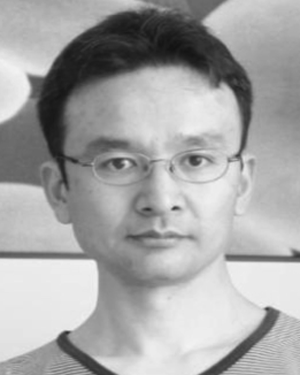 Hayashi, Tsunemasa合作论文数7
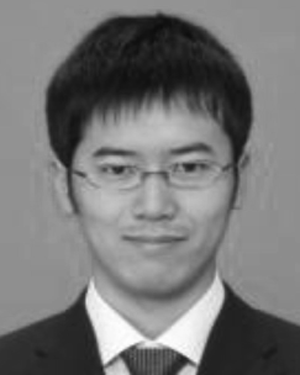 Nakayama, Hiroki合作论文数7Takunori Shimazaki合作论文数7Atsushi Ooka合作论文数7
 Koji Yamamoto (山本浩司)合作论文数Graduate School of Economics, Faculty of Economics, The University of Tokyo7
 Dijiang Huang合作论文数School of Computing and Augmented Intelligence, Arizona State University7
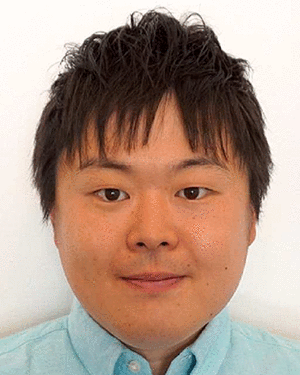 Daisuke Anzai合作论文数Nagoya Institute of Technology7
 Deep Medhi合作论文数Department of Computer Science and Electrical Engineering, University of Missouri-Kansas City7Shinji Nishijima合作论文数6
 Manato Fujimoto合作论文数6Takahiro Yamamoto合作论文数6Takeshi Yokoyama合作论文数6Satoshi Doi合作论文数6Masato Kita合作论文数6Kohsuke Harada合作论文数University of Tokyo Graduate School of Agricultural and Life Sciences6
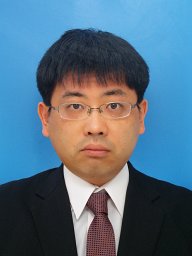 Yuichi Ohsita合作论文数Graduate School of Information Science and Technology;Osaka University;Graduate School of Information Science and Technology, Osaka University6
 Suyong Eum合作论文数6Rumi Iwai合作论文数5Yoshifumi Kawakubo合作论文数5Tomoko Yamashita合作论文数5Okuda, K.合作论文数Grad. Sch. of Eng., Osaka City Univ.;c;Grad. Sch. of Eng., Osaka City Univ.5Koyano, S.合作论文数5Hiroomi Isozaki合作论文数5
 Tianyi Xing合作论文数WalmartLabs5Masaki Tai合作论文数5Kazuhiko Yamashita合作论文数5Taketsugu Yao合作论文数5Taku Kitagawa合作论文数4Mitsuru Sato合作论文数4
 Go Hasegawa (長谷川剛)合作论文数Research Institute of Electrical Communication, Tohoku University4
 Kohei Shiomoto合作论文数NTT Network Serv Syst Labs, NTT Corp4




