Hospital scheduling requires the coordinated allocation of operating rooms, inpatient beds, and healthcare staff under strict constraints and interacting performance objectives. Decisions at the surgical level propagate through downstream care units, while congestion in inpatient services may restrict surgical activity, resulting in a large-scale and tightly coupled optimization problem. This paper proposes an integrated framework based on a unified Quadratic Unconstrained Binary Optimization (QUBO) formulation that jointly models operating room scheduling, bed management across clinical phases, and human resource allocation. Non-linear congestion effects are captured using a Choquet integral–based aggregation of soft criteria, explicitly modeling interactions between delays, bed shortages, staff overload, and cancellations. The resulting non-convex QUBO is solved using a neural-guided quantum-inspired simulated annealing algorithm. Experiments on realistic synthetic instances demonstrate clear improvements over classical simulated annealing and unguided quantum-inspired methods in terms of feasibility, solution quality, and convergence speed.
In this paper, we present an end-to-end solution for solving the Non-Emergency Patients Transportation Problem (NEPTP) using Deep Reinforcement Learning (DRL). First, the NEPTP is modeled as a Markov Decision Process (MDP), enabling the application of reinforcement learning techniques. We then train a single model that learns to find near optimal solutions for problem instances sampled from a given distribution, guided solely by reward signals and feasibility constraints. The trained model represents a parameterized stochastic policy, optimized using Proximal Policy Optimization (PPO) to learn efficient routing decisions. To validate the approach, we initially tested the model on Solomon benchmark instances for the Vehicle Routing Problem with Time Windows (VRPTW). The proposed method achieves high quality solutions compared to classical heuristics, in terms of execution time (after training) and generalization across different problem instances. Subsequently, the trained model is adapted to accommodate the specific constraints of non-emergency medical transportation, including time windows, multiple depots, and patient specific requirements. Experimental results demonstrate that the approach effectively reduces overall transportation costs while ensuring timely and feasible patient transfers, highlighting its potential for real world applications in healthcare logistics.
Ensuring accurate prescriptions and proper medication administration is critical for patient safety and effective clinical outcomes. Identifying and preventing prescription errors can significantly reduce healthcare costs and adverse health effects. Current solutions range from rule-based systems, which rely on predefined rules and clinical expertise but lack adaptability to unexpected errors, to supervised machine learning approaches, which are hindered by limited labeled error data and opaque algorithmic processes. To overcome these limitations, we propose a prescription error detection method based on a one-class classification approach. Leveraging the publicly available MIMIC database, advanced language modeling and dimensionality reduction techniques, our framework autonomously learns meaningful representations of medication prescriptions without requiring explicit error labels. Additionally, we incorporate Lime and SHAP methods to explain the model's predictions, providing clinicians with interpretable insights into the decision-making process and enhancing trust in the model's reliability. Three experiments were conducted to evaluate the effectiveness of our approach. The results reveal that leveraging BERT embeddings in conjunction with Principal Component Analysis for dimensionality reduction and Local Outlier Factor-based one-class classification achieves the highest performance, with : precision=81.71%; Recall=87.32%; F1-score=86.84%. These results highlight our method's effectiveness in detecting potential prescription errors without the need for labeled error data.
Medical staff scheduling is a complex challenge with significant implications for patient care and staff well-being. This study presents an innovative approach that combines multiple optimization algorithms working collaboratively in a multi-agent system (MAS) to address shift allocation. By integrating these algorithms, the method ensures fair distribution, optimizes staff preferences, and minimizes constraint violations, effectively balancing workload and respecting individual requests. Tested on both simulated and real-world data, the solution demonstrates enhanced scheduling efficiency and adaptability particularly using heuristics for managing multiple schedules.
Airborne particulate matter (PM) poses significant health risks, necessitating accurate toxicity threshold determination for effective risk assessment. This study introduces a novel machine-learning (ML) approach to predict PM toxicity thresholds and identify the key physico-chemical and exposure characteristics. Five machine learning algorithms — logistic regression, support vector classifier, decision tree, random forest, and extreme gradient boosting — were employed to develop predictive models using a comprehensive dataset from existing studies. We developed models using the initial dataset and a class weight approach to address data imbalance. For the imbalanced data, the Random Forest classifier outperformed others with 87% accuracy, 81% recall, and the fewest false negatives (23). In the class weight approach, the Support Vector Classifier minimized false negatives (21), while the Random Forest model achieved superior overall performance with 86% accuracy, 80% recall, and an F1-score of 82%. Furthermore, eXplainable Artificial Intelligence (XAI) techniques, specifically SHAP (SHapley Additive exPlanations) values, were utilized to quantify feature contributions to predictions, offering insights beyond traditional laboratory approaches. This study represents the first application of machine learning for predicting PM toxicity thresholds, providing a robust tool for health risk assessment. The proposed methodology offers a time- and cost-effective alternative to classical laboratory tests, potentially revolutionizing PM toxicity threshold determination in scientific and epidemiological research. This innovative approach has significant implications for shaping regulatory policies and designing targeted interventions to mitigate health risks associated with airborne PM.
For several years, we have been witnessing an increase in pollution and traffic jams in large cities. Research has therefore focused on the development of new, greener, and more flexible means of transport to complement the existing static transport offer. These means of transport are intended to be shared and dynamic to attract more people. One of these promising means of transportation is dynamic multi-hop ridesharing which makes it possible to route a rider through several drivers for a more flexible ridesharing offer. While the majority of papers on this topic deal with the global optimality of the system, we are interested in a preferential optimization for each individual in the system. In this context, this paper addresses an innovative solution to the on-demand multi-hop dynamic ridesharing problem where each actor (driver or rider) is represented by an autonomous and interactive entity called an "agent." This ridesharing system is, therefore, a multi-agent system (MAS) in which each agent has a limited rationality. This MAS permits us to define the communications, perceptions, and preferences of drivers and riders. We detail a preference-weighted objective function for riders that allows the simulation of a wide range of behaviors. We propose the use of R-trees to optimize the computational cost of identifying candidate drivers and the best associated transfer nodes. We present various simulation scenarios by varying user preferences and instance parameters. Our experiments show that our model can efficiently simulate real-world behaviors and is able to optimize ridesharing on a case-by-case basis.
Early disease detection through the analysis of laboratory tests is critical for the successful treatment of certain diseases. However, current medical knowledge relies on the use of certain biomarkers in order to diagnose associated diseases. This means that some diseases cannot be detected unless the corresponding biomarker is actually measured.In this paper, we will explore the possibility of using machine learning to detect abnormal values in biomarkers, even when they are not directly measured. This stems from the fact that, as an ensemble of features, even a set of common biomarkers contains sufficient information to suspect anomalies in a patient’s analyses.We present a complete pipeline for processing medical laboratory data, taking into account the many challenges offered by this use case, such as data cleanliness, the abundance of missing values, and strong class imbalance. Using this framework, we perform a case study on prostate cancer and its associated biomarker, Prostate-Specific Antigen (PSA). Our implementation, based on an imbalance-aware ensemble prediction model, is tested on a real laboratory dataset of more than 8 million records. We find that basing the ensemble on Random Forest models provides the best results, with a ROC-AUC of 75.86%, indicating that it is indeed possible to detect abnormal PSA values without measuring it directly. We also show that a simple baseline of 24 commonly-measured biomarkers provides near-equivalent results to a full set of features. Our work offers new perspectives for routine disease screening.
Pulmonary Tuberculosis (PTB) is an infectious disease caused by a bacterium called Mycobacterium tuberculosis. This paper aims to create Symbolic Artificial Intelligence (SAI) system to diagnose PTB using clinical and paraclinical data. Usually, the automatic PTB diagnosis is based on either microbiological tests or lung X-rays. It is challenging to identify PTB accurately due to similarities with other diseases in the lungs. X-ray alone is not sufficient to diagnose PTB. Therefore, it is crucial to implement a system that can diagnose based on all paraclinical data. Thus, we propose in this paper a new PTB ontology that stores all paraclinical tests and clinical symptoms. Our SAI system includes domain ontology and a knowledge base with performance indicators and proposes a solution to diagnose current and future PTB also abnormal patients. Our approach is based on a real database of more than four years from our collaborators at Pondicherry hospital in India.
Chronic Kidney Disease (CKD) is a common disease with high incidence and high risk for the patients’ health when it degrades to its most advanced stages. When detected early, it is possible to slow down the progression of the disease, leading to an increased survival rate and lighter treatment. As a consequence, many prediction models have emerged for the prediction of CKD. However, few of them manage to efficiently predict the onset of the disease months to years prior. In this paper, we propose an artificial neural network combining the strengths of convolution and involution layers in order to predict the degradation of CKD to its later stages, based on a set of 25 common laboratory analyses as well as the age and gender of the patient. Using a dataset from a French medical laboratory containing more than 400 000 patients, we show that our model achieves better performance than state-of-the-art models, with a recall of 83%, F1-score of 76%, and 97% overall accuracy. The proposed method is flexible and easily applicable to other diseases, offering encouraging perspectives in the field of early disease prediction, as well as the use of involution layers for deep learning with time series.
The health product circuit corresponds to the chain of steps that a medicine goes through in hospital, from prescription to administration. The safety and regulation of all the stages of this circuit are major issues to ensure the safety and protect the well-being of hospitalized patients. In this paper we present an automatic system for analyzing prescriptions using Artificial Intelligence (AI) and Machine Learning (ML), with the aim of ensuring patient safety by limiting the risk of prescription errors or drug iatrogeny. Our study is made in collaboration with Lille University Hospital (LUH). We exploited the MIMIC-III (Medical Information Mart for Intensive Care) a large, single-center database containing information corresponding to patients admitted to critical care units at a large tertiary care hospital.
Healthcare systems worldwide are increasingly subject to in-depth analysis. Problems in healthcare systems are of concern to the general public. For example, overcrowding in emergency departments creates several issues including longer waiting times, more frequent medical errors, a longer length of stay and worsened performance indicators. Overcrowding situations reduce the availability of staff and material resources, and therefore deteriorate the quality of care. The main cause of the overcrowding in emergency departments is the permanent interferences between the scheduled patients, unscheduled patients and urgent and unscheduled patients arriving at the emergency department. The objective of the present study is to develop an innovative decision support system that minimizes these interferences, while taking into account the perturbations that can occur throughout the day. The research’s ultimate goal is to improve the performance indicators via two processes: the first is a memetic algorithm based on a four dimensional hypercube genetic algorithm and local search techniques, and the second is based on a multi-agent system which dynamically orchestrates the patient pathway (given by the scheduling algorithm). In order to test and validate our approach, experiments are designed with real data from the adult emergency department at Lille University Medical Center. Simulations showed that with our approach we were able to reduce the waiting time of patients by 28.12%.
Since March 2022, the centralized cytotoxic preparation unit at the Lille University Hospital (Lille, France) is equipped with augmented reality eyewear for preparation and quality control. The technology enables a user-friendly guided step by step preparation process. It also assists the user by identifying vials through data matrix scan and recording photos at different stages of preparation in order to replace the in-process double visual inspection which will now be carried out a posteriori during the release control. In this paper, we evaluate user feedback and model the learning curve for this new tool. The team's feedback was evaluated using the System Usability Scale (SUS) and Short User Experience Questionnaire (S-UEQ). Both questionnaires showed very good acceptance of the tool by our teams, with scores of 79.7 for the SUS and 2.014 for the UEQ. Finally, a learning curve was drawn up according to Wright, showing a learning curve of 91%. This study shows that the tool has been very well integrated into our preparation unit.
Medication iatrogeny is a significant patient safety challenge in the healthcare field. This issue pertains to the undesirable effects resulting from the use of drugs, including errors in prescribing, dosing, or administration. In this context, the use of Machine Learning (ML) techniques to predict clinical outcomes is becoming increasingly common. The objective of this work is to develop a decision-support system designed to provide recommendations and assist pharmacists in analyzing prescriptions to reduce the risks associated with iatrogenic medication use for patients. ML algorithms are applied to classify prescriptions as valid or invalid using a MIMIC database containing patient medical data. We followed strict guidelines to process the data to improve model performance and then evaluated the model's performance using cross-validation, referring to standard metrics. The system integrates with existing hospital software, allowing pharmacists to receive recommendations and alerts for potential medication errors. We obtained an average accuracy of 96% for predicting the validity of medical prescriptions. Our study demonstrates that the use of ML algorithms for predicting the validity of medical prescriptions is an effective method. The results also suggest that diversifying the data could improve the model's performance. The findings of this study have valuable implications for clinical practice by providing a useful tool for the early detection of medication errors and could contribute to the enhancement of decision support systems in medicine.
In distribution logistics, the planning of vehicles’ routes and vehicles’ loads are traditionally managed separately, despite these activities are correlated. This often leads to various re-designs to make the routes and load plans compatible and applicable in practice. Moreover, the planned routes, which are static by definition, cannot always cope with unexpected events. Traffic congestion, vehicle failures, adverse meteorological conditions, and further undesired events can make the planned routes inapplicable and require vehicles’ re-routing . This results in lower service levels, undesired delays, and higher costs for logistics companies. With the aim of overcoming the above limitations, this work proposes a novel approach based on a matheuristic algorithm that jointly solves the problem of delivery planning and dynamic vehicle routing to automate the delivery process in a logistics 4.0 perspective. The presented algorithm includes two different phases: the static phase, which is executed offline and in advance with respect to the delivery day, and the dynamic phase, which is executed in real-time to cope with unexpected events during the delivery. For the first phase, a matheuristic approach is defined to efficiently solve the combined vehicle routing and loading problems. Differently, for the second phase, a genetic algorithm is proposed to re-route vehicles in real-time, considering both the redefinition in real-time of the nominal trip and/or of the sequence of the customers to be visited. The algorithm is tested both on a literature benchmark and on a real dataset provided by an Italian logistics company. The obtained results show that, on the one hand, the proposed algorithm can automatically provide feasible solutions that minimise travel costs, total travelled distance, and empty space on the vehicles; on the other hand, it can ensure in real-time effective re-routing solutions in case of unexpected events occurring during delivery. Note to Practitioners —This work is motivated by the need for facilitating the operations of planning and routing deliveries in the external logistics sector. We propose an algorithm that automatically generates feasible routing and loading plans for a set of Transport Units (TUs) (i.e., the static phase), and then updates in real-time the nominal route in case of unexpected events (i.e., the dynamic phase). More specifically, the first phase of the algorithm takes as input the set of different clients, the list of products packed into bins (i.e., standard packing units) to be delivered to each client, and the set of transport units available for the deliveries, and provides as output the number and type of TUs to be used, the composition of the bins in each transport unit, and the corresponding route, while optimising the space occupation in each TU and the travel costs. The second phase, instead, takes as input the nominal routes computed in the first phase and, in case of unexpected events (e.g., accidents, slowdowns, etc.) affecting one or more routes, it re-routes the involved trucks guaranteeing the maximum efficiency in regards to travel cost, travel time, and quality of service. The adoption of this algorithm by logistic companies supports the automation of the delivery process and drastically improves the efficiency of logistic operations, with particular regard to the number of used TUs, costs, safety of goods, and customers’ satisfaction.
The compounding of injectable cancer drugs for clinical trials often requires specific procedures, with limited access to the starting materials and especially the active compound. These characteristics prevent the application of qualitative or quantitative analyses and quality control techniques. Hence, for some very complex compounding operations, double visual inspection is considered to be less reliable, more time-consuming and more human-resource-intensive than other methods. The compounding team at Lille University Hospital (Lille, France) has equipped one of its preparation areas with a new device: augmented reality (AR) eyewear connected to an oncology drug management system, as a support tool for compounding and quality control. The tool has been tested, adapted and improved within the unit and is now used for investigational drug compounding on a routine basis. In a prospective, single-centre study, we evaluated the feasibility of the implementation of this novel AR approach for the compounding of injectable investigational cancer drugs. During the 6-month study period, 564 clinical trial compounding operations were performed with the AR eyewear. The proportion of poor-quality photos taken with the AR eyewear fell over time, as users became more familiar with the tool. A user satisfaction survey highlighted a very high level of uptake and a wish to broaden the scope of the compounding performed with AR support. The AR eyewear constitutes an innovative, cost-effective tool that increased the level of safety without disrupting the unit’s operating procedures. The tool’s flexibility enabled its integration into a variety of working environments. The various improvements now being developed should help to further boost the added value of this novel device.
own objectives such as their waiting time or their travel time. In the proposed solution, driver and passenger agents have a dynamically modeled perception using R-Trees. We model their detour and route preferences and show the impact of these on the resolution of a dynamic ridesha-ring instance. The presented results show that our system dynamically handles complex passenger requests while minimizing the impact of ridesharing for drivers across a wide spectrum of preferences and behaviors.
Traditional document classification relies on text-based Natural Language Processing (NLP), limiting its effectiveness with visually complex or Optical Character Recognition (OCR)-sensitive documents. Indeed, the result of text recognition from an image directly influences the outcomes of classification traditionally based on NLP techniques. This paper introduces a novel multimodal approach that integrates textual and visual information to enhance accuracy, particularly in challenging OCR scenarios. We showcase practical applications highlighting the potential of our approach to improve document classification. The results to be presented in this paper seem interesting and appealing, demonstrating an improvement of accuracy.
 Hayfa Zgaya合作论文数90
 Sarah Ben Othman合作论文数41Pierre Borne合作论文数Ecole Centrale de Lille29
 Jean-Marie Renard合作论文数Centre Hospitalier, Régional Universitaire Département de l’information médicale (DIM) Lille21Hayfa Zgaya-Biau合作论文数16
 Nesrine Zoghlami合作论文数16
 Christian Tahon合作论文数15Faiza Ajmi合作论文数13Faten Ajmi合作论文数Ecole Cent Lille, Cristal Lab, UMR 9189, Villeneuve Dascq, France11
 Mariagrazia Dotoli合作论文数Department of Electrical and Information Engineering, Politecnico di Bari9Ines Ajmi合作论文数8Khaled Mesghouni合作论文数LAGIS : Laboratoire d'Automatique, Cité scientifique-B.P.8
 Corwin Fevre合作论文数7
 Bertrand Décaudin合作论文数Faculte de Pharmacie, Université de Lille7Sondes Ben Cheikh合作论文数7Alain Martinot合作论文数7
 Philippe Mathieu合作论文数University of Lille Nord de France;Centre de Recherche en Informatique, Signal et Automatique de Lille, Université de Lille7Karama Jeribi合作论文数7Ayda Kaddoussi合作论文数7
 Pascal Odou合作论文数7Grégoire Smith合作论文数6
 Lotfi Gammoudi合作论文数6amani daknou合作论文数6
 Fayech, B.合作论文数Lab. d''Automatique et d''Informatique Industrielle de Lille, Ecole Centrale de Lille;c;Lab. d''Automatique et d''Informatique Industrielle de Lille, Ecole Centrale de Lille6
 Prof. Dr. Imed Kacem合作论文数LCOMS, Univ Lorraine6Hervé Hubert合作论文数Laboratory of Public Health, University Lille-Northern France6Manel Sghaier合作论文数6
 Alain Quilliot合作论文数LIMOS, Univ Blaise Pascal5
 Khaled Ghédira合作论文数SOIE, Institut Supérieur de Gestion de Tunis5
 Mekki Ksouri合作论文数ACS5Sawsan Saad合作论文数Mons5Thomas Bourdeaud'Huy合作论文数5
 E. Gargouri合作论文数5Maouche, S.合作论文数4francis bretaudeau合作论文数4Michèle Vasseur合作论文数4Chandoul, W.合作论文数4
 Salah Zidi合作论文数4Khouloud Fakhfakh Maala合作论文数3Chloé Rousselière合作论文数3Ningkui Wang合作论文数Sch Math & Stat, Hubei Minzu Univ3Melki, A.合作论文数3Emmanuel Castelain合作论文数3Régis Beuscart合作论文数3
 Hinda Mejri合作论文数3
 N. Liouane合作论文数Ensi Enim3
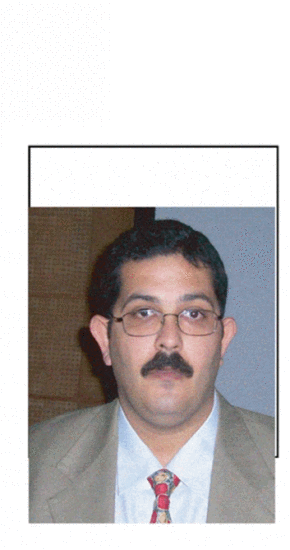 Ihsen Saad合作论文数3
 Salah Maouche合作论文数3Laetitia Jourdan合作论文数Université de Lille3




