which published December 18, 2023; 10.1073/pnas.2312962120 (Proc. Natl. Acad. Sci. Stanislav ?erna should be added to the author list between Katharina Fuchs and forming research in an early stage of the study, and Pascal Flohr and Cheryl A. Makarewicz should be credited with contributing data analysis and interpretation in The authors also note that the author names Marta dal Corso and Andreea Terna should The corrected author line, affiliation line, and author contributions appear below. The online version has been corrected. The SI Appendix has also been updated.
Four complex dual-chambered pottery firing kilns have been recently systematically excavated at the Cucuteni-Tripolye mega-site of Stolniceni in Northern Moldova. The data obtained from these investigations are corroborated with older and newer evidences from other sites and allow us to address wide problems such as technological and social context for specialized pottery firing on large Cucuteni-Tripolye settlements from the 4th millennium BC.
Besides its contribution to understanding the formation process of large settlements and complex social organization in the late period of Cucuteni-Trypillia, the site of Stolniceni (Republic of Moldova) provided new data on the construction and spatial distribution within the site of pottery kilns. The extensive magnetic surveys revealed a large settlement, with more than 350 burnt dwellings, hundreds of pits, ditches, paths, and 19 kilns. Of the latter, four were excavated during the 2016-2018 campaigns. Three kilns were more or less similar in terms of sizes and construction, belonging to the “simple”, dual chambered, updraught type. The best-preserved of them already served as model for a published experiment conducted in 2017 near the Stolniceni archaeological base. The fourth provided several surprising building features, like six additional holes arranged around the fire channels and communicating with them, and two small clay arches above the channels’ ends. A plausible hypothesis of the researchers is that these elements were meant to improve the draught, by increasing and uniformizing the circulation of hot air throughout the upper chamber. Thus, in order to test how this technological innovation acts on the firing efficiency, we conducted a new experiment (August-September 2020, Băiceni-Romania). The firing process and temperatures reached in this type of kiln proved the concern of prehistoric potters for continuous improvement of their craft, raising questions about the emergence and socio-economic implications of such innovations.
The two Linear Pottery culture lithic complexes presented in this paper came from northern Moldova. The Nicolaevca V assemblage was gathered from excavations of a small LBK dwelling, while the Ţâra II collection came from an eight-shaped pit. There was a “deposit” of objects suitable for knapping found in Nicolaevca V. This complex reflects flake-oriented expedient knapping. The Ţâra II complex represents a complicated sequence for obtaining regular blades. The interpretation of their differences is sought in the social organization of Neolithic flint-knapping, in which the Nicolaevca V lithic assemblage supposedly reflects domestic production in a household context, while Ţâra II products could have been involved in the exchange network.
The article addresses the problem of the organization of groups of houses in the Copper Age mega-sites regarding the western area of the Cucuteni-Tripolye culture distribution. Based on data from older excavations at the settlement of Brinzeni VIII in Northern Moldova, it is argued that differences in house areas may be reflected in the household inventories and, therefore, point to social differentiation. The necessity of targeted pit investigation as a valuable research tool for future investigations of the socio-economic structure of the mega-sites is argued.
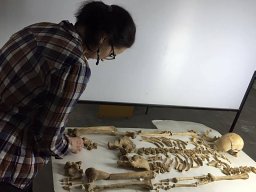
The Cucuteni-Trypillia complex (CTC) flourished in eastern Europe for over two millennia (5100–2800 BCE) from the end of the Neolithic to the Early Bronze Age. Its vast distribution area encompassed modern-day eastern Romania, Moldova and western/central Ukraine. Due to a lack of existing burials throughout most of this time, only little is known about the people associated with this complex and their genetic composition. Here, we present genome-wide data generated from the skeletal remains of four females that were excavated from two Late CTC sites in Moldova (3500–3100 BCE). All individuals carried a large Neolithic-derived ancestry component and were genetically more closely related to Linear Pottery than to Anatolian farmers. Three of the specimens also showed considerable amounts of steppe-related ancestry, suggesting influx into the CTC gene-pool from people affiliated with, for instance, the Ukraine Mesolithic. The latter scenario is supported by archaeological evidence. Taken together, our results confirm that the steppe component arrived in eastern Europe farming communities maybe as early as 3500 BCE. In addition, they are in agreement with the hypothesis of ongoing contacts and gradual admixture between incoming steppe and local western populations.
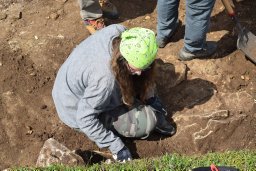
During extensive field work, different aspects of the large Tripolye settlement Stolniceni I in northwest Moldova were investigated by an international team. These investigations allow a reassessment of these population agglomerations from the first half of the 4th millennium BCE in Moldova and their comparison with more eastern Tripolye sites. The investigations carried out in 2017 included the completion of the archaeo-magnetic survey of the settlement and the targeted archaeological excavations of various types of contexts. Besides the investigation of a ditch enclosing the site and test trenches in different parts of the settlement, the excavations focused mainly on two areas in the north of the settlement: On the one hand, excavations were carried out in a pottery production complex, including the uncovering of a pottery kiln, several pits and a dwelling. On the other hand, one specific ‘ash-mound-like’ anomaly was investigated which are arranged in regular intervals at the periphery of the settlement. The archaeological excavations were accompanied by comprehensive archaeobotanical analyses, which provide an insight into the subsistence and wood selection in the settlement, as well as permitting environmental reconstructions. A larger series of 14C-datings proves the occupation of the settlement Stolniceni I over a longer period between about 3925 and 3700 BCE.
There are numerous Eneolithic settlements of the Cucuteni-Trypillia culture in North and Central Moldova. Its distribution ranges from the East of Romania via Moldova up to the Dnieper River. In Romania and Moldova settlements measure 10 to 30 ha, in Ukraine many are bigger than 100 ha. Indeed, these represent the largest settlements of Stone Age and Eneolothic Europe! During the 1970s and 1980s, Soviet Archaeologists started research on these by means of aerial photographs and magnetic prospections which has been continued by the Romano-Germanic Commission with their Moldovan and Ukrainian partners for a research project that started in 2009. Ahead of excavations, large-scale prospections have been conducted, first in Moldova and from 2011 onwards also in Ukraine. In 2017, the first aerial photographs of three of the most important sites in Moldova have been produced using drones. These pictures are being used foremost in order to create topographical maps and height models. Via the GIS based analysis of data it is possible to draw a more comprehensive picture of the phenomenon.
Geomagnetic research and drillings provide new results regarding settlement organisation and population size of three small settlements from the Pre-Cucuteni and Cucuteni AB period in the Suceva County in Romanian Bucovina. In these settlements from different stages of the Pre-Cucuteni complex domestic dwellings can be distinguished from clearly oversized (special?) buildings which are situated in central positions and which contain partly special inventories. Different principles of settlement organisation are visible which show each far-reaching references to the Central Balkans on the one hand and the Bug-Dnieper interfluve on the other hand. Consistently populations with less than 200 inhabitants are reconstructed based on analogies to other Cucuteni-Tripolye sites.
Our knowledge of the Bandkeramik (LBK) to the east of the Carpathian Mountains is rather limited, especially when compared to the level of scientific discourse reached in some western parts of the vast area of LBK's distribution. Therefore, it would seem useful to examine selected LBK settlements in western Ukraine and Moldova. Our research focused on the question of whether the full LBK package reached the easternmost area of distribution of the Bandkeramik, especially with regard to the longhouses that are so characteristic of this culture. Until recent years the existence of these structures was questioned by various scholars. Six sites with LBK layers were chosen for magnetometer survey, and on some of them additional test trenches were dug; evidence of earlier excavations was reconsidered. As a first result of our work, proof of the long-debated presence of longhouses could be established, mainly on the basis of parallel long pits. Most of the longhouses are orientated more or less NE-SW, which seems to be a common peculiarity of the eastern region. But at the same time, due to unfavourable soil conditions of the local chernozem, it was not possible to obtain detailed ground plans. Only in some cases could a limited number of postholes be detected. At the Bandkeramik settlement of Kamyane, situated on the right bank of the middle course of the Southern Bug river, abundant LBK material and some pottery fragments decorated in the style of the Romanian Dudesti Culture were unearthed during small-scale excavations. In the vicinity of the settlement a shoe-last adze was found whose raw material originated from the Iser Mountains of northern Bohemia. Hence, long-distance contacts were apparently also a key feature of the easternmost LBK sites.
Between 2014-2015, a joint Moldavian-German expedition undertook surface investigations, geophysical prospections and small-scale excavations on several LBK sites from the Republic of Moldova. This fieldwork allowed us to obtain unique data on the internal organization of Neolithic sites from the Prut-Dniester interfluve. The geomagnetic scans led to the identification of long houses, typical for the LBK from Central and Western Europe. Some of these complexes have been checked by small test-trenches. The geophysical plots also included some Copper Age structures overlapping the LBK ones. Thus, we have been able to obtain the first complete geophysical plan of a Precucuteni settlement from the territory of Moldova. The analysis of the data obtained from the field led to a reconsideration of some older conceptions regarding the architecture and internal organization of LBK settlements from the North-Western Black Sea region.
The small scale excavations conducted in 2016 on the site of Nicolaevca V had as objective to substantiate the existing interpretation of the geophysical plan and to date the anomalies from the two areas of the site. By making three archaeological excavations of various sizes we found out that the anomalies in the northern part of the settlement relate to the Precucuteni-Tripolye A stage of the Cucuteni-Tripolye culture, while the anomalies in the southern part date back to the Neolithic and belong to the Linear Pottery Culture. On the early Copper Age settlement there were partially investigated a large underground complex (probably dugout) and a burnt surface dwelling. The investigation of the Linear Pottery culture settlement allowed us to obtain a complete section of a longhouse with its inner space and two afferent long pits.
 Maciej Dębiec合作论文数Prehist & Early Hist, Univ Regensburg4
 Vornicu Andreea合作论文数4Johannes Müller合作论文数4
 Thomas Saile合作论文数4Robert Hofmann合作论文数4Knut Rassmann合作论文数3
 Mariana Vasilache合作论文数2
 Marta Dal Corso合作论文数CRC 1266 Scales of Transformation, Deutsche Forschungsgemeinschaft2Vitalii Rud合作论文数2
 Dmytro Kiosak合作论文数Dept Asian & North African Studies, CaFoscari Univ Venice2Martin Posselt合作论文数2
 Wiebke Kirleis合作论文数2Roman Scholz合作论文数1Galyna Pashkevych合作论文数1Liudmyla Shatilo合作论文数1
 Alexander Immel合作论文数1Oleg Šarov合作论文数1Constantin Aparaschivei合作论文数1Mila Shatilo合作论文数1
 Brunchi Radu合作论文数1
 Ghenadie Sirbu合作论文数Academy of Science of Moldova, the State University of Moldova1
 Casandra Brasoveanu合作论文数Alexandru Ioan Cuza University of Iași1
 Ana Drob合作论文数Dept Exact Sci & Nat Sci, Alexandru Ioan Cuza Univ1Hannes Knapp合作论文数1Julian Susat合作论文数Univ Kiel, Inst Clin Mol Biol, D-24105 Kiel, Germany1
 Katharina Fuchs合作论文数Univ Kiel, Inst Clin Mol Biol, Rosalind Franklin Str 12, D-24105 Kiel, Germany1
 Felix-Adrian Tencariu合作论文数Alexandru Ioan Cuza University of Iași1
 Angela Simalcsik合作论文数Olga Necrasov Ctr Anthropol Res, Romanian Acad1
 Dragana Filipovic合作论文数Inst Pre & Protohist, Univ Kiel1
 Mykhailo Yu Videiko合作论文数1Pascal Flohr合作论文数Department of Archaeology, University of Reading1
 Stefan Dreibrodt合作论文数1
 Ben Krause-Kyora合作论文数Graduate School Human Development in Landscapes, Christian-Albrechts-University Kiel1Almut Nebel合作论文数1Frank Schlütz合作论文数1Cheryl A. Makarewicz合作论文数Institute for Pre- and Protohistory, Christian-Albrechts-Universität1




