Bell inequalities limit the possible observations of non-communicating parties. Here, we present analogous inequalities for any number of communicating parties under the causal constraints of static causal order, definite causal order, and bi-causal order. All derived inequalities are remarkably simple. They correspond to upper bounds on the winning chance in graphical games: Given a specific directed graph over the parties, the parties are challenged to communicate along a randomly chosen arc. In the case of definite causal order, every game that we find is specified by a kefalopoda digraph. Based on this we define weakly causal correlations as those that satisfy all kefalopoda inequalities. We show that the problem of deciding whether some correlations are weakly causal is solvable in polynomial time in the number of parties.
A projective measurement cannot decrease the von Neumann entropy if the outcome is ignored. However, under certain sound assumptions and using the quantum violation of Leggett-Garg inequalities, we have previously demonstrated that this property is not inherited by a classical simulation of such a measurement process. In the simulation, a measurement erases prior information by partially resetting the system, suggesting that the quantum-state update following a measurement cannot be entirely epistemic. The erasure of information has been proved by assuming that the maximally mixed quantum state corresponds to maximal ignorance of the classical state. A more intricate proof employed the weaker hypothesis that the entropy is finite at some stage of the simulation. In this paper, we focus on the quantum-foundational implications of this theorem. We first provide a simple proof by directly using the second hypothesis. Second, we identify information erasure as the mechanism breaking the time symmetry in ontological theories. This symmetry break has been previously proved by Pusey and Leifer. Third, we show that information erasure, and thus symmetry break, can be avoided by employing a branching similar to many-worlds theory. The information flow and the time asymmetry are transferred to the measurement devices and the subsequent comparison of results, which inherently involve time-asymmetric processes. Thus, causality and the absence of information erasure suggest that measurements have multiple actual outcomes. Similarly, Deutsch and Hayden argued that Bell's theorem leads to the same conclusion if locality is given for granted. We conclude by showing that the problem of the clumsiness loophole in an experimental Leggett-Garg test of macrorealism is mitigated by the information-erasure theorem.
Quantum signal processing (QSP) is a framework which was proven to unify and simplify a large number of known quantum algorithms, as well as discovering new ones. QSP allows one to transform a signal embedded in a given unitary using polynomials. Characterizing which polynomials can be achieved with QSP protocols is an important part of the power of this technique, and while such a characterization is well-understood in the case of univariate signals, it is unclear which multivariate polynomials can be constructed when the signal is a vector, rather than a scalar. This work uses a slightly different formalism than what is found in the literature, and uses it to find simpler necessary conditions for decomposability, as well as a sufficient condition – the first, to the best of our knowledge, proven for a (generally inhomogeneous) multivariate polynomial in the context of quantum signal processing.
In statistical mechanics, entropy is defined as a fundamental quantity. However, its unit, J/K, involves that of temperature, which is only subsequently defined - and defined in terms of entropy. This circularity arises with the introduction of Boltzmann's constant into the very expression of entropy. The J/K carried by the constant prevents entropy from finding a unit of its own while simultaneously obfuscating its informational nature. Following the precepts of information theory, we argue that entropy is well measured in bits and coincides with information capacity at thermodynamic equilibrium. Consequently, not only is the temperature of a system in equilibrium expressed in J/bit, but it acquires a clear meaning: It is the cost in energy to increase its information capacity by 1 bit. Viewing temperature as joules per bit uncovers the strong duality exhibited by Gibbs long ago between available capacity and free energy. It also simplifies Landauer's cost and clarifies that it is a cost of displacement, not of erasure. Replacing the kelvin with the bit as an SI unit would remove Boltzmann's constant from the seven defining constants.
Causal models capture cause-effect relations both qualitatively-via the graphical causal structure-and quantitatively-via the model parameters. They offer a powerful framework for analyzing and constructing processes. Here, we introduce a tool-the flow of causal structures-to visualize and explore the dynamical aspect of classical-deterministic processes, arguably like those present in general relativity. The flow describes all possible ways in which the causal structure of a process can evolve. We also present an algorithm to construct its supergraph-the superflow-from the causal structure only, without invoking the model parameters. As an application, we show that if all leaves of a flow are trivial, then the corresponding process produces causal correlations only, i.e., correlations where future data cannot influence past events. This strengthens the result that processes, where every directed cycle in their causal structure is chordless, establish causal correlations only. We also discuss the main difficulties for the quantum generalization of the present algorithms.
Hidden-variable theories effectively solve the measurement problem. However, a serious issue of this route towards a realistic completion of quantum theory is raised by Bell's proof that the resulting theories are nonlocal. A possible resolution is to reject the assumption that measurements have single actual outcomes. Indeed, relaxing this premise, Deutsch and Hayden showed that Bell's theorem can be evaded by delaying the buildup of the correlations until the parties compare their outcomes at a meeting point. However, the Deutsch-Hayden theory, which is deterministic and psi-ontic, leads to an infinite information flow towards the meeting point. Furthermore, alternative branches are weighted by amplitudes, leading to interpretative issues. In this paper, we introduce a general framework that combines the randomness of single-world theories with the coexistence of diverse instances, as found in many-worlds theory. This framework incorporates the existing theories as limiting cases. We explore how this hybrid approach addresses key challenges of single-world and Deutsch-Hayden theories. On one hand, the multiplicity of coexisting instances allows us to circumvent nonlocality and, possibly, contextuality. On the other hand, randomness makes it possible to derive quantum probabilities from unweighted counts of instances and ensemble averages. Furthermore, it can lead to a reduction of the information flow. We illustrate this framework with a local model for two spatially separate maximally entangled qubits. The model requires two unweighted instances and a finite information flow – just one bit per measurement is communicated to the meeting point. Setting aside its foundational motivations, this framework has also relevance in quantum communication complexity and leads to novel technical questions, potentially providing new insights into some peculiarities of entanglement.
The Leggett-Garg inequalities were originally intro-duced for experimentally testing a possible break of the quantum evolution in meso scopic systems. In this paper, we take a different point of view by focusing on faithful classical simulations of sequential quantum measurements. In this context, the violation of Leggett-Garg inequalities implies that classically simulated quantum measurements induce perturbations into the subsequent evolution of the classical variables. We show that the implication is even stronger and a measurement erases previous information by performing a partial reset on the classical state. Thus, the measuring device acts as a low-temperature bath absorbing entropy from the measured system. Information erasure is a form of preparation contextuality. Our proof is straightforward if one assumes that maximal ignorance of the quantum state is compatible with maximal ignorance of the classical state. We also employ a weaker hypothesis.
Quantum measurements generally introduce perturbations into the subsequent evolution of the measured system. Furthermore, a projective measurement cannot decrease the uncertainty on the system if the outcome is ignored; that is, the von Neumann entropy cannot decrease. However, under certain sound assumptions and using the quantum violation of Leggett-Garg inequalities, we demonstrate that this property is not inherited by a faithful classical causal simulation of a measurement process. In the simulation, a measurement erases previous information by performing a partial reset on the system. Thus, the measuring device acts as a low-temperature bath absorbing entropy from the measured system. Information erasure is a form of Spekkens' preparation contextuality. Our proof is straightforward if one assumes that maximal ignorance of the quantum state is compatible with maximal ignorance of the classical state. We also employ a weaker hypothesis. Information erasure is related to a theorem of Leifer and Pusey, which states that time symmetry implies retrocausality. In light of our findings, we discuss Spekkens' preparation contextuality, as well as a weakness in the hypothesis of time symmetry as defined by Leifer and Pusey.
Boltzmann's constant reflects a historical misunderstanding of the concept of entropy, whose informational nature is obfuscated when expressed in J/K. We suggest that the development of temperature and energy, historically prior to that of entropy, does not amount to their logical priority: Temperature should be defined in terms of entropy, not vice versa. Following the precepts of information theory, entropy is measured in bits, and coincides with information capacity at thermodynamic equilibrium. Consequently, not only is the temperature of an equilibrated system expressed in J/bit, but it acquires an operational meaning: It is the cost in energy to increase its information capacity by 1 bit. Our proposal also supports the notion of available capacity, analogous to free energy. Finally, it simplifies Landauer's cost and clarifies that it is a cost of displacement, not of erasure.
We discuss a simple toy model which allows, in a natural way, for deriving central facts from thermodynamics such as its fundamental laws, including Carnot’s version of the second principle. Our viewpoint represents thermodynamic systems as binary strings, and it links their temperature to their Hamming weight. From this, we can reproduce the possibility of negative temperatures, the notion of equilibrium as the coïncidence of two notions of temperature — statistical versus structural —, as well as the zeroth law of thermodynamics (transitivity of the thermal-equilibrium relation), which we find to be redundant, as other authors, yet at the same time not to be universally valid.
We propose one of the very few constructive consequences of the second law of thermodynamics. More specifically, we present protocols for secret-key establishment and multiparty computation the security of which is based fundamentally on Landauer's principle. The latter states that the erasure cost of each bit of information is at least kTln2 (where k is Boltzmann's constant and T is the absolute temperature of the environment). Albeit impractical, our protocols explore the limits of reversible computation, and the only assumption about the adversary is her inability to access a quantity of free energy that is exponential in the one of the honest participants. Our results generalize to the quantum realm.
In line with advances in recent years about realizing cryptographic functionalities in an information-theoretically secure way from physical phenomena and laws, we propose here to obtain useful tasks from the sole assumption of limited free energy. Specifically, based on that assumption -- resulting in a setting loosely related to Maurer's bounded-storage model -- we derive protocols for unconditional proofs-of-thermodynamical-work, secret sharing of free energy, unforgeable money, and proofs-of-position. While our schemes can be considered classical and not quantum per se, they are resistant against both classes of adversaries.
New algorithms for prime factorization that outperform the existing ones or take advantage of particular properties of the prime factors can have a practical impact on present implementations of cryptographic algorithms that rely on the complexity of factorization. Currently used keys are chosen on the basis of the present algorithmic knowledge and, thus, can potentially be subject to future breaches. For this reason, it is worth to investigate new approaches which have the potentiality of giving a computational advantage. The problem has also relevance in quantum computation, as an efficient quantum algorithm for prime factorization already exists. Thus, better classical asymptotic complexity can provide a better understanding of the advantages offered by quantum computers. In this paper, we reduce the factorization problem to the search of points of parametrizable varieties, in particular curves, over finite fields. The varieties are required to have an arbitrarily large number of intersection points with some hypersurface over the base field. For a subexponential or poly- nomial factoring complexity, the number of parameters have to scale sublinearly in the space dimension n and the complexity of computing a point given the parameters has to be subexponential or polynomial, respectively. We outline a procedure for building these varieties, which is illustrated with two constructions. In one case, we show that there are varieties whose points can be evaluated efficiently given a number of parameters not greater than n/2. In the other case, the bound is dropped to n/3. Incidentally, the first construction resembles a kind of retro-causal model. Retro-causality is considered one possible explanation of quantum weirdness.
The CHSH no-signalling game studies Bell nonlocality by showcasing a gap between the win rates of classical strategies, quantum-entangled strategies, and no-signalling strategies. Similarly, the CHSH* single-system game explores the advantage of irreversible processes by showcasing a gap between the win rates of classical reversible strategies, quantum reversible strategies, and irreversible strategies. The irreversible process of erasure rules supreme for the CHSH* single-system game, but this erasure advantage does not necessarily extend to every single-system game: We introduce the 32-Game, in which reversibility is irrelevant and only the distinction between classical and quantum operations matters. We showcase our new insight by modifying the CHSH* game to make it erasure-immune, while conserving its quantum advantage. We conclude by the reverse procedure: We tune the 32-Game to make it erasure-vulnerable, and erase its quantum advantage in the process. The take-home message is that, when the size of the single-system is too small for Alice to encode her whole input, quantum advantage and erasure advantage can happen independently.
Can normal science-in the Kuhnian sense-add something substantial to the discussion about the measurement problem? Does an extended Wigner's-friend Gedankenexperiment illustrate new issues? Or a new quality of known issues? Are we led to new interpretations, new perspectives, or do we iterate the previously known? The recent debate does, as we argue, neither constitute a turning point in the discussion about the measurement problem nor fundamentally challenge the legitimacy of quantum mechanics. Instead, the measurement problem asks for a reflection on fundamental paradigms of doing physics.
The measurement problem is seen as an ambiguity of quantum mechanics, or, beyond that, as a contradiction within the theory: Quantum mechanics offers two conflicting descriptions of the Wigner's-friend experiment. As we argue in this note there are, however, obstacles from within quantum mechanics and regarding our perspective onto doing physics towards fully describing a measurement. We conclude that the ability to exhaustively describe a measurement is an assumption necessary for the common framing of the measurement problem and ensuing suggested solutions.
In view of the importance of quantum non-locality in cryptography, quantum computation, and communication complexity, it is crucial to decide whether a given correlation exhibits non-locality or not. As proved by Pitowski, this problem is NP-complete, and is thus computationally intractable unless NP is equal to P. In this paper, we first prove that the Euclidean distance of given correlations from the local polytope can be computed in polynomial time with arbitrary fixed error, granted the access to a certain oracle; namely, given a fixed error, we derive two upper bounds on the running time. The first bound is linear in the number of measurements. The second bound scales with the number of measurements to the sixth power. The former holds only for a very high number of measurements, and is never observed in the performed numerical tests. We, then, introduce a simple algorithm for simulating the oracle. In all of the considered numerical tests, the simulation of the oracle contributes with a multiplicative factor to the overall running time and, thus, does not affect the sixth-power law of the oracle-assisted algorithm.
Results of measurements give legitimacy to a physical theory. What if acquiring these results in the first place necessitates what the same theory considers to be an interaction? In this note, we assume that theories account for interactions so that they are empirically traceable, and that observations necessarily go with such an interaction with the observed system. We investigate consequences of this assumption, and the unfolding language game leads us to contextual and probabilistic theories. Contextuality becomes a means to render interactions, thus also measurements, empirically tangible. The measurement becomes problematic if one tries to commensurate the interaction assumption with the notion of a spectator theory. The measurement "problem" is, thus, the collision of different epistemologic stances.
Starting from Landauer's slogan "information is physical," we revise and modify Landauer's principle stating that the erasure of information has a minimal price in the form of a certain quantity of free energy. We establish a direct link between the erasure cost and the work value of a piece of information and show that the former is essentially the length of the string's best compression by a reversible computation. We generalize the principle by deriving bounds on the free energy to be invested for-or gained from, for that matter-a general computation. We then revisit the second law of thermodynamics and compactly rephrase it (assuming the Church-Turing-Deutsch hypothesis that physical reality can be simulated by a universal Turing machine): Time evolutions are logically reversible-"the future fully remembers the past (but not necessarily vice versa)." We link this view to previous formulations of the second law, and we argue that it has a particular feature that suggests its "logico-informational" nature, namely, simulation resilience: If a computation faithfully simulates a physical process violating the law, then that very computation procedure violates it as well.
 Ueli Maurer合作论文数Institute of Theoretical Computer Science, Department of Computer Science, Eidgenössische Technische Hochschule Zürich20
 Renato Renner合作论文数Institute for Theoretical Physics, Department of Physics, Eidgenössische Technische Hochschule Zürich19
 Alberto Montina合作论文数Dipartimento di Fisica, Università di Firenze15
 Ämin Baumeler合作论文数Faculty of Informatics, Università Della Svizzera Italiana11Jürg Wullschleger合作论文数10
 Esther Hänggi合作论文数Computer Science Department, ETH Zurich9Xavier Coiteux-Roy合作论文数Fac Informat, Univ Svizzera Italiana7
 Gilles Brassard合作论文数Department of Computer Science and Operations Research, Faculty of Arts and Science, Université de Montréal6Wullschleger, J.合作论文数5
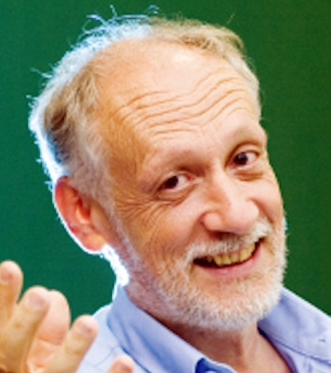 Nicolas Gisin合作论文数Department of Applied Physics, University of Geneva5Aemin Baumeler合作论文数4
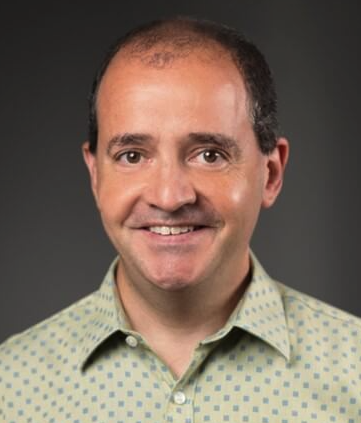 Valerio Scarani合作论文数Department of Physics, Faculty of Science, National University of Singapore;Centre for Quantum Technologies, National University of Singapore4Matthias Fitzi合作论文数Department of Computer Science;Swiss Federal Institute of Technology;Department of Computer Science, Swiss Federal Institute of Technology4
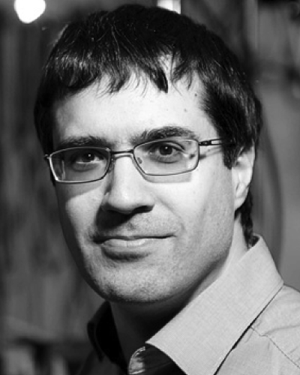 André Stefanov合作论文数Group of Applied Physics, University of Geneva4
 Severin Winkler合作论文数ETH Zurich4Manuel Forster合作论文数3Charles Alexandre Bédard合作论文数3
 Sacha Schwarz合作论文数Infinite Potential Labs LP, 485 Wes Graham Way, Waterloo, ON N2L A07, Canada3
 Banz Bessire合作论文数3Ebbe, H.合作论文数3
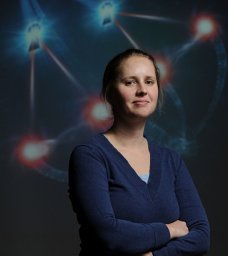 Anne Broadbent合作论文数Departement IRO;Universite de Montreal;Departement IRO, Universite de Montreal3A Sahai合作论文数2Benno Salwey合作论文数2adrien feix合作论文数2
 Anna Lysyanskaya合作论文数Department of Computer Science, Brown University2
 Alain Tapp合作论文数DIRO, Universite de Montreal2
 Yeong-Cherng Liang合作论文数Group of Applied Physics;University of Geneva;Group of Applied Physics, University of Geneva2
 Andre Allan Methot合作论文数2
 Claude Crépeau合作论文数School of Computer Science, McGill University2
 Sandu Popescu合作论文数School of Physics, University of Bristol2
 Ronald L. Rivest合作论文数Department of Electrical Engineering and Computer Science, Massachusetts Institute of Technology2
 Christian Anton合作论文数1Veronika Baumann合作论文数1Marcell Pfaffhauser合作论文数1Carla Rieger合作论文数Department of Physics, Eidgenössische Technische Hochschule1
 Wolfgang M. Heckl合作论文数School of Education, Technische Universität München1Skripsky, J.合作论文数1
 Markus Aspelmeyer合作论文数Faculty of Physics, University of Vienna;Institute for Quantum Optics and Quantum Information Vienna, Austrian Academy of Sciences1
 Viktor Galliard合作论文数1
 Manfred Bayer合作论文数Department of Physics, TU Dortmund University1
 Christian Bernhard合作论文数Department of Physics, University of Fribourg1
 Fedor Jelezko合作论文数Institute for Quantum Optics, Ulm University;Department of Physics, Ulm University1
 Gerd Leuchs合作论文数Institut für Optik, Information und Photonik, Department Physik, Naturwissenschaftliche Fakultät, Friedrich-Alexander-Universität Erlangen-Nürnberg1
 Peter Hänggi合作论文数Institute of Physics, Faculty of Mathematics, Natural Sciences, and Materials Engineering, University of Augsburg1
 Harald Fuchs (哈罗德·富克斯)合作论文数Physical Institute, University of Münster;Center of Nanotechnology, University of Münster;Institute of Nanotechnology, Karlsruhe Insitute of Technology1Pfaffhauser M合作论文数1
 Bernhard Keimer合作论文数Department of Solid State Spectroscopy, Max Planck Institute for Solid State Research;University of Stuttgart;Max-Planck-Institut für Festkörperforschung1
 Kurt Schönhammer合作论文数Institut für Theoretische Physik, Universität Göttingen1
 Christine Silberhorn合作论文数Paderborn University1




