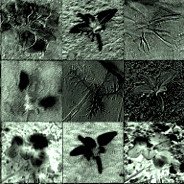
A database of images of approximately 960 unique plants belonging to 12 species at several growth stages is made publicly available. It comprises annotated RGB images with a physical resolution of roughly 10 pixels per mm. To standardise the evaluation of classification results obtained with the database, a benchmark based on $f_{1}$ scores is proposed. The dataset is available at this https URL
The stricter legislation within the European Union for the regulation of herbicides that are prone to leaching causes a greater economic burden on the agricultural industry through taxation. Owing to the increased economic burden, research in reducing herbicide usage has been prompted. High-resolution images from digital cameras support the studying of plant characteristics. These images can also be utilized to analyze shape and texture characteristics for weed identification. Instead of detecting weed patches, weed density can be estimated at a sub-patch level, through which even the identification of a single plant is possible. The aim of this study is to adapt the monocot and dicot coverage ratio vision (MoDiCoVi) algorithm to estimate dicotyledon leaf cover, perform grid spraying in real time, and present initial results in terms of potential herbicide savings in maize. The authors designed and executed an automated, large-scale field trial supported by the Armadillo autonomous tool carrier robot. The field trial consisted of 299 maize plots. Half of the plots (parcels) were planned with additional seeded weeds; the other half were planned with naturally occurring weeds. The in-situ evaluation showed that, compared to conventional broadcast spraying, the proposed method can reduce herbicide usage by 65% without measurable loss in biological effect.
SummaryNon‐destructive assessment of herbicide effects may be able to support integrated weed management. To test whether effects of herbicides on canopy variables could be detected by sensors, two crops were used as models and treated with herbicides at BBCH 20 using a logarithmic sprayer. Twelve days after spraying at BBCH 25 and 42 days after sowing, nine sensor systems scanned a spring barley and an oilseed rape field experiment sown at different densities and sprayed with increasing field rates of glyphosate and tribenuron‐methyl. The objective was to compare ED50s for crops and weeds derived by the different sensors in relation to crop density and herbicides. Although sensors were not directly developed to detect herbicide symptoms, they all detected changes in canopy colours or height and crop density. Generally ED50s showed the same pattern in response to crop density within herbicide, but there were marked differences between barley and oilseed rape. We suggest that the results of comparing the various sensor outputs could become a stepping stone to future standardisation for the benefit of the research and development of sensors that will detect herbicide effect on crops and weeds, particularly at the most vulnerable stages of development of the canopy.
The aim of this research is an improvement of plant seedling recognition by two new approaches of shape feature generation based on plant silhouettes. Experiments show that the proposed feature sets possess value in plant recognition when compared with other feature sets. Both methods approximate a distance distribution of an object, either by resampling or by approximation of the distribution with a high degree Legendre polynomial. In the latter case, the polynomial coefficients constitute a feature set. The methods have been tested through a discrimination process where two similar plant species are to be distinguished into their respective classes. The used performance assessment is based on the classification accuracy of 4 different classifiers (a k-Nearest Neighbor, Naive-Bayes, Linear Support Vector Machine, Nonlinear Support Vector Machine). Another set of 21 well-known shape features described in the literature is used for comparison. The used data consisted of 139 samples of cornflower (Centaura cyanus L.) and 63 samples of nightshade (Solanum nigrum L.). The highest discrimination accuracy was achieved with the Legendre Polynomial feature set and amounted to 97.5%. This feature set consisted of 10 numerical values. Another feature set consisting of 21 common features achieved an accuracy of 92.5%. The results suggest that the Legendre Polynomial feature set can compete with or outperform the commonly used feature sets.
Successful intra-row mechanical weed control of sugar beet (beta vulgaris) in early growth stages requires precise knowledge about location of crop plants. A computer vision system for locating plant stem emerging point (PSEP) of sugar beet in early growth stages was developed and tested. The system is based on detection of individual leaves; each leaf location is then described by centre of mass and petiole location. After leaf detection were the true PSEP locations annotated manually and a multivariate normal distribution model of the PSEP relative to the located leaf was built. From testing the system, PSEP estimates based on a single leaf have an average error of similar to 3 mm. When several leaves are detected the average error decreases to less than 2 mm. (C) 2011 IAgrE. Published by Elsevier Ltd. All rights reserved.
 Rasmus Nyholm Jørgensen合作论文数7
 Henrik Midtiby合作论文数7
 Kjeld Jensen合作论文数SDU UAS MMMI, University of Southern Denmark3
 Morten Stigaard Laursen合作论文数Dept Engn DK, Aarhus Univ3
 Christian Andreasen合作论文数Department of Plant and Environmental Sciences, Faculty of Science, University of Copenhagen2
 jesper svensgaard合作论文数Faculty of Science, University of Copenhagen2P. Hamouz合作论文数2
 Gerassimos Peteinatos合作论文数Hellenic Agricultural Oranization;Institut für Phytomedizin, University of Hohenheim2Svend Christensen合作论文数Faculty of Life Sciences, University of Copenhagen2
 Jens Carl Streibig合作论文数Institut for Plante- og Miljøvidenskab, Københavns Universitet2
 Demos Chachalis合作论文数2Dionisio Andujar合作论文数2
 Peter Kryger Jensen合作论文数2Roland Gerhards合作论文数2
 Therese With Berge合作论文数1claes lund jaegerhansen合作论文数1
 Jesper Rasmussen合作论文数Department of Plant and Environmental Sciences, Exercise and Sports, Faculty of Science, University of Copenhagen1martin weis合作论文数1matthew c keller合作论文数1J. Nielsen合作论文数1M. Weis合作论文数1
 Mads Dyrmann合作论文数Aarhus University1
 Martin P. Christiansen合作论文数1
 Hannes Nordmeyer合作论文数1Nielsen Jon T合作论文数1A. Papadopoulos合作论文数1
 Anders Krogh Mortensen合作论文数Danish National Research Foundation Center for Quantum Optics, University of Aarhus1




