The second part of the review on dust structures (the first part was published in Plasma Phys. Rep. 39, 515 (2013)) is devoted to experimental and theoretical studies on the stability of structures and their formation from the initially uniform dusty plasma components. The applicability limits of theoretical results and the role played by nonlinearity in the screening of dust grains are considered. The importance of nonlinearity is demonstrated by using numerous laboratory observations of planar clusters and volumetric dust structures. The simplest compact agglomerates of dust grains in the form of stable planar clusters are discussed. The universal character of instability resulting in the structurization of an initially uniform dusty plasma is shown. The fundamental correlations described in the first part of the review, supplemented with effects of dust inertia and dust friction by the neutral gas, are use to analyze structurization instability. The history of the development of theoretical ideas on the physics of the cluster formation for different types of interaction between dust grains is described.
Dust structuring is a natural and universal process in complex plasmas. The scattering of electromagnetic waves by dust structures is governed by the factor of coherency, i.e., the total number of coherent electrons in a single structure. In the present paper, we consider how the factor of coherency changes due to additional pulse electron heating and show that it obeys a hysteresis. After the end of the pulse heating, the scattering intensity differs substantially from that before heating. There are three necessary conditions for scattering hysteresis: first, the radiation wavelength should be larger than the pattern (structure) size; second, the total number of coherent electrons confined by the structure should be large; and third, the heating pulse duration should be shorter than the characteristic time of dust structure formation. We present the results of numerical calculations using existing models of self-consistent dust structures with either positively or negatively charged dust grains. It is shown that, depending on the grain charge and the ionization rate, two types of hysteresis are possible: one with a final increase of the scattering and the other with a final decrease of the scattering. It is suggested that the hysteresis of coherent scattering can be used as a tool in laboratory experiments and that it can be a basic mechanism explaining the observed hysteresis in radar scattering by noctilucent clouds during active experiments on electron heating in mesosphere. (C) 2015 AIP Publishing LLC.
It is demonstrated explicitly that the scattering of electromagnetic waves by dust structures can be strongly enhanced as compared to incoherent scattering by random electrons. If the size of the dust structure is much less than the wavelength of the incident radiation, the scattering is coherent. In this case, the scattering is proportional to the square of the total number of electrons in the structure. In the opposite limit, the scattering is incoherent being proportional to the total number of electrons in the structure. The factor describing the degree of coherency is calculated numerically for several models of self-organized structures. It is demonstrated in general way that for sudden heating of electrons, the factor of coherency in scattering by structures can decrease by several orders of magnitude with subsequent increase after the heating is switched off. In laboratory dusty plasmas, the coherent scattering is proposed for diagnostics of universal structuring instability and as a probe for determining the properties typical for self-organized nature of structures that are observed in recent experiments.
We review research aimed at understanding the phenomena occurring in a complex plasma under microgravity conditions. Some aspects of the work already performed are considered that have not previously been given sufficient attention but which are potentially crucial for future work. These aspects, in particular, include the observation of compact dust structures that are estimated to be capable of confining all components of a dust plasma in a bounded spatial volume; experimental evidence of the nonlinear screening of dust particles; and experimental evidence of the excitation of collective electric fields. In theoretical terms, novel collective attraction processes between likely charged dust particles are discussed and all schemes of the shadowy attraction between dust particles used earlier, including in attempts to interpret observations, are reviewed and evaluated. Dust structures are considered from the standpoint of the current self-organization theory. It is emphasized that phase transitions between states of self-organized systems differ significantly from those in homogeneous states and that the phase diagrams should be constructed in terms of the parameters of a self-organized structure and cannot be constructed in terms of the temperature and density or similar parameters of homogeneous structures. Using the existing theoretical approaches to modeling self-organized structures in dust plasmas, the parameter distribution of a structure is recalculated for a simpler model that includes the quasineutrality condition and neglects diffusion. These calculations indicate that under microgravity conditions, any self-organized structure can contain a limited number of dust particles and is finite in size. The maximum possible number of particles in a structure determines the characteristic inter-grain distance in dust crystals that can be created under microgravity conditions. Crystallization criteria for the structures are examined and the quasispherical chambers proposed for future experiments are discussed.
An explanation is proposed for the recently discovered effect of spontaneous dusty plasma structuring (and the appearance of compact dust structures) under conditions of nonlinear dust screening. Physical processes are considered that make homogenous dusty plasma universally unstable and lead to the appearance of structures. It is shown for the first time that the efficiency of structuring increases substantially in the presence of plasma flows caused by the charging of nonlinearly screened dust grains. General results are obtained for arbitrary nonlinear screening, and special attention is paid to the model of nonlinear screening often used since 1964. The growth rate of structuring instability is derived. It is shown that, in the case of nonlinear screening, the structuring has a threshold determined by the friction of grains against the neutral gas. The theoretically obtained threshold agrees with recent experimental observations. The dispersion relation for dusty plasma structuring is shown to be similar to the dispersion relation for gravitational instability with an effective gravitational constant. The effective dust attraction caused by this instability is shown to be collective, and the dependence of the effective gravitational constant on the dust-to-ion density ratio is found explicitly for the first time. It is demonstrated that the proposed method of calculation of dust attraction by using the effective gravitational constant is the most efficient and straightforward. Understanding of the role of nonlinear screening gives deeper physical grounds for the theoretical interpretation of the observed phenomenon of dust crystal formation in complex plasmas.
are normalized to unity: (v) v (v) v 1 f d d Equation (2) describes the relay-race ion transport; this model was proposed by L. A. Sena [1, 2]. According to the model, the ion velocity after collision is equal to the velocity of the atom with which it collided. This model neglects a change in the atom velocity during collision. To consider the effect of collisions, the Bhatnagar, Gross, Krook ( BGK ) model integral is often used to describe the relaxation of the ion distribution to the equilibrium distribution function of atoms with a characteristic relaxation time, which is assumed constant:
The scattering of a wave by an individual particle is due to the fact that the particle oscillates in the field of the incident wave and these oscillations radiate the scattered wave. It is usually believed that scattering in a plasma, even though the cross section in it is on the order of the Thomson scattering cross section in a vacuum, takes place by plasma density fluctuations, which also involve ions, so that the total scattered radiation is not the sum of Thomson scattering by individual electrons. Although the scattering formulas widely used in processing observations are correct, their interpretation often is not. This note proves rigorously that scattering in a plasma is the sum of the scattering from the electrons and ions, with the total momentum difference between the incident and scattered waves being distributed among the electrons and ions, and that it is only based on this interpretation that we can obtain the conservation laws for waves and particles in the plasma. General physical, astrophysical, and other implications of the correct interpretation of scattering processes for radiation frequencies much larger than the plasma frequency are discussed.
Дана история развития теоретических представлений о физике неустойчивости однородной пылевой плазмы относительно ее структуризации, т.е. возникновения сгущений и разрежений плотности пылевых частиц и их концентрации в различные структуры, которые наблюдались в лабораторной плазме и в условиях микрогравитации. Обсуждаются теоретические модели компактных пылевых структур, которые могут появляться на нелинейной стадии структуризационной неустойчивости, и модели системы войдов как окружающих компактные структуры, так и образующихся в центре структур. Возможны два типичные размера структур: меньше или больше характерной длины свободного пробега ионов плазменных потоков. И первые, и вторые могут иметь достаточно регулярные распределения пылевых частиц, но первые, как правило, требуют внешнего удержания, а вторые могут быть самоподдерживающимися (что представляет отдельный интерес). В данном обзоре они названы пылевыми кластерами и самоорганизованными пылевыми структурами соответственно. Для обоих типов структур существенны новые физические процессы, которые возникают только при наличии пылевой компоненты. Роль нелинейностей в экранировании пылевых частиц большого заряда, часто встречающихся в современных лабораторных экспериментах, оказывается весьма большой, но раньше она не исследовалась. Хотя структуризация возникает как при линейном, так и при нелинейном экранировании, она может сильно различаться в лабораторных и в астрофизических условиях. Исследования по нелинейному экранированию больших зарядов в плазме были начаты несколько десятилетий тому назад, однако до сих пор этот фактор почти не учитывается при интерпретации процессов, происходящих в лабораторной пылевой плазме.
X-ray and extreme ultraviolet emission from galaxy clusters can be interpreted as thermal emission from a hot plasma gravitationally bound to the cluster and constituting a significant amount of the mass of the cluster. The origin of this plasma and its thermal energy content can be linked to the formation process through the theory of self-organization of these structures.
Dust structurization is considered to be typical for complex plasmas. Homogeneous dusty plasmas are shown to be universally unstable. The dusty plasma structurization instability is similar to the gravitational instability and can results in creation of different compact dust structures. A general approach for investigation of the nonlinear stage of structurization in dusty plasmas is proposed and master equations for the description of self-organized structures are formulated in the general form that can be used for any nonlinear model of dust screening. New effects due to the scattering of ions on the nonlinearly screened grains are calculated: nonlinear ion dust drag force and nonlinear ion diffusion. The physics of confinement of dust and plasma components in the equilibria of compact dust structures is presented and is supported by numerical calculations of master equations. The necessary conditions for the existence of equilibrium structures are found for an arbitrary nonlinearity in dust screening. Features of compact dust structures observed in recent experiments agree with the numerically calculated ones. Some proposals for future experiments in spherical chamber are given.
The model of collisions of ions with gas atoms, considering resonant charge exchange of ions, polarization and elastic (gas-kinetic) interactions is constructed. Ion drift characteristics in the dc electric field are calculated. The results are compared to calculations based on the Bhatnagar-Gross-Krook model collision integral (BGK integral). It is shown that the use of the BGK collision integral leads to significant errors due to the specificity of ion-atom collisions.
1367-2630/9/8/263. [ 15 ]http://peswiki.com/index.php/Directory:Stanley_Meyer [ 16 ]http://www.rense.com/health/rife.htm
1367-2630/9/8/263. [ 17 ] Paula Peterson, “Viewing the Inner Life of Plants” An interview with Dr. Konstantin Korotkov (date not provided) http://www.spiritofmaat.com/archive/aug3/korotkov.htm [ 18 ] Sir Roger Penrose FRS & S. Hameroff MD, “Consciousness in the Universe: Neuroscience, Quantum Space-Time Geometry & Orch OR Theory” Journal of Cosmology, Vol 14. In press (2011) http://journalofcosmology.com/
We consider quantum collective effects in astrophysical plasmas. Both stimulated and spontaneous quantum effects are shown to be of the same order of magnitude or larger than the relativistic corrections related to the "comptonization" processes.
Self‐organized dust structures are investigated using a Gurevich‐Parker model for non‐linear dust screening. The non‐linear dust drag coefficients and non‐linear diffusion coefficients are calculated numerically as functions of nonlinear parameter for screening, dust density and ion flux drift velocity. Nonlinear ion dust drag inside the structures creates an electric field with potential well for ions at the structure center. The equilibrium dust structures confine both the dust grains and the plasma particles, have a finite size and have inside an enhanced dust and ion densities. The necessary conditions for existence of equilibrium dust structures are found. The equilibrium dust structures are determined by two global parameters related to the external plasma flux and to the power of ionization. The equilibrium exist only in a restricted phase space of these two parameters and depends on the the drag coefficient at the structure center. The equilibrium requirements are found using non‐linear drag coefficient calculated numerically. It is shown that this phase space area can be broad but it is systematically decreasing with an increase of the ionization rate. It is found that equilibrium exists for dust structures with large dust and ion density concentration at the center and that for these structures the ion diffusion is strongly suppressed by ion scattering on non‐linearly screened grains. The results of the theory can be used to interpret the recently observed compact dust structures in micro‐gravity experiments and can provide some recommendations for future micro‐gravity experiments in spherical chambers (© 2011 WILEY‐VCH Verlag GmbH & Co. KGaA, Weinheim)
Basic equations for dust structures are formulated that account for the balance of the forces, plasma fluxes, and grain charges with allowance for nonlinearity in the screening of individual grains and possible violation of quasineutrality due to the interaction of collective fields with plasma fluxes. A theory of non-linear drag forces exerted by plasma fluxes on dust grains is developed for moderate drift flux velocities, higher than the mean ion thermal velocity but much lower than the acoustic speed. It is shown that equilibrium dust structures have finite sizes and negative charges and that they can exist only in a certain range of intensities of external fluxes on their surfaces. When there is no additional volume ionization, the size of the structures is determined by the intensity of the external flux. A study is made of a weakly ionized dusty plasma in which the interaction of its components with neutral gas atoms plays a major role. The ion, electron, and dust density distributions, as well as the distributions of the dust grain charges and plasma fluxes, are calculated self-consistently as functions of the distance from the center of a structure.
A study is made of how equilibrium spherical dust structures depend on the volume ionization power, the neutral gas pressure, the number of trapped dust grains, and the ion-to-electron temperature ratio. It is shown that the structures are charged negatively and their charge is determined by the floating potential, which depends on the radius of the structure and on the ion temperature. The structures are charged mainly by absorbing a plasma flux. Conditions are determined under which the polarization fields and charges out-side the structures change sign, indicating the presence of overscreening effects, previously known only for individual dust grains. It is shown that overscreening outside the structures results exclusively from the plasma fluxes that are generated by the structure itself and are required to maintain it in equilibrium.
Although a general description of the pair grain interaction can be directly obtained from fluctuations of grain distributions and grain pair correlation function, we prefer here to give a simple description of the collective interaction using the model of a “test” grain in a “sea” of all other grains. In the limit of linear fluctuations this can lead to a direct description of the grain interaction in the presence of many grains (with collective effects included) for β ≪ 1. But using this approach we will also be able to demonstrate how the non-linearity changes the collective interaction for β ≫ 1.
 Sergei Vladimirovich Vladimirov合作论文数School of Physics, The University of Sydney/Joint Institute for High Temperatures, Russian Academy of Sciences47
 Robert Bingham合作论文数rutherford appleton laboratory46U Deangelis合作论文数23U de Angelis合作论文数20F. Kh. Khakimov合作论文数20
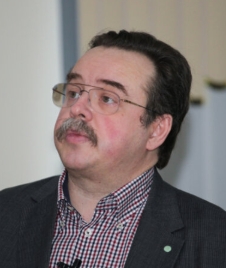 Sergey Popel合作论文数Faculty of Physics, Russian Academy of Sciences;Department of Space Physics, Russian Academy of Sciences;Space Research Institute, Russian Academy of Sciences16A. Forlani合作论文数14
 Hubertus Thomas合作论文数Institute of Materials Physics in Space, Deutsches Zentrum für Luft-und Raumfahrt e.V.13Fotekh Kh. Khakimov合作论文数12V. A. Liperovskii合作论文数10v v g makhankov合作论文数9
 Gregor Morfill合作论文数9Sergey I. Popel合作论文数8k komilov合作论文数7V.G. Makhankov合作论文数6
 Lennart Stenflo合作论文数Department of Physics, Chemistry and Biology, Linköping University6Gregor E. Morfill合作论文数6Gregory Morfill合作论文数6
 N. G. Gusein-Zade合作论文数6Alexander S Chikhachev合作论文数6N. G. Gusein-zade合作论文数5solomon borisovich pikelner合作论文数5Tsytovic.Vn合作论文数5JM DAWSON合作论文数5Vs Krivitskii合作论文数5
 Pradeep Kumar Shukla合作论文数Ruhr Univ Bochum5
 O. Havnes合作论文数5M. Khakimova合作论文数5n g gouseinzade合作论文数4A. A. Veryaev合作论文数4Vladimir S. Ptuskin合作论文数4Alexander Ignatov合作论文数4Ve Fortov合作论文数3b a klumov合作论文数3Boris B Kadomtsev合作论文数3
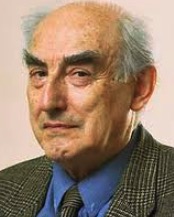 Vitaly L. Ginzburg合作论文数P.N.Lebedev Physical Institute, Russian Academy of Sciences3Ya. K. Khodataev合作论文数3J. G. Lominadze合作论文数3Yu. A. Nikolaev合作论文数Ioffe Physical-Technical Institute, Russian Academy of Sciences3B G Shchinov合作论文数3
 Vladimir Mikhailovich Tomozov合作论文数3Sadruddin Benkadda合作论文数International Institute for Fusion Science, CNRS - Université de Provence3Hans Wilhelmsson合作论文数3
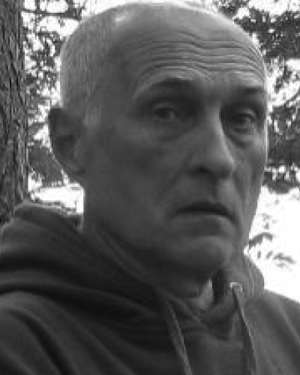 V. P. Tarakanov合作论文数3H Wilhelmsson合作论文数2Sa Belkov合作论文数2L.M. Ozernoi合作论文数2




