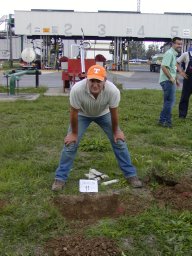
Eksploataciju nafte u svim dionicama, o pocetnih radova rudarskog busenja do izgradnje sustava za otpremu - podzemne mreže naftovoda, prate zahvati i postupci rizicni za okolis. Premda suvremena tehnicka rjesenja i suvremeni materijali koje koristi INA – Naftaplin u svim dionicama pružaju visok stupanj jamstva sigurnosti, mogucnost razlicitih incidenata ipak nije nažalost potpuno iskljucena. Incidenti dovode u opasnost prirodne resurse, ponajprije tlo i vodu, a ovisno o težini, mogu, na krace ili dulje vrijeme dovesti u pitanje namjenu zemljista na kojemu se incident zbio, odnosno iskljuciti mogucnost koristenja zemljista za uzgoj bilja i stoke. U posljednjem desetljecu djelatnici Agronomskoga fakulteta sudjelovali su u izradi mnogih studija koje su se odnosile na procjenu oneciscenosti tla u kome je doslo do naftnoga incidenta, odnosno izradili su studije i elaborate mjera popravke tih tala uslijed nekih nepredviđenih incidenata u rudarskim radovima. U ovom radu izloženi su rezultati visegodisnjih istraživanja uzgoja nekih usjeva u vegetacijskim posudama pri razlicitom stupnju oneciscenja tla naftom. U istraživanjima su pracene promjene u kemijskom kompleksu tla (pH, sadržaj organske tvari, ukupna i mineralna ulja, teske kovine, policiklicki aromatski ugljikovodici), sadržaj ukupnih i mineralnih ulja u procijednoj vodi, a isto tako i ostvareni prinosi uzgajanih usjeva – sa istraživanim parametrima (kemijske promjene u biljnom materijalu uzrokovane razlicitim stupnjem oneciscenja tla).
SUMMARY Effect of different rates of hydrated lime and zeolite tuffs, as lime materials, mineral and organic fertilizers upon the yield of maize and winter wheat grain was studied in an exact field trial set up on Eutric Gleysol, near Karlovac, Central Croatia. The following crops were cultivated during the study period: 1999 and 2001 - maize, 1999/00 and 2001/02 - winter wheat. In the first investigation year, the highest yield of maize grain of 9.78 t ha -1 was achieved with the combination of the higher mineral fertilizer rate and the higher rate of farmyard manure. In the following year, the highest yield of winter wheat grain of 5.85 t ha -1 was achieved with the combination of the higher mineral fertilizer rate and the higher rate of hydrated lime. In the third and fourth investigation years, the highest yields of maize grain (10.05 t ha -1 ) and wheat (5.48 t ha -1 ) were recorded for the combination of the higher rates of mineral fertilizers and hydrated lime. The foregoing allows the conclusion that mineral and organic fertilization combined with hydrated lime is the optimal solution for increasing the yields of test crops.
- -N concentration in drainage water. At the treat- ments with 100 and 150 kg ha-1 N, average nitrate nitrogen concentration was lower than 15 mgL-1 for all years. Maximum average concentration went up to 36.6 mgL -1 NO3 - and NH4 + concentration in drainage water. The lowest values of leached NO3 - were recorded just before the seeding and fertilization - 11.7 to 27.0 mgL -1 of drainage water. The highest values were recorded in September primarily owing to extremely high precipitation in that month. Concentrations of leached NO3 - were much above the tolerated 50 mgL -1 : 57 to 107.8 mgL -1 NO3 - . KLACIC et al. (1998) studied the effect of different pipe drainage distances upon the concentration and quantity of nitrogen leached in winter wheat production on hydromorphic soils of Sava River valley. Depending on the pipe drainage distance, leached nitrogen ranged from 11.0 to 21.7 kgha-1. About 56 % of total leached nitrogen originated from fertilizers added in basic and pre-seeding soil preparation. Investigation goal of our research was to determine the influence of different mineral nitrogen rates on NO3 - N and NH4 + N concentration in drainpipe water and on quantities of nitrogen leached.