The Neutralized Drift Compression Experiment (NDCX-II) is a user facility located at Lawrence Berkeley National Laboratory which is uniquely designed for ion-beam-driven high energy density laboratory physics and heavy ion fusion research. Construction was completed in March 2012 and the facility is now in the commissioning phase. A significant amount of engineering was carried out in order to meet the performance parameters required for a wide range of target heating experiments while making the most cost-effective use of high-value hardware available from a decommissioned high current electron induction accelerator. The technical challenges and design of this new ion induction accelerator facility are described.
NDCX-II, the second neutralized drift compression experiment, is a moderate energy, high current accelerator designed to drive targets for warm dense matter and IFE-relevant energy coupling studies, and to serve as a testbed for high current accelerator physics. As part of the design process, studies were carried out to assess the sensitivities of the accelerator to errors, and to further optimize the design in concert with the evolving pulsed power engineering. The Warp code was used to carry out detailed simulations in both axisymmetric and full 3-D geometry. Ensembles of simulations were carried out to characterize the effects of errors, such as timing jitter and noise on the accelerator waveforms, noise on the source waveform, and solenoid and source offsets. In some cases, the ensemble studies resulted in better designs, revealing operating points with improved performance and showing possible means for further improvement. These studies also revealed a new non-paraxial effect of the final focus solenoid on the beam, which must be taken into account in designing an optimal final focusing system.
enhanced versions of NDCX-II (the machine is designed to be extensible and reconfigurable), and carry out studies to define a next-step ion beam facility. To accomplish these goals, much of the work will involve iterative optimization employing Warp runs that assume ideal beam neutralization downstream of the accelerator. (3) Carry out detailed target simulations in the Warm Dense Matter regime using the ALE-AMR code, including surface tension effects, liquid-vapor coexistence, and accurate models of both the driving beam and the target geometry. For this we will need to make multiple runs (to capture shot-to-shot variations), and to both develop and employ synthetic diagnostics (to enable comparison with experiments). The new science that will be revealed is the physics of the transition from the liquid to vapor state of a volumetrically superheated material, wherein droplets are formed, and wherein phase transitions, surface tension and hydrodynamics all play significant roles in the dynamics. These simulations will enable calculations of equation of state and other material properties, and will also be of interest for their illumination of the science of droplet formation.
The Warp code (and its framework of associated tools) was initially developed for particle-in-cell simulations of space-charge-dominated ion beams in accelerators, for heavy-ion-driven inertial fusion energy, and related experiments. It has found a broad range of applications, including nonneutral plasmas in traps, stray electron clouds in accelerators, laser-based acceleration, and the focusing of ion beams produced when short-pulse lasers irradiate foil targets. We summarize novel methods used in Warp, including: time-stepping conducive to diagnosis and particle injection; an interactive Python-Fortran-C structure that enables scripted and interactive user steering of runs; a variety of geometries (3-D x, y, z; 2-D r, z; 2-D x, y); electrostatic and electromagnetic field solvers; a cut-cell representation for internal boundaries; the use of warped coordinates for bent beam lines; adaptive mesh refinement, including a capability for time-dependent space-charge-limited flow from curved surfaces; models for accelerator lattice elements (magnetic or electrostatic quadrupole lenses, accelerating gaps, etc.) at user-selectable levels of detail; models for particle interactions with gas and walls; moment/envelope models that support sophisticated particle loading; a drift-Lorentz mover for rapid tracking through regions of strong and weak magnetic field; a Lorentz-boosted frame formulation with a Lorentz-invariant modification of the Boris mover; an electromagnetic solver with tunable dispersion and stride-based digital filtering; and a pseudospectral electromagnetic solver. Warp has proven useful for a wide range of applications, described very briefly herein. It is available as an open-source code under a BSD license. This paper describes material presented during the Prof. Charles K. (Ned) Birdsall Memorial Session of the 2013 IEEE Pulsed Power and Plasma Science Conference. In addition to our overview of the computational methods used in Warp, we summarize a few aspects of Ned's contributions to plasma simulation and to the careers of those he mentored.
NDCX-II is a newly completed accelerator facility at LBNL, built to study ion-heated warm dense matter, as well as aspects of ion-driven targets and intense-beam dynamics for inertial-fusion energy. The baseline design calls for using 12 induction cells to accelerate 30–50nC of Li+ ions to 1.2MeV. During commissioning, though, we plan to extend the source lifetime by extracting less total charge. Over time, we expect that NDCX-II will be upgraded to substantially higher energies, necessitating the use of heavier ions to keep a suitable deposition range in targets. For operational flexibility, the option of using a helium plasma source is also being investigated. Each of these options requires development of an alternate acceleration schedule. The schedules here are worked out with a fast-running 1-D particle-in-cell code ASP.
Our principal goals, and activities in support of those goals, over the next five years are as follows: (1) Optimize the properties of the NDCX-II beam for each class of target experiments; achieve quantitative agreement with measurements; develop improved machine configurations and operating points. To accomplish these goals, we plan to use Warp to simulate NDCX-II from source to target, in full kinetic detail, including first-principles modeling of beam neutralization by plasma. The output from an ensemble of Warp runs (representing shot-to-shot variations) will be used as input to target simulations using ALE-AMR on NERSC, and other codes. (2) Develop enhanced versions of NDCX-II (the machine is designed to be extensible and reconfigurable), and carry out studies to define a next-step ion beam facility. To accomplish these goals, much of the work will involve iterative optimization employing Warp runs that assume ideal beam neutralization downstream of the accelerator. (3) Carry out detailed target simulations in the Warm Dense Matter regime using the ALE-AMR code, including surface tension effects, liquid-vapor coexistence, and accurate models of both the driving beam and the target geometry. For this we will need to make multiple runs (to capture shot-to-shot variations), and to both develop and employ synthetic diagnostics (to enable comparison with experiments). The new science that will be revealed is the physics of the transition from the liquid to vapor state of a volumetrically superheated material, wherein droplets are formed, and wherein phase transitions, surface tension and hydrodynamics all play significant roles in the dynamics. These simulations will enable calculations of equation of state and other material properties, and will also be of interest for their illumination of the science of droplet formation.
Author(s): Roy, P.K.; Kwan, J.W.; Seidl, P.A.; W; Greenway; Kehl, J.; Leitner, M.; Takakuwa, J.; Waldron, W.; Wu, J.K.; Grote, D.P.; Sharp, W.; Vay, J.
The Heavy Ion Fusion Science Virtual National Laboratory(a collaboration of LBNL, LLNL, and PPPL) is using intense ion beams to heat thin foils to the warm dense matter regime at <~;; 1 eV, and is developing capabilities for studying target physics relevant to ion-driven inertial fusion energy. The need for rapid target heating led to the development of plasma-neutralized pulse compression, with current amplification factors exceeding 50 now routine on the Neutralized Drift Compression Experiment (NDCX). Construction of an improved platform, NDCX-II, has begun at LBNL with planned completion in 2012. Using refurbished induction cells from the Advanced Test Accelerator at LLNL, NDCX-II will compress a ~;;500 ns pulse of Li+ ions to ~;;1 ns while accelerating it to 3-4 MeV over ~;;15 m. Strong space charge forces are incorporated into the machine design at a fundamental level. We are using analysis, an interactive 1D PIC code (ASP) with optimizing capabilities and centroid tracking, and multi-dimensional Warpcode PIC simulations, to develop the NDCX-II accelerator. This paper describes the computational models employed, and the resulting physics design for the accelerator.
The Heavy Ion Fusion Science Virtual National Laboratory (HIFS-VNL) is currently developing design concepts for NDCX-II, the second phase of the Neutralized Drift Compression Experiment, which will use ion beams to explore Warm Dense Matter (WDM) and Inertial Fusion Energy (IFE) target hydrodynamics. The ion induction accelerator will consist of a new short pulse injector and induction cells from the decommissioned Advanced Test Accelerator (ATA) at Lawrence Livermore National Laboratory (LLNL). To fit within an existing building and to meet the energy and temporal requirements of various target experiments, an aggressive beam compression and acceleration schedule is planned. WDM physics and ion-driven direct drive hydrodynamics will initially be explored with 30 nC of lithium ions in experiments involving ion deposition, ablation, acceleration and stability of planar targets. Other ion sources which may deliver higher charge per bunch will be explored. A test stand has been built at Lawrence Berkeley National Laboratory (LBNL) to test refurbished ATA induction cells and pulsed power hardware for voltage holding and ability to produce various compression and acceleration waveforms. Another test stand is being used to develop and characterize lithium-doped aluminosilicate ion sources. The first experiments will include heating metallic targets to 10,000 K and hydrodynamics studies with cryogenic hydrogen targets.
The Virtual National Laboratory for Heavy-Ion Fusion Science is developing a physics design for NDCX-II, an experiment to study warm dense matter heated by ions near the Bragg-peak energy. Present plans call for using about thirty induction cells to accelerate 30nC of Li+ ions to more than 3MeV, followed by neutralized drift-compression. To heat targets to useful temperatures, the beam must be compressed to a millimeter-scale radius and a duration of about 1ns. An interactive 1-D particle-in-cell simulation with an electrostatic field solver, acceleration-gap fringe fields, and a library of realizable analytic waveforms has been used for developing NDCX-II acceleration schedules. Axisymmetric simulations with WARP have validated this 1-D model and have been used both to design transverse focusing and to compensate for injection non-uniformities and radial variation of the fields. Highlights of this work are presented here.
The Heavy Ion Fusion Science Virtual National Laboratory (HIFS-VNL), a collaboration of LBNL, LLNL, and PPPL, has achieved 60-fold pulse compression of ion beams on the Neutralized Drift Compression eXperiment (NDCX) at LBNL. In NDCX, a ramped voltage pulse from an induction cell imparts a velocity “tilt” to the beam; the beam's tail then catches up with its head in a plasma environment that provides neutralization. The HIFS-VNL's mission is to carry out studies of warm dense matter (WDM) physics using ion beams as the energy source; an emerging thrust is basic target physics for heavy ion-driven inertial fusion energy (IFE). These goals require an improved platform, labeled NDCX-II. Development of NDCX-II at modest cost was recently enabled by the availability of induction cells and associated hardware from the decommissioned advanced test accelerator (ATA) facility at LLNL. Our initial physics design concept accelerates a ∼30nC pulse of Li+ ions to ∼3MeV, then compresses it to ∼1ns while focusing it onto a mm-scale spot. It uses the ATA cells themselves (with waveforms shaped by passive circuits) to impart the final velocity tilt; smart pulsers provide small corrections. The ATA accelerated electrons; acceleration of non-relativistic ions involves more complex beam dynamics both transversely and longitudinally. We are using an interactive one-dimensional kinetic simulation model and multidimensional Warp-code simulations to develop the NDCX-II accelerator section. Both LSP and Warp codes are being applied to the beam dynamics in the neutralized drift and final focus regions, and the plasma injection process. The status of this effort is described.
The Virtual National Laboratory for Heavy-Ion Fusion Science is developing a physics design for NDCX-II, an experiment to study warm dense matter heated by ions. Present plans call for using 34 induction cells to accelerate 45 nC of Li+ ions to more than 3 MeV, followed by neutralized drift-compression. To heat targets to the desired temperatures, the beam must be compressed to a millimeter-scale radius and a duration of about 1 ns. A novel NDCX-II acceleration schedule has been developed using an interactive one-dimensional particle-in-cell simulation ASP to model the longitudinal physics and axisymmetric WARP simulations to validate the 1-D model and add transverse focusing. Three-dimensional Warp runs have been used recently to study the sensitivity to misalignments in the focusing solenoids.
Author(s): Friedman, A.; Grote, D.P.; Sharp, W.M.; Henestroza, E.; Leitner, M.; Logan, B.G.; Waldron, W.L. | Abstract: The Heavy Ion Fusion Science Virtual National Laboratory, a collaboration of LBNL, LLNL, and PPPL, is studying Warm Dense Matter physics driven by ion beams, and basic target physics for heavy ion-driven Inertial Fusion Energy. A low-cost path toward the next-step facility for this research, NDCX-II, has been enabled by the recent donation of induction cells and associated hardware from the decommissioned Advanced Test Accelerator (ATA) facility at LLNL. We are using a combination of analysis, an interactive one-dimensional kinetic simulation model, and multidimensional Warp-code simulations to develop a physics design concept for the NDCX-II accelerator section. A 30-nC pulse of singly charged Li ions is accelerated to ~;3 MeV, compressed from ~;500 ns to ~;1 ns, and focused to a sub-mm spot. We present the novel strategy underlying the acceleration schedule and illustrate the space-charge-dominated beam dynamics graphically.
An experiment to inject and match a 10 mu s, singly charged K+ ion bunch at an ion energy of 0.3 MeV, current of 45 mA, and dimensionless perveance of 10(-3) into a solenoid lattice has been carried out at LBNL. The principal objective of this experiment is to match and transport the space-charge dominated ion beam and compare predicted and measured emittance. Initial investigation also presented the opportunity to study electron cloud effects and the effects of misalignments. A qualitative comparison of experimental and calculated results are presented, which include time resolved current density, transverse distributions, and phase space of the beam at different diagnostic planes.
 D. P. Grote合作论文数81
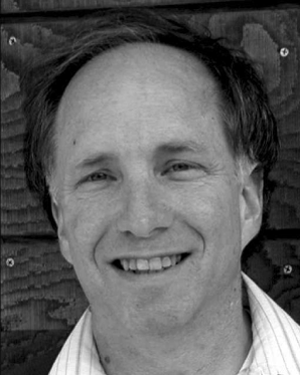 A. Friedman合作论文数Lawrence Livermore National Laboratory69John J. Barnard合作论文数66
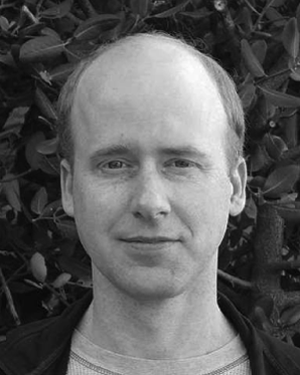 Steven M. Lund合作论文数42Enrique Henestroza合作论文数39B G Logan合作论文数37
 J.-L. Vay合作论文数Lawrence Berkeley National Laboratory34w l waldron合作论文数29
 Dale R. Welch合作论文数Voss Scientific29R. H. Cohen合作论文数29
 Shin-Shan YU (余欣珊)合作论文数High Energy Physics Laboratory, Department of Physics, National Central University28e p lee合作论文数26
 Ronald C. Davidson合作论文数Plasma Physics Laboratory, Princeton University26
 Arthur W Molvik合作论文数Lawrence Livermore National Laboratory26d v rose合作论文数24s eylon合作论文数24
 Peter a Seidl合作论文数Lawrence Berkeley National Laboratory24
 P.K. Roy合作论文数lawrence berkeley national laboratory23
 Igor Kaganovich合作论文数Princeton Plasma Physics Laboratory;Princeton University22T. J. Fessenden合作论文数Lawrence Berkeley Laboratory22
 M. Leitner合作论文数Lawrence Berkeley National Laboratory21Francis Bieniosek合作论文数21C.M. Celata合作论文数20Thomas Sangster合作论文数University of Rochester19J.W. Kwan合作论文数19
 H. C. Kirbie合作论文数16Erik P. Gilson合作论文数16Andris Faltens合作论文数15
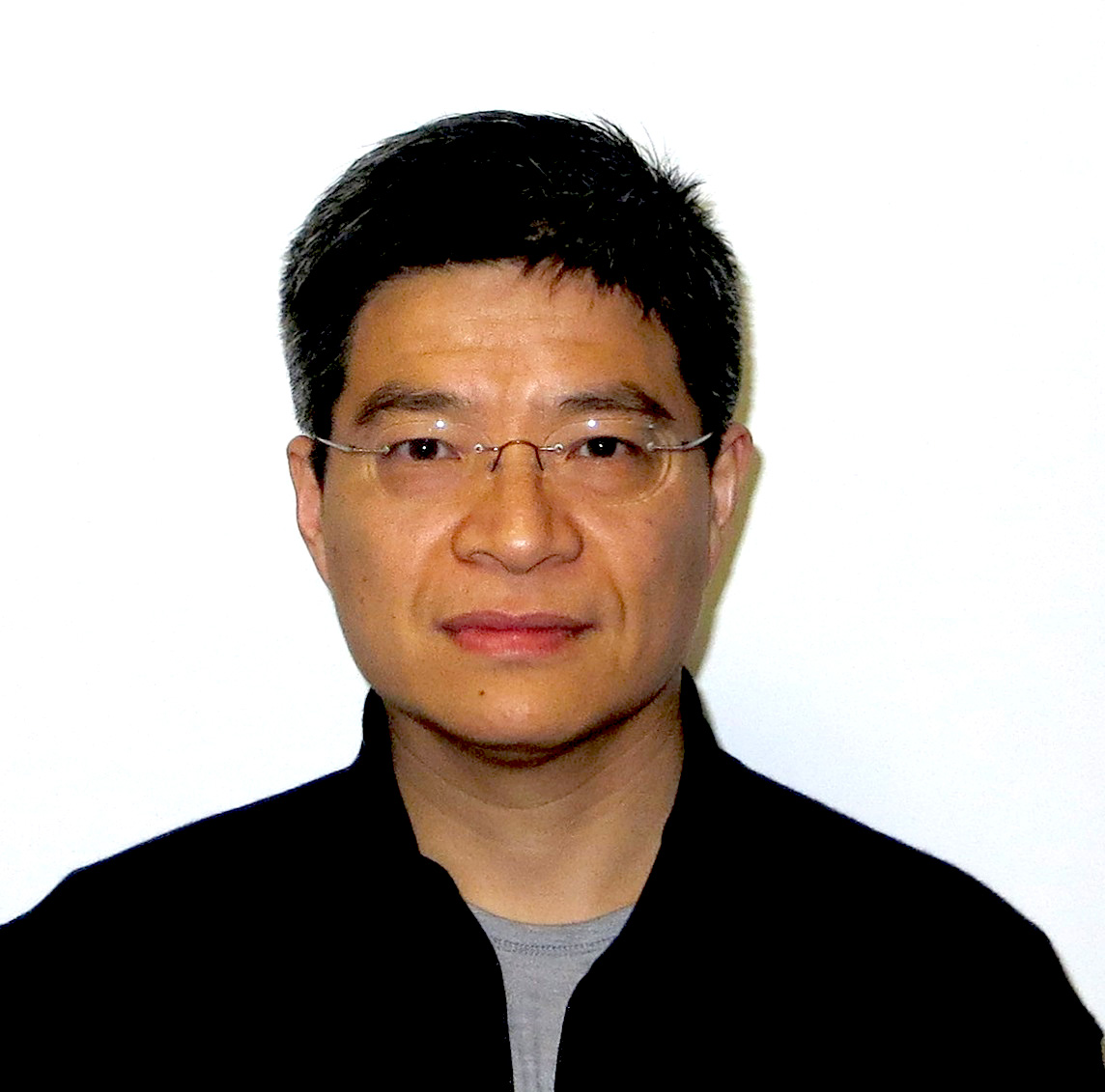 Hong Qin (秦宏)合作论文数School of Physical Sciences, University of Science and Technology of China;School of Nuclear Science and Technology, University of Science and Technology of China;Chinese Academy of Sciences15
 Josh Coleman合作论文数14
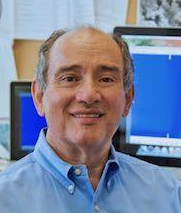 Philip C. Efthimion合作论文数Princeton Plasma Physics Laboratory, Princeton University14
 I. Haber合作论文数14Da Callahan合作论文数13Simon Yu合作论文数11D. L. Judd合作论文数11
 Adam Sefkow合作论文数Department of Mechanical Engineering, Hajim School of Engineering & Applied Sciences, University of Rochester;Laboratory for Laser Energetics, University of Rochester;Department of Physics, University of Rochester;Department of Computer Science, University of Rochester11r l hanks合作论文数9e halaxa合作论文数9
 Anna Tauschwitz合作论文数9M. Kireeff Covo合作论文数9Edward A. Startsev合作论文数9w g greenway合作论文数8
 Andre Anders合作论文数Plasma Engineering LLC8David Baca合作论文数8
 Wayne R. Meier合作论文数Lawrence Livermore National Laboratory;Department of Physics and Astronomy and Ames, Iowa State University;Lawrence Livermore National Laboratory8G Mant合作论文数8
 Debra Callahan合作论文数Focused Energy Inc.8A Debeling合作论文数7l ahle合作论文数7




