Towing systems exhibit non-minimum-phase depth responses that can cause severe inverse-response overshoot. Their inherent cable–body coupling requires online estimation of tow-cable tension, whereas conventional numerical cable models are computationally prohibitive for real-time control. Accordingly, this paper proposes a depth-control method integrating a deep-learning-based tow-cable surrogate model (TTC-SM) with a cascade adaptive sliding-mode controller. First, a coupled cable–body dynamic model incorporating the TTC-SM is established to estimate the magnitude and direction of the terminal tow-cable tension in real time and introduce these estimates into the towed-object dynamics as feedforward terms. Based on this model, a cascade adaptive sliding-mode controller is designed. Its feedforward component directly compensates for the pitch-channel moment disturbance induced by tow-cable tension, while the outer loop generates a smooth desired attitude from the depth error and the inner loop ensures rapid attitude tracking. This architecture prevents direct depth feedback from exciting the non-minimum-phase inverse response. Sinusoidal trajectory-tracking simulations show that the proposed method limits the depth error during the inverse-response phase to 1.90 m, compared with PID control (5.22 m) and MPC (8.76 m). It achieves an MAE of 0.07 m and an RMSE of 0.21 m, corresponding to maximum reductions of 90.4% and 86.4%, respectively.
Anomaly detection in multivariate time series focuses on recognizing unusual patterns or sequences that diverge from normal dynamics, benefiting fields such as social platforms, industrial systems, and financial markets. In practice, however, complex feature interrelationships and the scarcity of anomalous events make it challenging to capture both temporal dependencies and feature correlations. To address this challenge, an anomaly detection method based on nonlinear spiking neural P model with autapses (AD-NSNP-AU) for multivariate time series is introduced in this study. Building upon variational autoencoder (VAE) architecture, the model innovatively incorporates the nonlinear spiking neural P model with autapses (NSNP-AU model), offering a novel approach to addressing time series anomaly detection. In AD-NSNP-AU, the NSNP-AU model is integrated with the attention mechanism to capture temporal dependencies at the encoding step, while Transformer encoder layers extract feature correlations. The two feature types are then effectively integrated by a multi-head self-attention mech anism, which highlights and extracts the critical features. In the decoding phase, an NSNP-AU-based network reconstructs the time series. The performance of AD-NSNP-AU is shown to be superior in experiments across four public datasets, with the model securing the top rank in F1 scores against twelve baseline methods and achieving a recall close to 1 on the Mars Science Laboratory (MSL) dataset.
To address the problems of lagging fault early warning, low utilization of multi-source heterogeneous data, and insufficient integration between digital twin and AI models in the operation and maintenance (O M) of wind turbine blades, a real-time fault prediction method driven by digital twin for wind turbine blades is proposed. A digital twin of wind turbine blades with three-layer mapping including geometry, physics, and behavior is constructed, and a time-series prediction model named CBA-Trans is designed, which integrates 1D Convolutional Neural Network (1D-CNN), Bidirectional Long Short-Term Memory (BiLSTM), and Multi-Head Attention mechanism. The model achieves deep extraction and adaptive weight allocation of multi-dimensional time-series features such as vibration, temperature, strain, and wind speed. Experimental results on 2.17 million data records from 10 units in a wind farm show that the proposed method achieves a fault prediction accuracy of 94.3
With the development of deep learning technology, the recommender system began to use deep neural networks for modeling, which enables the recommendation system to better capture the complex patterns and features in the data. Session-based recommendation has also gradually received attention, especially for scenarios which deal with user behavior sequences and real-time requirements in a session. However, existing session-based recommendation methods tend to ignore users' long-term interest changes, and there are still challenges for context understanding. In addition, session-based recommendation also has drift problems (i.e., the short-term behavior of users does not necessarily represent their real interests), which will affect the accuracy of recommendations. Therefore, this paper proposes a novel graph attention network, termed GAN-GSNP. This network combines a gated spiking neural P system with an extra balancing effect (EB-GSNP) to alleviate the drift problem in session-based recommendation by processing both global and local embeddings simultaneously. In addition, the GAN-GSNP model also proposes a multi-branch feature extraction strategy, which uses Self-Attention and feedforward networks in parallel to extract the high-order features embedded globally by users, so as to capture the global dependencies within the session or between different items, and make full use of the user's contextual information. Experimental results on two real datasets demonstrate the effectiveness and accuracy of the proposed GAN-GSNP model.
Deep learning-based methods have achieved significant improvements in medical image segmentation in recent years. Due to the large amount of labeled data required for neural network training and the difficulty of medical image labeling, semi-supervised learning (SSL) has received great attention in medical image segmentation. However, existing SSL methods often fail to make full use of unlabeled data. Therefore, this study proposes a novel semi-supervised medical image segmentation framework that aims to produce more accurate predictions from unlabeled data. First, a simple and efficient segmentation network is designed, called UNet-ReS. It uses ResNet as the encoder to extract features, and uses spiking neural P-like convolutional neuron model inspired by nonlinear spiking neural P systems to build the decoder. UNet-ReS can generate high-quality unlabeled data prediction in a semi-supervised framework while obtaining reliable pseudo-label. Second, a pseudo-label guided cross-patch contrastive learning loss is proposed to improve the feature representation of deep semantic information from different classes in segmentation prediction. The intra-class aggregation and inter-class separability of deep semantic features from different classes are improved by minimizing the intra-class distance and maximizing the inter-class distance. This helps to improve the overall accuracy of segmentation predictions. The proposed method is validated on three different types of public datasets, including ACDC, Kvasir-SEG, and CRAG. The experimental results show that the proposed method outperforms other semi-supervised segmentation methods.
In this article, we propose a static reconfiguration method for thermoelectric generation (TEG) arrays to improve reliability and power output. Based on a series–parallel and series–parallel (SP&SP) configuration, a modular diagonal switching (MDS) technique is presented for a 6 × 6 TEG array. By strategically repositioning specific TEG modules within a fixed array, power loss can be minimized and output efficiency can be optimized. Under six varied hot‐side nonuniform temperature distribution (HNTD) conditions, simulation experiments are performed and compared with the output performance of six various TEG array configurations. The proposed MDS method can obtain a maximum enhancement in output power by 13.33% while simultaneously reducing the power loss rate from 13.64% to 2.13%. Under three HNTD conditions, validation tests on five TEG array structures demonstrated that the proposed MDS method can increases power output up to 14.29% and reduce power loss from 21.76% to 4.72%. Therefore, the proposed MDS method can effectively suppress power loss and improve efficiency of waste heat recovery.
Most existing convolutional neural networks achieve high segmentation accuracy while neglecting the high hardware cost. In this paper, we integrate Spiking neural P-type(SNP-type) and depthwise convolution to introduce a multi-channel SNP-type convolution (MCConvSNP). With it, we propose a lightweight segmentation neural network to assist physicians in precisely identifying lesion areas. The proposed network is an asymmetric network with only encoders, and the decoder is complemented by adaptive fusion and skip connections. It is an asymmetric design that reduces a large number of network parameters. Furthermore, the encoder is composed of an MCConvSNP pyramid, which has a small parameter and enables fast multi-scale feature information extraction. Experiments at ISIC2018 dataset challenge demonstrate that the proposed model has the highest Acc and DSC among the state-of-the-art methods. At the same time, generalization experiments on ISIC2016 dataset and PH2 dataset also demonstrate a favorable generalization ability. Finally, we compare the computational complexity as well as the computational speed of the models in experiments, where SLP-Net has the highest overall superiority.
To address the issues of non-linearity, non-stationarity, and low prediction accuracy of power net load, this paper proposes a basic framework for future load forecasting researches in sustainable energy systems under extreme weather events and provides new direction for membrane computing model in terms of power net load forecasting. Based on gated spiking neural P systems and generative adversarial network (GAN), in this study, we proposed a novel combined forecasting model. Initially, with considering the impact of factors such as radiation and environmental temperature on the net load, the Kendall correlation coefficient method is employed for feature selection of power system net load samples, eliminating redundant features to construct the high coupling feature combination matrix. Subsequently, the conditional label matrices of related factors and random noise are inputted into the GAN, the generator produces synthetic samples which approximate real samples and the discriminator extracts non-linear behaviors of real data. Then high-quality samples are input into gated spiking neural P model for training. Finally, simulation results demonstrate that the proposed model surpasses other deep learning models in terms of forecasting accuracy under different scenarios.
Sequential recommendation plays an important role in providing a more personalized and accurate recommendation experience, and helps users discover new content that they may be interested in. However, sequence recommendation still faces long-term dependency issues (early behavior has a significant impact on subsequent recommendation results) and requiring high real-time performance. Moreover, the existing models based on recurrent networks or attention mechanisms still have shortcomings in addressing the long-term dependency problem and dynamic real-time performance of sequence recommendations. To address these challenges, we propose a long short-termmemory-spiking neural neural P (LSTM-SNP) self attention network, termed LSAF, for sequence recommendation that integrates long- and short-term user sequences. For this purpose, a three-channel structure is designed, where the long-term and short-term sequences are processed respectively by two self attention channels, and an LSTM-SNP channel is used to learn the user’s long-term dynamics. Then, these learned long-term and short-term features together are integrated by a self attention layer, and the prediction score and the predicted item (i.e. the next interaction item for user) can be obtained. In the LSAF model, the LSTM-SNP can effectively capture long-term and short-term dependency and nonlinear temporal characteristics. We evaluate the proposed LSAF model on three real-world datasets. The comparative experimental results with 13 baseline methods indicate that LSAF provides a competitive method for sequence recommendation.
Image super-resolution (ISR) is designed to recover lost detail information from low-resolution images, resulting in high-quality and high-definition high-resolution images. In the existing single ISR (SISR) methods based on convolutional neural networks (CNN), however, most of the models cannot effectively combine global and local information and are also easy to ignore the correlation between different hierarchical feature information. To address these problems, this study proposes a multi-level feature interactive image super-resolution network, which is constructed by the convolutional units inspired by nonlinear spiking mechanism in nonlinear spiking neural P systems, including shallow feature processing, deep feature extraction and fusion, and reconstruction modules. The different omni domain self-attention blocks are introduced to extract global information in the deep feature extraction and fusion stage and formed a feature enhancement module having a Transformer structure using a novel convolutional unit for extracting local information. Furthermore, to adaptively fuse features between different hierarchies, we design a multi-level feature fusion module, which not only can adaptively fuse features between different hierarchies, but also can better interact with contextual information. The proposed model is compared with 16 state-of-the-art or baseline models on five benchmark datasets. The experimental results show that the proposed model not only achieves good reconstruction performance, but also strikes a good balance between model parameters and performance.
Sequence recommendation is used to predict the user's next potentially interesting items and behaviors. It not only focuses on the user's independent interaction behavior, but also considers the user's historical behavior sequence. However, sequence recommendation still faces some challenges: the existing models still have shortcomings in addressing long-term dependencies and fully utilizing contextual information in sequence recommendation. To address these challenges, we propose a four-channel model based on a multi-level self-attention network with gated spiking neural P (GSNP) systems, termed SR-MAG model. The four channels are divided into two groups, and each group is composed of an attention channel and an GSNP attention channel. Moreover, they process long-term sequences and short-term sequences respectively to obtain long-term or short-term attention channel features. These features are then passed through a self-attention network to effectively extract user context information. The proposed SR-MAG model is tested on three real datasets and compared with 10 baseline methods. Experimental results demonstrate the effectiveness of the proposed SR-MAG model in sequence recommendation tasks.
Pre-stack depth migration using high precision velocity model is an effective tool to restore the real structures under the variation of lateral interval velocity. Due to lots of seismic data in shallow water area with low coverage and large minimum offset, it is difficult to use shallow seismic data to invert the correct velocity, which will cause large velocity error to the targets when calculating deep velocity. Meanwhile, the frequency bandwidth of carbonate reefs is narrow owing to the absorption of muddy seabed and formation. How to improve the imaging accuracy and resolution of the carbonate reefs by the limited seismic data becomes the key to the reservoir research and subsequent drilling. Two of the key challenges for velocity model building in the shallow water area with the interest targets of low relief carbonate reefs are a heterogeneous overburden, such as small scale low velocity channels and the presence of high velocity carbonates, which result in strong velocity contrasts. Two model building techniques have been presented in this paper to address these challenges. FWI has been shown to be highly effective in resolving overburden heterogeneity and high-precision tomography allows us to preserve sharp contrasts in our velocity models, TTI QPSDM solved the imaging accuracy of low relief carbonate reefs and broaden the frequency band. Full waveform inversion has certain requirements on the accuracy of initial velocity model. The greater the velocity model error, the more serious the FWI local minimum caused by cycle skipping. On the other hand, the interval velocity model converted from RMS velocity with Dix formula lacks velocity details in shallow layers due to the small acquisition coverages causing hard to get accurate velocity from seismic data, and shallow logging data are not usually recorded by reason of limited investment and less target interest. How to get relative accurate initial velocity model, high quality shot gathers with rich low frequency and signal to noise ration improvement is important points in this paper.
Nonlinear spiking neural P (NSNP) systems are neural-like membrane computing models with nonlinear spiking mechanisms. Because of this nonlinear spiking mechanism, NSNP systems can show rich nonlinear dynamics. Reservoir computing (RC) is a novel recurrent neural network (RNN) and can overcome some shortcomings of traditional RNNs. Based on NSNP systems, we developed two RC variants for time series classification, RC-SNP and RC-RMS-SNP, which are without and integrated with reservoir model space (RMS), respectively. The two RC variants use NSNP systems as the reservoirs and can be easily implemented in the RC framework. The proposed two RC variants were evaluated on 17 benchmark time series classification datasets and compared with 16 state-of-the-art or baseline classification models. The comparison results demonstrate the effectiveness of the proposed two RC variants for time series classification tasks.
Deep learning technology has been successfully used in Chest X-ray (CXR) images of COVID-19 patients. However, due to the characteristics of COVID-19 pneumonia and X-ray imaging, the deep learning methods still face many challenges, such as lower imaging quality, fewer training samples, complex radiological features and irregular shapes. To address these challenges, this study first introduces an extensive NSNP-like neuron model, and then proposes a multitask adversarial network architecture based on ENSNP-like neurons for chest X-ray images of COVID-19, called MAE-Net. The MAE-Net serves two tasks: (i) converting low-quality CXR images to high-quality images; (ii) classifying CXR images of COVID-19. The adversarial architecture of MAE-Net uses two generators and two discriminators, and two new loss functions have been introduced to guide the optimization of the network. The MAE-Net is tested on four benchmark COVID-19 CXR image datasets and compared them with eight deep learning models. The experimental results show that the proposed MAE-Net can enhance the conversion quality and the accuracy of image classification results.
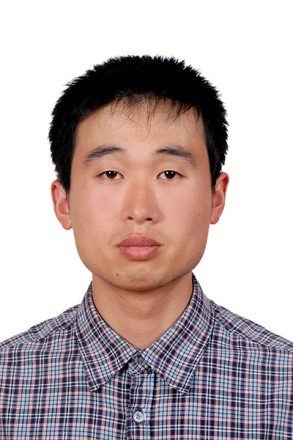 Hong Peng (彭宏)合作论文数School of Information Science and Engineering, Lanzhou University115
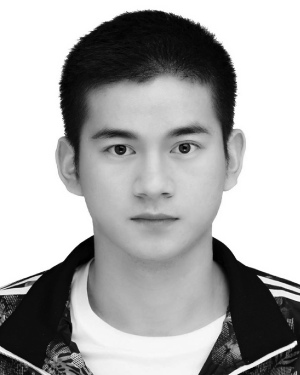 Qian Yang合作论文数Xihua Univ, Sch Comp & Software Engn, Chengdu 610039, Sichuan, Peoples R China28
 Mario de J. Pérez-Jiménez合作论文数Department of Computer Science and Artificial Intelligence, University of Seville27
 Song Xiaoxiao合作论文数26
 Zhang Sun合作论文数School of Electrical Engineering, Southwest Jiaotong University, Chengdu, China22
 Tao Wang合作论文数Academy of Medical Engineering and Translational Medicine, Tianjin University22
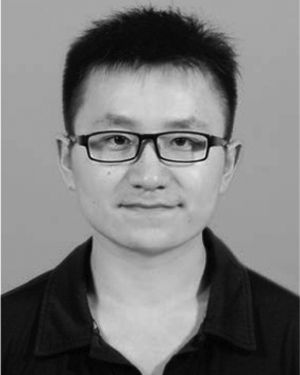 Xiaohui Luo合作论文数Huazhong University of Science and Technology, Huazhong Univ. of Sci. and Technol.21HuaJun Zhang (张华俊)合作论文数18ShengSheng Yang (杨生生)合作论文数17
 Peng Shi合作论文数School of Electrical and Electronic Engineering, The University of Adelaide;Faculty of Sciences, Engineering and Technology, The University of Adelaide17
 Agustin Riscos-Núñez合作论文数E.T.S. Ingeniería Informática, Universidad de Sevilla13HongJun Li (李洪峻)合作论文数12
 Liang Pu (蒲亮)合作论文数School of Energy and Power Engineering, Xi'an Jiaotong University12
 Detian Li (李得天)合作论文数Lanzhou Institute of Physics, China Aerospace Science and Technology Corporation11Xiaogang Qin (秦晓刚)合作论文数11
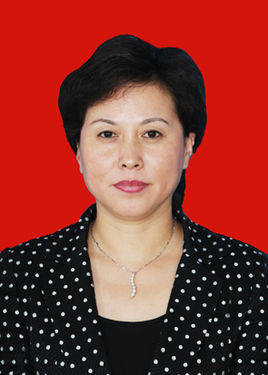 Guangzhi Sun (孙光芝)合作论文数Jilin Province Department of Culture and Tourism10
 Ximeng Chen (陈熙萌)合作论文数School of Nuclear Science and Technology, Lanzhou University10HuiPing Liu (刘慧萍)合作论文数9
 Qian Liu合作论文数Beijing University of Technology, Beijing Polytechnic University9
 Jianxiong Shao (邵剑雄)合作论文数School of Nuclear Science and Technology, Lanzhou University9
 Linqiang Pan (潘林强)合作论文数School of Artificial Intelligence and Automation, Huazhong University of Science and Technology9
 Fayuan xi (席发元)合作论文数8
 Yifeng Chen合作论文数7
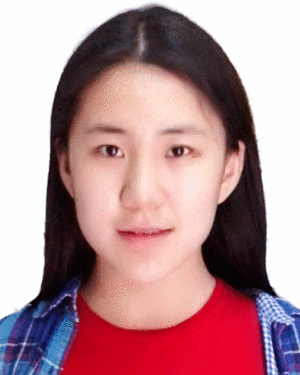 Zeqiong Lv合作论文数Xihua Univ, Sch Comp & Software Engn, Chengdu 610039, Sichuan, Peoples R China7
 Tao Huang合作论文数Department of Energy, Politecnico di Torino;School of Electrical Engineering and Electronic Information, Xihua University7
 Xiangnian Huang (黄襄念)合作论文数西华大学计算机与软件工程学院7
 Baowei Ding (丁宝卫)合作论文数School of Nuclear Science and Technology, Lanzhou University7
 Junkui Xu (徐俊奎)合作论文数University of Chinese Academy of Sciences;Institute of Modern Physics, Chinese Academy of Sciences6Yi-Feng Chen合作论文数6Yanping Huang合作论文数6Wenmei Yi合作论文数Xihua Univ, Sch Comp & Software Engn, Chengdu 610039, Sichuan, Peoples R China6
 Jun Ming合作论文数Xihua Univ, Sichuan Prov Key Lab Power Elect Energy Saving Te, Chengdu 610039, Sichuan, Peoples R China6
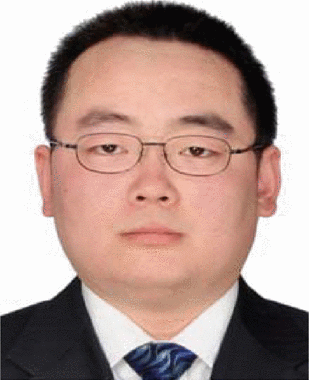 Liang SHI (史亮)合作论文数6
 Lifan Long合作论文数6Hong Yin (银鸿)合作论文数6Qing Liu (柳青)合作论文数6
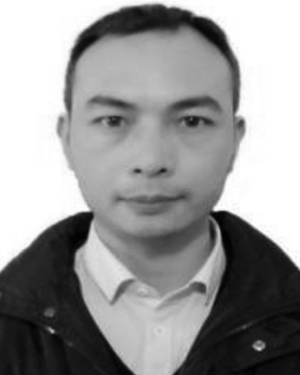 Liu Zhicai合作论文数6Lou Feng-Jun合作论文数6
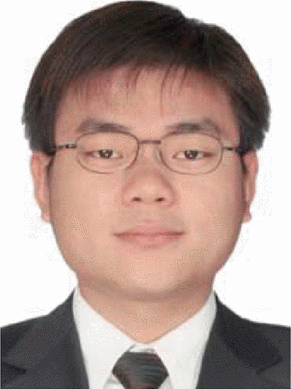 Tang Daotan合作论文数6Xin Xiong合作论文数5Cui Ying (崔 莹)合作论文数5Juan Hu合作论文数Xihua Univ, Sch Comp & Software Engn, Chengdu 610039, Sichuan, Peoples R China5ZhanZu Feng (冯展祖)合作论文数5
 David Orellana-Martín合作论文数5
 Qing Hou (侯氢)合作论文数Institute of Nuclear Science and Technology, Sichuan University5Xue Yu-Xiong合作论文数5Yongzhi Yin (尹永智)合作论文数School of Management, Lanzhou University5Wenping Yu合作论文数5




