BACKGROUND:Patients with heart failure and reduced left ventricular ejection fraction (LVEF) are at elevated risk of ventricular tachycardia or fibrillation (VT/VF), pump failure, and noncardiac death. OBJECTIVES:The purpose of this study was to evaluate the relationship between LVEF and VT/VF risk, accounting for nonarrhythmic mortality as a competing event. METHODS:We analyzed primary prevention implantable cardioverter-defibrillator (ICD) recipients from 5 major trials (MADIT-II [Multicenter Automatic Defibrillator Implantation Trial II], MADIT-CRT [Multicenter Automatic Defibrillator Implantation Trial-Cardiac Resynchronization Therapy], MADIT-RIT [Multicenter Automatic Defibrillator Implantation Trial-Reduce Inappropriate Therapy], MADIT-RISK, RAID [Ranolazine in High-Risk Patients With Implanted Cardioverter-Defibrillator]), stratified by LVEF tertiles (≤20%, 21%-29%, 30%-35%). Outcomes included sustained VT/VF (primary), fast VT/VF (≥200 beats/min), appropriate ICD shocks, and all-cause mortality. Fine and Gray models were used to adjust for the competing risk of nonarrhythmic mortality. RESULTS:The study population comprised 5,168 patients. At 3 years, the cumulative incidence of sustained VT/VF was inversely correlated with increasing LVEF tertiles: 28% for LVEF ≤20%, 23% for LVEF 21%-29%, and 20% for LVEF 30%-35% (P < 0.001). In multivariable models, patients with LVEF ≤20% had a 23% higher cumulative incidence of sustained VT/VF (P = 0.004), 33% higher cumulative incidence of fast VT/VF (P = 0.001), and 31% higher cumulative incidence of ICD shocks (P = 0.003) compared with those with LVEF >20%. These associations were similar across subgroups, cardiac resynchronization therapy-defibrillator use, and cardiomyopathy etiology. Patients with LVEF ≤20% also had a 1.5-fold increased risk of all-cause mortality (P < 0.001). CONCLUSIONS:Patients with very low LVEF have higher cumulative incidence of sustained VT/VF and ICD shocks, along with an increased competing risk of death. These findings suggest that LVEF is an important factor in the shared decision-making process for a primary prevention ICD.
Numerous novel therapeutic options for the treatment of arrhythmogenic right ventricular cardiomyopathy (ARVC) are being investigated. In light of the stochastic nature of sustained ventricular arrhythmia occurrence and the slow progression of structural features in patients with ARVC, the definition of primary outcomes in randomized controlled trials in this population is challenging. The use of a reduction in the premature ventricular complex burden derived from ambulatory electrocardiogram monitors has been proposed as a potential primary outcome for trials enrolling patients with ARVC. This expert review summarizes the evidence supporting premature ventricular complex burden as a key clinical metric for patients with ARVC and discusses feasibility and caveats of implementing such a metric in randomized clinical trials.
Background Women with congenital long‐QT syndrome (LQTS) experience increased risk of cardiac events (CE) after the onset of adolescence, possibly due to the effect of sex hormones on the cardiac ion channels. We hypothesized that late menarche may affect the risk of CE in women with LQTS. Methods Beginning in 2010, information on age at menses onset was obtained from all women enrolled in the Rochester LQTS Registry. Multivariable modeling was employed to evaluate the association of age at menarche with the burden of CE (total number of syncope, aborted cardiac arrest, and LQTS‐related sudden cardiac death) during the subsequent 20 years of follow‐up. Menarche groups were defined as early (<12 years), normal (12–16 years), and late (>16 years). Results We report data on 435 genetically confirmed LQTS women, of whom 68, 346, and 21 were in the early, normal, and late‐onset groups, respectively. The mean cumulative rate of CE at 20 years of follow‐up in women with late menarche was 28% and 64% higher than in women with normal or early menarche, respectively; P<0.001 for the overall difference during follow‐up. Consistently, multivariable analysis showed that late menarche was associated with a pronounced 52% increased risk of CE compared with normal menarche (P=0.02). Conclusions Late menarche is associated with increased risk of CE in women with congenital LQTS. Further research is warranted to validate these findings and ascertain the explanatory pathophysiological pathways.
BACKGROUND:Cardiac implantable electronic devices (CIEDs) frequently detect brief, often subclinical atrial fibrillation (AF), but their value for predicting progression to persistent AF remains uncertain. Statistical and machine learning (ML) approaches may enable dynamic risk stratification using this longitudinal device data. OBJECTIVE:To develop a risk stratification model using clinical and CIED-derived AF burden measured over a rolling 6-month window to predict progression to persistent AF. METHODS:We analyzed continuous CIED data from 1985 patients without prior persistent AF implanted between 2016 and 2024 at a tertiary medical center. AF burden and clinical variables were summarized using overlapping 6-month rolling windows to estimate 1-year risk of persistent AF. Associations were evaluated using Kaplan-Meier and Cox proportional hazards models. A gradient-boosted decision tree model (XGBoost) was used to predict progression. RESULTS:During a mean follow-up of 1192 days, 874 patients (44%) developed paroxysmal AF, of whom 257 (29%) progressed to persistent AF after a mean of 813 days. Patients with no AF or < 1 h/day of AF in the prior 6 months had > 97% 1-year freedom from persistent AF, whereas those with > 8 h/day had a 63% progression rate. Higher AF burden was strongly associated with progression (maximum HR 8.66, p < 0.001). The ML model demonstrated high predictive performance (sensitivity 99.4%, specificity 95.7%). CONCLUSION:CIED-detected AF burden is strongly associated with progression to persistent AF. ML-based analysis of 6-month device data enables accurate, point-in-time risk stratification to support earlier and more targeted clinical management.
La enfermedad de Chagas se asocia con una marcada incidencia de arritmias ventriculares. Siendo los potencjales ventriculares tardíos conocidos predictores de arritmias ventriculares malignas y muerte súbita, se estudió la incidencia de los mismos en un grupo de pacientes con enfermedad de Chagas. Se evaluaron prospectivamente de 84 pacientes (59 mujeres, 25 hombres; 48:!: 16 años), todos con serología positiva para enfermedad de Chagas. La electrocardiografía de señal promediada fue analizada con el sistema time domain en pacientes sin bloqueo completo de rama (n = 61), Y con el sistema frequency domain en todos los pacientes. Se los clasificó de acuerdo con su compromiso cardíaco en cuatro grupos: A, B, C y D, y los resultados obtenidos fueron comparados con un grupo control de 40 voluntarios sanos. La incidencia: de los potenciales ventriculares tardíos en Jos pacientes con enfermedad de Chagas dependió del método utilizado. Cuando se empleó el sistema clásico (time domain en pacientes sin bloqueo completo de rama y frequency domain en pacientes con bloqueo) presentó potenciales ventriculares tardíos e132,1 %. Cuando todos los pacientes fueron analizados por frequency domain se encontraron componentes de alta frecuencia en e140,4 % de ellos. Al comparar estos resultados con los obtenidos en el grupo de voluntarios sanos encontramos diferencias significativas. No las hubo, en cambio, entre IDS pacientes con evidencia de afectación cardiaca entre sí. Sin embargo, los potenciales ventriculares tardíos fueron más frecuentes en aquellos que presentaban electrocardiograma y/o Holter anormal con respecto a IDS pacientes sin evidencia de cardiopatía 0 con disfunción ventricular (p < 0,05). También encontramos diferencias al comparar el grupo de voluntarios sanos con el grupo de pacientes sintomáticos de nuestra serie, por frequency domain (p < 0,05). Concluimos que: a) los potenciales ventriculares tardíos son frecuentemente encontrados en la enfermedad de Chagas y en un elevado número de pacientes que son totalmente asintomáticos; b) existe una relación directa entre la presencia de potenciales ventriculares tardíos y alteraciones en el electrocardiograma y arritmias ventriculares en el registro Holter, pero no con la existencia de disfunción ventricular en los enfermos con cardiopatía chagásica conocida.
Abstract Aims Coronary artery disease (CAD) remains a leading cause of morbidity. Existing clinical likelihood models often lack specificity, contributing to unnecessary diagnostic testing. To develop, train, and validate the electro-mechanical risk (EMR) Score. This machine learning model uses cardiac mechanical information from resting seismocardiography (SCG) recordings and patient-level clinical risk factors to estimate obstructive CAD likelihood. Methods and results This multi-centre clinical study included 2110 adults. Resting SCG was recorded using a sternum accelerometer. Obstructive CAD was defined as 50% or greater stenosis on coronary computed tomography angiography or invasive coronary angiography. A one-dimensional convolutional neural network was trained to compute the EMR Score. Performance was evaluated using repeated cross-validation and external-centre validation and compared with the 2024 ESC Risk-Factor–weighted Clinical Likelihood (RF-CL) model. Among 2110 participants (mean [SD] age, 57.8 [10.3] years; 801 women [38%]), 760 had obstructive CAD. In symptomatic individuals, the EMR Score achieved an AUC of 0.88, outperforming RF-CL (AUC, 0.85; P = 0.023), with higher specificity (53% vs. 35%) and comparable sensitivity (94% vs. 97%). In external-centre validation, the EMR Score achieved an AUC of 0.91, sensitivity of 97.8%, specificity of 52.0%, PPV of 78.0%, and NPV of 93.0%. In asymptomatic participants, the AUC was 0.89. The EMR Score classified 23% of the cohort as very low likelihood, with 2% CAD prevalence. Conclusion The EMR Score non-invasively estimated obstructive CAD likelihood, with external-centre validation supporting generalizability beyond internal cross-validation. Clinical trial registration ClinicalTrials.gov (NCT06880120, NCT06880133)
Background The benefit of an implantable cardioverter-defibrillator (ICD) in patients with heart failure with reduced ejection fraction on foundational therapy that includes a sodium-glucose cotransporter 2 inhibitor is unknown. Objectives This study aims to evaluate the impact of an ICD among participants enrolled in EMPEROR-Reduced (Empagliflozin Outcome Trial in Patients with Chronic Heart Failure and a Reduced Ejection Fraction). Methods Propensity score matching was used to compare outcomes in patients with and without an ICD in the placebo and empagliflozin arms of the EMPEROR-Reduced trial. Time-to-event curves and Cox regression analysis were used to evaluate the risk of the primary endpoint of sudden cardiac death (SCD). Results A total of 1,674 patients were included in the analysis of whom 837 (429 on placebo and 408 on empagliflozin) with an ICD at baseline were matched to 837 (424 on placebo and 413 on empagliflozin) without an ICD. Background therapy included an angiotensin-converting enzyme inhibitor/angiotensin receptor blocker/angiotensin receptor blocker-neprilysin inhibitor (≥88%); beta-blockers (≥94%), and mineralocorticoid receptor antagonists (≥65%). Cox regression analysis showed ICD vs non-ICD treatment was associated with a lower risk of SCD in both the empagliflozin (HR: 0.59; 95% CI: 0.26-1.3) and placebo arms of the trial (HR: 0.31; 95% CI: 0.13-0.74), treatment-by-ICD interaction P = 0.30. Conclusions In patients with heart failure with reduced ejection fraction enrolled in EMPEROR-Reduced, those with an ICD (vs non-ICD) experienced a lower risk of SCD regardless of empagliflozin treatment.
 Arthur J. Moss合作论文数University of Rochester Medical School456
 Scott Mcnitt合作论文数431
 Ilan Goldenberg合作论文数Department of Medicine, Cardiology Heart Research, University of Rochester275
 Valentina Kutyifa合作论文数Heart Centre;Semmelweis University;Cardiology Department;of Cardiovascular Surgery;Semmelweis University, Semmelweis University213Polonsky Bronislava合作论文数119
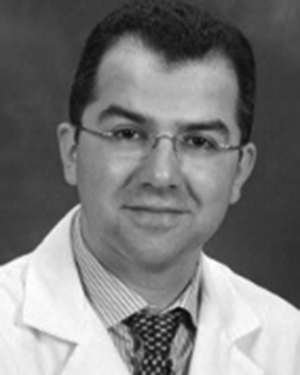 Mehmet K. Aktas合作论文数Cardiology, University of Rochester112
 James Patrick Daubert合作论文数Division of Cardiology, Department of Medicine, Duke University School of Medicine96
 Jean-Phillippe Couderc合作论文数Department of Medicine, Cardiology Heart Research, University of Rochester Medical Center;Department of Electrical and Computer Engineering, University of Rochester Medical Center;VPG Medical Inc;Clario76Helmut U. Klein合作论文数72
 Alon Barsheshet合作论文数Cardiology Division of the Department of Medicine, University of Rochester Medical Center68
 Scott David Solomon合作论文数Heart and Vascular Center, Brigham and Women's Hospital;Clinical Trials Outcomes Center, Brigham and Women's Hospital;Harvard Medical School65Spencer Rosero合作论文数56
 Jack Hall合作论文数Department of Biostatistics and Computational Biology, University of Rochester Medical Center50
 Arwa Younis合作论文数Department of Cardiovascular Medicine (H.Y., A.Y., I.Z., K.H., E.A.),, Cleveland Clinic48Mark L. Andrews合作论文数44Christian Jons合作论文数The Heart Center, Rigshospitalet;Dept of Cardiology, Rigshospitalet44Mary Brown合作论文数43Ruwald Anne-Christine合作论文数Heart Res Follow Up Program, Univ Rochester43
 Jeffrey Towbin合作论文数University of Tennessee Health Science Center;Le Bonheur Children's Hospital;St. Jude Children's Research Hospital40
 Paul J. Wang合作论文数Department of Medicine, Stanford University;Cardiovascular Institute, Stanford University;Maternal & Child Health Research Institute, Stanford University40
 Martin Huth Ruwald合作论文数Dept Cardiol, Gentofte Univ Hosp39Slava Polonsky合作论文数37
 Michael J. Ackerman合作论文数Children's Center, Mayo Clinic;Division of Heart Rhythm Services, Department of Cardiovascular Medicine, Mayo Clinic35
 Yitschak Biton合作论文数Hadasssah Medical Center, Hebrew University in Jerusalem Medical School34Cygankiewicz Iwona合作论文数33Jonathan S. Steinberg合作论文数St Luke’s-Roosevelt Hospital Center33
 Jennifer Robinson合作论文数Department of Epidemiology, College of Public Health, University of Iowa;Department of Medicine, Carver College of Medicine, University of Iowa32
 Claudio Schuger合作论文数Henry Ford Hospital32Cannom David S合作论文数29
 Elizabeth S. Kaufman合作论文数School of Medicine, Case Western Reserve University;MetroHealth29
 Coeli Lopes合作论文数Cardiovascular Research Institute (CML),, University of Rochester Medical Center29
 Derick R Peterson合作论文数27
 Bela Merkely合作论文数Department of Aviation and Space Medicine, Faculty of Medicine, Semmelweis University27Xiaojuan Xia合作论文数26
 Peter Schwartz合作论文数Cardiovascular Genetics Laboratory, IRCCS Istituto Auxologico Italiano;Center for Cardiac Arrhythmias of Genetic Origin, IRCCS Istituto Auxologico Italiano26
 Pyotr G Platonov合作论文数Center for Integrative Electrocardiology, Lund University26
 Frank I. Marcus合作论文数Sarver Heart Center, College of Medicine - Tucson, The University of Arizona25Ryszard Piotrowicz合作论文数24G. Michael Vincent合作论文数23
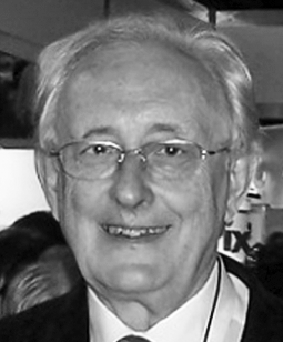 de Luna Antonio Bayes合作论文数23Henry Greenberg合作论文数23
 Silvia G Priori合作论文数Department of Molecular Medicine, University of Pavia;Hospital ICS Maugeri22Jesaia Benhorin合作论文数22
 Ming Qi (祁鸣)合作论文数Sir Run Run Shaw Hospital, Zhejiang University School of Medicine;James D. Watson Institute of Genome Sciences, Zhejiang University22
 Arthur Wilde合作论文数Academic Cardiovascular Science Institute, Amsterdam UMC;Department of Clinical and Experimental Cardiology, University of Amsterdam;Academic Medical Centre, University of Amsterdam;Irving Medical Centre, Columbia University21
 N. A. Mark Estes合作论文数Division of Cardiology, Department of Medicine, School of Medicine, University of Pittsburgh;University of Pittsburgh Medical Center21
 Wataru Shimizu (清水渉)合作论文数Department of Cardiovascular Medicine, Nippon Medical School;Graduate School, Nippon Medical School20
 David Q Rich合作论文数Department of Community and Preventive Medicine, University of Rochester School of Medicine and Dentistry20Ewa Piotrowicz合作论文数20




