This paper is motivated by robotic systems that solve difficult real-world problems such as search and rescue (SAR) or precision agriculture 1. These applications require robots to operate in complex, uncertain environments while maintaining safe interactions with human teammates within a specified level of performance. In this paper, we study the scheduling of real-time applications on heterogeneous hardware platforms inspired by such contexts. To capture the stochasticity due to unpredictable environments, we propose the stochastic heterogeneous parallel conditional DAG (SHPC-DAG) model, which extends the most recent HPC-DAG model in two regards. First, it uses conditional DAG nodes to model the execution of computational pipelines based on context, while the stochasticity of DAG edges captures the uncertain nature of a system's environment or the reliability of its hardware. Second, considering the pessimism of deterministic worst-case execution time (WCET), it uses probability distributions to model the execution times of subtasks (DAG nodes). We propose a new partitioning algorithm Least Latency Partitioned (LLP), which considers precedence constraints among nodes during the allocation process. Coupled with a scheduling algorithm that accounts for varying subtask criticality and constraints, the end-to-end latencies of safety-critical paths/nodes are then minimized. We use tasksets inspired by real robotics to demonstrate that our framework allows for efficient scheduling in complex computational pipelines, with more flexible representation of timing constraints, and ultimately, safety-performance tradeoffs.
Modern real-time systems often involve numerous computational tasks characterized by intricate dependency relationships. Within these systems, data propagate through cause-effect chains from one task to another, making it imperative to minimize end-to-end latency to ensure system safety and reliability. In this article, we introduce innovative nonpreemptive scheduling techniques designed to reduce the worst-case end-to-end latency and/or time disparity for task sets modeled with directed acyclic graphs (DAGs). This is challenging because of the noncontinuous and nonconvex characteristics of the objective functions, hindering the direct application of standard optimization frameworks. Customized optimization frameworks aiming at achieving optimal solutions may suffer from scalability issues, while general heuristic algorithms often lack theoretical performance guarantees. To address this challenge, we incorporate the "1-opt" concept from the optimization literature (Essentially, 1-opt means that the quality of a solution cannot be improved if only one single variable can be changed) into the design of our algorithm. We propose a novel optimization algorithm that effectively balances the tradeoff between theoretical guarantees and algorithm scalability. By demonstrating its theoretical performance guarantees, we establish that the algorithm produces 1-opt solutions while maintaining polynomial run-time complexity. Through extensive large-scale experiments, we demonstrate that our algorithm can effectively reduce the latency metrics by 20% to 40%, compared to state-of-the-art methods.
Global fixed-priority (G-FP) scheduling is a widely applied scheduling policy for real-time systems running on multiprocessor platforms. The state-of-the-art in priority assignment for G-FP follows one of two approaches. The first is to use a simple heuristic for priority assignment that works with any (thus the most accurate) schedulability analysis. The second is to leverage Audsley's polynomial-time optimal priority assignment (OPA) algorithm, which can only accommodate a less accurate analysis that satisfies the compatibility conditions required by OPA. In this article, we study this critical issue and present a novel algorithm. We first use the concept of response time estimation range to build a new priority assignment framework, which is optimal with a more accurate schedulability analysis than OPA since its compatibility conditions are much weaker than those of OPA. This new frontier on the second approach is then judiciously combined with the first approach to take advantage of both. We evaluate the effectiveness of the proposed algorithm with various task sets. Compared with existing approaches, our algorithm always achieves the highest-acceptance ratio and can outperform them by 25% on average.
When optimizing real-time systems, designers often face a challenging problem where the schedulability constraints are non-convex, non-continuous, or lack an analytical form to understand their properties. Although the optimization framework NORTH proposed in previous work is general (it works with arbitrary schedulability analysis) and scalable, it can only handle problems with continuous variables, which limits its application. In this paper, we extend the applications of the framework NORTH to problems with a hybrid of continuous and discrete variables. This is achieved in a coordinate-descent method, where the continuous and discrete variables are optimized separately during iterations. The new framework, NORTH+, improves around 20 than NORTH in experiments.
The Logical Execution Time (LET) programming model has recently received considerable attention, particularly because of its timing and dataflow determinism. In LET, task computation appears always to take the same amount of time (called the task's LET interval), and the task reads (resp. writes) at the beginning (resp. end) of the interval. Compared to other communication mechanisms, such as implicit communication and Dynamic Buffer Protocol (DBP), LET performs worse on many metrics, such as end-to-end latency (including reaction time and data age) and time disparity jitter. Compared with the default LET setting, the flexible LET (fLET) model shrinks the LET interval while still guaranteeing schedulability by introducing the virtual offset to defer the read operation and using the virtual deadline to move up the write operation. Therefore, fLET has the potential to significantly improve the end-to-end timing performance while keeping the benefits of deterministic behavior on timing and dataflow. To fully realize the potential of fLET, we consider the problem of optimizing the assignments of its virtual offsets and deadlines. We propose new abstractions to describe the task communication pattern and new optimization algorithms to explore the solution space efficiently. The algorithms leverage the linearizability of communication patterns and utilize symbolic operations to achieve efficient optimization while providing a theoretical guarantee. The framework supports optimizing multiple performance metrics and guarantees bounded suboptimality when optimizing end-to-end latency. Experimental results show that our optimization algorithms improve upon the default LET and its existing extensions and significantly outperform implicit communication and DBP in terms of various metrics, such as end-to-end latency, time disparity, and its jitter.
Equipping real-time systems with soft error resilience can be challenging due to the tradeoff of the timing and failure requirements for mixed-criticality tasks. Violation of these requirements yields failed task scheduling in one way or another. However, not every task requires the same degree of soft error resilience. For example, low-criticality tasks can run with low or even no soft error resilience, whereas mid- or highcriticality tasks may require relatively high resilience depending on their inherent failure requirement. Unfortunately, existing soft error resilience schemes do not have the ability to control the degree of their resilience in a fine-grained way, i.e., they can only be turned on or off as a whole during task execution. To this end, this paper presents RTailor (Resilience Tailor), a compiler-directed parameterized soft error resilience scheme that achieves the desired level of soft error protection according to the demand of each task. The key idea is that for a given protection ratio, compilers can transform a hot loop such that the number of its iterations protected over the total iterations matches the ratio. Compared to full resilience protecting every iteration, RTailor's parameterized soft error resilience significantly reduces the performance overhead of tasks, thereby improving their real-time schedulability. The experimental results highlight that for four representative fault rates, RTailor achieves 15%~average schedulability improvements over the state-of-the-art work that lacks parameterized soft error resilience.
This letter takes a first step towards the analysis of safety and performance critical computational tasks for autonomous robots. Our contribution is a safety-performance (SP) metric that ensures safety first and then rewards improved performance of real-time computational tasks, building on the notion of "nominal safety" which defines timely computation as critical to safety. To fully utilize the computing capacity of heterogeneous processing units (e.g., CPU + GPU), a computational task graph model called the Stochastic Heterogeneous Parallel Directed Acyclic Graph (SHP-DAG) is adopted to capture the uncertain nature of robotic applications and their required computation. Compared to state-of-the-art task models, SHP-DAG avoids the pessimism of deterministic worst-case execution time (WCET), instead modeling the execution times of tasks by probability distributions. Our SP metric is defined upon this task model, which allows us to apply the FIFO and CFS schedulers of the Linux kernel on complex robotic computational tasks and compare the SP metric with baseline metrics, average and worst-case makespan. Extensive experimental results on NVIDIA Jetson AGX Xavier hardware demonstrate that the proposed SP metric is appropriate for managing computational tasks in a manner that balances safety and performance in robotic systems.
In this paper we address the timing verification for processing graphs used to implement autonomous driving systems by the company Perceptin. We demonstrate how to extend our previous results on end-to-end timing analysis in terms of maximum reaction time and maximum data age for cause-effect chains in automotive systems for the posed challenge.
Chinese calligraphy is a unique art form with great artistic value but difficult to master. In this paper, we formulate the calligraphy writing problem as a trajectory optimization problem, and propose an improved virtual brush model for simulating the real writing process. Our approach is inspired by pseudospectral optimal control in that we parameterize the actuator trajectory for each stroke as a Chebyshev polynomial. The proposed dynamic virtual brush model plays a key role in formulating the objective function to be optimized. Our approach shows excellent performance in drawing aesthetically pleasing characters, and does so much more efficiently than previous work, opening up the possibility to achieve real-time closed-loop control.
 Haibo Zeng (曾海波)合作论文数8
 Ashrarul Haq Sifat合作论文数7
 Sen Wang (王森)合作论文数School of Petroleum Engineering, China University of Petroleum7
 Ryan Williams合作论文数Department of Electrical Engineering and Computer Science, Massachusetts Institute of Technology7Shaoyu Huang合作论文数6
 Changhee Jung合作论文数Department of Computer Science, Purdue University6Burhanuddin Bharmal合作论文数2
 Jia-Bin Huang合作论文数Department of Computer Science, University of Maryland;Reality Labs, Meta2Chen Jiaqi合作论文数Georgia Institute of Technology , Atlanta, GA, USA 1
 Jianping Zeng合作论文数Purdue University1
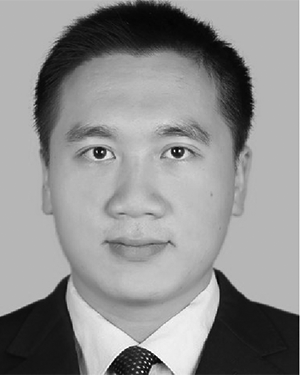 Yecheng Zhao合作论文数Virginia Tech1
 Frank Dellaert合作论文数GVU Center, College of Computing, Georgia Institute of Technology;School of Interactive Computing, College of Computing, Georgia Institute of Technology;Verdant Robotics1
 Seth Hutchinson合作论文数University of Illinois Urbana-Champaign;Khoury College of Computer Sciences, Northeastern University1




