In this work, the Coulomb effects (Coulomb correlations) in pi+pi- pairs produced in p + Ni collisions at 24 GeV=c, are studied using experimental pi+pi- pair distributions in Q, the relative momentum in the pair center-of-mass system (c.m.s.), and its projections Q(L) (longitudinal component) and Q(t) (transverse component) relative to the pair direction in the laboratory system (LS). The major part of the pion pairs ("Coulomb pairs") is produced in the decay of rho, omega and Delta resonances and other short-lived sources. In these pairs, the significant Coulomb interaction occurs at small Q, dominating the pi+pi- interaction in the final state. The minor part of the pairs ("non-Coulomb pairs") is produced if one or both pions arose from long-lived sources like eta, eta ' or from different interactions. In this case, the final state interaction is practically absent. The Q, Q(L), and Q(t) distributions of the Coulomb pairs in the c.m.s. have been simulated assuming they are described by the phase space modified by the known point-like Coulomb correlation function A(C)(Q), corrected for small effects due to the nonpointlike pair production and the strong two-pion interaction. The same distributions of non-Coulomb pairs have been simulated according to the phase space, but without A(C)(Q). In all Q(t) intervals, the experimental Q(L) spectrum shows a peak around Q(L) = 0 caused by the Coulomb final state interaction. The full width at half maximum increases with Q(t) from 3 MeV/c for 0 < Q(t) < 0.25 MeV/c to 11 MeV/c for 4.0 < Q(t) < 5.0 MeV/c. The experimental Q(L) distributions have been fitted with two free parameters: the fraction of Coulomb pairs and the normalization constant. The precision of the description of these distributions is better than 2% in Q(t) intervals 2-3, 3-4, and 4-5 MeV/c and better than 0.5% in the total Q(t) interval 0-5 MeV/c. It is shown that the number of Coulomb pairs in all Q(t) intervals, including the small Q(t) (small opening angles theta in the LS) is calculated with theoretical precision better than 2%. The comparison of the simulated and experimental numbers of Coulomb pairs at small Q(t) allows us to check and correct the detection efficiency for the pairs with small. (0.06 mrad and smaller). It is shown that Coulomb pairs can be used as a new physical tool to check and correct the quality of the simulated events. The special property of the Coulomb pairs is the possibility of checking and correcting the detection efficiency, especially for the pairs with small opening angles.
Recently, experiments on basic plasma physics issues for solving future problems in fusion energy have been performed on a Large Helical Device. There are several problems to be solved in future devices for fusion energy. Emerging issues in burning plasma are: alpha-channeling (ion heating by alpha particles), turbulence and transport in electron dominant heating helium ash exhaust, reduction of the divertor heat load. To solve these problems, understanding the basic plasma physics of (1) wave–particle interaction through (inverse) Landau damping, (2) characteristics of electron-scale (high- k ) turbulence, (3) ion mixing and the isotope effect, and (4) turbulence spreading and detachment, is necessary. This overview discusses the experimental studies on these issues and turbulent transport in multi-ion plasma and other issues in the appendix.
Electron-scale turbulence, whose wavelength is the electron Larmor radius, is thought to have the potential to cause stiffness in an electron temperature gradient and degrade the confinement of future burning plasma in which the electron heating by alpha particles is dominant. The dependence of electron-scale turbulence and electron heat flux on the electron temperature inverse gradient length Rax/LTe , were investigated. The electron temperature gradient was successfully varied in the range of -3<Rax/LTe<12 by controlling the injection power of on/off-axis electron cyclotron heating. The results show a significant increase in the electron-scale turbulence with increasing Rax/LTe , especially in conditions where Electron Temperature Gradient (ETG) instability is linearly unstable, suggesting the presence of ETG turbulence at high Rax/LTe . The electron heat flux also increases steeply with increasing Rax/LTe . In addition, the electron-scale turbulence is observed even at Rax/LTe similar to 0 , which is stable in linear GKV calculations. Finding the cause of this phenomenon is an interesting task for the future.
In magnetically confined fusion plasmas, a gyrotron is an essential auxiliary heating device for generating and sustaining plasma through electron cyclotron resonance heating owing to its ability to generate high-power microwaves. Microwaves emitted from a gyrotron are often transmitted through waveguides, and the transmitted power is monitored by a power monitor with a multi-hole directional coupler at the miter bend of the transmission line. Recently, a high-power dual-frequency gyrotron has been installed and operated in the Large Helical Device. A power monitor with good sensitivity to multiple frequencies is required to monitor the power transmission of the different frequencies at the same transmission line. In order to realize the power monitor, which can couple with the multiple-frequency microwaves, we focused on a sub-waveguide shape in the power monitor and investigated the influence of the tapered sub-waveguide by conducting electromagnetic simulations using a simple model. We also performed the high-power test using a power monitor with a tapered sub-waveguide. The experimental result was different from the simulation, but enough receiving power was obtained at both 116 and 154 GHz.
The world's first quasi-axisymmetric stellarator, CFQS, is now under construction. The CFQS will be dedicated to studies on the interaction between flow and turbulence, and confinement improvement by suppression of turbulence in connection with proof-of-principle experiment of quasi-axisymmetry. In order to conduct this experimental research, a heavy ion beam probe (HIBP) system is planned to be installed and utilized to measure the radial electric field and its fluctuation in a CFQS plasma. In this paper, an orbit calculation for a probe beam is performed to verify feasibility of the HIBP in the CFQS. The required beam energy, possible ion species, and the observable region in a CFQS plasma are investigated. The beam attenuation by a CFQS plasma is also estimated for different beam ion species. If we use Cs-133(+) as a primary probe beam, the required beam energy is expected to be 30 similar to 50 keV, which is relatively easy to handle. In this case the beam attenuation, evaluated by the ratio between the injected and detected beam currents, is 10(-3)similar to 10(-2) in a CFQS plasma with a line-averaged electron density of <1.0 x 10(19) m(-3). For a higher density plasma, usage of Rb-85(+) is better in terms of low-beam-attenuation, and a high signal-to-noise ratio. The HIBP in the CFQS will provide a great opportunity to study physics experimentally, related to the radial electric field, poloidal flow, and turbulence suppression.
A quasi-axisymmetric stellarator, the CFQS, has been designed as a joint project of the National Institute for Fusion Science and Southwest Jiaotong University to prove intrinsic advantages of quasi-axisymmetry. Principal parameters of the CFQS are as follows: the major radius is 1 m, the magnetic field strength is 1 T, the aspect ratio is 4, and the toroidal periodic number is 2. The magnetic field configuration is designed based on that of the CHS-qa. Enhanced confinement properties within the context of neoclassical theory are achieved by its quasi-axisymmetric configuration. In the entire radial range, the magnetic well is retained to keep favourable stability features in the magnetohydrodynamic equilibrium. A magnetic field coil system was designed for the CFQS, which consists of 16 modular coils, 12 toroidal field coils, and 4 poloidal field coils. The supporting structure is designed to withstand strong electromagnetic force under 1 T operation, maintaining enough space for heating and diagnostic systems. The mock-up modular coil with the most complicated shape was constructed by Hefei Keye Electro Physical Equipment Manufacturing Co., Ltd. to check manufacturability and the achieved accuracy. A heat-run test was performed to check the temperature rise of conductors, and the capability of 1 T operation was confirmed. After various tests for the mock-up coil, construction of actual modular coils and the vacuum vessel has begun.
The DIRAC experiment at CERN investigated in the reaction p(24 GeV/c) + Ni the particle pairs K+K-, pi(+pi)-, and p p over line with relative momentum Q in the pair system less than 100 MeV/c. Because of background influence studies, DIRAC explored three subsamples of K+K- pairs, obtained by subtracting -using the time-of-flight (TOF) technique-the background from initial Q distributions with K+K- sample fractions more than 70%, 50%, and 30%. The corresponding pair distributions in Q and in its longitudinal projection Q(L) were analyzed first in a Coulomb model, which takes into account only the Coulomb final -state interaction (FSI) and assuming pointlike pair production. This Coulomb model analysis leads to a K+K- yield increase of about four at Q(L) = 0.5 MeV/c compared to 100 MeV/c. In order to study contributions from strong interaction, a second more sophisticated model was applied, considering also strong FSI via the resonances f(0)(980) and a(0)(980) and a variable distance r* between the produced K mesons besides Coulomb FSI. This analysis was based on three different parameter sets for the pair production. For the 70% subsample and with the best parameters, 3680 +/- 370 K+K- pairs were found to be compared to 3900 +/- 410 K+K- extracted by means of the Coulomb model. Knowing the efficiency of the TOF cut for background suppression, the total number of detected K+K- pairs was evaluated to be around 40000 +/- 10%, which agrees with the result from the 30% subsample. The K+K- pair number in the 50% subsample differs from the two other values by about three standard deviations, confirming-as discussed in the paper-that experimental data in this subsample is less reliable. In summary, the upgraded DIRAC experiment observed increased K+K- production at small relative momentum Q. The pair distribution in Q is well described by Coulomb FSI, whereas a potential influence from strong interaction in this Q region is insignificant within experimental errors.
Presence of a large population of fast particles may qualitatively modify the tokamak equilibrium from the one that can be described by standard magneto-hydrodynamics (MHD). The kinetic modification of the MHD equilibrium was studied for a lower-hybrid (LH) wave driven plasma on the TST-2 spherical tokamak. The analysis was performed using an equilibrium reconstruction method based on an extended MHD model that considers a two-component plasma of bulk MHD fluid and kinetic fast electrons. Scrape-off-layer current appeared naturally in the extended MHD analysis because of the finite electron orbit excursion from the flux surfaces. This reduced the bulk pressure contribution to the toroidal current substantially. The resulting poloidal flux profile was more consistent with that inferred from the Thomson scattering measurement.
Isotope effects are one of the most important issues for predicting future reactor operations. Large helical device (LHD) is the presently working largest stellarator/helical device using super conducting helical coils. In LHD, deuterium experiments started in 2017. Extensive studies regarding isotope effects on transport have been carried out. In this paper, the results of isotope effect studies in LHD are reported. The systematic studies were performed adjusting operational parameters and nondimensional parameters. In L mode like normal confinement plasma, where internal and edge transport barriers are not formed, the scaling of global energy confinement time ( τ E ) with operational parameters shows positive mass dependence ( M 0.27 ; where M is effective ion mass) in electron cyclotron heating plasma and no mass dependence ( M 0.0 ) in neutral beam injection heating plasma. The non-negative ion mass dependence is anti-gyro-Bohm scaling. The role of the turbulence in isotope effects was also found by turbulence measurements and gyrokinetic simulation. Better accessibility to electron and ion internal transport barrier (ITB) plasma is found in deuterium (D) plasma than in hydrogen (H). Gyro kinetic non-linear simulation shows reduced ion heat flux due to the larger generation of zonal flow in deuterium plasma. Peaked carbon density profile plays a prominent role in reducing ion energy transport in ITB plasma. This is evident only in plasma with deuterium ions. New findings on the mixing and non-mixing states of D and H particle transports are reported. In the mixing state, ion particle diffusivities are higher than electron particle diffusivities and D and H ion density profiles are almost identical. In the non-mixing state, ion particle diffusivity is much lower than electron diffusivity. Deuterium and hydrogen ion profiles are clearly different. Different turbulence structures were found in the mixing and non-mixing states suggesting different turbulence modes play a role.
A.V. Artamonov, B. Bassalleck, B. Bhuyan, a E.W. Blackmore, D.A. Bryman, S. Chen, 4 I-H. Chiang, I.-A. Christidi, b P.S. Cooper, M.V. Diwan, J.S. Frank, c T. Fujiwara, J. Hu, J. Ives, A.O. Izmaylov, D.E. Jaffe, S. Kabe, d S.H. Kettell, M.M. Khabibullin, A.N. Khotjantsev, P. Kitching, M. Kobayashi, T.K. Komatsubara, A. Konaka, Yu.G. Kudenko, 13, 14 L.G. Landsberg, d B. Lewis, K.K. Li, L.S. Littenberg, J.A. Macdonald, d J. Mildenberger, O.V. Mineev, M. Miyajima, K. Mizouchi, N. Muramatsu, e T. Nakano, M. Nomachi, T. Nomura, f T. Numao, V.F. Obraztsov, K. Omata, D.I. Patalakha, R. Poutissou, G. Redlinger, T. Sato, T. Sekiguchi, A.T. Shaikhiev, T. Shinkawa, R.C. Strand, S. Sugimoto, d Y. Tamagawa, R. Tschirhart, T. Tsunemi, g D.V. Vavilov, h B. Viren, Zhe Wang, 3 Hanyu Wei, N.V. Yershov, Y. Yoshimura, and T. Yoshioka i
We assess the magnetic field configuration in modern fusion devices by comparing experiments with the same heating power, between a stellarator and a heliotron. The key role of turbulence is evident in the optimized stellarator, while neoclassical processes largely determine the transport in the heliotron device. Gyrokinetic simulations elucidate the underlying mechanisms promoting stronger ion scale turbulence in the stellarator. Similar plasma performances in these experiments suggests that neoclassical and turbulent transport should both be optimized in next step reactor designs.
We have completed establishing a 56 GHz electron cyclotron heating (ECH) system with a new gyrotron to realize high beta plasma experiments with pure deuterium gas in the Large Helical Device (LHD). This new ECH system made it possible to conduct the relatively low magnetic field experiment around 1 T with pure deuterium gas because tangential neutral beam injection (NBI) systems of deuterium beams did not have enough power to initiate plasma in the LHD. We succeeded in initiating and sustaining pure deuterium plasma in the magnetic field of 1 T by using the 56 GHz ECH system and the deuterium NBI (D-NBI). This new ECH system contributed to expanding the new experimental regime in the LHD.
The analysis method of the Motional Stark Effect (MSE) diagnostic to measure the rotational transform and current profiles in the Large Helical Device has been improved. This was done by using the Variational Moments Equilibrium Code to calculate an equilibrium database for various pressure profiles and current profiles. This method looks for the radial profile of the rotational transform in the equilibrium database that gives the best fit to the polarization angle profiles measured with the MSE diagnostic. This analysis improves the measurements of rotational transform, especially near the magnetic axis, where the sensitivity of the polarization angle measurements becomes low and the uncertainty due to error in the estimation of the Pfirsch-Schlüter current becomes large. The radial profiles of the rotational transform and current profiles for Electron Cyclotron Current Drive and Neutral Beam Current Drive are obtained in the new analysis method with a sufficiently high accuracy to discuss the discrepancy of the current density profiles between the measurements and the calculations.
A real-time interlock system for power injection in electron cyclotron resonance heating (ECRH) was developed to be applied to Large Helical Device (LHD) plasma. This system enabled perpendicular injection, thus improving the performance of ECRH more than has ever been achieved before in LHD. Perpendicular propagation of the electron cyclotron wave at 77 GHz became more insensitive to the effect of refraction in comparison to the conventional oblique propagation. The achieved central electron temperature in the case of perpendicular injection was approximately 2 keV higher than that in the case of standard oblique injection for a central electron density of 1 × 10¹⁹ m−3 by 1 MW injection. With such improved performance of ECRH, high-density ECRH plasma of 8 × 10¹⁹ m−3 was successfully sustained after the injection of multiple hydrogen ice pellets for the first time in LHD.
A real-time control system for the deposition location of electron cyclotron resonance heating (ECRH) has been newly developed and applied to experiments on the Large Helical Device (LHD). Appropriate settings for a steerable launcher for ECRH were obtained by evaluating the deposition location and the absorption power for various electron density profiles using a ray-tracing code. The real-time deposition location control system adjusts launcher settings to improve the first-pass absorption of the refracted electron cyclotron wave, based on the ray-tracing calculations. The control system was designed to use a fast field programmable gate array (FPGA). The FPGA processes in real time the calculation of characteristic parameters regarding the density profile and the calculation of target positions requested for rotation control of a steering mirror of the launcher. The real-time deposition location control during ECRH discharges on the LHD functioned successfully in maintaining the absorption power higher than that without the control, which resulted from the deposition location maintained in the plasma core region.
Isotope effects of ECRH plasma in LHD were investigated in detail. A clear difference of transport and turbulence characteristics in H and D plasmas was found in the core region, with normalized radius rho < 0.8 in high collisionality regime. On the other hand, differences of transport and turbulence were relatively small in low collisionality regime. Power balance analysis and neoclassical calculation showed a reduction of the anomalous contribution to electron and ion transport in D plasma compared with H plasma in the high collisionality regime. In core region, density modulation experiments also showed more reduced particle diffusion in D plasma than in H plasma, in the high collisionality regime. Ion scale turbulence was clearly reduced at rho < 0.8 in high collisionality regime in D plasma compared with H plasma. The gyrokinetic linear analyses showed that the dominant instability rho = 0.5 and 0.8 were ion temperature gradient mode (ITG). The linear growth rate of ITG was reduced in D plasma than in H plasma in high collisionality regime. This is due to the lower normalized ITG and density gradient. More hollowed density profile in D plasma is likely to be the key control parameter. Present analyses suggest that anomalous process play a role to make hollower density profiles in D plasma rather than neoclassical process. Electron scale turbulence were also investigated from the measurements and linear gyrokinetic simulations.
In this study, we perform a comprehensive comparison of the transport hysteresis width in deuterium (D) plasmas, hydrogen (H) plasmas, and D-H mixed plasmas. The core focused modulation electron cyclotron resonance heating (MECH) is applied as the heat source perturbation, and the heat flux is evaluated using the energy conservation equation with the measured electron temperature response and the ECH deposition profile calculated by the ray-tracing scheme. Systematic density scan in plasmas with different ion mass reveals that there is no significant isotope effect in their hysteresis width. It is found that plasmas with heavier isotope mass can easily form the electron internal transport barrier. As the hysteresis width is insensitive to the isotope mass, the classical part of the diffusivity is considered to be responsible for the isotope effect in the transport barrier formation.
Collective Thomson scattering (CTS) is one of attractive diagnostics for measuring locally and directly the fuel temperature and the velocity distribution of fast ions in fusion plasmas. A mega-watt class source of millimeter or sub-millimeter waves is required to detect a weak scattered radiation superimposed on background radiation owing to electron cyclotron emissions (ECEs) from plasmas. Based on electron cyclotron resonance heating (ECRH) system with the frequencies of 77 GHz and 154 GHz in the Large Helical Device (LHD), the CTS diagnostic system has been developed to measure bulk ion temperatures from a few keV to similar to 10 keV and fast ions originated from 180 keV-neutral beam injection in the LHD. The measured CTS spectra and their time evolutions are analyzed with the electrostatic scattering theory. The bulk ion temperatures obtained from CTS spectra increase with the neutral beam injections and decrease with the heating terminated. The velocity map of simulated fast ions explains that the bumps on tail of measured CTS spectra are caused by the co- and counter-fast ions. A new prescription for anisotropic velocity distribution function is proposed. As for 154 GHz bands, the CTS spectrum broadenings for D and H plasmas are distinguished reasonably at the same temperature, and its ion temperatures are comparable to those of the charge exchange recombination spectroscopy. As reactor-relevant diagnostics, a 300 GHz gyrotron and a corresponding receiver system have been implemented in LHD to access high density plasmas with low background ECEs. The recent progress for CTS diagnostics and their spectrum analysis with the probe frequencies of 77 GHz, 154 GHz, and 300 GHz in the LHD experiments is described.
 t shimozuma合作论文数266S Kubo合作论文数226Igami H合作论文数183Takashi Mutoh合作论文数177
 Masaki Osakabe (長壁正樹)合作论文数National Institute for Fusion Science, National Institute of Natural Sciences148
 IDA, Katsumi合作论文数National Institute for Fusion Science;Particle Measurement Research Section, High-Temperature Plasma Physics Research Division, The Graduate University for Advanced Studies139
 Mitsutaka Isobe (磯部光孝)合作论文数National Institute for Fusion Science132
 Hiroshi Idei合作论文数130Minami T合作论文数129TOI K合作论文数National Institute for Fusion Science,129Kunizo Ohkubo合作论文数114
 Kenta Matsuoka (松岡健太)合作论文数106T Notake合作论文数99
 Tokihiko Tokuzawa合作论文数99
 Yamada Ikuya合作论文数98
 Shigeru Inagaki合作论文数Research Institute for Applied Mechanics, Kyushu University98M. Yokoyama合作论文数94
 Yasuhiko Takeiri合作论文数91A. Shimizu合作论文数89A. Komori合作论文数88
 Suguru Masuzaki合作论文数Department of Helical Plasma Research, National Institute for Fusion Science88k narihara合作论文数86
 t seki合作论文数86
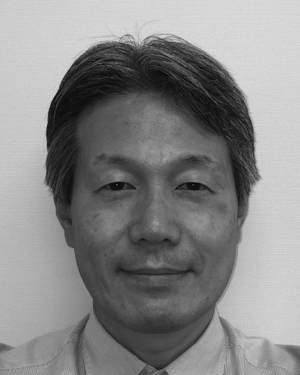 S Murakami合作论文数86Hisamichi Funaba合作论文数86
 y nagayama合作论文数Natl Inst Fus Sci83
 Junichi Miyazawa合作论文数83Kobayashi S合作论文数82
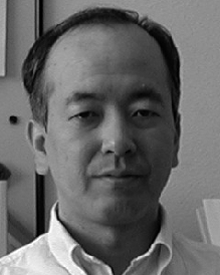 T. Morisaki合作论文数82
 O. Kaneko合作论文数80Kazuo Kawahata合作论文数80
 Kazunobu Nagasaki (長﨑百伸)合作论文数Advanced Particle Beam Energy Department, Institute of Advanced Energy, Kyoto University80Ryuhei Kumazawa合作论文数79T Watari合作论文数78
 K. Tsumori合作论文数77Shoichi Okamura合作论文数77
 Kenichi Nagaoka (永岡賢一)合作论文数National Institute for Fusion Science;Department of Physics, Graduate School of Science, Nagoya University77R. Sakamoto合作论文数76Naoyuki Tamura合作论文数76Nobuyoshi Ohyabu合作论文数76H Yamada合作论文数75
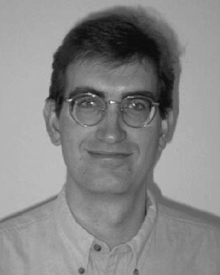 BJ Peterson合作论文数75
 Naoko Ashikawa合作论文数National Institute for Fusion Science75
 Osamu Motojima合作论文数The National Institute for Fusion Science, National Institutes of Natural Sciences75
 Kiyomasa Y. Watanabe (渡邊清政)合作论文数High Density Plasma Physics Research Devision, National Institute for Fusion Science, National Instsitutes of Natural Siences;Energy Engineering Department, Graduate School of Engineering, Nagoya University75
 Satoshi Ohdachi (大舘暁)合作论文数High density plasma research division, National Institute for Fusion Science74
 Mikio Shoji合作论文数Dementia reserch Center, Geriatrice Research Institute and Hopspital73Chie Suzuki合作论文数73S. Morita合作论文数72




