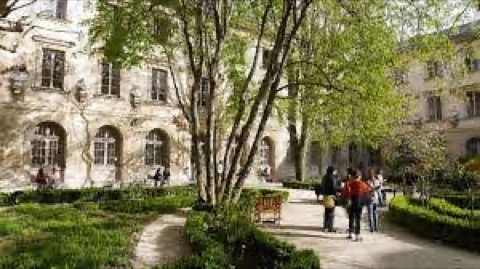
巴黎高等师范学院(École normale supérieure,ENS),或称巴黎高等师范学校,于1794年10月30日(雾月9日)由法兰西第一共和国国民议会下令创建。学校在法国大革命中饱经动荡,1808年由拿破仑和拉普拉斯整顿后重新开学。现为巴黎高师集团和巴黎文理研究大学(PSL)的成员之一。学校本部位于巴黎邬尔姆路的圣·热内维埃芙山,总校在巴黎有3处校区,还在外省郎寨和富尔于夫设有分校 。 在18世纪的法国,教师具有崇高的地位。巴黎高师一如其名,是一所师范大学,其初始使命是“培养已受过实用知识训练的公民,使他们在各方面最有能力的教授的指导下,学习教学的艺术”。两百多年来,高师为法国培养了无数杰出的教师人才、数百位法兰西学院院士、13名诺贝尔奖获得者、14名菲尔兹奖获得者(世界第4),是世界重要的数学、科学和哲学研究中心。 如同剑桥大学之于英国、哥廷根大学之于德国、彼得堡大学之于俄罗斯,法国则有巴黎综合理工学院和高师。高师拥有的杰出人才包括拉普拉斯、拉格朗日、柯西、傅里叶、蒙日、伽罗瓦、勒让德、埃尔米特等数学家,古诺、巴斯德、丹尼尔·拉加什、涂尔干、饶勒斯、德布鲁、托马斯·皮凯蒂等科学家,罗曼·罗兰、萨特、波伏娃、阿隆、阿兰、布尔迪厄等哲学家,蓬皮杜、洛朗·法比尤斯、朱佩等政治家。 高师每年只招收200余名学生,没有毕业证发放资格,也没有国家学历证书的授予权。学生必须通过高师所属的合作大学的注册学籍,取得该大学颁发的学位。

Knowing when to say “I don’t know” is fundamental to human judgment, yet AI assistants offer a fluent answer to almost any question. In five experiments (N = 3,132; four preregistered, one direct replication), participants answered difficult questions and could always decline to respond. We engineered the questions so that AI advice was wrong, separating AI use from its accuracy. Merely having access to AI nearly eliminated participants’ willingness to suspend judgment, and this held whether the advice was actively requested or simply displayed. Consequently, participants answered more questions but were correct about a third as often as when AI was unavailable—yet their confidence nearly doubled. Incentivizing accuracy and penalizing inaccuracy led participants to seek and follow AI advice less, answer more accurately, and suspend judgment more often, though still far less than when AI was unavailable. As AI suggestions grow ubiquitous and unsolicited, they may not simply affect answer accuracy; they may even alter the metacognitive threshold at which people decide whether they know enough to answer.
We derive a weak-strong uniqueness and stability principle for the Landau equation in the soft potentials case (including Coulomb interactions). The distance between two solutions is measured by their relative entropy, which to our knowledge was never used before in stability estimates. The logarithm of the strong solution is required to have polynomial growth while the weak solution can be any H-solution with sufficiently many moments at initial time. Since we require a substantial amount of regularity on the strong solution, we also provide an example of sufficient conditions on the initial data that ensure this regularity in the Coulomb (and very soft potentials) case.
Understanding the spatial organization of individual cell types within tissue and how this organization is disrupted in disease, is a central question in biology and medicine. Hematoxylin and eosin-stained slides are widely available and provide detailed morphological context, while spatial gene expression profiling offers complementary molecular insights, though it remains costly and limited in accessibility. Predicting gene expression directly from histological images is therefore an attractive goal. However, existing approaches typically rely on small image patches, limiting resolution and the ability to capture fine-grained morphological variation. Here, we introduce a deep learning approach that predicts single-cell gene expression from morphology, matching patch-based methods on spot level prediction tasks. The model recovers biologically meaningful expression patterns across two cancer datasets and distinguishes fine cell populations. This approach enables molecular-level interpretation of standard histological slides at scale, offering new opportunities to study tissue organization and cellular diversity in health and disease.
Statistical learning enables us to identify patterns in our environment and predict future events, thereby supporting a range of motor, cognitive, and linguistic skills. Despite its significance, the developmental trajectory of statistical learning has remained unclear due to a lack of comprehensive longitudinal studies. Cross-sectional research has hinted at enhanced statistical learning in children up to 11-13 years, followed by a decline into adulthood, yet definitive insights require a longitudinal approach. Our study addresses this critical gap by assessing statistical learning in the same participants at ages 7, 8, 11, and 14. Utilizing linear mixed models and latent class analyses, we observed a decline in statistical learning with age, and found that higher executive functions were associated with this decline. This study provides robust evidence that statistical learning is more effective in early childhood, offering crucial insights into the developmental trajectory of this fundamental cognitive ability.
In this work, we revisit the following estimate due to Dahlberg . Let x_0 a fixed point in a bounded Lipschitz domain Ω. Then there exists a constant C > 0 such that if u is a harmonic function in Ω and vanishes at x_0, then C^-1‖ u ‖_L^2(Γ)≤(∫_Ωϱ|∇ u |^2)^1/2≤ C ‖ u ‖_L^2(Γ), where ϱ is the distance to the boundary of Ω. Using Grisvard's work and interpolation theory for subspaces, we complete the solvability of the inhomogeneous Dirichlet problem: (ℒ_D^0) -Δu = f Ω u = 0 Γ, in a framework of fractional Sobolev spaces H^s(Ω), when Ω is a polygon or a polyhedron domain and 1/2 ≤ s ≤ 2. Thanks to these regularity results and an explicit function given by Nečas, we show that the above inequalities cannot be valid in their current form. On the other hand, we identify a functional space which satisfies the embeddings H^1/2_00(Ω)↪ E(∇; Ω) ↪ H^1/2(Ω) and the trace operator γ_0 from E(∇; Ω) into L^2(Γ) is well-defined and continuous. This leads to an alternative to the functions H^1/2(Ω), non necessarily harmonic, for having a trace in L^2(Γ) and also to a new characterization of H^1/2_00(Ω) as the kernel of this operator. However, we show that if the domain Ω is of class 𝒞^1, 1, then the above inequalities are valid.





