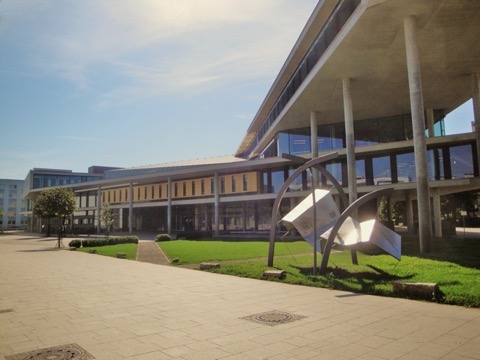
The Otto von Guericke University Magdeburg (German: Otto-von-Guericke-Universität Magdeburg, short OvGU) was founded in 1993 and is one of the youngest universities in Germany. The university in Magdeburg has about 14,000 students in nine faculties. There are 11,700 papers published in international journals from this institute.It is named after the physicist and mayor of Magdeburg Otto von Guericke, famous for his experiments with the Magdeburg hemispheres. The former Technical University Magdeburg (Technische Hochschule Magdeburg), a teacher training college and a medical school were absorbed into the university when it was created. The university now composes nine faculties.

In this contribution, we address the challenge of non-convex optimization for parameter estimation and propose a general theoretical framework to improve global convergence and its practical implementation based on neural networks. Such inverse problems, as discussed here, are typically formulated in terms of a forward model. We interpret the set of model predictions as a Riemannian manifold and identify the origin of non-convexity in the twisted and entangled surface of the model manifold. Under assumptions of regularity, we aim to unfold and rectify the manifold using an interpretable residual autoencoder to facilitate global optimization. Crucially, this transformation must preserve the orthogonality of noisy measurements below a specified signal-to-noise ratio to support unique identification. In the theoretical limit, perfect rectification of the model manifold and its tubular neighborhood reduces the inverse problem to linear least squares. We validate our approach in a proof of concept and demonstrate its practical feasibility using a synthetic model based on a parametrized cosine series with two, three, and four parameters, confirming significant acceleration in convergence and robust global identification of parameter estimates.
Spectroscopic ellipsometry is applied to determine the dielectric functions (DFs) epsilon and absorption coefficients alpha of orthorhombic multi-domain kappa-(InxGa1-x)(2)O-3 from 0.5 to 6.5 eV. The investigated (001)-oriented thin films with 0 <= x <= 0.175 were grown by molecular beam epitaxy on c-plane sapphire substrates. By an anisotropic analysis, we demonstrate that the in-plane DF epsilon(perpendicular to) can be decomposed into their components of the orthorhombic dielectric tensor epsilon(xx) and epsilon(yy). The resulting three characteristic transition energies (E-x, E-y,E-1, E-y,E-2) were found to shift to lower energies with increasing In-content. The results are compared to previous studies, and the origin of apparent agreements is critically examined.
The recovery of cathode materials from spent lithium-ion batteries (LIBs) is highly beneficial for environmental protection and resource circularity. Here, an efficient closed-loop process is proposed for recycling spent LiCoO2. A novel deep eutectic solvent (DES) composed of betaine hydrochloride and pyruvic acid is proposed to achieve rapid and efficient leaching of Li and Co under mild conditions. Leaching kinetics of the DES is analyzed using the shrinking core model, while the leaching mechanism is systematically investigated by integrating experimental and theoretical approaches. Co and Li are recovered from the leachate through precipitation, and the leaching performance of the regenerated DES is also examined. The electrochemical performance of the regenerated LiCoO2 is tested and compared with commercial LiCoO2. Finally, the economic and environmental analysis of the closed-loop recovery process is studied to evaluate its application prospects. This work provides valuable guidance for the comprehensive recycling and utilization of spent LIBs.
Abstract Background Previous studies have not demonstrated sufficient effects of intensive care unit (ICU) follow-up clinics on health-related quality of life. This may also be influenced by the design and implementation of these studies. Feasibility and context of such studies have yet to be sufficiently researched. It is therefore crucial to investigate these contextual factors. This study aimed to explore the experiences of patients, relatives, and healthcare professionals with both the randomised controlled trial (RCT) and the ICU follow-up clinic, to assess the feasibility and acceptability of the intervention and the study design from the perspectives of those involved. Methods This qualitative research was embedded in the process evaluation of a pilot RCT on an ICU follow-up clinic. We conducted 18 semi-structured interviews with former ICU patients, relatives and the clinical study team who participated in the PINA study and used field notes from the clinical study team. Data analysis was carried out using qualitative content analysis. Results The pilot RCT was well received by potential patients and their relatives, and the motivation to participate was high, as was the motivation of the clinical study team. The main benefits of the ICU follow-up clinic intervention named by participants were being taken seriously and receiving referrals that they would not typically get from a general practitioner. The offer of home visits for patients with long travel distances to the ICU follow-up clinic was highly appreciated. Conclusions It was feasible to integrate the perspectives of patients, relatives, and healthcare professionals within a pilot RCT on an ICU follow-up clinic. Across all stakeholder groups, the ICU follow-up clinic and the RCT trial design were considered acceptable and valuable, suggesting that such follow-up care meets patient needs and that a large-scale study appears feasible. Trial registration ClinicalTrials.gov US NLM, NCT04186468, Submission: 02/12/2019, Registration: 04/12/2019, https://clinicaltrials.gov/ct2/show/NCT04186468 .
This paper critically examines conceptualizations of "transnational," "global" or "cosmopolitan" habitus in migration, globalization and inequality research. We conceptualize habitus as a configuration of basic dispositions, using items from the Schwartz values battery, and compare the effect of habitual dispositions, class, and migration on cosmopolitan self-identification via country-specific multiple regression models, based on data from the World Values Survey (2005-2015) of around 100,000 individuals from 74 countries. We show that migration experiences and habitual dispositions of openness to new and stimulating experiences rather than orientations toward tradition and security are associated with stronger global self-identification. We also find a tendency among the upper classes toward cosmopolitan identification; however, these effects vary between an economic and a cultural capital route as well as among societies. Our findings thus caution against the uncritical use of "one-size-fits-all" concepts such as transnational, global and cosmopolitan habitus independent from specific social and cultural contexts.





