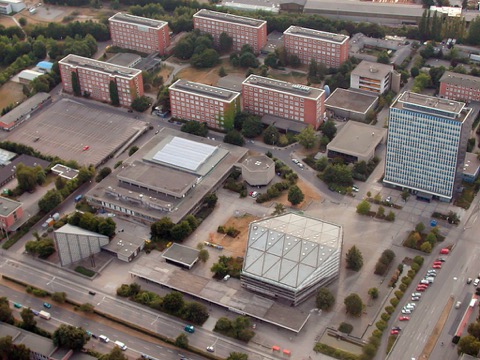
The University of Kiel, officially the Christian-Albrecht University of Kiel, (German: Christian-Albrechts-Universität zu Kiel, abbreviated CAU, known informally as Christiana Albertina) is a university in the city of Kiel, Germany. It was founded in 1665 as the Academia Holsatorum Chiloniensis by Christian Albert, Duke of Holstein-Gottorp and has approximately 27,000 students today. Kiel University is the largest, oldest, and most prestigious in the state of Schleswig-Holstein. Until 1864/66 it was not only the northernmost university in Germany but at the same time the 2nd largest university of Denmark. Faculty, alumni, and researchers of the Kiel University have won 12 Nobel Prizes. Kiel University has been a member of the German Universities Excellence Initiative since 2006. The Cluster of Excellence The Future Ocean, which was established in cooperation with the GEOMAR Helmholtz Centre for Ocean Research Kiel in 2006, is internationally recognized. The second Cluster of Excellence "Inflammation at Interfaces" deals with chronic inflammatory diseases. The Kiel Institute for the World Economy is also affiliated with Kiel University. The university has a great reputation for its focus on public international law. The oldest public international law institution in Germany and Europe - the Walther Schuecking Institute for International Law - is based in Kiel.

This paper investigates how the specific design of an agglomeration bonus affects farmers' willingness to participate in a stylised peatland restoration scheme. The analysis is based on a discrete choice experiment with 110 farmers from peatland regions in northwest Germany. The results suggest that, relative to the scheme's land-use restrictions, the agglomeration bonus plays a minor role in the decision to participate in the scheme. The bonus had no statistically significant effect in the mixed logit estimations and was mostly ignored in the decision-making process. Only when preferences are adjusted for attribute non-attendance does the bonus enhance willingness to participate and the scheme's cost-effectiveness. Respondents who did not ignore the attributes of bonus design preferred a lump sum payment at the start of the scheme to an annual disbursement of the bonus, and an area-based bonus to a neighbourhood bonus. More generally, the results suggest that only mediocre levels of commitment on the part of farmers can be achieved through a voluntary approach. More ambitious peatland restoration, which may be necessary to achieve the reduction targets in the LULUCF sector, will need to combine incentive systems with regulatory or planning instruments.
As unconventional hydrocarbon exploration increasingly targets deeply buried, highly mature source rocks, there is a growing need to accurately characterize organic matter exposed to extreme thermal conditions. A key analytical challenge in such systems is the reliable determination of total organic carbon (TOC), thermal maturity (Tmax), and hydrocarbon generation potential (S2 and Hydrogen Index, HI) using standard Rock-Eval pyrolysis. In overmature samples, the conventional upper pyrolysis temperature of 650 degrees C is insufficient to fully evolve the S2 peak, resulting in underestimated S2 and TOC values and unreliable Tmax determinations. To overcome this limitation, this study introduces a modified extended temperature programmed pyrolysis protocol that extending the final temperature to 850 degrees C on a series of synthetically matured shale samples produced by confined-pressure hydrous pyrolysis across a range of thermal maturities. The results show that this approach enables complete S2 evolution where conventional Rock-Eval analysis fails to resolve the hydrocarbon generation signal. The resulting S2 pyrograms exhibit a bimodal distribution, with the first peak corresponding to residual kerogen and the second to pyrobitumen formation. Systematic evolution of the second peak yields robust Tmax values show a strong linear relationship with thermal maturity (Tmax = 95.17 EASY%Ro + 345.96), indicating that pyrobitumen serves as a reliable proxy for advanced thermal maturity. These results show that standard Rock-Eval protocols can significantly underestimate TOC and misrepresent maturity in overmature source rocks, whereas high-temperature programmed pyrolysis extends the applicability of pyrolysis-based geochemical parameters into the overmature domain. By enabling more accurate characterization of highly evolved organic matter, this method provides a practical and improved geochemical foundation for basin modeling and thermal simulation studies, addressing a critical gap in the evaluation of overmature petroleum systems.
Preclinical surgical studies in rodent models play a pivotal role in elucidating the mechanisms of bone repair and regeneration. Similar to clinical practice, intraoperative and postoperative complications in preclinical studies significantly affect treatment outcomes and may even alter the overall experimental results. Well-established laboratory infrastructure and experimental procedures can reduce the risk of adverse events, such as intraoperative technical errors and postoperative infection. However, these aspects are often underreported or overlooked in the literature. In this study, fracture fixation in rats is presented as an example to highlight the essential but often unreported details, such as virtual surgical planning, preoperative rehearsal, disinfection protocols, intraoperative management, postoperative support, multidisciplinary collaboration, and research documentation. Supplementary and alternative solutions are also proposed for laboratories with limited resources. By applying virtual planning and rehearsal with three-dimensional (3D)-printed samples, the authors have performed 108 consecutive external fixation procedures for rat femoral fractures since 2020, with no intraoperative dropouts attributable to surgical technique errors. The operative time stabilized at 45.6 ± 3.8 minutes (mean ± standard deviation), reflecting low variability and a reproducible workflow. Systematic implementation of these strategies helps prevent postoperative complications, enhances animal welfare, and improves the reproducibility and translational potential of preclinical research.
Seismic reflection data from Vincennes Bay, East Antarctica, provide the first insights into the Cenozoic evolution of the East Antarctic Ice Sheet (EAIS) in the Knox Coast. Long-distance seismic horizon correlation allows age estimates for the seismic stratigraphic framework constructed for the continental shelf. Preglacial depositional patterns reveal extensive fluvial plains on the continental shelf from the Late Cretaceous until the latest Eocene (similar to 34 Ma). These transitioned to glaciofluvial outwash plains during the late Oligocene. The earliest clear indication of ice sheets present on the Vincennes Bay continental shelf are two generations of large buried tunnel valley systems that developed during the Oligocene-Miocene Transition (similar to 24 Ma) and early Miocene during meltwater-rich glaciations originating in the Knox Coastal Plain. Glacially transported sediment wedges deposited at the end of the early mid-Miocene (>similar to 14 Ma) mark the beginning of steep glacial progradation of the continental shelf continuing through the Miocene and Pliocene. Ice sheet development from the late mid-Miocene to the Quaternary is likely driven by the Aurora Subglacial Basin via the Vanderford Glacier. This suggests a major reorganization of ice flow from the early glaciations of the Oligocene and early Miocene to the later development of modern configurations, established in the late mid-Miocene. Our results provide the first data of the Cenozoic development of the EAIS in Vincennes Bay and demonstrate the variability of ice flow conditions with past climatic changes.
Implicit academic self-concepts and intrinsic values describe students’ automatically activated perceived abilities and attitudes towards school subjects. In the present research, we examined these implicit constructs within the context of a framework that integrates key elements of three prominent theories from the field of educational psychology: expectancy-value theory, dimensional comparison theory, and theory on vocational interests. To this end, we developed four go/no-go association tasks (GNATs) to measure implicit math and German self-concepts and values. Furthermore, we examined the formation and impact of these implicit constructs using cross-sectional data from a sample of 946 ninth- and tenth-graders from German high schools. Guided by three central research questions, we found (1) evidence for the validity of the GNATs to measure students’ implicit self-concepts and values in math, (2) that implicit math self-concepts and values appear to be influenced by dimensional comparisons (where students compare their achievements in different subjects), but not by social comparisons (where students compare their achievements with those of other students), and (3) that implicit math self-concepts predict students’ vocational interests over and above their achievements, explicit self-concepts, and explicit values in math and German. Our research also demonstrated the benefit of combining key elements from different theories of educational psychology to gain a deeper understanding of the relationships between students’ achievements, self-concepts, values, and vocational interests. Moreover, it is of great practical relevance as it highlights the importance of implicit self-concepts and values for students.





