In this paper we review the semiclassical extended Thomas-Fermi theory for describing the ground-state properties of nuclei. The binding energies calculated in this approach do not contain shell effects and, in this sense, they are analogous to those obtained from the mass formula. We discuss some techniques for incorporating the shell effects which are missing in the semiclassical calculation, such as the so-called expectation value method and the Kohn-Sham scheme. We present numerical applications for effective zero-range Skyrme forces and finite-range Gogny forces.
It is proposed to equip the PIK and WWR-M research reactors at the Petersburg Nuclear Physics Institute (PNPI) with high-density ultracold neutron (UCN) sources, where UCNs will be obtained based on the effect of their accumulation in superfluid helium (due to the specific features of this quantum fluid). The maximum UCN storage time in superfluid helium is obtained at temperatures on the order of 1 K. These sources are expected to yield UCN densities of 103–104 cm–3, i.e., approximately three orders of magnitude higher than the density from existing UCN sources throughout the world. The development of highest intensity UCN sources will make PNPI an international center of fundamental UCN research.
Nuclear reactions using proton beams and tin targets are studied in order to obtain antimony radionuclides. A new target system that includes on-line monitoring of target heating is used. To determine the parameters of proton beams, experimental studies on nuclear reactions are performed using Ti, Cu and stainless steel targets. Using modern model approximations, cross sections are determined for the formation of radionuclides 119Sb and 117Sb in the investigated nuclear reactions.
A research program aimed at studying fundamental interactions by means of ultracold and polarized cold neutrons at the GEK-4-4′ channel of the PIK reactor is presented. The apparatus to be used includes a source of cold neutrons in the heavy-water reflector of the reactor, a source of ultracold neutrons based on superfluid helium and installed in a cold-neutron beam extracted from the GEK-4 channel, and a number of experimental facilities in neutron beams. An experiment devoted to searches for the neutron electric dipole moment and an experiment aimed at a measurement the neutron lifetime with the aid of a large gravitational trap are planned to be performed in a beam of ultracold neutrons. An experiment devoted to measuring neutron-decay asymmetries with the aid of a superconducting solenoid is planned in a beam of cold polarized neutrons from the GEK-4′ channel. The second ultracold-neutron source and an experiment aimed at measuring the neutron lifetime with the aid of a magnetic trap are planned in the neutron-guide system of the GEK-3 channel. In the realms of neutrino physics, an experiment intended for sterile-neutrino searches is designed. The state of affairs around the preparation of the experimental equipment for this program is discussed.
The orthogonality condition model (OCM) is used to describe α+16O scattering at low energies. A double folding potential with density-dependent effective NN interactions is used as the local potential of the model. The energies and widths of α-cluster resonances and differential cross sections are calculated. The results are compared to one obtained using the standard potential approach, without the nonlocal interaction of the OCM.
The research program on fundamental interactions with ultra cold and polarized cold neutrons on GEK-4-4' channel of PIK reactor is presented. An experimental complex scheme comprises: a source of cold neutrons in deuterium reflector of the reactor, a source of ultra cold neutrons (UCN) on superfluid He on the output beam of cold neutrons of GEK-4 channel and a number of experimental installations on neutron beams. Using a UCN beam, we are planning to make an experiment on a neutron lifetime measurement with a big gravitation trap. The article discusses the state of things relevant to preparation of experimental set-up as well as the current situation in this field and motivation for neutron life time measurement.
At present, the possible existence of a sterile neutrino having a significantly smaller crosssection of interaction with a substance than, for example, electron antineutrinos from a reactor, is being widely discussed. It has been suggested that due to transition of a reactor antineutrino into a sterile state, one can observe both the oscillation effect at short range distances from the reactor and deficiency of the reactor antineutrino flux at large range distances [1,2] (Fig. 1). In addition, sterile neutrinos are considered as candidates for dark matter [3]. The ratio of experimentally observed neutrino flux to the predicted one is estimated as 0.927±0.023 [1]. This effect comprises 3 standard deviations. It is still insufficient to confirm the existence of reactor antineutrino anomaly. The method of comparison of the measured antineutrino flux with the expected one from the reactor is unsatisfactory, because of the problem of an accurate estimation of the reactor antineutrino flux and efficiency of the antineutrino detector. The idea of oscillations can be tested by direct measurements of the effect of flux variation and the spectrum of antineutrino at short range distances from the reactor. The detector should be movable and spectral-sensitive. Our experiment sets the task of either confirming or disproving the possibility of a sterile neutrino existence at certain accuracy level.
A resonance-like structure in the excitation function for elastic and inelastic 14C + 12C interactions is investigated. Angular distributions for the 14C(12C,10Be)16O reaction at center-of-mass energies of 21.1, 23.5, and 24.6 MeV are obtained. It is shown that the angular distribution at the maximum cross section corresponds to the 12+ resonance and the 10Be + 16O structure. The position of the level with an angular momentum of 10+ is predicted.
The angular distribution of the products of the 14C + 12C reaction at the energies E cm = 22.1, 23.5, and 24.6 MeV has been studied near a 23.5-MeV quasimolecular resonance. Channels with the yield of 8,9,10Be have been considered for various excitation energies of the residual nucleus. The results have been analyzed within the cluster and DWBA models. It has been shown that an approach based on the assumption of direct processes reproduces the features of the angular distributions. Oscillations corresponding to the formation of a quasimolecular resonance with an angular momentum of 12+ have been detected near the resonance.
A theoretical study of even–even nuclei (2 ≤ Z ≤ 8) with extreme neutron excess stable with respect to one-neutron emission, including nuclei beyond the neutron drip line (NDL), is performed. The calculations are based on the Hartree–Fock (HF) method with Skyrme forces (SkI2) and allowance for axial deformation and the Bardeen–Cooper–Schrieffer (BCS) pairing approximation. It is shown that beyond the NDL, 18He and 40C isotopes form peninsulas of nuclei stable with respect to one-neutron emissions. The restoration of stability beyond the NDL for 18He and 40C can be explained by the complete filling of neutron subshells with high angular momentum and the introduction of corresponding neutron levels in the region of discrete bound states.
Using HF + BCS method with Skyrme forces we analyze the neutron drip line. It is shown that around magic and new magic numbers the drip line may form stability peninsulas. It is shown that the location of these peninsulas does not depend on the choice of Skyrme forces. It is found that the size of the peninsulas is sensitive to the choice of Skyrme forces and the most extended peninsulas appear with the SkI2 set.
The resonance capture of multineutrons by the 88Sr and 27Al nuclei has been calculated by the Hartree–Fock method with the Skyrme forces (Ska) taking into account pairing in the Bardeen–Cooper–Schrieffer approximation. The calculated binding energies of multineutrons, rms radii, pairing energies, and quadrupole deformation parameters point in favor of the resonance capture mechanism.
Angular distributions of differential cross sections for scattering of alpha-particles on 24 Mg nuclei are described as scattering on a black absorbing nucleus and its alpha-cluster components using first-order Bessel functions. The dependence of the interaction radius of alpha-clusters in a nucleus on the energy of incident particles is found. The radius varies because scattering at low energies can occur upon the correlated motion of two or three alpha-clusters. Scattering at average energies occurs mainly on separated alpha-cluster structures. As the energy increases, the contribution from the alpha-particle mode falls while the contribution from the modes of scattering on nucleons rises; this can manifest itself as growth of the interaction radius due to the interference between the alpha-cluster mode and those of smaller cluster structures and nucleons. A contribution to the nonuniform rise of angular distributions of differential cross sections is thus also possible due to these effects.
A hydrodynamic approach with a non-equilibrium equation of state is used to describe the collisions of heavy ions at medium and intermediate energies. In the development of this approach, with the inclusion of nuclear viscosity effects and the introduction of an amendment to the microcanonical distribution, the double differential cross sections of proton emission in collisions of different nuclei are calculated, which are in agreement with the available experimental data on the emission of high-energy particles, including the cumulative spectral region.
Using HF + BCS method we study light nuclei with nuclear charge in the range 2 ≤ Z ≤ 8 and lying near the neutron drip line. The HF method uses effective Skyrme forces and allows for axial deformations. We find that the neutron drip line forms stability peninsulas at 18 He and 40 C . These isotopes are found to be stable against one neutron emission and possess the highest known neutron to proton ratio in stable nuclei.
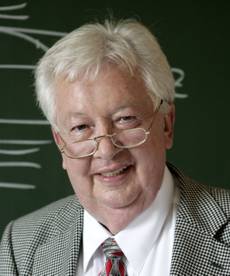 Walter Greiner合作论文数Frankfurt Institute for Advanced Studies51
 D. K. Gridnev合作论文数36V. G. Kartavenko合作论文数33VN TARASOV合作论文数30V. B. Subbotin合作论文数30D. V. Tarasov合作论文数Kharkov Institute for Physics and Technology28Ernst F Hefter合作论文数26
 Sergey Fadeev合作论文数Institute of Mechanics and Engineering, Russian Academy of Sciences25V. M. Semjonov合作论文数22X. Vinas合作论文数21Ya Nemilov合作论文数19V. F. Litvin合作论文数17Vm Semenov合作论文数16S. Yu. Torilov合作论文数15Lv Krasnov合作论文数14Tv Orlova合作论文数14Yu. A. Nemilov合作论文数13Stefan Schramm合作论文数12E. D. Teterin合作论文数11V. Z. Goldberg合作论文数Russian Research Center “Kurchatov”,11Ef Khefter合作论文数10
 Salwa Saad合作论文数10r p kolalis合作论文数8Zherebts.Ki合作论文数8Ya Lakomkin合作论文数8
 Konstantin V. Lukyanov合作论文数Joint Institute for Nuclear Research8L. V. Krasnov合作论文数8
 Alexander T. D'yachenko合作论文数7Sh. Hamada合作论文数7V. I. Kuprikov合作论文数7S. V. Khlebnikov合作论文数7N. Amangeldi合作论文数6Va Komarov合作论文数6Vs Romanov合作论文数6N. A. Maltsev合作论文数6M. Brenner合作论文数6Tom Lonnroth合作论文数6Anatolii P. Serebrov合作论文数6K.I. Zherebtsova合作论文数6Ernst F. Hefter合作论文数6N. Burtebayev合作论文数6
 A. K. Fomin合作论文数6yu a lakomkin合作论文数5T. V. Korovitskaya合作论文数5D. V. Prudnikov合作论文数5Nz Darvish合作论文数5Ae Antropov合作论文数5Pp Zarubin合作论文数5
 Konstantin Ershov合作论文数5




