In large-scale sparse multiobjective optimization problems (LSMOPs), searching for high-quality sparse solutions in the large-scale search space is challenging. The search capability of most existing genetic operators deteriorates dramatically when directly tackling LSMOPs, as they often fail to grasp the informative search direction. Thus, this paper proposes a neural network-assisted evolutionary search (NNES) strategy to achieve efficient directed search for solving LSMOPs. NNES leverages the predictive power of neural networks (NNs) to guide each solution toward rapid convergence along its learned promising Pareto descent direction. Specifically, NNES first pairs training data from the current population based on convergence-sparsity tradeoff to represent solution improvement directions. Then an NN is employed to learn the underlying directional improvements from these paired solutions. Finally, new promising sparse solutions are generated along the direction predicted by the trained NN for assisting the optimization. In addition, an improved environmental selection is customized with balanceable convergence, diversity, and sparsity. Experimental studies validate the superior performance of the proposed algorithm compared with the state-of-the-art evolutionary algorithms.
Multimodal multi-objective evolutionary algorithms (MMEAs) tailored for multimodal multi-objective optimisation problems (MMOPs) have achieved considerable advancements in recent years. However, the adaptation of MMEAs to large-scale MMOPs with sparse Pareto optimal solutions and the attainment of all equivalent Pareto optimal solution sets (PSs) remain challenging mainly due to the obstacles of the dimensionality curse, the unknown multimodality and the unknown sparsity. Therefore, this study proposes a cascade clustering-based two-stage evolutionary algorithm to address these issues. In particular, this study employs a cascade clustering technique to distinguish distinct PSs accurately from current subpopulations. Simultaneously, a two-stage optimisation approach determined by cascade clustering is adopted to meticulously uphold multimodality detection and ensure accurate unimodal evolution. Moreover, a balanced evolution strategy is incorporated into the two-stage evolutionary process to promote the independent accurate evolution of each modality and achieve the evolutionary balance among different modalities. Furthermore, the scores of the decision variables updated by local guidance vectors are used to guide the generation of subpopulations for facilitating convergence in their respective search directions. Compared with six state-of-the-art multimodal algorithms, the proposed method achieves the first rank across all SMMOP test suites in terms of IGDX, while significantly outperforming competitors on the majority of SMMOP test suites in both IGD and HV indicators.
In the last three decades, a large number of metaheuristics inspired by biological evolution, swarm behaviors, and natural phenomenons have been proposed for solving black-box optimization problems. While metaheuristics successively showed superior performance over their predecessors on benchmark problems, it has been criticized that some of them tend to search towards the origin and can only perform well on problems with optimal variables of zero. While experimental studies on such over-customization issues have been given in the literature, there is a lack of theoretical analysis methods. In this paper, we suggest a comprehensive method to theoretically study the potential over-customization issues of metaheuristics, by means of deriving the conditions of search space transformation invariance properties of variation operators. The proposed method is used to theoretically analyze the translation, scale, and rotation invariance properties of several representative metaheuristics, and the conclusions are further verified by a variety of experiments. Our conclusions reveal that some metaheuristics are sensitive to the transformations of search spaces, which means that their performance superiority on specific problems may not demonstrate their effectiveness in more generic scenarios. At last, we give some advices on the avoidance of the over-customization in developing metaheuristics. We hope the conclusions of this paper are beneficial for the development of new metaheuristics.
Multi-modal multi-objective optimization problems (MMOPs) are particularly challenging due to the difficulty of identifying multiple equivalent Pareto optimal solutions that are similar in the objective space but differ significantly in the decision space. While some evolutionary algorithms perform well on MMOPs, they struggle with large-scale MMOPs, especially those with sparse optimal solutions, due to the curse of dimensionality. These algorithms not only face challenges in converging to Pareto optimal solutions but also in assessing population diversity in a high-dimensional decision space. To remedy these issues, this paper proposes a cooperative multi-population evolutionary algorithm for large-scale MMOPs with sparse optimal solutions. The proposed algorithm balances solutions’ optimality in the objective space and diversity in the decision space by evolving two categories of subpopulations. The first category of subpopulations groups decision variables to efficiently converge to specific Pareto optimal solutions. The second category explores the global search space to discover potential equivalent Pareto optimal solutions, preserving solutions’ diversity in the decision space. These two categories collaborate by exchanging information, enabling dynamic management of subpopulations to allocate computational resources evenly across equivalent Pareto optimal solutions. Experimental results on benchmark problems and real-world applications demonstrate that the proposed algorithm has significant advantages over state-of-the-art evolutionary algorithms.
JPEG has been widely utilized across diverse applications and devices for approximately 30 years, and it will continue to dominate the image ecosystem for an extended duration. Optimizing the quantization table in JPEG compression not only maintains compatibility with the JPEG standard but also enhances compression efficiency, which is crucial for image storage and transmission. Existing Evolutionary Algorithm (EA) based optimization of JPEG quantization tables primarily focuses on optimizing the luminance quantization tables, but the optimization cannot be tailored for specified bit-rates. To address this problem, this paper proposes a rate-distortion optimal evolutionary algorithm with fixed bit-rates for the JPEG quantization table optimization, which optimizes the quantization tables through a co-evolutionary algorithm with two populations: one with bit-rate constraints and the other without any constraints, adopting the rate-distortion optimal principle based population update and different environmental selection strategies for each population. The two populations are evolved simultaneously and cooperate with each other to achieve better optimization performance. Experimental results on classical benchmark datasets demonstrate that our method can achieve the better quantization tables than current state-of-the-art algorithms in both compression efficiency and image quality while more accurate target bit-rate for JPEG compression can also be achieved through our method.
Evolutionary multitasking optimization, where the auxiliary task transfers knowledge to assist the main task, has been recognized in solving constrained multi-objective optimization problems. However, the auxiliary task of most algorithms encounters difficulties in transferring useful knowledge due to quantities of decision variables and constraints in volumetric modulated arc therapy planning. To tackle this issue, an effective auxiliary task is tailored to this problem, which features a small number of decision variables and relaxed constraints. The auxiliary task is derived from cloning the original problem. In particular, the constraint information of the original problem is utilized to reduce decision variables, and the constraints are relaxed accordingly. With the proposed auxiliary task, a multitask-based constrained evolutionary algorithm is developed for volumetric modulated arc therapy planning(MTCEA/VMAT). Experimental results on six clinical cases exhibit the superior performance of the proposed algorithm against representative algorithms.
Many-objective evolutionary algorithms (MaOEAs) have shown great potential for many-objective optimization problems (MaOPs). However, most existing MaOEAs struggle with problems characterized by irregular Pareto fronts (PFs), primarily due to limitations in diversity preservation. To address this challenge, this paper proposes a manifold embedding-based evolutionary algorithm tailored for MaOPs with irregular PFs. The proposed algorithm introduces a customized environmental selection mechanism using an angle-based manifold embedding approach to enhance diversity maintenance. First, hierarchical clustering is applied in a lower-dimensional embedded space to support the environmental selection process, promoting better diversity preservation. Next, a diversity quality indicator, defined in the latent manifold space, is developed to more accurately capture distances between solutions based on the intrinsic structure of the PF. Furthermore, a parameter-free comprehensive quality indicator, integrating both diversity and convergence, is introduced to guide selection within each cluster. To further improve performance, an external archive is employed to retain high-quality solutions throughout the evolutionary process. Comparative studies on 20 widely used test problems with complex and irregular PFs demonstrate that the proposed algorithm consistently outperforms state-of-the-art methods.
Over the past decades, extensive research has been conducted on adversarial attacks and defense mechanisms in deep learning, particularly in real-world applications such as autonomous vehicles, medical diagnosis, etc. Recent studies have revealed that evolutionary algorithms that solve data-driven optimization problems are also vulnerable to adversarial attacks. However, research endeavors to address adversarial attacks in this context have not yet been initiated. Conducting such attacks is more challenging than those on deep neural networks, primarily due to the absence of defined gradients or loss functions in evolutionary algorithms, which complicates the application of existing attack methods. To address this issue, this paper introduces a novel adversarial attack model targeting evolutionary algorithms solving data-driven optimization problems. To model real-world malicious behaviors, this paper proposes an attack algorithm that develops perturbation cutoff and subpopulation filtering strategies, while also supporting a new sparse operator to ensure the attack’s destructiveness and imperceptibility. The effectiveness of our proposed model and algorithm is demonstrated through experimental evaluation on datasets for both single- and multi-objective optimization problems. Through these experiments, three key questions are addressed: Can a small perturbation of the dataset significantly degrade evolutionary algorithm performance? If so, are robust evolutionary algorithms more resistant to attacks than conventional ones? Furthermore, can the perturbation generated by one evolutionary algorithm also degrade the performance of other evolutionary algorithms? This study emphasizes the importance of evolutionary algorithm safety in real-world applications and provides valuable insights into the future development of trustworthy evolutionary algorithms.
Constrained multi-objective optimization problems (CMOPs) are of great significance in the context of practical applications, ranging from scientific to engineering domains. Most existing constrained multi-objective evolutionary algorithms (CMOEAs) usually employ fixed operators all the time, which exhibit poor versatility in handling various CMOPs. Therefore, some recent studies have focused on adaptively selecting the best operators for the current population states during the search process. The evolutionary algorithms proposed in these studies learn the value of each operator and recommend the operator with the highest value for the current population, resulting in only a single operator being recommended at each generation, which can potentially lead to local optima and inefficient utilization of function evaluations. To address the dilemma in operator adaptation, this paper proposes a reinforcement learning-based automated operator portfolio approach to learn an allocation scheme of operators at each generation. This approach considers the optimization-related and constraint-related features of the current population as states, the overall improvement in population convergence and diversity as rewards, and different operator portfolios as actions. By utilizing deep neural networks to establish a mapping model between the population states and the expected cumulative rewards, the proposed approach determines the optimal operator portfolio during the evolutionary process. By embedding the proposed approach into existing CMOEAs, a deep reinforcement learning-assisted automated operator portfolio based evolutionary algorithm for solving CMOPs, abbreviated as CMOEA-AOP, is developed. Empirical studies on 33 benchmark problems demonstrate that the proposed algorithm significantly enhances the performance of CMOEAs and exhibits more stable performance across different CMOPs.
The spatiotemporal dynamics of traffic forecasting make it a challenging task. In recent years, by adapting to the topology of traffic networks where road segments serve as nodes, graph convolutional networks (GCNs) have been able to capture spatiotemporal dependencies, thereby improving traffic forecasting performance. However, there are two shortcomings of GCN-based methods: 1) existing methods treat the delays between nodes in the traffic network as equally important and fail to extract critical information effectively, leading to information redundancy, the introduction of irrelevant noise, and increased computational costs and 2) most methods overlook the issue that spatiotemporal correlations between nodes are inconsistent across different timescales. This article designs a new dynamic delay-aware multiscal spatiotemporal graph convolutional network (DDAMGCN) for traffic forecasting. Specifically, a dynamic delay-aware module is designed to identify key nodes and model the important delays from key nodes, so that the model focuses on key information and reduces computational cost. Additionally, a novel multiscale spatiotemporal graph convolution module is designed to achieve fine-grained modeling of the spatiotemporal correlation of different nodes at different timescales. Experiments on eight real traffic datasets verify the superiority of the proposed method compared to several state-of-the-art baselines.
Evolutionary sequential transfer optimization (ES-TO) algorithms are suitable for computationally expensive optimization problems, since they can transfer knowledge from solved related tasks to reduce computational costs. However, existing ESTO algorithms face significant challenges in expensive optimization where inconsistent dimensions and features across heterogeneous tasks hinder effective knowledge transfer. The current methods attempt to bridge these spaces via alignment, while such mappings inevitably distort landscape geometry, potentially misguiding the evolutionary search. To this end, we develop a DBL-ESTO approach, which directly bridges landscapes using a newly proposed heterogeneous transfer kernel. Specifically, the proposed kernel is designed to directly address dimension mismatch between tasks by incorporating a Dirac delta function without altering the original data structures. Moreover, to capture the heterogeneous data features of tasks, distinct standard kernels are employed for different tasks. To leverage knowledge from multiple source tasks, the heterogeneous transfer kernel assigns a learnable parametric coefficient to model inter-task correlations, which facilitates an adaptive source task selection approach for identifying high-quality source tasks. To directly transfer landscape knowledge, the proposed kernel is incorporated into the transfer Gaussian process regression (TGPR) to enable cross-task landscape sharing, subsequently constructing a surrogate model by aggregating multiple TGPRs. Experimental results on 24 test problems and one real-world problem verify the effectiveness of DBL-ESTO approach.
Large-scale multiobjective optimization problems are characterized by high-dimensional decision spaces and complex search landscapes. These challenges create a dilemma for balancing convergence and diversity in the objective space under limited function evaluations. To address this issue, this paper proposes a two-stage large-scale multiobjective evolutionary algorithm based on offset direction sampling and dual-layer competition. In the rapid convergence stage, a set of high-quality solutions is used to construct search directions in the decision space, followed by sampling along these directions to assist faster convergence of the population. In the precise convergence stage, all individuals are divided into elite and non-elite layers based on non-dominated ranks. Through competition between different layers, two outstanding individuals are identified to further guide the population toward the Pareto-optimal front. Experimental evaluations on benchmark demonstrate significant competitive advantage of the proposed algorithm in addressing large-scale multiobjective optimization challenges involving up to 5000 decision variables.
Test-time adaptation (TTA) has emerged as a key strategy to enhance vision-language models (VLMs) under real-world distribution changes. However, existing methods always face two problems: (1) The fundamental trade-off dilemma: parameter-free TTA retains inference efficiency but fails to correct modality misalignment, while prompt tuning adapts to shifts, incurs high computational costs, and lacks knowledge retention. (2) Discriminative collapse also exists in TTA when faced with fine-grained downstream tasks. To alleviate these two bottlenecks, we introduce Style-aware Contrastive Test-Time Adaptation (SCTTA), a novel framework that jointly addresses modality misalignment and discriminative collapse. Firstly, we introduce Style-aware Embedding Adaptation (SEA), which dynamically refines text embeddings by incorporating domain-specific style attributes, improving alignment between visual and textual modalities. Secondly, we propose Fine-grained Contrastive Adaptation (FCA), which enhances feature separation by enforcing contrastive learning with adaptive prototypes, reducing inter-class feature overlap in fine-grained tasks. In addition, we introduce Dual-Cache Model (DCM), which extends prior unimodal cache model to a multimodal cache for the first time. Eventually, it accumulates adaptation knowledge through a visual-cache (capturing evolving domain styles) and a textual-cache (retaining discriminative semantics), enabling long-term adaptation without additional overhead. Extensive experiments on 15 datasets demonstrate that our approach achieves state-of-the-art performance for both fine-grained and out-of-distribution dataset benchmarks. Furthermore, SCTTA continuously improves as more test samples accumulate, validating its sustainable adaptation capacity. Our code is available at https://github.com/alusi123/SCTTA.
High-quality offline data with real evaluations is essential for training surrogate models in offline data-driven optimization. Most existing algorithms focus on enhancing training dataset quality by randomly selecting samples from the offline data and/or generating synthetic data. However, these approaches often fail to adequately account for the training data distribution, leading to suboptimal surrogate modeling for the optimization problem at hand. To address this issue, this paper proposes a data refinement method based on offline data distribution that combines subset selection with offline resampling, thereby ensuring consistency in promising regions between those revealed by the offline data and those of the surrogate model. Specifically, a subset selection process is employed to select high-quality data for alleviating the inconsistency, where a multi-layer perceptron is utilized to determine the selection proportion based on the distributional information of the offline data. Theoretical analysis demonstrates that the selected data promotes regional consistency by providing a tighter upper bound on the approximation error in promising regions. Furthermore, an offline resampling strategy is suggested to enhance such consistency by adding new data with real evaluations in promising regions, which are identified by each sample and its surrounding neighbors in the offline data. Experimental results on the benchmark problems and an airfoil shape optimization problem demonstrate the effectiveness and superiority of the proposed method.
Dimension reduction has notably emerged in solving large-scale multi-objective optimization problems (LSMOPs). Nevertheless, the determination of the latent dimension after dimension reduction remains a critical challenge, where inappropriate dimensions risk the failure to find the Pareto optimal set. To address this issue, an information bottleneck theory-guided dimension estimation method is proposed, which theoretically derives the optimal latent dimension of LSMOPs. Specifically, the latent dimension is established in a quantitative relationship with the importance of decision variables based on information bottleneck theory. Then, the importance of decision variables with respect to convergence and diversity is quantified to determine the optimal latent dimension, and the high-dimensional decision space is subsequently projected into a low-dimensional latent space via dimension reduction techniques. Experimental results demonstrate the effectiveness of the proposed method on various problem suites, i.e., LSMOP, WFG, and ZCAT, when integrated with different dimension-reduction techniques. Furthermore, the version integrated with the weighted optimization framework also outperforms five representative competitors with superior performance on most of test problems.
The Vehicle Routing Problem with Time Windows under Uncertain Travel Times (VRPTW-UT) is a challenging and practically significant combinatorial optimization problem. Although evolutionary algorithms (EAs) have shown potential in solving VRPTW-UT, they often struggle to balance robustness and convergence. Conventional EA approaches evaluate solutions across multiple disturbance scenes and discard those that become infeasible under any scenario. This often leads to the premature elimination of solutions that are only infeasible in a limited number of scenes, hindering the ability to effectively explore the trade-off between robustness and convergence. To address this issue, this paper proposes a Game-Theoretic Evolutionary Algorithm (GTEA) that models the search process as a game between two adversarial components: a perturbation generation part that constructs high-impact uncertainty scenes, and a robustness enhancement part that improves solutions under those critical conditions. This antagonistic process forces the population to evolve toward solutions that possess both high robustness and convergence, so that GTEA can efficiently produce solutions with high robustness and convergence. Extensive experiments on four benchmark datasets demonstrate that GTEA outperforms five state-of-the-art algorithms designed for VRPTW-UT, achieving superior convergence and robustness.
Knowledge tracing (KT) has emerged as a critical mechanism in educational technology to predict student performance by estimating their knowledge states from historical interaction data. Attention-based KT frameworks have shown significant potential in relating future performance to historical interactions. However, existing attention-based methods are heavily focused on recent interactions and struggle to effectively capture long-term information. To alleviate this challenge, we propose a method to effectively leverage long-term information. Specifically, existing models exhibit two main limitations. First, when estimating knowledge states, previous attention-based models typically rely solely on interaction counts to calculate positional distances in positional encoding, which oversimplifies the forgetting mechanism. Thus, they may lack flexibility in modeling diverse learning behaviors, leading to error accumulation in long-term dependency modeling. Second, less relevant and temporally distant interactions are frequently ignored. While they may not directly inform the knowledge state of the target question, they can still reflect stable characteristics of a student's personalized learning ability. To address the two limitations, we propose the LTKT method, which aims to improve long-term dependency capture through context-aware positional encoding and a personalization enhancement module. First, context-aware positional encoding computes adjusted relative positions based on the relationships between interactions, enabling the model to dynamically filter out irrelevant information and better adapt to different learning behaviors. Second, we propose a novel network for extracting and fusing personalized representations from less relevant interactions, enhancing personalization and long-term relationship modeling. Experiments on four real-world datasets demonstrate the effectiveness and superiority of our approach. Our code is available at https://github.com/q5h4666-e/LTKT.
Computerized Adaptive Testing (CAT), as a key technology for personalized education, aims to accurately assess examinee proficiency by retrieving exercises dynamically matching current ability estimates. However, existing CAT research is constrained by limitations of static offline data and isolated component optimization. Restricted by partial labels in offline logs, researchers degrade the dynamic assessment process into static sequence prediction. Current research focuses on isolated perspectives, e.g., selection or diagnosis, neglecting the overall CAT interaction process. To address this, we propose AgentCAT, a Large Language Model-based multi-agent simulation system, to construct a high-fidelity benchmarking environment for dynamic testing. This framework comprises three modules: (1) The examinee agent with memory retrieval and Chain-of-Thought reasoning simulates responses based on cognitive profiles; (2) The selection agent uses coarse-to-fine bucketing and knowledge graph exploration to balance local difficulty and global coverage; (3) The supervisor uses dual-auditing and robust update to ensure convergence and validity. To validate the framework, we evaluated on two real-world datasets across three dimensions: macro-level ability convergence, micro-level interaction logic, and data sparsity resilience. Results show AgentCAT achieves effective ability estimation, and its selection strategy balances difficulty adaptation and instructional coherence, aligning with human pedagogical intuition.
Elastic precision quantization enables multi-bit deployment via a single optimization pass, fitting diverse quantization scenarios. Yet, the high storage and optimization costs associated with the Transformer architecture, research on elastic quantization remains limited, particularly for large language models. This paper proposes QuEPT, an efficient post-training scheme that reconstructs block-wise multi-bit errors with one-shot calibration on a small data slice. It can dynamically adapt to various predefined bit-widths by cascading different low-rank adapters, and supports real-time switching between uniform quantization and mixed precision quantization without repeated optimization. To enhance accuracy and robustness, we introduce Multi-Bit Token Merging (MB-ToMe) to dynamically fuse token features across different bit-widths, improving robustness during bit-width switching. Additionally, we propose Multi-Bit Cascaded Low-Rank adapters (MB-CLoRA) to strengthen correlations between bit-width groups, further improve the overall performance of QuEPT. Extensive experiments demonstrate that QuEPT achieves comparable or better performance to existing state-of-the-art post-training quantization methods.
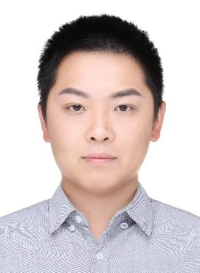 Ye Tian (田野)合作论文数School of Computer Science and Technology, Anhui University128
 Yaochu Jin (金耀初)合作论文数Department of Artificial Intelligence, School of Engineering, Westlake University60
 Shangshang Yang (杨尚尚)合作论文数School of Computer Science and Technology, Anhui University55
 Haiping Ma (马海平)合作论文数Institute of Bioinspired Intelligence and Mining Knowledge, Anhui University42
 Yansen Su (苏延森)合作论文数School of Computer Science and Technology, Anhui University30
 Linqiang Pan (潘林强)合作论文数School of Artificial Intelligence and Automation, Huazhong University of Science and Technology28
 Ran Cheng (程然)合作论文数Department of Computing, Faculty of Computer and Mathematical Sciences, Hong Kong Polytechnic University;Department of Data Science & Artificial Intelligence, Faculty of Computer and Mathematical Sciences, Hong Kong Polytechnic University27
 Hao Jiang (江浩)合作论文数School of Computer Science and Technology of Anhui University21
 Fan Cheng (程凡)合作论文数School of Artificial Intelligence, Anhui University;Information Materials and Intelligent Sensing Laboratory of Anhui Province, Anhui University19
 Bin Luo (罗斌)合作论文数School of Computer Science and Technology, Anhui University18
 Xiaoshu Xiang (项小书)合作论文数Institutes of Physical Science and Information Technology, Anhui University18
 Shanshan Wang (王姗姗)合作论文数Institutes of Physical Science and Information Technology, Anhui University;Institute of Bioinspired Intelligence and Mining Knowledge, Anhui University18
 Lei Zhang (张磊)合作论文数MOE Key Laboratory of Intelligent Computing and Signal Processing, School of Computer Science and Technology, Anhui University18
 Limiao Zhang (张丽淼)合作论文数Institute of Bioinspired Intelligence and Mining Knowledge, Computer Science and Technology School, Anhui University17
 Zhuanlian Ding (丁转莲)合作论文数School of Internet Anhui University17
 Cheng He (何成)合作论文数School of Electrical and Electronic Engineering, Huazhong University of Science and Technology16
 Haifeng Zhang (张海峰)合作论文数School of Mathematical Sciences, Anhui University16
 Kay Chen Tan合作论文数Department of Data Science and Artificial Intelligence, Faculty of Computer and Mathematical Sciences, The Hong Kong Polytechnic University16
 Xun Yang (杨勋)合作论文数Department of Electronic Engineering and Information Science, School of Information Science and Technology, University of Science and Technology of China15
 Chao Wang (王朝)合作论文数School of Artificial Intelligence, Anhui University;Institute of Bioinspired Intelligence and Mining Knowledge, School of Computer Science and Technology, Anhui University15
 Ke Xu (许柯)合作论文数School of Artificial Intelligence, Anhui University13
 Jianfeng Qiu (邱剑锋)合作论文数School of Computer Science and Technology of Anhui University12
 Yajie Zhang合作论文数11
 Dengdi Sun (孙登第)合作论文数School of Artificial Intelligence, Anhui University11
 Chuan Qin (秦川)合作论文数Computer Network Information Center, Chinese Academy of Sciences;University of Chinese Academy of Sciences9
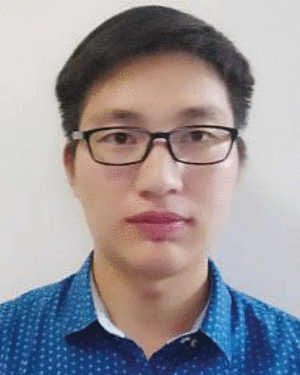 Langchun Si合作论文数9
 Chunhou Zheng (郑春厚)合作论文数School of Artificial Intelligence, Anhui University9
 Jianhua Xiao (肖建华)合作论文数College of Economie and Social Development, Nankai University9
 Xiangxiang Zeng (曾湘祥)合作论文数Department of Computer Science, College of Computer Science and Electronic Engineering, Hunan University8
 Ruifen Cao (曹瑞芬)合作论文数Information Materials and Intelligent Sensing Laboratory of Anhui Province, Anhui University;School of Computer Science and Technology, Anhui University7
 Yunyun Niu (牛云云)合作论文数School of Information Engineering, China University of Geosciences, Beijing7
 Hengshu Zhu (祝恒书)合作论文数Computer Network Information Center, Chinese Academy of Sciences;University of Chinese Academy of Sciences;The Hong Kong University of Science and Technology (Guangzhou)7
 Jinliang Ding (丁进良)合作论文数College of Information Science and Engineering, Northeastern University;Faculty of Robot Science and Engineering, Northeastern University7
 Shuai Shao合作论文数6
 Xiaoshan Yu合作论文数6
 Xiao Ding (丁效)合作论文数Research Center for Social Computing and Information Retrieval, Faculty of Computing, Harbin Institute of Technology6
 Jin Tang (汤进)合作论文数School of Computer Science and Technology, Anhui University;Information Materials and Intelligent Sensing Laboratory of Anhui Province, Anhui University6
 Xi Pei合作论文数6
 Congtao Wang合作论文数5
 Qijun Wang (王啟军)合作论文数School of Artificial Intelligence, Anhui University5
 Tao Song (宋弢)合作论文数College of Computer Science and Technology, China University of Petroleum (East China)5
 Shengxiang Yang合作论文数School of Computer Science and Informatics, De Montfort University;Centre for Computational Intelligence, De Montfort University5Panpan Zhang合作论文数4
 Mengzhu Wang (汪梦竹)合作论文数School of Artificial Intelligence, Hebei University of Technology;People's Liberation Army Academy of Military Sciences4
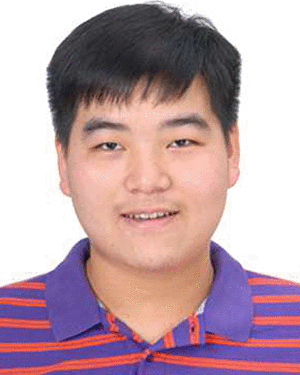 Haipeng Yang合作论文数4
 Shichen Peng合作论文数4
 Qingda Chen合作论文数Northeastern Univ, State Key Lab Synthet Automat Proc Ind, Shenyang 110819, Liaoning, Peoples R China4
 Meng Wang (汪萌)合作论文数School of Computer Science and Information Engineering, Hefei University of Technology4




