The widespread adoption of service-oriented architecture in software engineering has fueled the rapid growth of web and cloud services, as well as service-based systems. With the proliferation of numerous functionally-equivalent services, each offering varying quality levels, finding the appropriate service has become increasingly challenging and essential. This challenge has made service recommendation a critical area of research and practical interest. However, existing methods, such as those relying on utility functions or skyline techniques, failed to address a fundamental issue: recommending services that align with users' specific quality preferences, such as response time or failure rate. This problem involves two main aspects: (1) identifying appropriate services for user requests, and (2) identifying suitable users for new services. This paper proposes a set of approaches for bilateral personalized quality centric service recommendation, integrating k-nearest neighbors, dynamic skyline, and reverse dynamic skyline techniques. Our methods address the shortcomings of existing solutions by identifying both qualified and representative services and users. Extensive experiments on a dataset of 2507 real-world web services validate the effectiveness and efficiency of our approaches.
Semi-supervised local community detection aims to identify the community of a given node by leveraging known community structures. Although existing studies yield promising results, they often suffer from high time overhead and a heavy reliance on extensive prior information (i.e., a large number of known communities). However, acquiring such abundant known communities is expensive and often impractical in real-world networks. To address these issues, we propose the Pre-trained Prompt-driven Semi-supervised Local community detection method (PPSL). By adapting the “pre-train, prompt” paradigm, PPSL enhances efficiency; meanwhile, it incorporates node-level prompt signals derived from a limited set of known communities to reduce the dependence on a large number of known communities. Specifically, PPSL consists of three main components: node encoding, initial community formation and prompt community selection, and prompt-driven fine-tuning. The node encoding component employs graph neural networks to learn the representations of nodes and communities. Based on the representations of nodes, the second component detects the initial community for the given node and selects known communities that are structurally similar to the initial community as prompt communities for subsequent fine-tuning steps. Finally, the prompt-driven fine-tuning component constructs node-level prompt samples from these prompt communities and uses them to guide the final community identification. Experimental results on five real-world datasets demonstrate that PPSL outperforms baselines in both community quality and efficiency.
Drug-drug interaction (DDI) prediction aims to identify positive or negative interactions between drugs and is critical for drug development, clinical decision-making, and patient safety. DDIs are commonly modeled as graphs, where drugs are nodes and interactions are edges. Although heterogeneous graph neural networks (GNNs) can integrate diverse entities and relationships, existing methods usually treat all meta-paths equally and overlook meta-path attributes, such as edge type and path length. This limits their ability to capture distinct relational contexts and weakens the interpretability of DDI predictions. To address this issue, we propose IDME, an interpretable DDI prediction framework based on meta-path attribute encoding. IDME learns conversion factors for different edge types and attenuation factors for meta-path lengths, and uses them to modulate the message propagation process of GNNs. The framework contains three modules: meta-path attribute encoding, meta-path attribute aggregation, and DDI prediction. The encoding module assigns attribute-aware factors to meta-paths, the aggregation module integrates semantic information from diverse meta-paths to generate refined drug embeddings, and the prediction module produces interpretable DDI predictions. Experiments on three datasets demonstrate the effectiveness of IDME. Moreover, the learned conversion and attenuation factors reveal the importance of specific edge types and the influence of path length, providing useful insights into the underlying mechanisms of DDIs.
Graph-based collaborative filtering techniques have emerged as a promising recommendation approach by modeling user-item interaction as graphs. Recently, contrastive learning has been employed in graph collaborative through data augmentation, which can effectively offer data efficiency and reduce labeling costs. Nonetheless, most existing contrastive learning approaches overlook the heterogeneous auxiliary information pertaining to users and items, such as user social relationships and item categories, which are crucial to alleviate the data sparsity issue. In this paper, we propose a novel contrastive learning method, referred to as Heterogeneous Adaptive Preference Learning for Recommendation (HAPLRec), which explicitly incorporates fine-grained preference information from both users and items. Specifically, we construct user relationship graphs and item relationship graphs based on specific meta-paths in a heterogeneous graph. Subsequently, we conduct data augmentation on these graphs individually to obtain auxiliary contrastive tasks. Moreover, we introduce an optimization algorithm that leverages the gradient similarity between the main task and the auxiliary tasks, dynamically adjusting the weight assigned to each task to expedite achieving superior performance within a shorter time frame. The effectiveness of the proposed model is demonstrated through extensive experiments conducted on three publicly available datasets.
MR-to-CT synthesis is critical for MRI-only radiotherapy. Conventional unsupervised methods lack structural consistency constraints, leading to unacceptable anatomical misalignments in synthesized CT images. To address this, we propose SAM-guided structural consistency constraints by integrating the Segment Anything Model into unsupervised MR-to-CT synthesis. We leverage SAM's cross-modal segmentation capability to enforce anatomical alignment between MR and synthesized CT images. During training, prompt augmentation is incorporated to enhance generalization across diverse anatomical structures. The proposed method is evaluated on a nasopharyngeal carcinoma dataset. The results demonstrate that our approach outperforms others on this dataset with MAE of 108.12 HU, PSNR of 24.24 dB, and SSIM of 0.753. The proposed SAM-guided method maintains exceptional anatomical consistency in synthesized CT images, as confirmed by quantitative analyses and dose distribution assessments. This work shows potential for supporting MRI-only radiotherapy by improving anatomical localization accuracy.
As wind power becomes a cornerstone of renewable energy, its large-scale deployment creates an urgent need for collaborative monitoring across multiple wind farms. However, traditional condition monitoring methods for individual wind farms encounter significant limitations when applied to multi-wind-farm scenarios, primarily due to concerns about data privacy. To overcome this challenge, a federated learning-enabled distributed monitoring strategy for multi-wind-farm systems is proposed, effectively improving the accuracy and efficiency of condition monitoring while ensuring data privacy security. Specifically, we develop a distributed sparse principal component analysis method for dimensionality reduction. The algorithm operates within a federated learning framework, only requiring the transmission of low-dimensional model data (the principal components projection matrix) instead of raw SCADA data. On this basis, a multivariate exponentially weighted moving average (MEWMA) control chart is constructed for joint anomaly detection over multiple wind farms. The effectiveness and superiority of the proposed approach are demonstrated on both simulated fault cases and real wind farm datasets.
As an important modeling paradigm in click-through rate (CTR) prediction, the Deep Cross Network (DCN) and its derivative models have gained widespread recognition primarily due to their success in a trade-off between computational cost and performance. This paradigm employs a cross network to explicitly model feature interactions with linear growth, while leveraging deep neural networks (DNN) to implicitly capture higher-order feature interactions. However, these models still face several key limitations: (1) The performance of existing explicit feature interaction methods lags behind that of implicit DNN, resulting in overall model performance being dominated by the DNN; (2) While these models claim to capture high-order feature interactions, they often overlook potential noise within these interactions; (3) The learning process for different interaction network branches lacks appropriate supervision signals; and (4) The high-order feature interactions captured by these models are often implicit and non-interpretable due to their reliance on DNN. To address the identified limitations, this paper proposes a novel model, called Fusing Cross Network (FCN), along with two sub-networks: Linear Cross Network (LCN) and Exponential Cross Network (ECN). FCN explicitly captures feature interactions with both linear and exponential growth, eliminating the need to rely on implicit DNN. Moreover, we introduce the Self-Mask operation to filter noise layer by layer and reduce the number of parameters in the cross network by half. To effectively train these two cross networks, we propose a simple yet effective loss function called Tri-BCE, which provides tailored supervision signals for each network. We evaluate the effectiveness, efficiency, and interpretability of FCN on six benchmark datasets. Furthermore, by integrating LCN and ECN, FCN achieves a new state-of-the-art performance.
This is a corrigendum for the article “LyDRL: Lyapunov-guided Deep Reinforcement Learning for Stable Task Offloading in Connected Autonomous Vehicles” published in ACM Trans. Autonom. Adapt. Syst. 20, 3, Article 24 (September 2025), 29 pages.
Cross-domain Recommendation (CDR) exploits multi-domain correlations to alleviate data sparsity. As a core task within this field, inter-domain recommendation focuses on predicting preferences for users who interact in a source domain but lack behavioral records in a target domain. Existing approaches predominantly rely on overlapping users as anchors for knowledge transfer. In real-world scenarios, overlapping users are often scarce, leaving the vast majority of users with only single-domain interactions. For these users, the absence of explicit alignment signals makes fine-grained preference transfer intrinsically difficult. To address this challenge, this paper proposes Language-Guided Conditional Diffusion for CDR (LGCD), a novel framework that integrates Large Language Models (LLMs) and diffusion models for inter-domain sequential recommendation. Specifically, we leverage LLM reasoning to bridge the domain gap by inferring potential target preferences for single-domain users and mapping them to real items, thereby constructing pseudo-overlapping data. We distinguish between real and pseudo-interaction pathways and introduce additional supervision constraints to mitigate the semantic noise brought by pseudo-interaction. Furthermore, we design a conditional diffusion architecture to precisely guide the generation of target user representations based on source-domain patterns. Extensive experiments demonstrate that LGCD significantly outperforms state-of-the-art methods in inter-domain recommendation tasks.
Graph neural networks (GNNs) have been widely adopted in collaborative filtering to model higher order relationships between users and items. However, existing methods mainly focus on interaction-based structures and neglect the explicit modeling of semantic relations among users and among items. Within these graph structures, deep graph message propagation tends to cause over-smoothing, where node embeddings converge to similar representations, hindering effective personalization. To address these challenges, we propose a semantic-augmented multiview graph-based recommendation framework (SAGRec). Specifically, SAGRec constructs semantic similarity graphs based on embeddings generated by large language models to capture semantic relations between users and between items. Next, we propose a frequency-aware propagation mechanism. It leverages representation differences between nodes and incorporates gated message passing to retain node distinctions during propagation. To further mitigate representation drift induced by multilayer propagation, we design an adaptive inter-layer contrastive learning strategy that enforces consistency while maintaining discriminability across layers. Comprehensive empirical evaluations conducted on three real-world datasets show that SAGRec achieves consistently superior performance over baseline methods with respect to normalized discounted cumulative gain and recall.
Large Language Models (LLMs) have demonstrated remarkable performance across various tasks by effectively utilizing a prompting strategy. However, they are highly sensitive to input perturbations, such as typographical errors or slight character order errors, which can significantly impair their performance. Despite advances in prompting techniques such as Chain-of-Thought and automatic prompt generation, developing a prompting strategy that explicitly mitigates the negative impact of such perturbations remains an open challenge. To bridge this gap, we propose Robustness of Prompting (RoP), a novel prompting strategy aimed at enhancing the robustness of LLMs. RoP consists of two stages: Error Correction and Guidance. In the Error Correction stage, RoP applies diverse perturbation methods to generate adversarial examples, which are used to generate prompts that correct input errors automatically. In the Guidance stage, RoP generates an optimal guidance prompt based on the corrected input, guiding the model to generate more robust and accurate inferences. Through comprehensive experiments spanning arithmetic, commonsense, and logical reasoning tasks, we demonstrate that RoP significantly improves LLMs' robustness against adversarial perturbations. Crucially, it preserves model accuracy with only minimal degradation compared to clean input scenarios, thereby establishing RoP as a practical and effective approach for enhancing LLM robustness in real-world applications.
Accurately capturing user preferences across diverse domains is a fundamental challenge in cross-domain recommendation (CDR) systems. Recent literature has established that disentangling user preferences into global and domain-specific components significantly enhances recommendation performance. However, existing CDR systems are hindered by two critical challenges: 1) how to align user representations across domains to accommodate the discrepancy of user intents in different domains; and 2) how to mitigate data conflicts caused by cross-domain heterogeneity. To address these limitations, we propose intent-aware contrastive learning for cross-domain recommendation (ICCDR). This framework learns unified user interests across domains while mitigating data conflicts from heterogeneity. The ICCDR framework consists of the following core components: 1) a cross-intent module that dynamically identifies users' consistent intents across domains to guide the transfer of knowledge; and 2) an information bottleneck-based aggregation module designed to mitigate data conflicts by filtering out task-irrelevant information, thereby retaining only the essential latent features required for effective knowledge transfer. Extensive experiments conducted on Amazon datasets demonstrate that the ICCDR framework outperforms traditional baseline methods.
Accurate and robust anomaly detection is critical for microservice system reliability. Recent multimodal approaches have improved detection comprehensiveness by integrating metrics, logs, and traces. However, they often overlook intra-modal uncertainty from noise, ambiguity, or missing data, and inter-modal uncertainty arising from varying predictive capabilities across modalities. Additionally, extensive labeling of multimodal data remains costly. To address these limitations, we propose MUAD, an uncertainty-aware multimodal anomaly detection framework with active learning. MUAD employs a Graph-based Probabilistic Encoder (GPE) to model intra-modal uncertainty through probabilistic representations, and a Confidence-aware Fusion Mechanism (CFM) to dynamically weight modalities based on their prediction confidence. Furthermore, an active learning paradigm iteratively refines the model using high-confidence pseudo-labels and informative samples, maintaining performance under label-deficient conditions. Experiments on three benchmark datasets demonstrate MUAD achieves 98.10% average F1-score, outperforming state-of-the-art methods by up to 7.87%. Results also confirm its robustness under low-quality data and limited labels.
Large Language Models (LLMs) have shown strong potential for recommendation (LLMRec) due to their powerful reasoning and generalization abilities. However, effectively aligning the textual semantics modeled by LLMs with the collaborative signals remains a key challenge. Existing methods either translate collaborative information into textual prompts or inject pre-trained embeddings into the LLM, both of which treat structural information as static input and fail to capture high-order relational dependencies. To bridge this gap, we propose GraphLoRA, a novel framework that generalizes low-rank adaptation from independent to structure-aware propagation. GraphLoRA embeds a trainable graph message-passing network within the low-rank adaptation pathway, enabling structural signals to propagate through the parameter space. This design allows collaborative topology to explicitly guide parameter updates, fostering deep integration between graph-structured and textual semantic information. Extensive experiments on multiple benchmarks demonstrate that GraphLoRA not only outperforms state-of-the-art LLM-based recommendation methods but also achieves superior generalization, effectively balancing structural reasoning capability with computational efficiency. Code is available at \href{https://github.com/wgj15965/GraphLoRA}{https://github.com/wgj15965/GraphLoRA}.
Predicting drug-disease interactions (DSI) is a pivotal task in computational drug discovery, aiming to identify potential therapeutic or adverse effects between drugs and diseases. Current methodologies primarily model on two levels of features: the macroscopic level, utilizing network topology, and the mesoscopic level, leveraging molecular-level features. While valuable, these approaches share a common shortcoming: they frequently fail to capture fine-grained, mechanistic interactions. This refers to the specific interplay between drug functional groups and disease symptoms that underpins pharmacological effects. To address this limitation, we propose LOGIC, a novel model for LLM-driven cross-scale feature coupling for DSI prediction. LOGIC comprehensively models drug and disease representations across micro-, meso-, and macro-scales. The key innovation of LOGIC lies in constructing a dictionary of functional groups and symptoms, and performing a simple and intuitive multi-hot encoding of drugs and diseases at the micro-scale, and in employing large language models (LLMs) to derive the meso-scale features of diseases without requiring additional domain knowledge. LOGIC mainly consists of four modules: (1) Drug-disease micro-scale feature learning; (2) Drug-disease meso-scale feature learning; (3) Drug-disease macro-scale feature learning; and (4) cross-scale feature coupling prediction, which integrates micro-, meso- and macro-scale features for both drugs and diseases, and employs the matrix multiplication operation to model fine-grained feature interactions in the dimension level for DSI prediction. Extensive experiments conducted on multiple datasets validate the effectiveness and scalability of LOGIC.
Accurate Quality of Service (QoS) prediction is a major challenge in the field of service recommendation. Existing QoS prediction methods typically predict missing QoS values by analyzing historical call records of users and services. While these methods demonstrate effectiveness, they face limitations in addressing the sparsity of user service call data and fully utilizing contextual information related to service calls. To address these challenges, we propose a spatio-temporal context-aware QoS prediction method via contrastive learning, which effectively integrates temporal and spatial contextual information of users and services. First, we employ a neighborhood selection method that combines spatial and temporal dimensions to construct embeddings for similar users and services. Second, we generate contrastive views based on the similar and original embeddings, leveraging contrastive learning to capture self-supervised signals and alleviate data sparsity. Finally, the resulting embeddings, which incorporate both neighborhood and context information, are input into a multi-layer perceptron (MLP) for QoS prediction. Extensive experiments on real-world datasets demonstrate the effectiveness of our method, particularly in scenarios with extremely sparse training data, resulting in more accurate QoS predictions.
The remarkable text understanding and generation capabilities of large language models (LLMs) have revitalized the field of general recommendation based on implicit user feedback. Rather than deploying LLMs directly as recommendation models, a more flexible paradigm leverages their ability to interpret users' historical interactions and semantic contexts to extract structured profiles that characterize user preferences. These profiles can be further transformed into actionable high-dimensional representations, serving as powerful signals to augment and strengthen recommendation models. However, the mechanism by which such profiles enhance recommendation performance within the feature space remains insufficiently understood. Moreover, existing studies predominantly rely on nonlinear alignment and fusion strategies to incorporate these profiles, which often lead to semantic loss and fail to fully exploit their potential. To address these limitations, we revisit profiles from a retrieval perspective and propose a simple yet effective recommendation framework built upon distribution shaping (ProMax) in this paper. We begin by employing dense retrieval to uncover the collaborative relationships between user and item profiles within the feature space. Based on this insight, we introduce a dual distribution-reshaping process, in which the profile distribution acts as a guiding signal to steer the recommendation model toward learning user preferences for unseen items beyond the scope of observed interactions. We apply ProMax to four classic recommendation methods on three public datasets. The results indicate that ProMax substantially improves base model performance and outperforms existing LLM-based recommendation approaches.
Ranking is a core stage in online advertising and recommender systems. Modern ranking models increasingly unify sequential modeling and feature interaction, yet many advances rely on proprietary data, closed implementations, and large-scale industrial infrastructure. This setting limits reproducible comparison and hinders academic study of scaling laws, long-sequence modeling, and multi-task ranking. To address these limitations, this paper proposes UniRank, an open benchmark for ranking models that unify sequential modeling and feature interaction. UniRank uses chronological pointwise autoregressive supervision, standardizes evaluation across feedback tasks, and provides a PyTorch toolkit with Distributed Data Parallel training, operator optimization, mixed-precision training, attention optimization, and other efficiency techniques that reduce hardware requirements. We benchmark 15 representative unified ranking models on five large-scale public datasets from short-video, advertising, and e-commerce platforms, with the largest dataset containing over 700 million instances and the longest behavior sequence exceeding 10^5 interactions. UniRank provides a reproducible basis for comparing unified ranking models, studying scaling laws under limited compute, and narrowing the gap between academic and industrial ranking research. We believe UniRank benefits researchers, practitioners, and beginners through reproducible experiments, production-oriented evaluation, and accessible implementations. Code and data are available at https://github.com/salmon1802/UniRank.
 Yi Zhang合作论文数31
 Qiang He合作论文数School of Science, Computing and Emerging Technologies, Swinburne University of Technology28
 Dengcheng Yan (颜登程)合作论文数Institutes of Physical Science and Information Technology, Anhui University27
 Yanping Zhang (张燕平)合作论文数School of Computer Science and Technology of Anhui University26Yuanting Yan (严远亭)合作论文数School of Computer Science and Technology of Anhui University21Li Ni (倪莉)合作论文数中国科学技术大学21
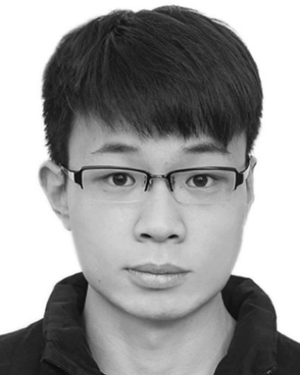 Lei Sang合作论文数Hefei University of Technology, China19
 Yun Yang合作论文数Department of Computer Science and Software Engineering, Swinburne University of Technology;Department of Computing Technologies, School of Science, Computing and Engineering Technologies, Swinburne University of Technology19
 Lin Mu (穆林)合作论文数School of Computer Science and Technology, Anhui University18
 Hui Dou (窦晖)合作论文数School of Computer Science and Technology, Anhui University15
 Yanming Chen (陈彦明)合作论文数School of Computer Science and Technology of Anhui University15
 Xindong Wu (吴信东)合作论文数School of Computer Science and Information Engineering, Hefei University of Technology;Key Laboratory of Knowledge Engineering with Big Data, Ministry of Education of China, Hefei University of Technology15
 Wenjian Luo (罗文坚)合作论文数School of Computer Science and Technology, Harbin Institute of Technology, Shenzhen14Wei Yang合作论文数Tencent AI Lab14
 Guangming Cui合作论文数Swinburne University of Technology13
 Wei Li (李炜)合作论文数12Linsen Song合作论文数11
 Xiaolong Xu (许小龙)合作论文数School of Software, Nanjing University of Information Science and Technology11
 Hong Zhong (仲红)合作论文数School of Computer Science and Technology, Anhui University;Key Laboratory of Intelligent Computing Signal Processing, Anhui University11
 Xing Guo (郭星)合作论文数School of Computer Science and Technology of Anhui University11
 Victor S. Sheng合作论文数Department of Computer Science, Whitacre College of Engineering, Texas Tech University11
 He Yunfei合作论文数10
 Jintao Wu (吴金涛)合作论文数School of Computer Science, Nanjing University of Information Science & Technology;Jiangsu Advanced Computing and Intelligent Service Engineering Research Center, Nanjing University of Information Science & Technology10
 Shu Zhao (赵姝)合作论文数School of Computer Science and Technology, Anhui University10
 Qingren Wang (王庆人)合作论文数School of Computer Science and Technology of Anhui University10
 Pengfei Chen (陈鹏飞)合作论文数School of Computer Science and Engineering, Sun Yat-sen University10
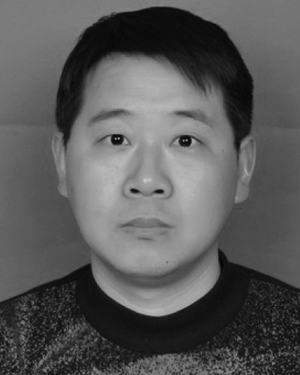 Fei Yang合作论文数9
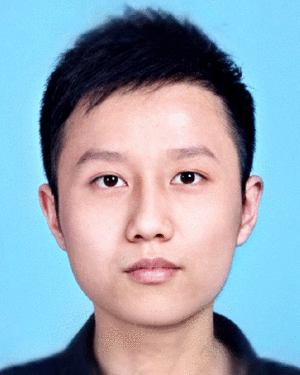 Zhaolong Ling合作论文数9
 Zibin Zheng (郑子彬)合作论文数School of Software Engineering, Sun Yat-Sen University9
 Kui Yu (俞奎)合作论文数School of Computer Science and Information Engineering, Hefei University of Technology9Liming Zhong合作论文数Southern Medical University9
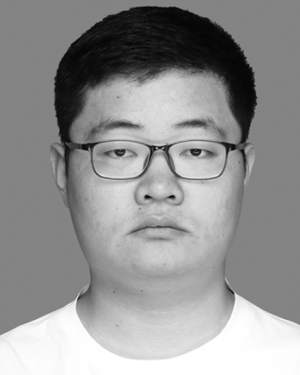 Wenxin Xie合作论文数8
 Ying Jin 合作论文数University of Macau · Department of English8
 Xuejun Li (李学俊)合作论文数School of Computer Science and Technology, Anhui University8
 Shuiguang Deng (邓水光)合作论文数College of Computer Science and Technology, Zhejiang University8
 Fulan Qian (钱付兰)合作论文数School of Computer Science and Technology, Anhui University8Honghao Li合作论文数7
 Peng Zhou (周芃)合作论文数School of Computer Science and Technology, Anhui University7
 Kaibin Wang (汪开斌)合作论文数Department of Computing Technologies, Swinburne University of Technology6
 Xuetao Wang合作论文数6
 ErZhou Zhu (朱二周)合作论文数School of Computer Science and Technology of Anhui University6
 Jie Chen (陈洁)合作论文数School of Computer Science and Technology of Anhui University6
 Kai Peng (彭凯)合作论文数School of Electronic Information and Communications, Huazhong University of Science and Technology6
 Lianyong Qi (齐连永)合作论文数Qufu Normal University;China University of Petroleum (East China)6Bo Li合作论文数5XinMing Zhang (张心明)合作论文数5
 Zhenhui Dai (戴振晖)合作论文数广州中医药大学广州中医药大学5
 Zhenglei Yu (于征磊)合作论文数College of Biological and Agricultural Engineering, Jilin University;Key Laboratory of Bionic Engineering, Ministry of Education, Jilin University5




