Score-based Generative Models (SGMs) have achieved remarkable success in generation tasks by establishing a diffusion process that gradually perturbs real data into Gaussian noise and then learning a reverse process to reconstruct the data from noise. However, conventional denoising methods, such as Langevin dynamics and numerical stochastic differential equation solvers, rely on randomness but suffer from slow generation speeds due to the high number of score function evaluations. To address this, we propose a plug-and-play Markov adaptive momentum sampling method, inspired by the strong connection between the SGMs' sampling process and stochastic gradient descent optimization. Our approach accelerates the transformation process without introducing additional hyperparameters. Theoretically, we establish a rigorous foundation by analyzing the relationship between the distribution of samples generated by our method and the original data distribution. This provides a novel perspective on the analysis of sampling distributions. Empirically, our method demonstrates superior efficiency, generating high-quality images/graphs in significantly fewer sampling steps-achieving a speedup of $2\times $ to $5\times $ -while maintaining or surpassing baseline performance on various image and graph generation benchmarks. These results underscore the effectiveness of adaptive momentum in enhancing the efficiency of SGMs.
Gradient-based optimization methods implemented on distributed computing architectures are increasingly used to tackle large-scale machine learning applications. A key bottleneck in such distributed systems is the high communication overhead for exchanging information, such as stochastic gradients, between workers. The inherent causes of this bottleneck are the frequent communication rounds and the full model gradient transmission in every round. In this study, we present SASG, a communication-efficient distributed algorithm that enjoys the advantages of sparse communication and adaptive aggregated stochastic gradients. By dynamically determining the workers who need to communicate through an adaptive aggregation rule and sparsifying the transmitted information, the SASG algorithm reduces both the overhead of communication rounds and the number of communication bits in the distributed system. For the theoretical analysis, we introduce an important auxiliary variable and define a new Lyapunov function to prove that the communication-efficient algorithm is convergent. The convergence result is identical to the sublinear rate of stochastic gradient descent, and our result also reveals that SASG scales well with the number of distributed workers. Finally, experiments on training deep neural networks demonstrate that the proposed algorithm can significantly reduce communication overhead compared to previous methods.
Deep learning is experiencing a rise in large-scale models. Training large-scale models is costly, prompting researchers to train large-scale models on commodity servers that more researchers can access. The massive number of parameters necessitates the use of model parallelism training methods. Existing studies focus on training with pipeline model parallelism. However, the tensor model parallelism (TMP) is inevitable when the model size keeps increasing, where frequent data-dependent communication and computation operations significantly reduce the training efficiency. In this paper, we present Oases, an automated TMP method with overlapped communication to accelerate large-scale model training on commodity servers. Oases proposes a fine-grained training operation schedule to maximize overlapping communication and computation that have data dependence. Additionally, we design the Oases planner that searches for the best model parameter partition strategy of TMP to achieve further accelerations. Unlike existing methods, Oases planner is tailored to model the cost of overlapped communication-computation operations. We evaluate Oases on various model settings and two commodity clusters, and compare Oases to four state-of-the-art implementations. Experimental results show that Oases achieves speedups of 1.01–1.48× over the fastest baseline, and speedups of up to 1.95× over Megatron.
Stochastic gradient descent (SGD) performed in an asynchronous manner plays a crucial role in training large-scale machine learning models. However, the generalization performance of asynchronous delayed SGD, which is an essential metric for assessing machine learning algorithms, has rarely been explored. Existing generalization error bounds are rather pessimistic and cannot reveal the correlation between asynchronous delays and generalization. In this paper, we investigate sharper generalization error bound for SGD with asynchronous delay $\tau$. Leveraging the generating function analysis tool, we first establish the average stability of the delayed gradient algorithm. Based on this algorithmic stability, we provide upper bounds on the generalization error of $\tilde{\mathcal{O}}(\frac{T-\tau}{n\tau})$ and $\tilde{\mathcal{O}}(\frac{1}{n})$ for quadratic convex and strongly convex problems, respectively, where $T$ refers to the iteration number and $n$ is the amount of training data. Our theoretical results indicate that asynchronous delays reduce the generalization error of the delayed SGD algorithm. Analogous analysis can be generalized to the random delay setting, and the experimental results validate our theoretical findings.
In the domain of computer architecture, Federated Learning (FL) is a paradigm of distributed machine learning in edge systems. However, the systems' Non-Independent and Identically Distributed (Non-IID) data negatively affect the convergence efficiency of the global model, since only a subset of these data samples is beneficial for accelerating model convergence. In pursuit of this subset, a reliable approach involves determining a measure of validity to rank the samples within the dataset. In this paper, we propose the BHerd strategy, which selects a beneficial herd of local gradients to accelerate the convergence of the FL model. Specifically, we map the distribution of the local dataset to the local gradients and use the Herding strategy to obtain a permutation of the set of gradients, where the more advanced gradients in the permutation are closer to the average of the set of gradients. These top portions of the gradients will be selected and sent to the server for global aggregation. We conduct experiments on different datasets, models, and scenarios by building a prototype system, and experimental results demonstrate that our BHerd strategy is effective in selecting beneficial local gradients to mitigate the effects brought by the Non-IID dataset.
Sharpness-Aware Minimization (SAM) has proven highly effective in improving model generalization in machine learning tasks. However, SAM employs a fixed hyperparameter associated with the regularization to characterize the sharpness of the model. Despite its success, research on adaptive regularization methods based on SAM remains scarce. In this paper, we propose the SAM with Adaptive Regularization (SAMAR), which introduces a flexible sharpness ratio rule to update the regularization parameter dynamically. We provide theoretical proof of the convergence of SAMAR for functions satisfying the Lipschitz continuity. Additionally, experiments on image recognition tasks using CIFAR-10 and CIFAR-100 demonstrate that SAMAR enhances accuracy and model generalization.
Score-based generative models have demonstrated significant practical success in data-generating tasks. The models establish a diffusion process that perturbs the ground truth data to Gaussian noise and then learn the reverse process to transform noise into data. However, existing denoising methods such as Langevin dynamic and numerical stochastic differential equation solvers enjoy randomness but generate data slowly with a large number of score function evaluations, and the ordinary differential equation solvers enjoy faster sampling speed but no randomness may influence the sample quality. To this end, motivated by the Stochastic Gradient Descent (SGD) optimization methods and the high connection between the model sampling process with the SGD, we propose adaptive momentum sampling to accelerate the transforming process without introducing additional hyperparameters. Theoretically, we proved our method promises convergence under given conditions. In addition, we empirically show that our sampler can produce more faithful images/graphs in small sampling steps with 2 to 5 times speed up and obtain competitive scores compared to the baselines on image and graph generation tasks.
In various domains, the increasing application of machine learning allows researchers to access inexpensive predictive data, which can be utilized as auxiliary data for statistical inference. Although such data are often unreliable compared to gold-standard datasets, Prediction-Powered Inference (PPI) has been proposed to ensure statistical validity despite the unreliability. However, the challenge of `data silos' arises when the private gold-standard datasets are non-shareable for model training, leading to less accurate predictive models and invalid inferences. In this paper, we introduces the Federated Prediction-Powered Inference (Fed-PPI) framework, which addresses this challenge by enabling decentralized experimental data to contribute to statistically valid conclusions without sharing private information. The Fed-PPI framework involves training local models on private data, aggregating them through Federated Learning (FL), and deriving confidence intervals using PPI computation. The proposed framework is evaluated through experiments, demonstrating its effectiveness in producing valid confidence intervals.
Asynchronous stochastic gradient descent (ASGD) has evolved into an indispensable optimization algorithm for training modern large-scale distributed machine learning tasks. Therefore, it is imperative to explore the generalization performance of the ASGD algorithm. However, the existing results are either pessimistic and vacuous or restricted by strict assumptions that fail to reveal the intrinsic impact of asynchronous training on generalization. In this study, we establish sharper stability and generalization bounds for ASGD under much weaker assumptions. Firstly, this paper studies the on-average model stability of ASGD and provides a non-vacuous upper bound on the generalization error, without relying on the Lipschitz assumption. Furthermore, we investigate the excess generalization error of the ASGD algorithm, revealing the effects of asynchronous delay, model initialization, number of training samples and iterations on generalization performance. Secondly, for the first time, this study explores the generalization performance of ASGD in the non-smooth case. We replace smoothness with the much weaker Hölder continuous assumption and achieve similar generalization results as in the smooth case. Finally, we validate our theoretical findings by training numerous machine learning models, including convex problems and non-convex tasks in computer vision and natural language processing.
In recent years, distributed stochastic algorithms have become increasingly useful in the field of machine learning. However, similar to traditional stochastic algorithms, they face a challenge where achieving high fitness on the training set does not necessarily result in good performance on the test set. To address this issue, we propose to use of a distributed network topology to improve the generalization ability of the algorithms. We specifically focus on the Sharpness-Aware Minimization (SAM) algorithm, which relies on perturbation weights to find the maximum point with better generalization ability. In this paper, we present the decentralized stochastic sharpness-aware minimization (D-SSAM) algorithm, which incorporates the distributed network topology. We also provide sublinear convergence results for non-convex targets, which is comparable to consequence of Decentralized Stochastic Gradient Descent (DSGD). Finally, we empirically demonstrate the effectiveness of these results in deep networks and discuss their relationship to the generalization behavior of SAM.
The heavy ball momentum method is a commonly used technique for accelerating training processes in the machine learning community. However, empirical evidence suggests that the convergence of stochastic gradient descent (SGD) with heavy ball may slow down when the momentum hyperparameter approaches 1. Despite this observation, there are no established theories or solutions to explain and address this issue. In this study, we provide the first theoretical result that elucidates why momentum slows down SGD as it tends to 1. To better understand this inefficiency, we focus on the quadratic convex objective in the analysis. Our findings show that momentum accelerates SGD when the scaling parameter is not very close to 1. Conversely, when the scaling parameter approaches 1, momentum impairs SGD and degrades its stability. Based on the theoretical findings, we propose a descending warmup technique for the heavy ball momentum, which exploits the advantages of the heavy ball method and overcomes the inefficiency problem when the momentum tends to 1. Numerical results demonstrate the effectiveness of the proposed SHB-DW algorithm.
Distributed data-parallel training (DDP) is prevalent in large-scale deep learning. To increase the training throughput and scalability, high-performance collective communication methods such as AllReduce have recently proliferated for DDP use. However, these approaches require long communication periods with increasing model sizes. Collective communication transmits many sparse gradient values that can be efficiently compressed to reduce the required training time. State-of-the-art compression approaches do not provide mergeable compression for AllReduce and lack convergence bounds. We present a sparse sketch reducer (S2Reducer), a sparsity-preserving sketch-based collective communication method. S2Reducer preserves gradient sparsity and reduces communication costs via a bitmap informed count sketch structure and adapts to efficient AllReduce operators. We tune the count sketch organization to minimize the hash conflicts in a fixed-size budget. We prove that our method has the same convergence rate as vanilla data-parallel training and a much smaller communication overhead than those of state-of-the-art methods. We implement a GPU-accelerated S2Reducer for the Ring AllReduce-based DDP system. We perform extensive evaluations against four state-of-the-art methods across seven deep learning models. Our results show that S2Reducer converges to the same accuracy as that of state-of-the-art approaches while reducing the sparse communication overhead by up to 86% and achieving a speedup of up to $3.5\times $ in distributed training.
Gradient quantization has been widely used in distributed training of deep neural network (DNN) models to reduce communication cost. However, existing quantization methods overlook that gradients have a nonuniform distribution changing over time, which can lead to significant compression error that not only increases the number of training iterations but also requires a higher number of quantization bits (and consequently higher delay for each iteration) to keep the validation accuracy as high as the original stochastic gradient descent (SGD) approach. To address this problem, in this paper we propose cluster-aware sketch quantization (CASQ), a novel sketch-based gradient quantization method for SGD with convergence guarantees. CASQ models the nonuniform distribution of gradients via clustering, and adaptively allocates appropriate numbers of hash buckets based on the statistics of different clusters to compress gradients. Extensive evaluation shows that compared to existing quantization methods, CASQ-based SGD (i) achieves the same validation accuracy when decreasing quantization level from 3 bits to 2 bits, and (ii) reduces the training time to convergence by up to 43% for the same training loss.
The heavy ball momentum technique is widely used in accelerating the machine learning training process, which has demonstrated significant practical success in optimization tasks. However, most heavy ball methods require a preset hyperparameter that will result in excessive tuning, and a calibrated fixed hyperparameter may not lead to optimal performance. In this paper, we propose an adaptive criterion for the choice of the normalized momentum-related hyperparameter, motivated by the quadratic optimization training problem, to eliminate the adverse for tuning the hyperparameter and thus allow for a computationally efficient optimizer. We theoretically prove that our proposed adaptive method promises convergence for L-Lipschitz functions. In addition, we verify its practical efficiency on existing extensive machine learning benchmarks for image classification tasks. The numerical results show that besides the speed improvement, our proposed methods enjoy advantages, including more robust to large learning rates and better generalization.
The generalization ability often determines the success of machine learning algorithms in practice. Therefore, it is of great theoretical and practical importance to understand and bound the generalization error of machine learning algorithms. In this paper, we provide the first generalization results of the popular stochastic gradient descent (SGD) algorithm in the distributed asynchronous decentralized setting. Our analysis is based on the uniform stability tool, where stable means that the learned model does not change much in small variations of the training set. Under some mild assumptions, we perform a comprehensive generalizability analysis of the asynchronous decentralized SGD, including generalization error and excess generalization error bounds for the strongly convex, convex, and non-convex cases. Our theoretical results reveal the effects of the learning rate, training data size, training iterations, decentralized communication topology, and asynchronous delay on the generalization performance of the asynchronous decentralized SGD. We also study the optimization error regarding the objective function values and investigate how the initial point affects the excess generalization error. Finally, we conduct extensive experiments on MNIST, CIFAR-10, CIFAR-100, and Tiny-ImageNet datasets to validate the theoretical findings.
Deep learning is experiencing a rise in foundation models that are expected to lead in various fields. The massive number of parameters necessitates the use of tensor model parallelism (TMP) in foundation model training. However, TMP requires frequent communication operations which significantly reduces the training efficiency. In this paper, we present Oases, an automated TMP method with overlapped communication to accelerate foundation model training. Oases proposes a fine-grained training schedule to maximize overlapping communication and computation operations that have data dependence. Additionally, we design the Oases planner that searches for the best model parallel strategy to achieve further accelerations. Unlike existing methods, Oases planner is specifically tailored to model the cost of overlapped communication-computation operations. We evaluate Oases on various model settings and train environments, and compare Oases to four stat-of-the-art implementations. Experimental results demonstrate that Oases achieves speedups of 1.01--1.48X over the fastest baseline, and speedups of up to 1.9X over Megatron-LM.
The heavy ball momentum technique is widely used in accelerating the machine learning training process, which has demonstrated significant practical success in optimization tasks. However, most heavy ball methods require a preset hyperparameter that will result in excessive tuning, and a calibrated fixed hyperparameter may not lead to optimal performance. In this paper, we propose an adaptive criterion for the choice of the normalized momentum-related hyperparameter, motivated by the quadratic optimization training problem, to eliminate the adverse for tuning the hyperparameter and thus allow for a computationally efficient optimizer. We theoretically prove that our proposed adaptive method promises convergence for L-Lipschitz functions. In addition, we verify its practical efficiency on existing extensive machine learning benchmarks for image classification tasks. The numerical results show that besides the speed improvement, our proposed methods enjoy advantages, including more robust to large learning rates and better generalization.
Distributed stochastic gradient descent (SGD) approach has been widely used in large-scale deep learning, and the gradient collective method is vital to ensure the training scalability of the distributed deep learning system. Collective communication such as AllReduce has been widely adopted for the distributed SGD process to reduce the communication time. However, AllReduce incurs large bandwidth resources while most gradients are sparse in many cases since many gradient values are zeros and should be efficiently compressed for bandwidth saving. To reduce the sparse gradient communication overhead, we propose Sparse-Sketch Reducer (S2 Reducer), a novel sketch-based sparse gradient aggregation method with convergence guarantees. S2 Reducer reduces the communication cost by only compressing the non-zero gradients with count-sketch and bitmap, and enables the efficient AllReduce operators for parallel SGD training. We perform extensive evaluation against four state-of-the-art methods over five training models. Our results show that S2 Reducer converges to the same accuracy, reduces 81% sparse communication overhead, and achieves 1.8× distributed training speedup compared to state-of-the-art approaches.
The proliferation of massive datasets has led to significant interests in distributed algorithms for solving large-scale machine learning problems. However, the communication overhead is a major bottleneck that hampers the scalability of distributed machine learning systems. In this paper, we design two communication-efficient algorithms for distributed learning tasks. The first one is named EF-SIGNGD, in which we use the 1-bit(sign-based) gradient quantization method to save the communication bits. Moreover, the error feedback technique, i.e., incorporating the error made by the compression operator into the next step, is employed for the convergence guarantee. The second algorithm is called LE-SIGNGD, in which we introduce a well-designed lazy gradient aggregation rule to EF-SIGNGD that can detect the gradients with small changes and reuse the outdated information. LE-SIGNGD saves communication costs both in transmitted bits and communication rounds. Furthermore, we show that LE-SIGNGD is convergent under some mild assumptions. The effectiveness of the two proposed algorithms is demonstrated through experiments on both real and synthetic data.
 Eryuan Liao (廖二元)合作论文数The Second Xiangya Hospital of Central South University21
 Dongsheng Li (李东升)合作论文数School of Computer Science, National University of Defense Technology20
 Tao Sun (孙涛)合作论文数College of Computer, National University of Defense Technology17
 Xianping Wu (伍贤平)合作论文数National Clinical Research Center for Metabolic Diseases, The Second Xiangya Hospital of Central South University16
 Gan Huang (黄干)合作论文数National Clinical Research Center for Endocrine and Metabolic Diseases, The Second Xiangya Hospital of Central South University10
 Zhiquan Lai合作论文数7
 Ke-shi Ge合作论文数Natl Univ Def Technol, Coll Comp, Changsha, Hunan, Peoples R China5
 Shengwei Li合作论文数National Key Laboratory of Parallel and Distributed Computing, College of Computer Science and Technology, National University of Defense Technology4HanWen Wu (伍汉文)合作论文数4XuPing Zhu (朱旭萍)合作论文数4WeiLi Tang (唐炜立)合作论文数4
 Yongquan Fu (符永铨)合作论文数National Key Laboratory for Parallel and Distributed Processing, School of Computer, National University of Defense Technology4
 Jian Peng (彭健)合作论文数Xiangya Hospital Central South University4
 Kai Lu (卢凯)合作论文数College of Computer Science and Technology, National University of Defense Technology4
 Xicheng Lu (卢锡城)合作论文数National University of Defense Technology4Hong ZHANG (张红)合作论文数3
 Ping Luo (羅平)合作论文数Department of Computer Science, School of Computing and Data Science, The University of Hong Kong3
 Feng Liu合作论文数3
 Yiming Zhang (张一鸣)合作论文数School of Computer Science, Shanghai Jiao Tong University;NICE Lab, Department of Computer Science and Engineering, Shanghai Jiao Tong University;Peng Cheng Laboratory3Shangli Ji合作论文数2huiwen liu (刘辉文)合作论文数2Yuan Wu合作论文数2ZhaoFeng Long (龙兆丰)合作论文数2WenBo Wang (王闻博)合作论文数2PingFang Wang (王平芳)合作论文数2ShaoAi Jiang (蒋少艾)合作论文数2Shrestha Chandrama合作论文数The Third Xiangya Hospital, Central South University2Liao Liyan合作论文数2Yi Jiang合作论文数2
 Chuan Yang (杨川)合作论文数Sun Yat-sen Memorial Hospital, Sun Yat-sen University2
 Ruchun Dai (戴如春)合作论文数The Second Xiangya Hospital of Central South University2
 Zhiguang Zhou (周智广)合作论文数The Second Xiangya Hospital of Central South University2
 Daniel Bikle合作论文数School of Medicine, University of California, San Francisco;Departments of Medicine and Dermatology, University of California, San Francisco;University of California San Francisco Helen Diller Family Comprehensive Cancer Center;VA Medical Center2
 Zhongjian Xie合作论文数Department of Metabolism and Endocrinology, Second Xiangya Hospital, Central South University2
 Yiqun Peng (彭依群)合作论文数The Second Xiangya Hospital of Central South University2Jinping Zou合作论文数1Qiaoling Chen合作论文数1Chusheng Chao (超楚生)合作论文数1zeyuan lu (陆泽元)合作论文数1
 Weijie Liu合作论文数College of Computer, National University of Defense Technology1Wen-Bo Wang合作论文数1
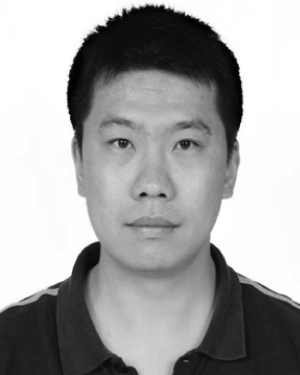 Feng Huang合作论文数Ordnance Engineering College(Ordnance Engineering College),Shijiazhuang,China1
 Peng Sun合作论文数Nanyang Technol Univ, Sch Comp Sci & Engn, Singapore, Singapore1QiYou Wei (魏启幼)合作论文数1JiPing Mao (毛季萍)合作论文数1HuiJu Zhong (钟惠菊)合作论文数1Xin Su (苏欣)合作论文数1




