Socially Assistive Robots (SAR) promote social interaction to provide cognitive, social and emotional support to people who interact with them. Therapies and interventions supported by SAR technologies for people with dementia (PwD) have found promising applications. Since a conversation is one of the most important strategies for social interaction with PwD we propose the use of a robot to enact a personalized conversation to calm, distract and relax people who suffer from dementia. However, a PwD-robot interaction has many differences with respect to an interaction between a robot and a person without dementia. Thus, to achieve our goal we propose a study to explore the adoption of a conversational SAR by PwD. In this work, we propose an exploratory study to answer open questions about PWD-robot interaction related to engagement, adoption factors, and communication strategies. We expect to answer these questions using common metrics used for human-robot interaction (HRI) and dementia research. With this study, we expect to determine which issues influence the adoption of a SAR by PwD. Moreover, this study will allow us to better understand how a PwD can interact with an autonomous conversational robot.
We present ACT-R/E (Adaptive Character of Thought-Rational / Embodied), a cognitive architecture for human-robot interaction. Our reason for using ACT-R/E is two-fold. First, ACT-R/E enables researchers to build good embodied models of people to understand how and why people think the way they do. Then, we leverage that knowledge of people by using it to predict what a person will do in different situations; e.g., that a person may forget something and may need to be reminded or that a person cannot see everything the robot sees. We also discuss methods of how to evaluate a cognitive architecture and show numerous empirically validated examples of ACT-R/E models.
Az ipari robotok egy új korszakba léptek. A robotok gyárainkban átmenetet képeznek egy egyszerű manipulátor, a teljes ipari robot, majd később az intelligens robotok között. Napjainkban a robotok kölcsönhatásba lépnek az emberekkel a munkahelyeken. Ahhoz, hogy megértsük a jelenlegi trendeket, illetve felvázoljuk az ipari robotok adaptív rugalmas automatizálásának fejlesztését, valamint, hogy ezeknek milyen hatásai lesznek a munkahelyekre, vagy magukra a robotokra, számos tényező meg kell vizsgálni.
In this work, we describe an autonomous mobile robotic system for finding, investigating, and modeling ambient noise sources in the environment. The system has been fully implemented in two different environments, using two different robotic platforms and a variety of sound source types. Making use of a two-step approach to autonomous exploration of the auditory scene, the robot first quickly moves through the environment to find and roughly localize unknown sound sources using the auditory evidence grid algorithm. Then, using the knowledge gained from the initial exploration, the robot investigates each source in more depth, improving upon the initial localization accuracy, identifying volume and directivity, and, finally, building a classification vector useful for detecting the sound source in the future.
How can we facilitate human-robot teamwork? The teamwork literature has identified the need to know the capabilities of teammates. How can we integrate the knowledge of another agent’s capabilities for a justifiably intelligent teammate? This paper describes extensions to the cognitive architecture, ACT-R, and the use of artificial intelligence (AI) and cognitive science approaches to produce a more cognitively-plausible, autonomous robotic system that “mentally” simulates the decision-making of its teammate. The extensions to ACT-R added capabilities to interact with the real world through the robot’s sensors and effectors and simulate the decision-making of its teammate. The AI applications provided visual sensor capabilities by methods clearly different than those used by humans. The integration of these approaches into intelligent team-based behavior is demonstrated on a mobile robot. Our “TeamBot” matches the descriptive work and theories on human teamwork. We illustrate our approach in a spatial, team-oriented task of a guard force responding appropriately to an alarm condition that requires the human and robot team to “man” two guard stations as soon as possible after the alarm.
One of the great challenges of putting humanoid robots into space is developing cognitive capabilities for the robots with an interface that allows human astronauts to collaborate with the robots as naturally and efficiently as they would with other astronauts. In this joint effort with NASA and the entire Robonaut team we are integrating natural language and gesture understanding, spatial reasoning incorporating such features as human-robot perspective taking, and cognitive model-based understanding to achieve a high level of human-robot interaction. Building greater autonomy into the robot frees the human operator(s) from focusing strictly on the demands of operating the robot, and instead allows the possibility of actively collaborating with the robot to focus on the task at hand. By using shared representations between the human and robot, and enabling the robot to assume the perspectives of the human, the humanoid robot may become a more effective collaborator with a human astronaut for achieving mission objectives in space.
In this work, we describe an autonomous mobile robotic system for finding and investigating ambient noise sources in the environment. Motivated by the large negative effect of ambient noise sources on robot audition, the long-term goal is to provide awareness of the auditory scene to a robot, so that it may more effectively act to filter out the interference or re-position itself to increase the signal-to-noise ratio. Here, we concentrate on the discovery of new sources of sound through the use of mobility and directed investigation. This is performed in a two-step process. In the first step, a mobile robot first explores the surrounding acoustical environment, creating evidence grid representations to localize the most influential sound sources in the auditory scene. Then in the second step, the robot investigates each potential sound source location in the environment so as to improve the localization result, and identify volume and directionality characteristics of the sound source. Once every source has been investigated, a noise map of the entire auditory scene is created for use by the robot in avoiding areas of loud ambient noise when performing an auditory task.
Human-Robot Interaction (HRI) has recently received considerable attention in the academic community, in labs, in technology companies, and through the media. Because of this attention, it is desirable to present a survey of HRI to serve as a tutorial to people outside the field and to promote discussion of a unified vision of HRI within the field. The goal of this review is to present a unified treatment of HRI-related problems, to identify key themes, and discuss challenge problems that are likely to shape the field in the near future. Although the review follows a survey structure, the goal of presenting a coherent "story" of HRI means that there are necessarily some well-written, intriguing, and influential papers that are not referenced. Instead of trying to survey every paper, we describe the HRI story from multiple perspectives with an eye toward identifying themes that cross applications. The survey attempts to include papers that represent a fair cross section of the universities, government efforts, industry labs, and countries that contribute to HRI, and a cross section of the disciplines that contribute to the field, such as human, factors, robotics, cognitive psychology, and design.
The second international conference on Human-Robot Interaction (HRI-2007) was held in Arlington, Virginia, March 9-11, 2007. The theme of the conference was Robot as Team Member and included posters and paper presentations on teamwork, social robotics, adaptation, observation and metrics, attention, user experience, and field testing. One hundred seventy-five researchers and practitioners attended the conference, and many more contributed to the conference as authors or reviewers. HRI-2008 will be held in Amsterdam, The Netherlands from March 12-15, 2008.
Robotic hardware designs are becoming more complex as the variety and number of on-board sensors increase and as greater computational power is provided in ever-smaller packages on-board robots. These advances in hardware, however, do not automatically translate into better software for controlling complex robots. Evolutionary techniques hold the potential to solve many difficult problems in robotics which defy simple conventional approaches, but present many challenges as well. Numerous disciplines including artificial life, cognitive science and neural networks, rule-based systems, behavior-based control, genetic algorithms and other forms of evolutionary computation have contributed to shaping the current state of evolutionary robotics. This paper provides an overview of developments in the emerging field of evolutionary robotics, and discusses some of the opportunities and challenges which currently face practitioners in the field.
How should a robot represent and reason about spatial information when it needs to collaborate effectively with a human? The form of spatial representation that is useful for robot navigation may not be useful in higher-level reasoning or working with humans as a team member. To explore this question, we have extended previous work on how children and robots learn to play hide and seek to a human-robot team covertly approaching a moving target. We used the cognitive modeling system, ACT-R, with an added spatial module to support the robot's spatial reasoning. The robot interacted with a team member through voice, gestures, and movement during the team's covert approach of a moving target. This paper describes the new robotic system and its integration of metric, symbolic, and cognitive layers of spatial representation and reasoning for its individual and team behavior.
In this paper, we describe a prototype interface that facilitates the control of a mobile robot team by a single operator, using a sketch interface on a Tablet PC. The user draws a sketch map of the scene and includes the robots in approximate starting positions. Both path and target position commands are supported as well as editing capabilities. Sensor feedback from the robots is included in the display such that the sketch interface acts as a two-way communication device between the user and the robots. The paper also includes results of a usability study, in which users were asked to perform a series of tasks.
Robotic hardware designs are becoming more complex as the variety and number of on-board sensors increase and as greater computational power is provided in eversmaller packages on-board robots. These advances in hardware, however, do not automatically translate into better software for controlling complex robots. Evolutionary techniques hold the potential to solve many difficult problems in robotics which defy simple conventional approaches, but present many challenges as well. Numerous disciplines including artificial life, cognitive science and neural networks, rule-based systems, behaviorbased control, genetic algorithms and other forms of evolutionary computation have contributed to shaping the current state of evolutionary robotics. This paper provides an overview of developments in the emerging field of evolutionary robotics, and discusses some of the opportunities and challenges which currently face practitioners in the field.
Creating a human-robot interface is a daunting experience. Capabilities and functionalities of the interface are dependent on the robustness of many different sensor and input modalities. For example, object recognition poses problems for state-of-the-art vision systems. Speech recognition in noisy environments remains problematic for acoustic systems. Natural language understanding and dialog are often limited to specific domains and baffled by ambiguous or novel utterances. Plans based on domain-specific tasks limit the applicability of dialog managers. The types of sensors used limit spatial knowledge and understanding, and constrain cognitive issues, such as perspective-taking.In this research, we are integrating several modalities, such as vision, audition, and natural language understanding to leverage the existing strengths of each modality and overcome individual weaknesses. We are using visual, acoustic, and linguistic inputs in various combinations to solve such problems as the disambiguation of referents (objects in the environment), localization of human speakers, and determination of the source of utterances and appropriateness of responses when humans and robots interact. For this research, we limit our consideration to the interaction of two humans and one robot in a retrieval scenario. This paper will describe the system and integration of the various modules prior to future testing.
This paper describes an effort to identify common metrics for task-oriented human-robot interaction (HRI). We begin by discussing the need for a toolkit of HRI metrics. We then describe the framework of our work and identify important biasing factors that must be taken into consideration. Finally, we present suggested common metrics for standardization and a case study. Preparation of a larger, more detailed toolkit is in progress.
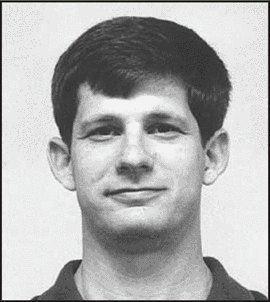 William Adams合作论文数47
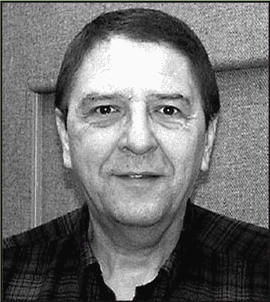 Dennis Perzanowski合作论文数Navy Center for Applied Research in Artificial Intelligence;Naval Research Laboratory;Navy Center for Applied Research in Artificial Intelligence, Naval Research Laboratory36
 J. Gregory Trafton合作论文数Naval Research Laboratory30Magda Bugajska合作论文数U.S. Naval Research Laboratory23
 John J Grefenstette合作论文数Public Health Dynamics Lab, School of Public Health, University of Pittsburgh22
 Nick Cassimatis合作论文数Dry.Ai15
 Donald Sofge合作论文数NeuroDyne , Inc14
 Marjorie Skubic合作论文数Department of Electrical Engineering and Computer Science, College of Engineering, University of Missouri;Department of Computer Science, College of Engineering, University of Missouri13Magdalena D. Bugajska合作论文数U.S. Naval Research Laboratory12
 Derek Brock合作论文数10
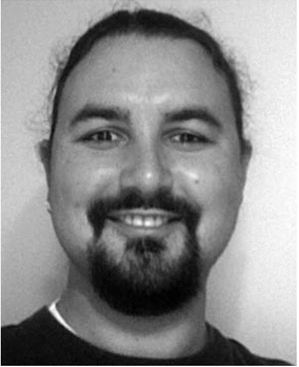 Samuel Blisard合作论文数University of Missouri - Columbia9
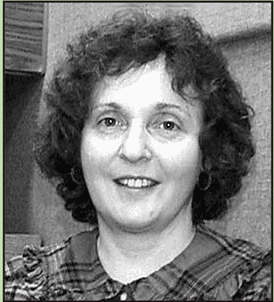 Elaine Marsh合作论文数7scott thomas合作论文数6
 Michael A. Goodrich合作论文数Computer Science Department, Brigham Young University6
 Brian Yamauchi合作论文数Boston Dynamics6
 Farilee Mintz合作论文数6
 Terrence Fong合作论文数NASA Ames Research Center5
 Laura Hiatt合作论文数Navy Center for Applied Research in Artificial Intelligence, U.S. Naval Research Laboratory5
 Kenneth A. De Jong合作论文数Department of Computer Science, School of Computing, George Mason University;Krasnow Institute, George Mason University;Volgenau School of Engineering, College of Engineering and Computing, George Mason University4
 Lynne Parker合作论文数Min H. Kao Department of Electrical Engineering and Computer Science, Tickle College of Engineering, University of Tennessee4
 Reid Simmons合作论文数Robotics Institute, School of Computer Science, Carnegie Mellon University4
 Eric Martinson合作论文数iRobot4
 Kenneth A. Kaufman合作论文数Internal Revenue Service4Magdalena Bugajska合作论文数U.S. Naval Research Laboratory4
 Ryszard S. Michalski合作论文数Machine Learning and Inference Laboratory, George Mason University;Center for Discovery Science and Health Informatics, George Mason University4Mitchell A. Potter合作论文数Naval Research Laboratory4
 Derek Anderson合作论文数3D. Brock合作论文数3
 Joachim Wegener合作论文数3Myriam Abramson合作论文数Naval Research Laboratory3
 Lise Getoor合作论文数Department of Computer Science, University of California, Santa Cruz;Department of Computer Science, University of Maryland3
 David Kortenkamp合作论文数TRACLabs Inc.3
 Julian F Miller合作论文数Department of Electronic Engineering, University of York3Matt Macmahon合作论文数Department of Electrical and Computer Engineering;Robotics, Intelligent;Laboratory University of Texas at Austin;Department of Electrical and Computer Engineering, Laboratory University of Texas at Austin3
 Robin Murphy合作论文数Humanitarian Robotics and AI Laboratory, Department of Computer Science and Engineering, College of Engineering, Texas A&M University3Robert W. Holt合作论文数3Jean Scholtz合作论文数Pacific Northwest National Laboratory|Virginia Tech|Department of Computer Science3Shaun Gittens合作论文数3Da Boehmdavis合作论文数2Connie Loggia Ramsey合作论文数2Yukio Ohsawa合作论文数2FL Crabbe合作论文数2Osuka, K.合作论文数2
 Graham Kendall合作论文数Petra Group;University of Nottingham2
 Mark Harman合作论文数Meta Platforms;Department of Computer Science, Faculty of Engineering, University College London2
 Russell K. Standish合作论文数School of Mathematics;University of New South Wales;School of Mathematics, University of New South Wales2
 Ian Horswill合作论文数Departments of Computer Science, McCormick School of Engineering, Northwestern University2
 Aaron Steinfeld合作论文数Robotics Institute, School of Computer Science, Carnegie Mellon University2
 Simon Parsons合作论文数School of Agri-Food Technology & Manufacturing, College of Health and Science, University of Lincoln2




