The sustainable development of our planet is considerably related to a relevant reduction of CO2 global emissions, with building consumption contributing more than 40%. In this scenario, new technological conceptions, such as building-integrated photovoltaic technology, emerged in order to satisfy the requirements of sustainability imposed by the European Union. Therefore, the aim of this work is to provide a technical and economical comparison of the performances of different vertical-mounted innovative photovoltaic systems, potentially integrated on a building instead of on traditional windows or glass walls. The proposed investigation was carried out by means of experimental tests on three different next-generation vertical structures. The related results are described and discussed, highlighting the advantages and the drawbacks of the proposed technologies.
The interest towards bifacial PV technology has increased over the last years, due to its potential capability of obtaining higher efficiencies with respect to traditional monofacial cells. Thus, the aim of this work is to present an experimental investigation on an innovative photovoltaic technology, such as the bifacial solar cells based on monocrystalline substrate. This analysis is mainly based on the determination of the current density/voltage, power density/voltage, External Quantum Efficiency (EQE) and Laser Beam Induced Current (LBIC) characterization. Interesting results are presented and discussed, demonstrating that the bifacial silicon solar cells can be a very promising technology with high electrical performances and efficiency.
In this paper proposes an experimental comparison between different rainfall harvesting devices and the study of the corresponding electrical rectifying circuit. More in detail, three harvesting structures are considered: the cantilever, the bridge and the floating circle. For each of the proposed structure, different waveforms have been acquired and discussed. The processed data have been compared in order to suggest the best choice for the rectifying circuit, from the simplest one to the most endorsed in the technical literature.
This paper presents the performances of rainfall energy harvesting through the use of a piezoelectric transducer and an Arduino-based measuring system.Different studies agree on the possibility of generating electricity from rainfall, but to date, a study on measuring the quantity of energy produced during rainfall is still missing.The present study begins with results obtained from laboratory researchers using piezoelectric transducers and oscilloscopes, finalized to measure the energy produced from a single raindrop, and concludes with an ad hoc Arduino-based measuring system, aimed to measure the actual amount of electrical energy produced by a piezoelectric transducer that is exposed to rainfall of variable durations.
This paper presents the performance comparison of PV windows with the purpose of tracing the behavior of next-generation systems, which could favor architectonical integration. More in detail, a dye sensitized solar cell (DSSC) and blue and grey thin film silicon panels have been analyzed. The systems can be placed behind a window or behind a wall of glass blocks. The three generation systems are then compared in terms of both efficiency and Fill Factor.
This paper presents the performances of rainfall energy harvesting through the use of a piezoelectric transducer and an Arduino-based measuring system. Diverse studies agree on the possibility of generating electricity from rainfall, but to date, a study that can measure the quantity of energy produced during rainfall is still missing. The present study begins with results obtained from laboratory researchers using piezoelectric transducers and oscilloscopes - to measure the energy produced from a single raindrop - and concludes with an ad hoc Arduino-based measuring system, aimed at measuring the actual amount of electrical energy produced by a piezoelectric transducer that is exposed to rainfall of variable durations.
In this paper a model to predict the harvest of the energy contained in rainfall by means of piezoelectric transducers is presented. Different studies agree on the level of suitable generated voltage on the electrodes of a piezoelectric transducer subjected to rainfall, but a complete characterization on the supplied power is still missing. This work, in order to limit optimistic forecasts, compares the behavior of the transducers subjected to real and artificial rainfall, a condition that has shown promising behavior in laboratory.
In this paper a detailed study on the piezoelectric energy harvesting of rainfall is presented. Different features have been taken into account in order to define the limits in this energy harvesting. Only commercial transducers have been considered: a lead zirconate titanate and polyvinylidene difluoride transducer.
There is an increasing focus on reducing costs and improving efficiency for photovoltaic (PV) cells and modules as well as finding a more efficient approach to the product manufacturing. This letter introduces an innovative solution to bypass shaded PV cells instead of a traditional Schottky diode, in order to avoid overheating of cells in the case of partial shading. The goal is to reduce the power dissipation and improve the general efficiency of a PV generator. A novel device called cool bypass switch is then presented. It is made up of a Power MOS driven by a controller with the task to charge a storage capacitor. Tests and comparisons with standard Schottky diodes are then performed and experimental results are reported in terms of current intensity and operating temperature. The resulting circuit shows better diode performances and considerably lower dissipated power in shading condition. The little packing cases allow an easy integration inside the PV module. In comparison with traditional diodes, the integrated power switch provides a negligible leakage current during PV panel energy production.
L’alimentazione di piccoli componenti elettronici, come sensori wireless usati per applicazioni di monitoraggio, può essere fornita utilizzando energia vibrazionale presente nell’ambiente per mezzo di trasduttori piezoelettrici. L’obiettivo è quello di sostituire l’impiego di batterie chimiche, che presentano sia costi di manutenzione che un problema di smaltimento delle stesse. Per raggiungere l’obiettivo bisogna conseguire il massimo trasferimento di potenza tra sistema meccanico e sistema elettrico. Una possibile fonte di energia vibrazionale è la pioggia. La caratterizzazione in potenza di un sistema di trasduzione deve quindi ricondurre il fenomeno in blocchi caratterizzabili per mezzo di rendimenti: Pout = ηcollision · ηpiezo · ηrect ·Pmax., in cui la potenza Pmax rappresenta l’energia ideale contenuta in una goccia d’acqua, ed rendimenti rappresentano le perdite di potenza ascrivibili ai processi di collisione, trasduzione meccanicaelettrica, e raddrizzamento del segnale elettrico. Il processo di collisione presenta comportamenti molto aleatori, dovuti all’ingenerarsi del fenomeno di splashing, dovuto all’inclinazione della goccia rispetto alla superficie di impatto, dalla velocità della stessa vista nei tre assi ed anche alla presenza di film sottili di acqua su trasduttori. Il rendimento di trasduzione è anche affetto da aleatorietà in quanto o strato sottile d’acqua che si deposita sul trasduttore ne varia la massa e quindi l’inerzia. Il rendimento di raddrizzamento e spianamento è quello meno influenzato da fattori aleatori. Lo studio del comportamento del trasduttore è stato effettuato considerando un sistema ibrido meccanico-elettrico in cui il trasformatore converte energia meccanica definita in termini di tensioni meccaniche e deformazioni in energia elettrica definita in termini di tensione voltaica e corrente elettrica.
 Fabio Viola合作论文数Dipartimento di Ingegneria Elettrica, Università degli Studi di Palermo, viale delle Scienze, 90128 Palermo, Italia8
 Giuseppe Schettino合作论文数6
 Caruso, M.合作论文数5R. Miceli合作论文数4
 Rosario Miceli合作论文数4
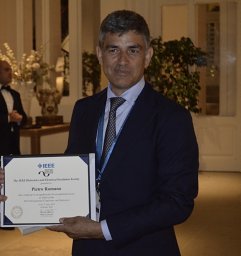 Pietro Romano合作论文数4P. Romano合作论文数3
 Antonino Imburgia合作论文数3
 Antonino Parisi合作论文数2
 Gabriele Adamo合作论文数Dept. of Energy, Inf. Eng. & Math. Models, Univ. of Palermo;c;Dept. of Energy, Inf. Eng. & Math. Models, Univ. of Palermo2
 Ciro Spataro合作论文数University of Palermo2
 Alessandro Busacca合作论文数DIEET, Università di Palermo2
 Guido Ala合作论文数Dipartimento di Ingegneria Elettrica, Elettronica e delle Telecomunicazioni, Università degli Studi di Palermo2g sauba合作论文数1a parisi合作论文数1Anita Busacca合作论文数1Saverio Guarino合作论文数1Luca Zumbo合作论文数1
 F. Ricco Galluzzo合作论文数1Graci, D.合作论文数1
 Filippo Pellitteri合作论文数1
 Giglia, G.合作论文数1
 Riccardo Pernice合作论文数Dept. of Energy, Inf. Eng. & Math. Models, Univ. of Palermo;c;Dept. of Energy, Inf. Eng. & Math. Models, Univ. of Palermo1
 Antonino Madonia合作论文数1
 Cosimo Gerardi合作论文数STMicroelectronics1
 S. Lombardo合作论文数CNR-IMM1
 Amedeo La Scala合作论文数1
 Maria Luisa Di Silvestre合作论文数DIEET, Università di Palermo1
 Patrizia Livreri合作论文数1
 Eleonora Riva Sanseverino合作论文数University of Palermo1




