Digital security is confronting an immense risk from malware or malicious software. In recent years, there has been an increase in the volume of malware, reaching above 980 million in 2019 * . To identify and classify this pernicious software, complex details and patterns among them are to be gathered, segregated, and analyzed. In this regard, Convolutional Neural Networks (CNN) - an architecture of Deep Neural Networks (DDN) can offer a more efficient and accurate solution than Conventional Neural Network (NN) systems. In this paper, we have looked into the consequences of using conventional NN systems and the benefits of using CNN on a sample of malware provided by Microsoft. In 2015, Microsoft announced a malware classification challenge and released more than 21,000 malware samples. Many interesting solutions were put forward by scientists and students around the world. Inspired by their efforts we also have put forward a method. We have converted the malware binary files into images and then trained a CNN model for identification and categorization of this malware to their respective families. From this method, we achieved a high percentage accuracy of 98.88%.
Directed diffusion is a data dissemination protocol for wireless sensor networks. In directed diffusion, interest and exploratory data are disseminated by flooding, which will bring broadcast storm resulting in substantial energy consumption of networks. Grid-based directed diffusion can improve the energy efficiency where geographic grids are constructed by self-organization of nodes using location information. The flooding of interest and exploratory data is limited in grid head nodes. To save more energy, a scheme of data aggregation based on wavelet sparseness is proposed. At the same time, to adapt to environments with high security requirements, secure schemes based on trust are added. The simulation experiments show that the proposed data aggregation scheme can obtain data aggregation results earlier and effectively extend lifetime of network. And experiments show that the proposed security schemes restrain malicious nodes when network is under attacks.
信息技术的快速发展对民众的日常生活产生了巨大的影响,公交车作为使用最多的交通工具已经发生了巨大变革,各种新技术的使用使其在日常运行过程中产生了海量数据,如何对这些数据进行科学有效地采集和深入挖掘分析利用成为当前各个公交系统平台共同的难题.本文通过对智慧公交平台的大数据现状调查分析,提出一些解决方法,以便为智慧公交系统平台的建设和完善提供建议.
China is a great agricultural country in the world,and agriculture plays an important role in Chinese economy. However,the tra-ditional agricultural production and management is too rough,not better meeting the needs of social development. The smart agriculture to changes in agricultural development has promoted, can be rough agriculture to special fine agriculture. With the help of Internet of Things,the building architecture and management of intelligent agriculture is proposed to maximize agricultural productivity,developing the high quality,high yield,low consumption and environmentally sustainable agriculture,efficient use of resources to complete all kinds of agricultural and environmental improvement can be sustainable development goals. The idea and method is proven effective and reason-able in the practice.
The vehicle license plate location is one of the key technologies in the license plate intelligent recognition system and it is nec-essary for the other work. Though there has some license plate location methods,the deficiency is low recognition accuracy. To improve the location level,a new method is proposed based on wavelet transform and support vector machines on the basis of previous research, fully applying the useful information of license plate. It has made use of wavelet transform to extract the vertical texture features. And then obtain the candidate plate location areas by using the mathematical morphology. Finally, the precise license plate location is located through support vector machine based on the license plate comprehensive feature. Experimental results indicate the algorithm is efficient and effective.
Food safety decision is an important content of food safety research. Based on variable precision rough sets model,a method of building decision tree with rules that have definite confidence is proposed for food safety analysis. It is an improvement for decision tree inducing approach presented in traditional methods. Present a new algorithm for constructing decision tree with variable precision weighted mean roughness as the criteria for selecting attribute. The new algorithm used variable precision approximate accuracy instead the approxi-mate accuracy. Noisy data of training sets are considered enough. Limited inconsistency is allowed to existed examples of the positive re-gions. So the decision tree is simplified and its extensive ability is improved and more comprehensible. Experiments show that the algo-rithm is feasible and effective.
How to accurately and rapidly detect traffic attack is an important security problem in wireless sensor networks. An energy-saving ARMA-based traffic attack detection protocol is proposed in this paper. The detection protocol uses linear prediction to establish easy ARMA( 2,1) model for sensor nodes. In the detection protocol, different nodes play different roles, and use different monitor schemes. Virtual cluster head and monitor nodes are elected. Monitor nodes monitor cluster head, and report to virtual cluster head. Virtual cluster head broadcasts abnormal cluster head to all member nodes, and initiates a new cluster head election. Member nodes are monitored by their cluster head. Simulation shows that, the detection protocol can real-time predict traffic attacks, and consume less energy. It not only protects sensor nodes against traffic attacks, but also prolongs the lifetime of network.
A security node-based key management protocol is proposed for cluster-based sensor networks. Member nodes and cluster heads are responsible for data collection and transmission. Security nodes are responsible for key management. Security nodes restrain key management function of cluster heads, and reduce damage of captured cluster heads. Generation of security nodes and different kinds of keys is described. Performance analysis and simulation show that the proposed key management protocol consumes less energy, and its delay time of key generation is short. At the same time, the protocol can provide more collaborative authentication security for keys. It has strong resilience against node capture, and can support large scale network.
Traffic attack and false data aggregation attack are serious to wireless sensor networks. How to detect the two kinds of attack is a difficult problem. An energy-efficient attack detection protocol is proposed in this paper. The detection protocol uses linear prediction to establish easy ARMA(2,1) model for sensor nodes. In the detection protocol, different nodes play different roles, and use different monitor schemes. Virtual cluster head and monitor nodes are elected. Monitor nodes monitor cluster head, and member nodes are monitored by their cluster head. At the same time, secure data aggregation schemes are added to the protocol. Simulation shows that, the detection protocol can real-time predict traffic attacks, and insure correct data aggregation, but consume less energy.
For incomplete food safety information system, this paper proposes a direct method of attribute relative reduction based on rough set theory. This reduction method gives the concept of tolerance relationship similar matrix via using an extension of equivalence relationship of rough set theory, which is called tolerance relationship. It solves the problem of inconsistency in the incomplete information system through the introduction of restrictions of the generalized decision function. It calculates the core attributes of incomplete information systems via the tolerance relationship similar matrix. It applies attribute significance, which this paper puts forward based on attribute frequency in the tolerance relationship similar matrix, as the heuristic konwledge. It makes use of binsearch heuristic algorithm to calculate the candidate attribute expansion so that it can reduce the expansion times to speed up reduction. Experiment results show that this method is simple and effective.
In order to implement progressive mesh representation of 3D model,the calculation method of collapse cost of model simplification based on edge collapse mode is improved.Firstly,model data from SMF data file is obtained,and the 3D model in the memory is established rapidly,and the weight calculation method of Garland's EM algorithm is redesigned.The square of the largest deviation of triangular plane normal adjacent to the vertex is used as the importance degree of vertex,and bring it into error metric formula,by simplifying progressive mesh is generated.The following experiment shows that the algorithm is succinct,and the generating speed of mesh and the contour information of model are completely preserved.
In directed diffusion rooting protocol, interest and exploratory data are disseminated by flooding, which will bring broadcast storm resulting in substantial energy consumption of wireless sensor networks. Grid-based directed diffusion rooting protocol can improve energy efficiency where geographic grids are constructed by self-organization of nodes using location information. Flooding of interest and exploratory data is limited in grid head nodes. But grid-based directed diffusion rooting protocol considers less about security. To adapt to environments with high security requirements, traffic attack detection and secure data aggregation schemes are added to grid-based directed diffusion rooting protocol. Simulation shows that the proposed schemes can real-time predict traffic attacks and improve accuracy of data aggregation results when networks are under attacks. At the same time, the protocol consumes less energy and extends lifetime of networks.
How to accurately and rapidly detect traffic attack is an important security problem in wireless sensor networks.An energy-efficient ARMA-based traffic attack detection protocol is proposed in this paper.The detection protocol uses linear prediction to establish easy ARMA(2,1) model for sensor nodes.In the detection protocol, different nodes play different roles, and use different monitor schemes.Virtual cluster head and monitor nodes are elected.Monitor nodes monitor cluster head, and report to virtual cluster head.Virtual cluster head broadcasts abnormal cluster head to all member nodes, and initiates a new cluster head election.Member nodes are monitored by their cluster head.Simulation shows that, the detection protocol can real-time predict traffic attacks, and consume less energy.It not only protects sensor nodes against traffic attacks, but also prolongs the lifetime of network.
According to analyzing the existing attribute reduction algorithms of food safety evaluation and the shortcoming of calculation of inefficient,the article defined a new attribute reduction algorithm based on roughness.The algorithm introduced roughness,beginning with null set and taking roughness PB(X) as selection criterion of condition attribute,got a new union by adding the minimum roughness into reduction set step by step,reduced search space using recursive method until the universe was empty and got reduced attribute set.Finally,the validity and availability of the algorithms were demonstrated.
Directed diffusion is a data dissemination protocol for wireless sensor networks. In directed diffusion, interest and exploratory data are disseminated by flooding, which will bring broadcast storm resulting in substantial energy consumption of networks. Grid-based directed diffusion can improve the energy efficiency where geographic grids are constructed by self-organization of nodes using location information. The flooding of interest and exploratory data is limited in grid head nodes. But grid-based directed diffusion considers less about security. To adapt to environments with high security requirements, secure grid head election, attack detection and secure data aggregation schemes are added to grid-based directed diffusion. The simulation experiments show that the proposed security protocol extends the lifetime of network, and restrains malicious nodes. So the protocol improves the accuracy of data aggregation results when network is under attacks.
In this letter, a Function node-based Multiple Pairwise Keys Management (MPKMF) protocol for Wireless Sensor Networks (WSNs) is firstly designed, in which ordinary nodes and cluster head nodes are responsible for data collection and transmission, and function nodes are responsible for key management. There are more than one function nodes in the cluster consulting the key generation and other security decision-making. The function nodes are the second-class security center because of the characteristics of the distributed WSNs. Secondly, It is also described that the formation of function nodes and cluster heads under the control of the former, and five kinds of keys, i.e., individual key, pairwise keys, cluster key, management key, and group key. Finally, performance analysis and experiments show that, the protocol is superior in communication and energy consumption. The delay of establishing the cluster key meets the requirements, and a multiple pairwise key which adopts the coordinated security authentication scheme is provided.
Directed diffusion is a data dissemination protocol for wireless sensor networks.In directed diffu- sion,flooding is used for dissemination of interest and exploratory data,which will bring broadcast storm resulting in substantial energy consumption of networks.A grid-based directed diffusion is presented to improve the energy efficiency of directed diffusion.Virtual geographic grid clusters are constructed by self-organization of nodes using geographic location information.The flooding of interest and exploratory data of original directed diffusion is limited in cluster head nodes.The simulation results and testhed ex- periments show that the method effectively reduces the network energy consumption.This gain is not achieved at the cost of either delivery ratio or the delay.Importantly,the decreased load also leads to a better delivery ratio and lower delay.
Directed diffusion is a data dissemination protocol for wireless sensor networks.In directed diffu-sion,flooding is used for dissemination of interest and exploratory data,which will bring broadcast stormresulting in substantial energy consumption of networks.A grid-based directed diffusion is presented toimprove the energy efficiency of directed diffusion.Virtual geographic grid clusters are constructed byself-organization of nodes using geographic location information.The flooding of interest and exploratorydata of original directed diffusion is limited in cluster head nodes.The simulation results and testhed ex-periments show that the method effectively reduces the network energy consumption.This gain is notachieved at the cost of either delivery ratio or the delay.Importantly,the decreased load also leads to abetter delivery ratio and lower delay.
A method for selecting path in radio transducer network based on AOMDV protocol includes storing information of multiple next jump neighbor node in itself route table when each sending node is initialized, enabling to select secondary priority next jump neighbor node to carry out routing continuously according to itself route table in routing course when routing of primary priority next jump neighbor node is failure, treating that routing of sending node is failure till routing of all next neighbor nodes in said route table is failure.
 E Xu (鄂旭)合作论文数渤海大学11
 Zhenzhou Ji (季振洲)合作论文数School of Computer Science and Technology, Harbin Institute of Technology, Weihai;Parallel and Intelligent Computing Research Center, Harbin Institute of Technology, Weihai3
 Jian Hou合作论文数3
 Jin ZHOU (周津)合作论文数2BaoMing Hou (侯宝明)合作论文数2
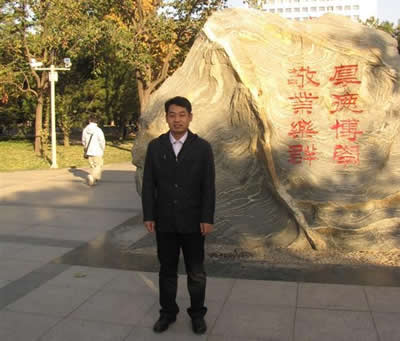 Longchang Zhang (张龙昌)合作论文数渤海大学信息科学与技术学院2Zhiyan Cao合作论文数1
 SUN Yan-dong (孙彦东)合作论文数1Guan Feng (冯冠)合作论文数1XianLi Su (苏宪利)合作论文数1Qi Yan (阎琦)合作论文数1JunYuan Ren (任骏原)合作论文数1Fang Han (韩芳)合作论文数1Zegang Shen (沈泽刚)合作论文数1
 Qiangkui Leng (冷强奎)合作论文数1
 Shuofei Tang (唐朔飞)合作论文数School of Computer Science and Technology, Faculty of Computing, Harbin Institute of Technology1




