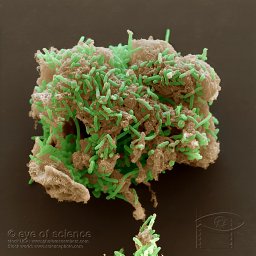
Microbial impacts on early carbonate diagenesis, particularly the formation of Mg-carbonates at low temperatures, have long eluded scientists. Our breakthrough laboratory experiments with two species of halophilic aerobic bacteria and marine carbonate grains reveal that these bacteria created a distinctive protodolomite (disordered dolomite) rim around the grains. Scanning Electron Microscopy (SEM) and X-ray Diffraction (XRD) confirmed the protodolomite formation, while solid-state nuclear magnetic resonance (NMR) revealed bacterial interactions with carboxylated organic matter, such as extracellular polymeric substances (EPS). We observed a significant carbon isotope fractionation (average δ13C = 11.3‰) and notable changes in Mg/Ca ratios throughout the experiments. Initial medium δ13C was − 18‰, sterile sediments were at 2‰ (n = 12), bacterial-altered sediments were − 6.8‰ (n = 12), and final medium δ13C was − 4.7‰. These results highlight the role of bacteria in driving organic carbon sequestration into Mg-rich carbonates and demonstrate the utility of NMR as a tool for detecting microbial biosignatures. This has significant implications for understanding carbonate diagenesis (dissolution and reprecipitation), climate science, and extraterrestrial research.
Micritization is an early diagenetic process that gradually alters primary carbonate sediment grains through cycles of dissolution and reprecipitation of microcrystalline calcite (micrite). Typically observed in modern shallow marine environments, micritic textures have been recognized as a vital component of storage and flow in hydrocarbon reservoirs, attracting scientific and economic interests. Due to their endolithic activity and the ability to promote nucleation and reprecipitation of carbonate crystals, microorganisms have progressively been shown to be key players in micritization, placing this process at the boundary between the geological and biological realms. However, published research is mainly based on geological and geochemical perspectives, overlooking the biological and ecological complexity of microbial communities of micritized sediments. In this paper, we summarize the state-of-the-art and research gaps in micritization from a microbial ecology perspective. Since a growing body of literature successfully applies in vitro and in situ 'fishing' strategies to unveil elusive microorganisms and expand our knowledge of microbial diversity, we encourage their application to the study of micritization. By employing these strategies in micritization research, we advocate promoting an interdisciplinary approach/perspective to identify and understand the overlooked/neglected microbial players and key pathways governing this phenomenon and their ecology/dynamics, reshaping our comprehension of this process.
Brejo do Espinho coastal lake (LBE) is one of the few places in the world where dolomite [CaMg(CO3)2] is precipitating in the modern environment under microbially induced processes and low oxygen conditions. We use pore morphometry of the foraminifera Ammonia cf. A. veneta to evaluate paleo-O2 dynamics during the dolomitic depositional phase that took place at LBE in the late Holocene. Foraminiferal community structure was also investigated, and results were compared to bulk isotopic composition of carbonates, total organic carbon (TOC), and X-ray Diffraction of sediments (XRD). The correlation matrix (Spearman method) showed that Ammonia test pores morphometric parameters displayed significant correlations with overall biotic and geochemical data, with pore area presenting a relatively higher association. Ammonia test pores were primarily controlled by the degradation of organic matter (Pore area-TOC, r = - 0.84), and foraminifera density appeared to be influenced by oxygen changes, with a higher abundance in the highest porosity intervals (Pore area-N, r = 0.82), indicating a direct effect of oxygen penetration on species dominance. These data also reveal a tolerant behavior of the low-O2 bioindicator species Quinqueloculina laevigata and A. veneta. Understanding microbemineral interactions is critical for interpreting paleo records, and our data provide strong support for coupling assemblage and pores analysis as paleo-O2 bioindicators for paleo-redox coastal settings.
The Laguna Negra, a high-altitude hypersaline close-basin lake in the Andes of Northwest Argentina, presents a unique environment for studying the formation of microbialites (Gomez et al., 2014; Buongiorno et al., 2019). The extreme conditions like high UV radiation and salinity restrict multicellular life, allowing microbial activity as one of the drivers of carbonate precipitation. Oncolites samples, interpreted as a result from fluid mizing and biologically mediated nucleation (Buongiorno et al., 2019) and collected under Europlanet project have been analyzed for the search of chemical and mineralogical biosignatures. Synchrotron µ-X-Ray Fluorescence provided major-to-trace elemental distributions, revealing elements concentrated in stromatolitic laminae (e.g., Sr, Co, Rb, Mo, Pb), concentrated in not strictly stromatolitic laminations (eg., Fe, Mn, Mo, Ni, As, Pb, Zn), and contrasting with the elements widespread in the matrix (e.g., Ca, Cl, Br, K T, V). UV photoluminescence macroscopy highlighted laminations invisible in naked eye, providing also complementary information of chemical differences. Synchrotron scanning SAXS/WAXS maps provided additional information on mineral composition and crystallites shape and orientation. These combined results provide complementary chemical and mineralogical information for the characterization of the biotic and abiotic layers involved on the oncolites accretion, allowing us to define combination of characters specific to microbially-mediated precipitations. This work also opens the way for the multiscale assessment of mineral biosignatures of microbial precipitation in laminated rocks, from Earth or elsewhere.Figure 1. a) UV photoluminescence macroscopy of the Laguna Negra cross-cut oncolite excited at 385 nm. Emission collected at 571 nm (red), 708 nm (green) and 835 nm (blue). B) Synchrotron XRF map of Sr (red), Zn (green) and Ca (blue). Stromatolitic layers are rich in Sr, while Zn is restricted to outer, likely evaporitic layers. References:Buongiorno, J. et al. (2019) ‘Mineralized microbialites as archives of environmental evolution, Laguna Negra, Catamarca Province, Argentina’, Geobiology, 17(2), pp. 199–222. Available at: https://doi.org/10.1111/gbi.12327.Gomez, F.J. et al. (2014) ‘Microbialites in a high-altitude Andean lake: Multiple controls on carbonate precipitation and lamina accretion’, Palaios, 29(6), pp. 233–249. Available at: https://doi.org/10.2110/palo.2013.049.
Over the few past decades, the concept of microbial sulfur cycling catalyzing the precipitation of CaMg (CO3)2 at low temperatures (<40 °C) has been studied intensely. In this respect, two hypersaline lagoons, Lagoa Vermelha and Brejo do Espinho, in Brazil, have been the subject of numerous studies investigating sedimentary Ca/Mg carbonate formation. Here, we present the sulfur and oxygen isotopic compositions of dissolved sulfate from surface water, as well as sulfate and sulfide from pore-water (δ34SSO4, δ18OSO4, and δ34SH2S), the sulfur isotopic composition of sedimentary pyrite (δ34SCRS), and sulfur and oxygen isotopic compositions of carbonate-associated sulfate (CAS, δ34SCAS and δ18OCAS). The pore-water profiles at Lagoa Vermelha indicate ongoing bacterial sulfate reduction by increasing δ34SSO4, δ18OSO4 and δ34SCRS values downcore. At Brejo do Espinho, the pore-water profiles displayed no depth-dependent isotope trends; the Ca/Mg ratio was, on average, lower, and the δ18OSO4 values in both surface and pore-water were strongly enriched in 18O. There was an overall mismatch between δ34SSO4 and the significantly higher δ34SCAS values. A negative correlation was observed between the Ca/Mg ratio and higher δ34SCAS values. The results show that the size difference between the two lagoons induces differences in the intensity of evaporation, which leads to the increased secretion of extrapolymeric substances (EPSs) by microbes in the smaller Brejo do Espinho. EPS provides the microenvironment where Ca/Mg carbonate can nucleate and preserve increased δ34SCAS values. Apart from EPS, increased sulfur oxidation is proposed to be a second factor causing relative enrichment of Ca/Mg carbonates at Brejo do Espinho. Our results emphasize the role of evaporative processes on Ca/Mg carbonate formation, and indicate that the respective δ34SCAS values reflect microenvironments rather than preserving an open marine δ34SSO4 signature.
Microbially induced carbonate precipitation (MICP) is an important process in the synthesis of carbonate minerals, and thus, it is widely explored as a novel approach with potential for many technological applications. However, the processes and mechanisms involved in carbonate mineral formation in the presence of microbes are not yet fully understood. This review covers the current knowledge regarding the role of microbial cells and metabolic products (e.g., extracellular polymeric substances, proteins and amino acids) on the adsorption of divalent metals, adsorption of ionic species and as templates for crystal nucleation. Moreover, they can play a role in the mineral precipitation, size, morphology and lattice. By understanding how microbes and their metabolic products promote suitable physicochemical conditions (pH, Mg/Ca ratio and free CO32− ions) to induce carbonate nucleation and precipitation, the manipulation of the final mineral precipitates could be a reality for (geo)biotechnological approaches. The applications and implications of biogenic carbonates in areas such as geology and engineering are presented and discussed in this review, with a major focus on biotechnology.
Lipid-biomarkers have been used to reconstruct environmental changes in lacustrine systems on a range of time scales. Lake sediments are excellent archives to apply these tools due to their rapid and amplified response to environmental pressures. For the past thirty years, the hypersaline lagoons of the Rio de Janeiro coastal plain have been studied as natural laboratories for the observation of the biogeochemical processes involved in modern dolomite precipitation. Here, we apply a multiproxy approach to characterize two depositional stages during the Holocene that may have triggered primary dolomite formation in these lagoonal environments. A first stage, with two sub-stages (1A − 6.1 to 4.2 kyr. BP; 1B − 4.2 to ∼3.6 kyr. BP) was deposited during the sea-level rise, with sediments containing an abundance of long-chain n-alkanes with 2H-depleted (δ2Hn-alk) signatures indicating riverine inputs of terrestrial organic carbon during prevailing wet conditions. A second stage (<∼3.6 kyr. BP), comprising lacustrine facies, was characterized by high amounts of authigenic carbonate precipitates (calcite, Mg-calcite, Ca-dolomite, and dolomite). The carbonates are the result of physico-chemical changes in the water after the isolation of the lagoons from both the Atlantic Ocean and the neighboring Lagoa de Araruama due to a fall in sea level and aridification associated with intensification of the coastal upwelling after 2.2 kyr. BP. The n-alkanes deposited during this phase contain variable proportions of long and short-chain homologues indicating a mixed source of organic matter (terrestrial higher plants and microorganisms), as well as changes in vegetation associated with the driest conditions, inferred from the 2H-enriched n-alkane homologous. These results clearly demonstrate a climatic influence on dolomite formation in coastal hypersaline environments linked to sea-level change and coastal upwelling phenomena. With these observations, we hypothesize that the existence of similar palaeoceanographic and environmental conditions in the geologic past may have triggered the formation of extensive microbial dolomite deposits. This study provides new elements to interpret the formation of massive dolomite deposits in the geological record, for example, along the Late Triassic Tethys margin.
Pores smaller than 10 microns in diameter (microporosity) can make up more than 90% of the total porosity in giant Arabian carbonate reservoirs. While a lot of research has been done to understand the distribution of microporosity, the diagenetic processes initiating its development are still debated. Since microporosity occurs in highly diagenetically overprinted rocks the involvement of early syn-sedimentary processes are generally overlooked. Micritization is a process happening during early diagenesis in the first centimeters of depth in which parts of carbonate grains are reworked to cryptocrystalline textures. The fundamental drivers of micritization are still somewhat debated, however, more and more evidence points to the involvement of microbes such as cyanobacteria, algae, or fungi. So, how can we decipher the diagenetic sequence that ancient limestones have experienced and predict microporosity distribution if the initial steps are poorly understood? The hypothesis driving this research places microbial micritization as the first step toward the creation of microporosity in limestones. Here, we present the first results undertaken as part of a multidisciplinary research project, at the interface of geology and microbiology and coupling field sampling and laboratory experiments. We compare the rates of micritization and the variety of microbial-related diagenetic features encountered between different carefully selected intertidal locations from the Red Sea and Arabian Sea (Saudi Arabia), and the Arabian Gulf (United Arab Emirates). A series of 1 m long sediment cores has been collected at low tide, and subsamples were extracted from every 10 cm for systematic petrographic and geochemical analyses. Thin section petrography revealed extensive microborings and associated micritization in the sediments. XRD analysis has been carried out to establish the mineral variations through the locations and depth, and SEM imagery further confirmed the presence of organic biofilms and mucous. The results from the metagenomic analysis revealed the microbial diversities and provide further understanding of the specific microbial drivers that play a key role in micritization processes. The work presented here hence aims to enhance the fundamental understanding of micritization in shallow marine carbonate sediment, the role of microbes in early diagenetic processes and their potential impact on microporosity development.
A review of relative sea-level (RSL) oscillations during the Holocene in Rio de Janeiro, southeastern Brazil, is presented based on new data. This new data encompasses analytical techniques, altimetric corrections and age recalibrations, using the marine local radiocarbon reservoir correction of 96 +/- 48 yrs. The effectiveness of geological and biological RSL indicators was tested, aiming to provide consistent information for future re-searches on the east coast of South America. Results confirm that RSL during Late Pleistocene-Holocene transition (11,970-11,122 cal yrs BP) was 4.5 m below Mean Sea-level (MSL). After that transition, a relatively rapid rise began. At approximately 7948-7598 cal yrs BP, the MSL was 0.5 m below the current marine level. Present-day, "zero", was reached for the first time in the Holocene, at approximately 7686-7269 cal yrs BP. The maximum level of the Holocene marine transgression occurred around 4787-4104 cal yrs BP with a height of 3.0 m above MSL. At the point of maximum transgression, the sea-level began a general behavior of lowering. However, between 3981 and 3345 to 1852-1413 cal yrs BP, evidence from vermetids suggests several alter-nating periods of slow and rapid sea-level, identified by four oscillations. New records, between 1220-780 and 1055-665 cal yrs BP, have indicated a continue lowering trend of RSL.
Summary The coastal region of the Rio de Janeiro state (Brazil) is characterized by a semi-arid microclimate associated with the upwelling coastal system of nearby Cabo Frio, which affects the hydrological and biogeochemical cycles in the region. Lakes and lagoons are natural laboratories to study biogeochemical signals that occur over geological times because they generally have higher sedimentation rates than the oceans. Lagoa Vermelha (LV) and Brejo do Espinho (LBE) beside amplify signals can register fluctuation in the local climate which is related to ocean circulation and biomineralization. These lagoons represent one of the few places in the world where modern precipitation of dolomite occurs. This study uses a multiproxy approach to characterize the deposition of carbonate sediments at these evaporitic environments. Sedimentary cores from LBE and LV, 1.6 and 6.1 cal kyr BP respectively, demonstrated mixed organic matter source reaching the lagoons with large input of terrestrial components. The dolomite-rich layers deposited ~2.1 cal kyr BP displayed enriched |18O and depleted |13C suggesting intense microbial activity and dryness. Using an approach combining organic and inorganic geochemical proxies has led to the recognition of dryness as an important regional climatic characteristic on the carbonate sedimentation in these hypersaline coastal lagoons.
BACKGROUND:The development of photoprotective lipsticks containing natural bioactive compounds is a relevant current strategy to increase sun protection factor (SPF) value and lower the concentration of chemical UV filters, known for promoting sensitivity reactions.AIMS:Twelve photoprotective lipsticks were developed by Design of Experiment (DOE) and characterized to verify the influence of Shea butter (Butyrospermum parkii), titanium dioxide (TiO2 ), and ethylhexyl methoxycinnamate (EHM) on physical parameters and in vitro photoprotective efficacy.METHODS:The influence of Shea butter, TiO2, and EHM was evaluated by several parameters, such as melting point, colorimetry, thermal analysis by DSC, texture analysis, and sunscreen activity estimated in vitro.RESULTS:The construction of prediction models was possible for the following responses: maximum force by the cantilever test at 25 and 45°C; maximum distance by hardness test at 25°C; slope value at 25 and 45°C by the cantilever test; and UVA/UVB ratio and in vitro SPF. TiO2 and EHM contributed to changes on the in vitro SPF value; however, unexpectedly, Shea butter had no influence on this efficacy parameter.CONCLUSION:The assay allowed us to observe the influence of the variables in the analysis and to develop a response prediction model for some of the parameters assessed.
In places where ocean currents cause upwelling, nearshore sea-surface temperatures (SST) are often cooler than nearby offshore waters. In the Arraial do Cabo Bay coast upper Holocene aragonitic vermetids are represented by monospecific clusters of overgrowing Petaloconchus varians occurring in supratidal/intertidal carbonate and mixed siliciclastic-carbonate deposits. Based on stable isotope composition (delta C-13, delta O-18) of fossil vermetid shells, radiocarbon ages and altimetric survey, the upper Holocene upwelling system of the Cabo Frio area (southeastern Brazil, Rio de Janeiro) is assessed. In the studied region, at 3700 cal. years BP the maximum relative sea level (RSL) was + 4.0 m with a SST of 20.7 degrees C. Subsequently, vermetid-based SST decreased from similar to 22.8 to similar to 17 degrees C (at similar to 3300 cal. years BP), with the coldest temperatures recording a strong upwelling event at around 2000 cal. years BP when the RSL was at + 2 m. The intensification in upwelling water masses is identified by the C-13 enrichment, along with higher delta O-18, in the vermetid shells. The decreasing SST trend assessed from similar to 3300 to similar to 2000 cal. years BP can be related to more frequent South Atlantic Coastal Water intrusions on the surface layer in the mid-shelf, increasing the nutrient concentration in the upper layer. From similar to 1900 to similar to 1300 cal. years BP, a higher SST up to similar to 21 degrees C occurred during the continuous sea-level fall.
Abstract. The formation of the Paraíba do Sul river delta plain on the coast of Rio de Janeiro state, Brazil, gave rise to diverse lagoons formed under different sea level regimes and climate variations. Sedimentary core lithology, organic matter geochemistry, and isotopic composition (δ13C and δ15N) were analyzed to interpret the sedimentation of the paleoenvironment of the Lagoa Salgada carbonate system. Different lithofacies reflect variations in the depositional environment. The abundance of silt and clay between 5.8 and 3.7 kyr enhances the interpretation of a transgressive system, which promoted the stagnation of coarse sediment deposition due to coast drowning. Geochemistry data from this period (5.8–3.7 kyr) suggest the dominance of a wet climate with an increase of C3 plants and a marked dry event between 4.2 and 3.8 kyr. This dryer event also matches with previously published records from around the world, indicating a global event at 4.2 ka. Between 3.8 and 1.5 kyr, Lagoa Salgada was isolated; sand and silt arrived at the system by erosion with the retreat of the ocean and less fluvial drainage. Geochemistry from this moment marks the changes to favorable conditions for microorganisms active in the precipitation of carbonates, forming microbial mats and stromatolites in the drier phase.
Interpretation of sea-level indicators is essential when studying paleo sea-level fluctuations during the Holocene. Sea-level indicators may have different origins, such as geological (beachrocks) and biological (vermetids and barnacles). In order to reconstruct paleo sea-level, it is necessary to attribute an indicative meaning to each sea-level indicator. This paper aims to discuss issues raised by Angulo et al. (2016) regarding to the sea-level fluctuations curve proposed by Castro et al. (2014) to the Rio de Janeiro State coast, Brazilian southeast. The key issue that deserves posing is that local or regional curves cannot be built based on large scale (global) RSL geophysical models even in places of steady crust like Brazil. Here, we put into question the relative sea-level fluctuation curve model proposed by Angulo et al. (2006, 2016) to the coast of Rio de Janeiro State and Pernambuco State. It is strengthened the proposal of using different origins indicators on RSL vertical variation, georeferenced by high precision altitude GPS, adjusted by Brazilian Geodetic System benchmarks, maintained by the Brazilian Institute of Geography and Statistics - IBGE. All issues regarding the curve drawn by Castro et al. (2014) are answered based on field data, laboratory analytical techniques, radiocarbon dating as well as relevant literature.
Beachrocks are rocks that indicate a former shoreline as well as the sedimentary constitution of ancient beaches. In micro-tidal environments, they accurately determine the position of the medium sea level during the lithification process. They are formed by the beach sediment cemented within the intertidal zone. The objective of this paper is to study study the beachrocks of the Cabo Frio Island, Arraial do Cabo - Rio de Janeiro from the geological, geomorphological, petrographic and geochronological point of view. The methods applied in this study consisted in sampling, petrographic analysis and radiocarbon dating. The results suggest that the beachrocks of this island were formed between 11.900 and 3800. These ages correspond to sea level conditions below the current level, at the current level and above the sea level in relation to the current level during the Holocene. The transition between the Pleistocene and the Holocene in the State of Rio de Janeiro was identified by this paper, corroborating the proposals of other authors.
Rochas de praia (beachrocks) marcam a linha de costa pretérita e a constituição sedimentar de paleopraias. Em ambiente de micro-marés definem com precisão a posição do nível médio do mar na ocasião do processo de litificação. O presente trabalho objetiva estudar os “beachrocks” da Ilha do Cabo Frio, Arraial do Cabo - Rio de Janeiro do ponto de vista geológico, geomorfológico, petrográfico e geocronológico. O método de trabalho constou de coleta de material, análise petrográfica e datação ao radiocarbono. Resultados obtidos sugerem que os “beachrocks” da referida ilha foram formados entre 11.900 a 3.800 cal anos A.P. Essas idades correspondem a condições de nível do mar abaixo do atual, no nível atual e acima do nível marinho em relação ao atual durante o Holoceno. Identificou-se através deste trabalho a passagem entre o Pleistoceno e o Holoceno no Estado do Rio de Janeiro, corroborando propostas de outros autores.
Southeastern Brazilian marine coastal deposits provide an excellent opportunity to investigate environmental changes such as sea level and trophic variability during the Holocene period. In this study, we present a sediment record from Arraial do Cabo Bay, Rio de Janeiro State. In order to improve the understanding of the upper subtidal palaeoecosystem evolutionary dynamics of this Bay, we provide a microfacies analysis of Holocene carbonate and mixed siliciclastic-carbonate deposits cropping out today from the supratidal to the subtidal zones. The age-depth model is based on 14C dating and revealed a basal age of ~7000cal.yearsBP. In the six distinguished microfacies, the biogenic components are dominated by vermetids and coralline algae. A number of subordinate components are also present, including the microfacies determining thin-shelled bivalves. Fossil vermetids are represented by monospecific clusters of overgrowing Petaloconchus varians. Coralline red algae are represented by Lithophyllum pustulatum, Spongites fruticulosus, Spongites yendoi, Mesophyllum engelharti, and unidentified geniculate corallines. The microfacies analysis revealed that the substrate of the benthic community in the upper subtidal ecosystem of the Bay changed according to the relative sea level: (1) during the rapid sea transgressive trend it was coarse soft substrate, (2) after the postglacial sea level maximum succeeding a slow decline to present sea level it changed into fine soft substrate. At ~7000years ago the coarse soft substrate was characterised by fruticose corallines and composed of quartz grains from continental run off input. After the postglacial sea level maximum the highstand elevation along with the established upwelling system brought about a predominantly carbonate deposition. Vermetids and corallines, along with thin-shelled bivalves, thrived in a low sedimentation rate setting and high nutrient level environment.
A compartimentação fisiográfica da geodiversidade marinha possibilita a compreensão dos processos geológicos que atuam no assoalho oceânico, permitindo uma visão integrada da feições e formas resultantes que constituem a margem continental e a bacia oceânicas, explicitando as adequabilidades e limitações desses ambientes. Objetiva-se desenvolver uma compartimentação fisiográfica para caracterização da geodiversidade marinha aplicado à região da Cadeia de Montes Vulcânicos Submarinos de Vitória / Trindade - CMVSVT e áreas adjacentes, situada no Atlântico Sul. Como procedimentos metodológicos, analisou-se, em ambiente de Sistema de Informação Geográfica (SIG), dados batimétricos, geológicos, geofísicos disponíveis na literatura e em bancos de dados institucionais. Resultados obtidos possibilitaram a compreensão dos processos geológicos formadores e modificadores dos ambientes que compõem o assoalho oceânico, fornecendo subsídios para orientação de futuros levantamentos da geodiversidade marinha na Plataforma Continental Jurídica Brasileira - PCJB e áreas adjacentes, no âmbito das 200 milhas náuticas da Zona Econômica Exclusiva Brasileira - ZEE. Através da integração dos resultados definiu-se a compartimentação do assoalho oceânico, ressaltando-se a indicação de áreas-chaves representativas da geodiversidade relacionadas aos valores científicos, ambientais, econômicos e educativos.
 Monica Sanchez-Roman合作论文数Geological Institute7
 Catia Fernandes Barbosa合作论文数Instituto de Química, Centro de Estudos Gerais, Universidade Federal Fluminense6
 Joao Wagner Alencar Castro合作论文数5
 Crisogono Vasconcelos合作论文数Geological Institute5
 Jose Carlos Sicoli Seoane合作论文数4
 Volker Christian Vahrenkamp合作论文数Rosenstiel School of Marine and Atmospheric Sciences, University of Miami4Julia Varella Malta合作论文数3Anna Paula Soares Cruz合作论文数3
 Viswasanthi Chandra合作论文数King Abdullah Univ Sci & Technol KAUST3
 Paula Spotorno合作论文数3
 Frederico Tapajos de Souza Tamega合作论文数3
 Daniel Ariztegui合作论文数3Joao Wagner de Alencar Castro合作论文数2
 Elisa Garuglieri合作论文数2
 Thomas Teillet合作论文数2
 Daniele Daffonchio合作论文数Dipartimento di Scienze e Tecnologie Alimentari e Microbiologiche, Università degli Studi di Milano2
 Davide Bassi合作论文数Dipartimento di Fisica, Università degli Studi di Trento2
 Yasufumi Iryu (井龍康文)合作论文数Laboratory for Carbonate Sedimentology and Geochemistry, Department of Earth Science, Graduate School of Science, Tohoku University;Advanced Institute for Marine Ecosystem Change, Tohoku University2
 Timothy I. Eglinton合作论文数Geological Instituteh, Department of Earth Sciences, ETH Zuric2
 Judith A. McKenzie合作论文数ETH Zurich2Vanessa Fichtner合作论文数1Daniel Francois合作论文数1
 Simon Schurr合作论文数1Thalita M Candido合作论文数1
 Kalen Rasmussen合作论文数School of Mines, Colorado1
 Anaïs Roussel合作论文数Dept Biol, Georgetown Univ1
 Daniel Fernandes合作论文数1
 Caique Lima Cabral合作论文数1
 Daniel Santos合作论文数Lab. Geodiversity and Earth Memory, Federal University of Rio de Janeiro1Aline Meneguci da Cunha合作论文数1
 M. C. Nash合作论文数Res Sch Earth Sci, Australian Natl Univ1Katja E. Goetschl合作论文数1
 Negar Haghipour合作论文数Swiss Fed Inst Technol, Geol Inst, Zurich, Switzerland1Daniela Osorio-Rodriguez合作论文数Lab Interacc Mol Microorganismos Agricolas, Univ los Andes1
 Lucas Lavo Antonio Jimo Miguel合作论文数1
 Lara Maldanis Cerqueira Peres合作论文数Univ Gustave Eiffel, Univ Savoie Mont Blanc1
 Miquela Ingalls合作论文数State Coll, Penn State Univ1Ricardo Coutinho合作论文数1
 Harald Strauß合作论文数Institut fur Geologie und Palaontologie - Historische und Regionale Geologie, Westfalische Wilhelms-Universitat Munster1
 Nicolás Misailidis Stríkis合作论文数Instituto de Geociências, Universidade de São Paulo1
 Adina Paytan合作论文数Institute of Marine Sciences, University of California, Santa Cruz;Departments of Earth and Planetary Sciences, University of California, Santa Cruz;Department of Ocean Sciences, University of California, Santa Cruz1Bárbara V. Silva合作论文数1Angelo C. Pinto合作论文数1
 Cleverson Guizan Silva合作论文数Universidade Federal Fluminense | UFF · Departamento de Geologia (GGO)1Ana Paula Bernardo Dos Santos合作论文数1
 Adrian Immenhauser合作论文数Institut fur Geologie, Mineralogie und Geophysik, Ruhr-Universitat Bochum1Kenitiro Suguio合作论文数1
 Ramona Marasco合作论文数Dipartimento di Scienze e Tecnologie Alimentari e Microbiologiche, Università degli Studi di Milano1Fernanda Daud Sarruf合作论文数School of Pharmaceutical Sciences, University of São Paulo1




