The long-term containment of high-level radioactive waste in geological disposal repositories relies on Engineered Barrier Systems (EBS), with bentonite clay emerging as a candidate material due to its unique properties. Understanding moisture dynamics within bentonite buffers is crucial for EBS performance, as it directly influences the material's swelling capacity, thermal and hydraulic conductivity, mechanical properties, and long-term evolution under complex thermal-hydrological-mechanical (THM) processes. This study develops an advanced Electrical Resistivity Tomography (ERT)-based framework to quantitatively monitor moisture dynamics under THM conditions. Our framework extends the Waxman-Smits model to incorporate the coupled effects of temperature, water content, fluid chemistry, and mechanical changes on bentonite's electrical properties. Utilizing HotBENT-Lab data from our companion paper, which includes electrical conductivity, CT density, and thermocouple measurements, this study offers a novel methodological framework bridging different scales of the model. Our results show that the extended model can estimate water content from ERT data, capturing spatial and temporal variations in moisture distribution within bentonite columns. However, the model tends to overestimate water content compared to CT density-derived measurements. We address this discrepancy by incorporating a simplified swelling effect model, which improves agreement between ERT and CT density-based water content estimates. We also discuss model limitations, including simplified treatment of swelling and micropore effects, and propose a conceptual framework for transitioning from laboratory to field applications, addressing challenges such as parameter scalability, field validation methods, and integration of diverse data sources. This ERT-based framework can potentially advance real-world moisture monitoring of bentonite-based EBS in nuclear waste repositories.
Bentonite clay is widely used in engineered barrier systems for the permanent disposal of high‐level radioactive waste due to its low permeability, high swelling capacity, and thermal stability. However, the complex thermal‐hydrological‐mechanical (THM) processes induced by heating from decaying radioactive waste and hydration from surrounding rock can lead to heterogeneous changes that are difficult to measure and predict. This study develops an Electrical Resistivity Tomography (ERT)‐based framework for monitoring THM processes, progressing from sample‐scale to bench‐scale tests, to inform field‐scale applications. Sample‐scale tests analyzed small bentonite samples under controlled variations in water content, temperature, and porosity to establish fundamental resistivity relationships. Bench‐scale tests involved larger bentonite columns subjected to heating (up to 200°C) and hydration under controlled pressure, simulating repository conditions. ERT measurements, complemented by X‐ray CT imaging, temperature monitoring, and tracing sensors, revealed coupled THM processes, such as hydration‐induced compression, swelling, and thermal gradients, leading to complex resistivity patterns. The results demonstrate the potential of ERT for capturing THM‐induced resistivity changes, though challenges remain in upscaling and quantitative analysis. This study evaluates laboratory test capabilities and proposes future improvements for understanding THM‐induced resistivity responses. A conceptual framework for ERT implementation in field‐scale monitoring is presented, synthesizing findings from both scales and exploring how ERT data can inform long‐term modeling and reduce prediction uncertainties. Overall, this ERT‐based framework offers a robust method for monitoring bentonite buffers, aiding in early issue detection and supporting the safe long‐term disposal of radioactive waste in geological repositories, while highlighting the need for future development.
The coupled thermo-hydrological-mechanical-chemical (THMC) behavior of rock within an Excavation Damaged Zone (EDZ) is critical for the safety and long-term performance of a geological repository for high-level radioactive wastes. While many laboratory experiments have been conducted to investigate EDZ rocks, the flow and deformation characteristics resulting from anisotropic rock textures and microcrack distribution under triaxial loading and elevated temperatures remain poorly understood. Particularly, cracks at various scales serve as fast paths for fluid flow and solute transport and present as focal points of mechanical weakness, which complicate the coupled THMC processes in anisotropic EDZ rocks and challenge modeling predictions. In this study, a series of core-scale experiments was conducted on three granite samples under repository-relevant conditions. These rock samples were obtained from the Grimsel Underground Research Laboratory (URL), featured by anisotropic minerals (represented by bedding layers) and microcrack distributions and coarse cm-scale grain sizes. During the experiments, samples were subjected to an elevated temperature at 90 °C and different triaxial loading conditions either by radial (normal to bedding layers) or axial (parallel to bedding layers) compaction. Water was injected into the samples, and the rock permeability evolutions and effluent water chemistry were monitored closely. For intact samples, thermal expansion of minerals at 90 °C resulted in a large, 75
Within the Spent Fuel & Waste Science and Technology (SFWST) Program, research work continues further with the goal to better understand long-term performance of disposal systems in three main geologic rock types: clay/shale, salt, and crystalline rock. This report documents LBNL’s research activities related to investigations of crystalline host rock according to the scope of two work packages: SF-20LB01030207 “Crystalline International Collaborations – LBNL,” and SF-20LB01030203 “Crystalline Disposal R&D – LBNL.” These research activities correspond are related to key Features, Events, and Processes (FEPs), ranked in importance from medium to high, as listed in Table 7 of the Used Fuel Disposition Campaign Disposal Research and Development Roadmap (FCR&D-USED-2011-000065 REV0) (Nutt, 2011). Specifically, these research activities address FEP 2.2.01, Excavation Disturbed Zone (EZD). The results of these research activities provide important insights into understanding and predicting flow and transport processes that could occur in low-permeability crystalline rocks, in which fractures might serve as main conduits for fluid flow and radionuclide transport. The evolution of the EDZ during the excavation of the tunnel as well as the evolution of microcrack growth within the EDZ after the emplacement of backfill are critical for predicting the long- term behavior of the EDZ. A number of factors including stress, temperature, water activity, capillary pressure, chemistry, and mineralogy can affect the rock evolution, which require advanced experimental tools to study it.
The design of a radioactive waste repository typically involves a multi-barrier system, including the natural barrier system (NBS), i.e., the host rock and its surrounding subsurface environment, and an engineered barrier system (EBS). The EBS is to be constructed from the man-made, engineered materials placed within a repository. The repository includes the waste form, waste canisters, buffer materials, backfill, and seals. The most common buffer material for EBS is compacted bentonite, which features low permeability and high retardation of radionuclides. Extensive studies concerning the behavior of bentonite backfill in crystalline and argillite/shale geologic environments for nuclear waste disposal have been conducted by means of laboratory experiments, numerical modeling, and large-scale in situ tests in Underground Research Laboratories (URLs) in Switzerland, France, Belgium, and Japan. This report includes the results of LBNL's research activities conducted according to the objectives and scope of the work packages "SF-20LB01030802 Engineered Barrier System R&D - LBNL" and "SF-20LB01030806 Engineered Barrier System International Collaborations - LBNL" of the Spent Fuel and Waste Science and Technology (SFWST) (formerly called Used Fuel Disposal) Campaign of the Department of Energy's (DOE) Office of Nuclear Energy. LBNL research studies included laboratory scale tests and modeling of the evolution of the EBS bentonite and associated coupled processes, and impacts of high temperature on parameters and processes relevant to the performance of crystalline and argillite repositories, including the evaluation of the technical basis for applying the maximum allowable temperature. The results of these studies are being addressing the technical elements necessary to evaluate the EBS design concepts. Emphasis is on the study of thermal, mechanical, and chemical processes that influence the performance of EBS, and the development of modeling capability for reliable assessment of these processes, and ultimately supporting the development of the GDSA model with detailed coupled THMC process models.
China has the largest quantity of technically recoverable shale gas resources in the world. However, the complex, three-dimensional (3D), multi-scale structure of the shale reservoir makes it extremely challenging to fully understand the mechanisms that govern shale gas migration and recovery efficiency. In this study, focused ion beam-scanning electron microscopy (FIB-SEM) was applied to identify the nano- and micron-scale 3D structures, including inter-particle pores, organic matter pores, intra-particle pores and fractures, of shale sampled from the Longmaxi Formation, Sichuan Basin, China. The 3D structural and physical characteristics, such as morphology, porosity, connectivity, and permeability of multi-scale pores and fractures, were analysed using 3D reconstruction techniques and the lattice Boltzmann method (LBM). The results show that the majority of pores in the Longmaxi shale samples varied between 10 and 40 nm in size, although some significantly larger intra-particle pores were also detected. The micro-fractures exhibited higher permeability and gas migration capacity than adjacent nano-pores, and organic matter nano-pores displayed high porosity and good connectivity. This study provides a way to quantitatively characterise the multi-scale structure and its effect on shale gas migration and fracturing potential in the Longmaxi formation, as well as in similar shale reservoirs elsewhere around the world.
CH4 permeation properties of fractured coal are of critical significance to coalbed gas recovery in coal seams. These properties are affected by the fracture network and by the dynamic evolution of fractured coal under excavation loads. Little information is presently available on the characteristics of fracture networks associated with different excavation methods and their influence on the CH4 permeability of fractured coal. This paper presents the results of an experimental investigation into CH4 permeation properties of fractured coal subject to three typical excavation stress paths and their dependence on the evolution of the interior coal fracture network. A triaxial testing machine and microfocus computed tomography (mu CT) were used to measure the permeability of fractured coal and to identify dynamic changes in the interior fracture network under typical excavation loads. Three-dimensional (3D) spatial morphologies and changes in coal fracture networks were characterized using fractal methods. A relationship between CH4 permeability and fractal characterization of the fracture network of coal was formulated. Results show that variations in excavation stress loads associated with different excavation paths induce complicated evolution of the coal fracture network, significantly modifying the CH4 permeability of fractured coal. (C) 2017 Elsevier Ltd. All rights reserved.
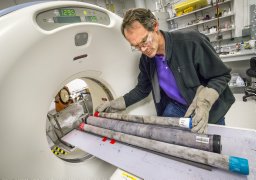
 Sharon E Borglin合作论文数Lawrence Berkeley Natl Lab, Univ Calif Berkeley5
 Timothy J. Kneafsey合作论文数Lawrence Berkeley National Laboratory5
 Liange Zheng合作论文数Earth Sciences Division, Lawrence Berkeley National Laboratory5
 Wu Yuxin合作论文数4
 Seiji Nakagawa合作论文数4
 Yang Ju (鞠杨)合作论文数School of Energy and Mining Engineering, China University of Mining and Technology-Beijing3Toshiyuki Bandai合作论文数2
 Benjamin Gilbert合作论文数Department of Earth and Planetary Science, University of California, Berkeley2
 Wenming Dong合作论文数2
 Patricia M. Fox合作论文数Department of Health Care Services2
 Luca Peruzzo合作论文数2Peter S. Nico合作论文数Chemistry Department;Cal State University;Chemistry Department, Cal State University2
 Jens Birkholzer合作论文数Energy Geosciences Division, Energy & Geosciences Department, Lawrence Berkeley National Laboratory2Autumn Taylor合作论文数1Paul J. Cook合作论文数1
 Edward N. Matteo合作论文数1Chunwei Chou合作论文数1Florie Caporuscio合作论文数1Piotr Zarzycki合作论文数1
 A. Zandanel合作论文数1
 Marlena Rock合作论文数Earth and Environmental Sciences, Los Alamos National Laboratory1
 Florian Soom合作论文数1
 Benoit Dessirier合作论文数1Lesa Brown合作论文数1
 Hao Xu合作论文数Princeton Univ, Dept Elect Engn, Princeton, NJ 08544 USA1
 Wenbo Gong合作论文数School of Mechanics and Civil Engineering, China University of Mining and Technology at Beijing, Beijing 100083, China1
 Alexandru Tatomir合作论文数Dept Earth Sci, Uppsala Univ1
 Chen Gruber合作论文数The Department of Civil and Environmental Engineering, Vanderbilt University1
 Farzad Basirat合作论文数Department of Earth Sciences, Uppsala University1
 Nithya Subramanian合作论文数Corresponding author.1
 Laura Nielsen Lammers合作论文数Department of Environmental Science, Policy and Management, College of Natural Resources, University of California, Berkeley1
 Feng Gao (高峰)合作论文数School of Mechanics & Civil Engineering, China University of Mining and Technology;State Key Laboratory of Intelligent Construction and Healthy Operation and Maintenance of Deep Underground Engineering, China University of Mining and Technology1Qingang Zhang合作论文数1
 Peng Liu (刘鹏)合作论文数School of Resources and Safety Engineering, Chongqing University1
 Tetsu Tokunaga合作论文数Earth Sciences Division, Lawrence Berkeley National Laboratory1
 Chin Fu Tsang合作论文数Lawrence Berkeley National Laboratory USA;Department of Earth Sciences, Uppsala Universitet1
 Patrick F Dobson合作论文数1
 Jiangtao Zheng (郑江韬)合作论文数State Key Laboratory of Coal Resources and Safe Mining, China University of Mining and Technology - Beijing;School of Mechanics and Civil Engineering, China University of Mining and Technology - Beijing1
 Heping Xie (谢和平)合作论文数Department of Science Aand Technology, Shenzhen University;Institute of Deep Earth Sciences & Green Energy, Shenzhen University;College of Civil and Transportation Engineering, Shenzhen University1
 Quanlin Zhou合作论文数Lawrence Berkeley National Laboratory, University of California1
 Mart Oostrom合作论文数Hydrology Group, Pacific Northwest National Laboratory1
 Henning Lorenz合作论文数1
 Christine Doughty合作论文数Energy Geosciences Division, Hydrogeology Department, E. O. Lawrence Berkeley National Laboratory1Auli Niemi合作论文数1
 Michael R. Whittaker合作论文数Australian Institute for Bioengineering and Nanotechnology;University of Queensland;Australian Institute for Bioengineering and Nanotechnology, University of Queensland1
 Lingzhi Xie (谢凌志)合作论文数Institute of New Energy and Low-Carbon Technology, Sichuan University;College of Carbon Neutrality Future Technology, Sichuan University1
 Carl I. Steefel (Carl Steefel)合作论文数Department of Geochemistry, Lawrence Berkeley National Laboratory;Energy Geosciences Division, Lawrence Berkeley National Laboratory1
 Bjarne S G Almqvist合作论文数Institute of Geophysics, ETH Zurich1
 Christophe Tournassat合作论文数BRGM1




