Industrial Systems-on-Chips (SoCs) often comprise hundreds of thousands to millions of nets and millions to tens of millions of connectivity edges, making empirical evaluation of hardware-Trojan (HT) detectors on realistic designs both necessary and difficult. Public benchmarks remain significantly smaller and hand-crafted, while releasing truly malicious RTL raises ethical and operational risks. This work presents an automated and scalable methodology for generating HT-like patterns in industry-scale netlists whose purpose is to stress-test detection tools without altering user-visible functionality. The pipeline (i) parses large gate-level designs into connectivity graphs, (ii) explores rare regions using SCOAP testability metrics, and (iii) applies parameterized, function-preserving graph transformations to synthesize trigger-payload pairs that mimic the statistical footprint of stealthy HTs. When evaluated on the benchmarks generated in this work, representative state-of-the-art graph-learning models fail to detect Trojans. The framework closes the evaluation gap between academic circuits and modern SoCs by providing reproducible challenge instances that advance security research without sharing step-by-step attack instructions.
Unit tests are critical in the hardware design lifecycle to ensure that component design modules are functionally correct and conform to the specification before they are integrated at the system level. Thus developing unit tests targeting various design features requires deep understanding of the design functionality and creativity. When one or more unit tests expose a design failure, the debugging engineer needs to diagnose, localize, and debug the failure to ensure design correctness, which is often a painstaking and intense process. In this work, we introduce LAUDE, a unified unit-test generation and debugging framework for hardware designs that cross-pollinates the semantic understanding of the design source code with the Chain-of-Thought (CoT) reasoning capabilities of foundational Large-Language Models (LLMs). LAUDE integrates prompt engineering and design execution information to enhance its unit test generation accuracy and code debuggability. We apply LAUDE with closed- and open-source LLMs to a large corpus of buggy hardware design codes derived from the VerilogEval dataset, where generated unit tests detected bugs in up to 100
Modern System-on-Chip (SoCs) often contain hundreds of millions to tens of billions of gates, making existing Hardware Trojan (HT) detection methods impractical due to their immense scale. The proposed approach incorporates symbolically enabled learning by modeling flattened gate-level netlists as Boolean networks represented as And-Inverter Graphs (AIGs), where all internal nodes are 2-input AND gates and inversions reside on the edges. Each directed connection is expressed as a triple within a Knowledge Graph Embedding (KGE) framework, producing compact, constant-size per-node representations that retain multi-hop structural context. The AIG's bounded fan-in and uniform semantics ensure training and inference complexity scale linearly with edge count, addressing major scalability bottlenecks in HT detection. Symbolically enabled learning across deep datapaths enables the model to differentiate circuit structures from rare and functionally inconsistent connections that signify potential Trojan triggers and payloads. Experiments on large-scale SoC benchmarks demonstrate clear geometric separation between Trojan and benign nodes and practical scalability.
Large-Language Models (LLMs) can be prone to flawed and unfaithful reasoning that decoding strategies like Self-Consistency (SC) fail to detect as they evaluate only final-answer agreement while ignoring the logical validity of intermediate steps. This raises three fundamental questions: How can we reliably quantify uncertainty in LLM reasoning? Can semantic, structural, and causal awareness select more faithful reasoning compared to naïve majority voting? and How robust is reasoning topology under adversarial conditions? To address these questions, we introduce GRAPHEVAL, a graph-based reasoning framework that re-frames uncertainty quantification (UQ) as a holistic reasoning fidelity problem. We propose a novel UQ metric, Graph Reasoning Coherence Score (GRCS), that quantifies semantic-structural consensus of the reasoning space and captures pathological mode collapse and confident hallucinations. We find that GRCS is the only metric that is consistently negatively correlated with reasoning faithfulness across both more capable and smaller models. Additionally, we introduce Graph Self-Consistency (GSC), a medoid-based decoding strategy that trades nominal accuracy for reasoning fidelity, exposing the degree to which SC is inflated by unfaithful lucky guesses in smaller models, while preserving or improving accuracy in more capable ones. Finally, through adversarial medoid ablation, we demonstrate that the GSC-selected path acts as a "load-bearing path" and forcing models away from it degrades reasoning faithfulness and, in targeted cases, causes drops in accuracy.
Power side-channel (PSC) attacks exploit power consumption patterns to extract sensitive information, posing risks to cryptographic operations crucial for secure systems. Traditional countermeasures, such as masking, face challenges like complex synthesis integration, high area overhead, and vulnerability to optimization removal during logic synthesis. To address these issues, we introduce proposed side-channel aware synthesis (PoSyn), a novel logic synthesis framework designed to enhance cryptographic hardware's resistance against PSC attacks. Our approach focuses on the optimal bipartite mapping of vulnerable register transfer level (RTL) components to standard cells from the technology library to minimize PSC leakage. By employing a cost function that integrates key characteristics from the RTL design and the standard cell library, we strategically modify the mapping criteria during the conversion of RTL designs into standard cell netlists without altering the design functionality. Furthermore, PoSyn is theoretically shown to minimize mutual information leakage, further reinforcing its security against PSC vulnerabilities. PoSyn is evaluated on a variety of cryptographic hardware, including AES, RSA, PRESENT, and postquantum cryptography algorithms like Saber and CRYSTALS-Kyber across 65-, 45-, and 15-nm nodes. Our experimental results demonstrate a significant reduction of success rates for differential power analysis (DPA) and correlation power analysis (CPA) attacks, as low as 3% and 6%, respectively. Furthermore, test vector leakage assessment (TVLA) confirms that the synthesized netlists exhibit negligible leakage. Moreover, compared to traditional countermeasures such as masking and shuffling, PoSyn achieves notably lowers the success rates, achieving a reduction by up to 72%, while simultaneously enhancing area efficiency by as much as 3.79 & times;. These results highlight the effectiveness of PoSyn in securing cryptographic hardware with minimal impact on area and performance.
Assertions have been the de facto collateral for simulation-based and formal verification of hardware designs for over a decade. The quality of hardware verification, i.e., detection and diagnosis of corner-case design bugs, is critically dependent on the quality of the assertions. With the onset of generative AI such as Transformers and Large-Language Models (LLMs), there has been a renewed interest in developing novel, effective, and scalable techniques of generating functional and security assertions from design source code. While there have been recent works that use commercial-of-the-shelf (COTS) LLMs for assertion generation, there is no comprehensive study in quantifying the effectiveness of LLMs in generating syntactically and semantically correct assertions. In this paper, we first discuss AssertionBench from our prior work, a comprehensive set of designs and assertions to quantify the goodness of a broad spectrum of COTS LLMs for the task of assertion generations from hardware design source code. Our key insight was that COTS LLMs are not yet ready for prime-time adoption for assertion generation as they generate a considerable fraction of syntactically and semantically incorrect assertions. Motivated by the insight, we propose AssertionLLM, a first of its kind LLM model, specifically fine-tuned for assertion generation. Our initial experimental results show that AssertionLLM considerably improves the semantic and syntactic correctness of the generated assertions over COTS LLMs.
Hardware Trojans (HTs) can be maliciously inserted in integrated circuits (ICs) during various phases of the circuit design process, posing significant security risks. Existing solutions are limited by their dependency on golden references, poor scalability, and suffer from high false positive and negative rates, making them less effective in detecting and mitigating HTs. In this article, a NetVGE framework is proposed for efficient HT detection at the register-transfer (RT) level. NetVGE generates weighted variable dependency graphs, which are embedded in a latent space in an unsupervised manner using the knowledge graph embedding (KGE) algorithm. The embedded HTs are accurately detected in the latent space with a HittER model. The effectiveness of NetVGE is demonstrated based on RT-level Trust-HUB benchmarks, yielding high recall (93%) and precision (98%). These results validate NetVGE's effectiveness for real-world hardware cybersecurity applications and demonstrate its scalability with increasing IC size compared to state-of-the-art HT detection methods.
Efficient workload scheduling is a critical challenge in modern heterogeneous computing environments, particularly in high-performance computing (HPC) systems. Traditional software-based schedulers struggle to efficiently balance workloads due to scheduling overhead, lack of adaptability to stochastic workloads, and suboptimal resource utilization. The scheduling problem further compounds in the context of shared HPC clusters, where job arrivals and processing times are inherently stochastic. Prediction of these elements is possible, but it introduces additional overhead. To perform this complex scheduling, we developed two FPGA-assisted hardware accelerator microarchitectures, Hercules and Stannic. Hercules adopts a task-centric abstraction of stochastic scheduling, whereas Stannic inherits a schedule-centric abstraction. These hardware-assisted solutions leverage parallelism, pre-calculation, and spatial memory access to significantly accelerate scheduling. We accelerate a non-preemptive stochastic online scheduling algorithm to produce heterogeneity-aware schedules in near real time. With Hercules, we achieved a speedup of up to 1060x over a baseline C/C++ implementation, demonstrating the efficacy of a hardware-assisted acceleration for heterogeneity-aware stochastic scheduling. With Stannic, we further improved efficiency, achieving a 7.5x reduction in latency per computation iteration and a 14x increase in the target heterogeneous system size. Experimental results show that the resulting schedules demonstrate efficient machine utilization and low average job latency in stochastic contexts.
An automated design methodology for RF circuits using a feedforward neural network is presented in this paper. Machine learning techniques for circuit design automation require a large amount of data for training. Generation of such large dataset from RF circuit simulation is very time consuming and computationally expensive. The proposed technique uses transfer learning in a two step approach which significantly reduces the amount of data needed from SPICE level circuit simulations. A large dataset, generated from the analytical models, is used in the initial training and a much smaller dataset, generated from the SPICE simulations, is used for transfer learning. The proposed technique is demonstrated through automated design of RF oscillators and very high accuracy is obtained in achieving the target specifications.
We present systematic and efficient solutions for both observability enhancement and root-cause diagnosis of post-silicon System-on-Chips (SoCs) validation with diverse usage scenarios. We model specification of interacting flows in typical applications for message selection. Our method for message selection optimizes flow specification coverage and trace buffer utilization. We define the diagnosis problem as identifying buggy traces as outliers and bug-free traces as inliers/normal behaviors, for which we use unsupervised learning algorithms for outlier detection. Instead of direct application of machine learning algorithms over trace data using the signals as raw features, we use feature engineering to transform raw features into more sophisticated features using domain specific operations. The engineered features are highly relevant to the diagnosis task and are generic to be applied across any hardware designs. We present debugging and root cause analysis of subtle post-silicon bugs in industry-scale OpenSPARC T2 SoC. We achieve a trace buffer utilization of 98.96\% with a flow specification coverage of 94.3\% (average). Our diagnosis method was able to diagnose up to 66.7\% more bugs and took up to 847$\times$ less diagnosis time as compared to the manual debugging with a diagnosis precision of 0.769.
The primary goal of approximate computing is enhancing system performance, such as energy efficiency, speed, and form factor. Despite the growing use of approximate multipliers, the design of efficient approximate compressors - a fundamental multiplier block - remains a significant challenge. In this brief, 8-transistor and 14-transistor 4:2 compressors are proposed. Both compressors exploit CMOS technology and a constant and conditional approximation of selected inputs, exhibiting fewer negative errors. As a result, a resource-expensive error recovery module is eliminated, yielding superior performance as compared with prior art. The 14-transistor architecture yields a lower error rate compared to the 8-transistor architecture, trading off lower area for higher accuracy. The compressor-tailored circuit architecture is also proposed and evaluated using image multiplication. The proposed multiplier exhibits 50% area savings and 93% lower power-delay-product compared to the exact multiplier, as well as higher accuracy, and 38% PDP enhancement compared with the state-of-the-art.
Due to the continuous technology scaling and the ever-increasing complexity and size of the hardware designs, manufacturing defects have become a key obstacle in meeting end-user demand. Despite decades of research, traditional test-generation techniques often struggle to scale to massive and complex designs. Such scalability issues stem from the numerous backtracking the traditional test generation techniques perform before converging to a test pattern. In this work, we present DETECTive that leverages deep learning on graphs to learn fault characteristics and predict test pattern(s) to expose faults without requiring backtracking. DETECTive is trained on small circuits, and its learned knowledge is transferable to predict test patterns for circuits that contain up to 29x more gates than the training circuits. Since DETECTive avoids backtracking completely, it can predict test patterns up to 15x faster than academic tools and up to 2x faster than commercial tools. DETECTive achieves up to 100% pattern accuracy on synthetic designs and up to 95% test pattern accuracy on realistic designs. To our knowledge, DETECTive is the first to leverage deep learning to predict test patterns for digital hardware designs that can complement the traditional test generation techniques for faster design closure.
In recent years, there has been an exponential growth in the size and complexity of System-on-Chip (SoC) designs targeting different specialized applications. The cost of an undetected bug in these systems is much higher than in traditional processors, as it may imply loss of property or life. Despite decades of research on simulation and formal methods for debugging and verification, the problem is exacerbated by the ever-shrinking time-to-market and ever-increasing demand to churn out billions of devices. In this work, we propose VeriBug, which leverages recent advances in deep learning (DL) to accelerate debugging at the Register-Transfer level (RTL) and generates explanations of likely root causes. Our experiments show that VeriBug can achieve an average bug localization coverage of 82.5% on open-source designs and a wide variety of injected bugs.
Power side-channel (PSC) attacks exploit the dynamic power consumption of cryptographic operations to leak sensitive information about encryption hardware. Therefore, it is necessary to conduct a PSC analysis to assess the susceptibility of cryptographic systems and mitigate potential risks. Existing PSC analysis primarily focuses on postsilicon implementations, which are inflexible in addressing design flaws, leading to costly and time-consuming postfabrication design re-spins. Hence, presilicon PSC analysis is required for the early detection of vulnerabilities to improve design robustness. In this article, we introduce SCAR, a novel presilicon PSC analysis framework based on graph neural networks (GNNs). SCAR converts register-transfer level (RTL) designs of encryption hardware into control-data flow graphs (CDFGs) and use that to detect the design modules susceptible to side-channel leakage. Furthermore, we incorporate a deep-learning-based explainer in SCAR to generate quantifiable and human-accessible explanations of our detection and localization decisions. We have also developed a fortification component as a part of SCAR that uses large-language models (LLMs) to automatically generate and insert additional design code at the localized zone to shore up the side-channel leakage. When evaluated on popular encryption algorithms like advanced encryption standard (AES), RSA, and PRESENT, and postquantum cryptography (PQC) algorithms like Saber and CRYSTALS-Kyber, SCAR, achieves up to 94.49% localization accuracy, 100% precision, and 90.48% recall. Additionally, through explainability analysis, SCAR reduces features for GNN model training by 57% while maintaining comparable accuracy. We believe that SCAR will transform the security-critical hardware design cycle, resulting in faster design closure at a reduced design cost.
In today's fast-evolving computing environment, hardware designs like System-on-Chips (SoCs) are ubiquitous due to their small form factor and ability to perform complex operations. These designs often compute using users' private information, necessitating rigorous security checks to prevent vulnerabilities that could expose sensitive data. In this work, we propose a novel approach for assertion generation tailored for checking information leakage in hardware designs. Leveraging static analysis and data mining techniques, we introduce SecMiner, a framework that automatically generates assertions capable of detecting potential information leakages in a hardware design. We develop a novel security label tracking algorithm to help track secure information flows within the design structure whose violation would indicate information leakage. Not all assertions may bear equal security implications; some might be critical in identifying critical vulnerabilities, while others could be simpler in capturing minor concerns. Hence, we introduce a security assertion ranking mechanism that mimics a domain expert to evaluate each assertion based on its relevance to the security of the design and ease of understanding. Our approach uniquely emphasizes identifying information flow within hardware designs, with a detailed and comprehensive ranking mechanism that enhances the depth and breadth of security analysis compared to previous methods. We evaluated our SecMiner framework on open-source hardware benchmarks such as cryptographic and security modules. The experimental results elucidate that our approach is fast, scalable, and computationally efficient with a reasonable memory footprint and can streamline the security validation process by prioritizing high-value assertions.
High-level synthesis (HLS) can greatly facilitate the description of complex hardware implementations, by raising the level of abstraction up to a classical imperative language such as C/C++, usually augmented with vendor-specific pragmas and APIs. Despite productivity improvements, attaining high performance for the final design remains a challenge, and higher-level tools like source-to-source compilers have been developed to generate programs targeting HLS toolchains. These tools may generate highly complex HLS-ready C/C++ code, reducing the programming effort and enabling critical optimizations. However, whether these HLS-friendly programs are produced by a human or a tool, validating their correctness or exposing bugs otherwise remains a fundamental challenge. In this work we target the problem of efficiently checking the semantics equivalence between two programs written in C/C++ as a means to ensuring the correctness of the description provided to the HLS toolchain, by proving an optimized code version fully preserves the semantics of the unoptimized one. We introduce a novel formal verification approach that combines concrete and abstract interpretation with a hybrid symbolic analysis. Notably, our approach is mostly agnostic to how control-flow, data storage, and dataflow are implemented in the two programs. It can prove equivalence under complex bufferization and loop/syntax transformations, for a rich class of programs with statically interpretable control-flow. We present our techniques and their complete end-to-end implementation, demonstrating how our system can verify the correctness of highly complex programs generated by source-to-source compilers for HLS, and detect bugs that may elude co-simulation.
The past decade has witnessed increasing adoption of high-level synthesis (HLS) to implement specialized hardware accelerators targeting either FPGAs or ASICs. However, current HLS programming models entangle algorithm specifications with hardware customization techniques, which lowers both the productivity and portability of the accelerator design. To tackle this problem, recent efforts such as HeteroCL propose to decouple algorithm definition from essential hardware customization techniques in compute, data type, and memory, increasing productivity, portability, and performance. While the decoupling of the algorithm and customizations provides benefits to the compilation/synthesis process, they also create new hurdles for the programmers to productively debug and validate the correctness of the optimized design. In this work, using HeteroCL and realistic machine learning applications as case studies, we first explain the key advantages of the decoupled programming model brought to a programmer to rapidly develop highperformance accelerators. Using the same case studies, we will further show how seemingly benign usage of the customization primitives can lead to new challenges to verification. We will then outline the research opportunities and discuss some of our recent efforts as the first step to enable a robust and viable verification solution in the future.
To achieve high performance with FPGA-equipped heterogeneous compute systems, it is crucial to co-optimize data placement and compute scheduling to maximize data reuse and bandwidth utilization for both on- and off-chip memory accesses. However, optimizing the data placement for FPGA accelerators is a complex task. One must acquire in-depth knowledge of the target FPGA device and its associated memory system in order to apply a set of advanced optimizations. Even with the latest high-level synthesis (HLS) tools, programmers often have to insert many low-level vendor-specific pragmas and substantially restructure the algorithmic code so that the right data are accessed at the right loop level using the right communication schemes. These code changes can significantly compromise the composability and portability of the original program. To address these challenges, we propose HeteroFlow, an FPGA accelerator programming model that decouples the algorithm specification from optimizations related to orchestrating the placement of data across a customized memory hierarchy. Specifically, we introduce a new primitive named .to(), which provides a unified programming interface for specifying data placement optimizations at different levels of granularity: (1) coarse-grained data placement between host and accelerator, (2) medium-grained kernel-level data placement within an accelerator, and (3) fine-grained data placement within a kernel. We build HeteroFlow on top of the open-source HeteroCL DSL and compilation framework. Experimental results on a set of realistic benchmarks show that, programs written in HeteroFlow can match the performance of extensively optimized manual HLS design with much fewer lines of code.
 Shobha Vasudevan合作论文数University of Illinois at Urbana-Champaign8
 Zhiru Zhang合作论文数Computer Systems Laboratory, School of Electrical and Computer Engineering, College of Engineering, Cornell University8
 Niansong Zhang合作论文数5
 Inna Partin-Vaisband合作论文数Department of Electrical and Computer Engineering, College of Engineering, University of Illinois Chicago4
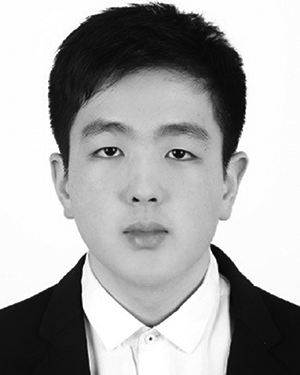 Shaojie Xiang合作论文数Cornell University3
 Chenhui Deng合作论文数Cornell University3
 Louis-Noël Pouchet合作论文数Department of Computer Science, College of Natural Sciences, Colorado State University;Department of Electrical and Computer Engineering, Walter Scott, Jr. College of Engineering, Colorado State University3
 Spencer Offenberger合作论文数2Pasquale Cocchini合作论文数2
 Zhenkun Yang合作论文数2Ecenur Ustun合作论文数Electrical and Electronics Engineering, Bogazici University2
 Kanad Basu合作论文数Department of Electrical & Computer Engineering, University of Texas at Dallas2
 Soham Dan (苏哈姆丹)合作论文数Department of Computer and Information Science, University of Pennsylvania2
 Sourav Medya合作论文数Kellogg School of Management, Northwestern University2
 Sai Ma合作论文数2Yuan Zhou合作论文数2
 Yi-Hsiang Lai合作论文数Graduate Institute of Electronics Engineering, National Taiwan University2
 Jeremy Casas合作论文数* Resource Centers2
 Siddhartha Mukhopadhyay合作论文数Department of Computer Science and Engineering, IIT Kharagpur2
 Pallab Dasgupta合作论文数Dept. of Computer Science & Engineering,;Indian Institute of Technology Kharagpur2Emily Tucker合作论文数1Amisha Srivastava合作论文数1Sanjay Das合作论文数1
 Cunxi Yu合作论文数Department of Electrical and Computer Engineering, A. James Clark School of Engineering, University of Maryland, College Park1Pedro Henrique Silva合作论文数1
 Gabriel Rodríguez合作论文数1
 Aritra Banerjee合作论文数1Avinash Ayalasomayajula合作论文数1
 Abhishek Kumar Sharma合作论文数1John Gough合作论文数1Navnil Choudhury合作论文数1
 Ayoub Sadeghi合作论文数Islamic Azad University1Nusrat Farzana合作论文数1
 Rafail Psiakis合作论文数Univ Rennes 1, IRISA, INRIA, Rennes, France1Rui Jiang合作论文数1
 Hongzheng Chen (陈红征)合作论文数Department of Polymer Science and Engineering, Zhejiang University1
 Farimah Farahmandi合作论文数University of Florida1Ewalt, N.合作论文数1Sagdeo, P.合作论文数1
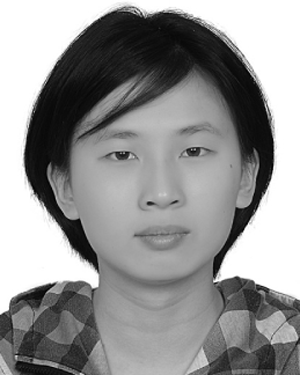 Zhijing Li合作论文数1
 Sandip Ray合作论文数Department of Computer Sciences, University of Texas1Jin Yang合作论文数Institute of High Energy Physics, Chinese Academy of Sciences1Rajdeep Mukhopadhyay合作论文数1
 Mariagrazia Graziano合作论文数Politecnico di Torino1
 Stefano Quer合作论文数Dip. di Automatica e Informatica1




