The recently established 'Out of Sight, Not out of Mind' (OSNOM) task for egocentric videos focuses on tracking objects that are moved by the camera wearer, online, maintaining knowledge of instance locations throughout the video even when they leave the field of view or become heavily occluded. In this paper, we propose the first learning-based solution to the OSNOM task: Whareformer, a transformer-based model with two components: an updatable memory of established tracks and a track assignment module that associates observations with existing tracks in a feed-forward manner. Whareformer jointly reasons over evolving object appearance (what) and updated 3D location (where), and employs a dedicated New Track token to reason about novel objects. Thanks to its design choices of using relative distances and evolving track representations, Whareformer is trained on a small set of 56 videos but achieves SOTA performance on 260 long test videos from three datasets: EPIC-KITCHENS-100 (unseen videos), IT3DEgo, and HD-EPIC, with significant absolute improvements over prior work.
We introduce the "single-life" learning paradigm, where we train a distinct vision model exclusively on egocentric videos captured by one individual. We leverage the multiple viewpoints naturally captured within a single life to learn a visual encoder in a self-supervised manner. Our experiments demonstrate three key findings. First, models trained independently on different lives develop a highly aligned geometric understanding. We demonstrate this by training visual encoders on distinct datasets each capturing a different life, both indoors and outdoors, as well as introducing a novel cross-attention-based metric to quantify the functional alignment of the internal representations developed by different models. Second, we show that single-life models learn generalizable geometric representations that effectively transfer to downstream tasks, such as depth estimation, in unseen environments. Third, we demonstrate that training on up to 30 hours from one week of the same person's life leads to comparable performance to training on 30 hours of diverse web data, highlighting the strength of single-life representation learning. Overall, our results establish that the shared structure of the world, both leads to consistency in models trained on individual lives, and provides a powerful signal for visual representation learning.
In this work, we investigate the degradation of existing VMR methods, particularly of DETR architectures, when trained on caption-based queries but evaluated on search queries. For this, we introduce three benchmarks by modifying the textual queries in three public VMR datasets – i.e., HD-EPIC, YouCook2 and ActivityNet-Captions. Our analysis reveals two key generalization challenges: (i) A language gap, arising from the linguistic under-specification of search queries, and (ii) a multi-moment gap, caused by the shift from single-moment to multi-moment queries. We also identify a critical issue in these architectures – an active decoder-query collapse – as a primary cause of the poor generalization to multi-moment instances. We mitigate this issue with architectural modifications that effectively increase the number of active decoder queries. Extensive experiments demonstrate that our approach improves performance on search queries by up to 14.82
Hand-object interaction (HOI) recognition requires capturing both hand manipulations and object transformations. However, existing video-language models often fall into shortcuts by relying on spurious correlations among hands, objects, or environmental context, rather than reasoning from the appearance and dynamics of hands and objects themselves. To address this limitation, we propose a new learning paradigm that combines (i) hand-object masked training, which enables robust reasoning from partial hand or object observations, and (ii) an HOI-dynamics-aware decoder that explicitly learns hand- and object-centric embeddings through auxiliary predictions of their locations and semantics, enhancing sensitivity to both cues. To systematically evaluate such cue-specific reasoning, we introduce Cue-Isolated HOI (CI-HOI), a new evaluation that assesses models' ability to predict actions from hand- and object-related cues independently. To enable CI-HOI, we curate the DEHOI testbed, which separates hand- and object-related observations for disentangled HOI evaluation through inpainting. Using DEHOI, we demonstrate both quantitatively and qualitatively that our training strategy exploits hand- and object-centric information more effectively than existing models. Our approach improves over existing models on DEHOI, standard action recognition, object state recognition, and even robot manipulation action recognition, leading to more robust HOI understanding.
Can one perceive a video's content without seeing its pixels, just from the camera trajectory-the path it carves through space? This paper is the first to systematically investigate this seemingly implausible question. Towards this end, we propose a contrastive learning framework to train CamFormer, a dedicated encoder that projects camera pose trajectories into a joint embedding space, aligning them with natural language. We find that, contrary to its apparent simplicity, the camera trajectory is a remarkably informative signal to uncover video content. In other words, "how you move" can indeed reveal "what you are doing" (egocentric) or "observing" (exocentric). We demonstrate the versatility of our learned CamFormer embeddings on a diverse suite of downstream tasks, ranging from cross-modal alignment to classification and temporal analysis. Importantly, our representations are robust across diverse camera pose estimation methods, including both high-fidelity multi-sensored and standard RGB-only estimators. Our findings establish camera trajectory as a lightweight, robust, and versatile modality for perceiving video content.
Recent advances in foundational 3D reconstruction models, such as DUSt3R and MASt3R, have shown great potential in 2D and 3D correspondence in static scenes. In this paper, we propose to adapt them for the task of point tracking through 3D grounded correspondence. We first demonstrate that these models are competitive point trackers when focusing on static points, present in current point tracking benchmarks (+33.5% on EgoPoints vs. CoTracker2). We propose to combine the reconstruction loss with training for dynamic correspondence along with a visibility head, and fine-tuning MASt3R for point tracking using a relatively small amount of synthetic data. Importantly, we only train and evaluate on pairs of frames where one contains the query point, effectively removing any temporal context. Using a mix of dynamic and static point correspondences, we achieve competitive or superior point tracking results on four datasets (e.g. competitive on TAP-Vid-DAVIS 73.8 δ_avg / 85.8% occlusion acc. for PointSt3R compared to 75.7 / 88.3% for CoTracker2; and significantly outperform CoTracker3 on EgoPoints 61.3 vs 54.2 and RGB-S 87.0 vs 82.8). We also present results on 3D point tracking along with several ablations on training datasets and percentage of dynamic correspondences.
Estimating accurate 3D hand-object pose from in-the-wild egocentric RGB remains challenging due to severe occlusions and ambiguous contact. Existing learning-based methods often struggle to generalise to in-the-wild scenes and are limited by the scarcity of supervision. We address these issues with two contributions. First, we introduce EPIC-Contact, an in-the-wild egocentric dataset of 2.3K clips (62.3K frames) with dense, bijective 3D hand-object contact correspondences and posed meshes. Second, we propose HOPformer, an end-to-end transformer that jointly predicts bi-manual hand and object pose in a single forward pass. A cross-attention decoder conditions object features on hand priors, producing robust pose estimation. We test HOPformer on the in-lab 3D dataset, ARCTIC, as well as our newly introduced EPIC-Contact dataset. HOPformer reaches 82.4
We address the problem of training on long-tailed data for video action recognition. We propose to augment the training set using a text-to-video generative model, conditioned on diverse text prompts grounded in action profiles and training exemplars. Our approach, called Gen2Balance, converts an imbalanced training set into a balanced combination of real and generated video clips. To effectively learn from such data, we employ a two-stage training strategy that mitigates domain shift and yields significant improvements. We evaluate on long-tailed versions of standard benchmarks: UCF-101 (UCF-LT) and a 100-class subset of Kinetics (K100-LT) selected to prioritise temporally challenging actions. Gen2Balance improves accuracy over the strongest baselines for long-tailed learning by 5.1
Understanding hands and the objects they interact with, both directly and through tools, is a key step for tasks ranging from action perception to 3D reconstruction and robotics. Our paper provides several contributions to the Hand-Object Interaction (HOI) understanding literature: (1) HOI-DETR, a new framework that introduces hand-object and object-object interactions to the Co-DETR architecture to produce a state-of-the-art method; (2) a comprehensive HOI evaluation suite of 4 diverse datasets, including a video benchmark derived from the HD-EPIC dataset and fresh annotations that improve the Hands23 benchmark and (3) a trained checkpoint that significantly improves the state of the art across Hands23, HOIST, FineBio, and HD-EPIC, including mAP gains of over 20 percentage points on Hands23 and FineBio. Our ablations confirm the contributions of each model component.
The Third Perception Test challenge was organised as a full-day workshop alongside the IEEE/CVF International Conference on Computer Vision (ICCV) 2025. Its primary goal is to benchmark state-of-the-art video models and measure the progress in multimodal perception. This year, the workshop featured 2 guest tracks as well: KiVA (an image understanding challenge) and Physic-IQ (a video generation challenge). In this report, we summarise the results from the main Perception Test challenge, detailing both the existing tasks as well as novel additions to the benchmark. In this iteration, we placed an emphasis on task unification, as this poses a more challenging test for current SOTA multimodal models. The challenge included five consolidated tracks: unified video QA, unified object and point tracking, unified action and sound localisation, grounded video QA, and hour-long video QA, alongside an analysis and interpretability track that is still open for submissions. Notably, the unified video QA track introduced a novel subset that reformulates traditional perception tasks (such as point tracking and temporal action localisation) as multiple-choice video QA questions that video-language models can natively tackle. The unified object and point tracking merged the original object tracking and point tracking tasks, whereas the unified action and sound localisation merged the original temporal action localisation and temporal sound localisation tracks. Accordingly, we required competitors to use unified approaches rather than engineered pipelines with task-specific models. By proposing such a unified challenge, Perception Test 2025 highlights the significant difficulties existing models face when tackling diverse perception tasks through unified interfaces.
Text-to-Video (T2V) retrieval aims to identify the most relevant item from a gallery of videos based on a user's text query. Traditional methods rely solely on aligning video and text modalities to compute the similarity and retrieve relevant items. However, recent advancements emphasise incorporating auxiliary information extracted from video and text modalities to improve retrieval performance and bridge the semantic gap between these modalities. Auxiliary information can include visual attributes, such as objects; temporal and spatial context; and textual descriptions, such as speech and rephrased captions. This survey comprehensively reviews 81 research papers on Text-to-Video retrieval that utilise such auxiliary information. It provides a detailed analysis of their methodologies; highlights state-of-the-art results on benchmark datasets; and discusses available datasets and their auxiliary information. Additionally, it proposes promising directions for future research, focusing on different ways to further enhance retrieval performance using this information.
Humans excel at multisensory perception and can often recognise object properties from the sound of their interactions. Inspired by this, we propose the novel task of Collision Sound Source Segmentation (CS3), where we aim to segment the objects responsible for a collision sound in visual input (i.e. video frames from the collision clip), conditioned on the audio. This task presents unique challenges. Unlike isolated sound events, a collision sound arises from interactions between two objects, and the acoustic signature of the collision depends on both. We focus on egocentric video, where sounds are often clear, but the visual scene is cluttered, objects are small, and interactions are brief. To address these challenges, we propose a weakly-supervised method for audio-conditioned segmentation, utilising foundation models (CLIP and SAM2). We also incorporate egocentric cues, i.e. objects in hands, to find acting objects that can potentially be collision sound sources. Our approach outperforms competitive baselines by 3× and 4.7× in mIoU on two benchmarks we introduce for the CS3 task: EPIC-CS3 and Ego4D-CS3.
Video Moment Retrieval is a common task to evaluate the performance of visual-language models-it involves localising start and end times of moments in videos from query sentences. The current task formulation assumes that the queried moment is present in the video, resulting in false positive moment predictions when irrelevant query sentences are provided. In this paper we propose the task of Negative-Aware Video Moment Retrieval (NA-VMR), which considers both moment retrieval accuracy and negative query rejection accuracy. We make the distinction between In-Domain and Out-of-Domain negative queries and provide new evaluation benchmarks for two popular video moment retrieval datasets: QVHighlights and Charades-STA. We analyse the ability of current SOTA video moment retrieval approaches to adapt to Negative-Aware Video Moment Retrieval and propose UniVTG-NA, an adaptation of UniVTG designed to tackle NA-VMR. UniVTG-NA achieves high negative rejection accuracy (avg. 98.4%) scores while retaining moment retrieval scores to within 3.87% Recall@1. Dataset splits are available at https://github.com/keflanagan/MomentofUntruth.
We introduce the task of Reconstructing Objects along Hand Interaction Timelines (ROHIT). We first define the Hand Interaction Timeline (HIT) from a rigid object's perspective. In a HIT, an object is first static relative to the scene, then is held in hand following contact, where its pose changes. This is usually followed by a firm grip during use, before it is released to be static again w.r.t. to the scene. We model these pose constraints over the HIT, and propose to propagate the object's pose along the HIT enabling superior reconstruction using our proposed Constrained Optimisation and Propagation (COP) framework. Importantly, we focus on timelines with stable grasps - i.e. where the hand is stably holding an object, effectively maintaining constant contact during use. This allows us to efficiently annotate, study, and evaluate object reconstruction in videos without 3D ground truth. We evaluate our proposed task, ROHIT, over two egocentric datasets, HOT3D and in-the-wild EPIC-Kitchens. In HOT3D, we curate 1.2K clips of stable grasps. In EPIC-Kitchens, we annotate 2.4K clips of stable grasps including 390 object instances across 9 categories from videos of daily interactions in 141 environments. Without 3D ground truth, we utilise 2D projection error to assess the reconstruction. Quantitatively, COP improves stable grasp reconstruction by 6.2-11.3
We introduce EPIC-SOUNDS, a large-scale dataset of audio annotations capturing temporal extents and class labels within the audio stream of the egocentric videos. We propose an annotation pipeline where annotators temporally label distinguishable audio segments and describe the action that could have caused this sound. We identify actions that can be discriminated purely from audio, through grouping these free-form descriptions of audio into classes. For actions that involve objects colliding, we collect human annotations of the materials of these objects (e.g. a glass object being placed on a wooden surface), which we verify from video, discarding ambiguities. Overall, EPIC-SOUNDS includes 78.4k categorised segments of audible events and actions, distributed across 44 classes as well as 39.2k non-categorised segments. We train and evaluate state-of-the-art audio recognition and detection models on our dataset, for both audio-only and audio-visual methods. We also conduct analysis on: the temporal overlap between audio events, the temporal and label correlations between audio and visual modalities, the ambiguities in annotating materials from audio-only input, the importance of audio-only labels and the limitations of current models to understand actions that sound.
We introduce Ego4D, a massive-scale egocentric video dataset and benchmark suite. It offers 3,670 hours of daily-life activity video spanning hundreds of scenarios (household, outdoor, workplace, leisure, etc.) captured by 931 unique camera wearers from 74 worldwide locations and 9 different countries. The approach to collection is designed to uphold rigorous privacy and ethics standards with consenting participants and robust de-identification procedures where relevant. Ego4D dramatically expands the volume of diverse egocentric video footage publicly available to the research community. Portions of the video are accompanied by audio, 3D meshes of the environment, eye gaze, stereo, and/or synchronized videos from multiple egocentric cameras at the same event. Furthermore, we present a host of new benchmark challenges centered around understanding the first-person visual experience in the past (querying an episodic memory), present (analyzing hand-object manipulation, audio-visual conversation, and social interactions), and future (forecasting activities). By publicly sharing this massive annotated dataset and benchmark suite, we aim to push the frontier of first-person perception. Project page: https://ego4d-data.org/
Human motion generation is a challenging task that aims to create realistic motion imitating natural human behaviour. We focus on the well-studied behaviour of priming an object/location for pick up or put down – that is, the spotting of an object/location from a distance, known as gaze priming, followed by the motion of approaching and reaching the target location. To that end, we curate, for the first time, 23.7K gaze-primed human motion sequences for reaching target object locations from five publicly available datasets, i.e., HD-EPIC, MoGaze, HOT3D, ADT, and GIMO. We pre-train a text-conditioned diffusion-based motion generation model, then fine-tune it conditioned on goal pose or location, on our curated sequences. Importantly, we evaluate the ability of the generated motion to imitate natural human movement through several metrics, including the 'Reach Success' and a newly introduced 'Prime Success' metric. On the largest dataset, HD-EPIC, our model achieves 60
 Majid Mirmehdi合作论文数School of Computer Science, University of Bristol48
 Walterio W. Mayol-Cuevas合作论文数School of Computer Science, Faculty of Engineering, The University of Bristol;Amazon37
 Michael Wray合作论文数School of Computer Science, Faculty of Science and Engineering, University of Bristol34
 Tilo Burghardt合作论文数School of Computer Science, Faculty of Science and Engineering, University of Bristol28
 Toby Perrett合作论文数Autodesk23
 Massimo Camplani合作论文数Dept Elect Elect Engn I, Univ Cagliari22
 Sion Hannuna合作论文数School of Computer Science, University of Bristol;Visual Information Laboratory, University of Bristol;Bristol Vision Institute, University of Bristol21
 Hazel Doughty合作论文数Leiden University19
 Andrew Zisserman合作论文数Department of Engineering Science, University of Oxford16
 Lili Tao合作论文数University of the West of England13
 Adeline Paiement合作论文数sphere13
 Davide Moltisanti合作论文数Department of Computer Science, Faculty of Science, University of Bath13
 Evangelos (Vangelis) Kazakos合作论文数Czech Institute of Informatics, Robotics and Cybernetics, Czech Technical University in Prague12
 Ian Craddock合作论文数School of Engineering Mathematics and Technology, Faculty of Science and Engineering, University of Bristol;School of Civil, Aerospace and Design Engineering, Faculty of Science and Engineering, University of Bristol12
 Alessandro Masullo合作论文数Department of Computer Science, Univerity of Bristol11
 David Hogg合作论文数School of Computer Science, Faculty of Engineering and Physical Sciences, University of Leeds10
 Will Price合作论文数Oracle9
 Andrew Calway合作论文数Department of Computer Science;University of Bristol9Zhifan Zhu合作论文数Nanjing University of Science and Technology, Nanjing, China8
 Antonino Furnari合作论文数Department of Mathematics and Computer Science, University of Catania8
 Soleimani Vahid合作论文数8
 Giovanni Maria Farinella合作论文数Department of Mathematics and Computer Science, University of Catania8
 Viorica Patraucean合作论文数Google DeepMind8
 João Carreira合作论文数Google DeepMind8
 Siddhant Bansal合作论文数School of Computer Science, Faculty of Science and Engineering, University of Bristol7
 Teesid Leelasawassuk合作论文数National Electronics and Computer Center7
 Jonathan Munro合作论文数Tractable7
 Joseph Heyward合作论文数6
 Longfei Chen (陈龙飞)合作论文数Academic Center for Computing and Media Studies, Kyoto University6
 Dodd James W合作论文数St George's Hospital NHS Trust6
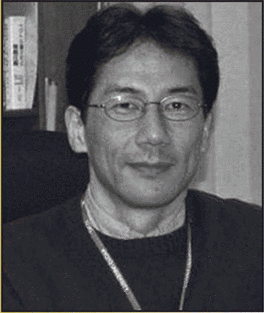 Yuichi Nakamura合作论文数6
 Kazuaki Kondo合作论文数6Jacob Chalk合作论文数5
 Adriano Fragomeni合作论文数5Farnoosh Heidarivincheh合作论文数University of Bristol5
 Yoichi Sato (佐藤洋一)合作论文数Institute of Industrial Science, The University of Tokyo5
 Sanja Fidler合作论文数University of Toronto5Kevin Flanagan合作论文数4S Hannuna合作论文数4Ahmad Darkhalil合作论文数4Charles Sharp合作论文数4
 Mike Z. Shou合作论文数Show Lab, Department of Electrical & Computer Engineering, National University of Singapore4
 Alex Stergiou合作论文数Department of Computer Science, Faculty of Electrical Engineering, Mathematics and Computer Science, University of Twente4jake hall合作论文数4
 Jaesung Huh合作论文数University of Oxford4
 Víctor Ponce López合作论文数Deptartment of Computer Science, Faculty of Engineering Sciences, University College London;UCL Energy Institute, University College London4
 Bin Zhu (朱斌)合作论文数School of Computing and Information Systems, Singapore Management University4
 Kristen Grauman合作论文数Department of Computer Science, University of Texas at Austin;Facebook AI Research4
 Tengda Han (韩腾达)合作论文数Google DeepMind4




