The air quality of South Korea was the focus of the NASA/NIER KORean -United States Air Quality (KORUS-AQ) mission of 2016. KORUS-AQ was planned for the period after the spring peak in outbreaks of Asian dust. Regardless of this strategic planning, quantifiable dust was still observed via instrumentation on the NASA DC8 in early May. A novel analysis of supermicron dust and associated supermicron ionic relationships was completed using two size dependent instruments. This supermicron dust provided surface area for heterogeneous chemistry between CaCO3, the gases HNO3, NO2, and SO2, and particulate (NH4)(2)SO4. Uptake of the pollutant gases is greatly enhanced by formation of an aqueous layer on the surface of the dust particles. More water is attracted to particles where uptake of HNO3 has replaced surface CaCO3 with Ca(NO3)(2) generating a dynamic aqueous layer on the dust particle. We propose that particulate (NH4)(2)SO4 coagulated with dust to form (NH4)(2)Ca(SO4)(2) on the particle surface, which rapidly formed CaSO4 and NH4+ in a Ca(NO3)(2) facilitated aqueous layer. A conceptual model is proposed to explain these dust uptake chemical processes. We define the nanoequivalent concentration of supermicron SO42- plus NO3 over the nanoequivalent concentration of supermicron NH4+ plus Ca2+ as the Dust Pollution Index (DPI), used to quantify the extent to which carbonate dust has been modified. DPI values range from 0 (pure dust) to 1 (completely reacted); thus, it represents the conversion of CaCO3 into secondary salts. This mechanism should be used to better predict chemical dynamics in atmospheric models while also helping to further explain the importance of dust and secondary coating on cloud formation processes and dust optical properties. Air masses containing dust that traversed industrial China while mixing with polluted southern air had significantly higher DPI values (average = 0.82, 1s = 0.10) compared to air masses that limited interaction with such pollution (average = 0.51, 1s = 0.13).
Biomass burning emissions are an important source of atmospheric nitrogen oxides (NOx = NO + NO2) and nitrous acid (HONO), which play important roles in atmosphere oxidation capacity and have severe impacts on air quality and climate. However, tracking NOx and HONO and their chemistry in the atmosphere based on concentration alone is challenging. Isotopic analysis provides a potential tracking tool. In this study, we measured the nitrogen isotopic composition (δN) of NOx and HONO during the Fire Influence on Regional and Global Environments Experiment (FIREX) laboratory experiments at the Missoula Fire Laboratory.
Recent work has identified nitric acid (HNO3) as a potential precursor of nitrous acid (HONO), which is an important source of oxidants that regulate ozone and particulate pollution. Recent work in our laboratory has indicated that the reduction of HNO3 to HONO can occur homogeneously in the presence of surrogates for volatile organic compounds (VOCs) emitted by motor vehicles. This study focuses on the impact of environmental variables on the rate of formation of HONO in this process. The observed base case (25.0 degrees C and similar to 20.0% relative humidity (RH)) HONO formation rate was 0.54 +/- 0.09 ppb h(-1), values comparable to enhancements observed in HONO during morning rush hour in Houston, TX. The rate was enhanced at lower temperatures of similar to 20.0 degrees C, but the rate remained statistically similar (1 sigma) for experiments conducted at temperatures of 25 degrees C, 30 degrees C, and 35 degrees C. The assumption that multiple reactive components of the VOC mixture react with HNO3 is supported by this observation, and the relative importance of each reactive species in the reaction may vary with temperature. The enhanced rate at lower temperatures could make the proposed reaction mechanism more important at night. The formation rate of HONO does not change substantially when initial HNO3 concentration is varied between 400 and 4600 ppt, suggesting that the concentration of reactive VOCs was the limiting factor. The reduction of HNO3 to HONO appears not to occur heterogeneously on the aerosol surfaces tested. The presence of similar to 120 ppb of ammonia has no observable impact on the reaction. However, it is likely that UV irradiation (lambda = 350 nm) decreases the formation rate of HONO either by consuming the reactive VOCs involved or by directly interfering with the reaction. The "renoxification" of less reactive HNO3 to more reactive HONO has significant implications for daytime ozone and particulate pollution. Copyright (C) 2015 Turkish National Committee for Air Pollution Research and Control. Production and hosting by Elsevier B.V. All rights reserved.
Chemical components of organic aerosol (OA) selectively absorb light at short wavelengths. In this study, the prevalence, sources, and optical importance of this so-called brown carbon (BrC) aerosol component are investigated throughout the North American continental tropospheric column during a summer of extensive biomass burning. Spectrophotometric absorption measurements on extracts of bulk aerosol samples collected from an aircraft over the central USA were analyzed to directly quantify BrC abundance. BrC was found to be prevalent throughout the 1 to 12 km altitude measurement range, with dramatic enhancements in biomass-burning plumes. BrC to black carbon (BC) ratios, under background tropospheric conditions, increased with altitude, consistent with a corresponding increase in the absorption Ångström exponent (AAE) determined from a three-wavelength particle soot absorption photometer (PSAP). The sum of inferred BC absorption and measured BrC absorption at 365 nm was within 3 % of the measured PSAP absorption for background conditions and 22 % for biomass burning. A radiative transfer model showed that BrC absorption reduced top-of-atmosphere (TOA) aerosol forcing by ~ 20 % in the background troposphere. Extensive radiative model simulations applying this study background tropospheric conditions provided a look-up chart for determining radiative forcing efficiencies of BrC as a function of a surface-measured BrC : BC ratio and single scattering albedo (SSA). The chart is a first attempt to provide a tool for better assessment of brown carbon's forcing effect when one is limited to only surface data. These results indicate that BrC is an important contributor to direct aerosol radiative forcing.
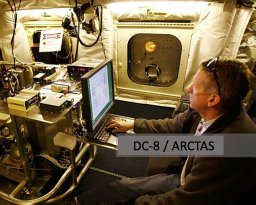
A focus of the Arctic Research of the Composition of the Troposphere from Aircraft and Satellites (ARCTAS) mission was examination of bromine photochemistry in the spring time high latitude troposphere based on aircraft and satellite measurements of bromine oxide (BrO) and related species. The NASA DC-8 aircraft utilized a chemical ionization mass spectrometer (CIMS) to measure BrO and a mist chamber (MC) to measure soluble bromide. We have determined that the MC detection efficiency to molecular bromine (Br2), hypobromous acid (HOBr), bromine oxide (BrO), and hydrogen bromide (HBr) as soluble bromide (Br−) was 0.9±0.1, 1.06+0.30/−0.35, 0.4±0.1, and 0.95±0.1, respectively. These efficiency factors were used to estimate soluble bromide levels along the DC-8 flight track of 17 April 2008 from photochemical calculations constrained to in situ BrO measured by CIMS. During this flight, the highest levels of soluble bromide and BrO were observed and atmospheric conditions were ideal for the space-borne observation of BrO. The good agreement (R2 = 0.76; slope = 0.95; intercept = −3.4 pmol mol−1) between modeled and observed soluble bromide, when BrO was above detection limit (>2 pmol mol−1) under unpolluted conditions (NO<10 pmol mol−1), indicates that the CIMS BrO measurements were consistent with the MC soluble bromide and that a well characterized MC can be used to derive mixing ratios of some reactive bromine compounds. Tropospheric BrO vertical column densities (BrOVCD) derived from CIMS BrO observations compare well with BrOTROPVCD from OMI on 17 April 2008.
Die anonyme, kostenlose medizinische Online-Beratung des Universitätsspitals Zürich ist seit August 1999 in Betrieb. Durchschnittlich erreichen zehn Fragen pro Tag die Online-Beratung. Insgesamt wurden bis Dezember 2003 13984 Anfragen beantwortet. Die Nutzer sind vorwiegend zwischen 20 und 50 Jahre alt und bewegen sich bezüglich Körpergrösse und Gewicht mehrheitlich im Normalbereich. Die eingegangenen Fragen wurden zu 53% von Frauen gestellt und betreffen ein breites medizinisches Spektrum. Häufig werden jedoch Fragen zu HIV, Ernährung, Impfungen sowie kontrazeptiven Massnahmen an die Online-Beratung gesendet. Intime Themen wie z.B. sexuelle Funktionsstörungen oder Veränderungen an den männlichen Genitalorganen sind ebenfalls überrepräsentiert. Möglicherweise ist die Online-Beratung ein niederschwelliges Angebot, das sich für die Beratung von intimen und heiklen Themen, insbesondere auch bei Männern, eignet.
In situ measurements of ozone, photochemically active bromine compounds, and other trace gases over the Arctic Ocean in April 2008 are used to examine the chemistry and geographical extent of ozone depletion in the arctic marine boundary layer (MBL). Data were obtained from the NOAA WP-3D aircraft during the Aerosol, Radiation, and Cloud Processes affecting Arctic Climate (ARCPAC) study and the NASA DC-8 aircraft during the Arctic Research of the Composition of the Troposphere from Aircraft and Satellites (ARCTAS) study. Fast (1 s) and sensitive (detection limits at the low pptv level) measurements of BrCl and BrO were obtained from three different chemical ionization mass spectrometer (CIMS) instruments, and soluble bromide was measured with a mist chamber. The CIMS instruments also detected Br2. Subsequent laboratory studies showed that HOBr rapidly converts to Br2 on the Teflon instrument inlets. This detected Br2 is identified as active bromine and represents a lower limit of the sum HOBr + Br2. The measured active bromine is shown to likely be HOBr during daytime flights in the arctic. In the MBL over the Arctic Ocean, soluble bromide and active bromine were consistently elevated and ozone was depleted. Ozone depletion and active bromine enhancement were confined to the MBL that was capped by a temperature inversion at 200–500 m altitude. In ozone-depleted air, BrO rarely exceeded 10 pptv and was always substantially lower than soluble bromide that was as high as 40 pptv. BrCl was rarely enhanced above the 2 pptv detection limit, either in the MBL, over Alaska, or in the arctic free troposphere.
In-situ airborne measurements of trace gases, aerosol size distributions, chemistry and optical properties were conducted over Mexico and the Eastern North Pacific during MILAGRO and INTEX-B. Heterogeneous reactions between secondary aerosol precursor gases and mineral dust lead to sequestration of sulfur, nitrogen and chlorine in the supermicrometer particulate size range.Simultaneous measurements of aerosol size distributions and weak-acid soluble calcium result in an estimate of 11 wt% of CaCO3 for Asian dust. During transport across the North Pacific, ~5–30% of the CaCO3 is converted to CaSO4 or Ca(NO3)2 with an additional ~4% consumed through reactions with HCl. The 1996 to 2008 record from the Mauna Loa Observatory confirm these findings, indicating that, on average, 19% of the CaCO3 has reacted to form CaSO4 and 7% has reacted to form Ca(NO3)2 and ~2% has reacted with HCl. In the nitrogen-oxide rich boundary layer near Mexico City up to 30% of the CaCO3 has reacted to form Ca(NO3)2 while an additional 8% has reacted with HCl.These heterogeneous reactions can result in a ~3% increase in dust solubility which has an insignificant effect on their optical properties compared to their variability in-situ. However, competition between supermicrometer dust and submicrometer primary aerosol for condensing secondary aerosol species led to a 25% smaller number median diameter for the accumulation mode aerosol. A 10–25% reduction of accumulation mode number median diameter results in a 30–70% reduction in submicrometer light scattering at relative humidities in the 80–95% range. At 80% RH submicrometer light scattering is only reduced ~3% due to a higher mass fraction of hydrophobic refractory components in the dust-affected accumulation mode aerosol. Thus reducing the geometric mean diameter of the submicrometer aerosol has a much larger effect on aerosol optical properties than changes to the hygroscopic:hydrophobic mass fractions of the accumulation mode aerosol.In the presence of dust, nitric acid concentrations are reduced to <50% of total nitrate (nitric acid plus particulate nitrate). NOy as a fraction of total nitrogen (NOy plus particulate nitrate), is reduced from >85% to 60–80% in the presence of dust. These observations support previous model studies which predict irreversible sequestration of reactive nitrogen species through heterogeneous reactions with mineral dust during long-range transport.
Gas-phase elemental mercury (Hg°) was measured aboard the NASA DC-8 aircraft during the Intercontinental Chemical Transport Experiment Phase B (INTEX-B) campaign in spring 2006. Flights were conducted around Mexico City and on two subsequent deployments over the North Pacific based out of Honolulu, Hawaii and Anchorage, Alaska. Data obtained from 0.15–12 km altitude showed that Hg° exhibited a relatively constant vertical profile centered around 100 ppqv. Highly concentrated pollution plumes emanating from the Mexico City urban agglomeration revealed that mixing ratios of Hg° as large as 500 ppqv were related to combustion tracers such as CO, but not SO2 which is presumably released locally from coal burning, refineries, and volcanoes. Our analysis of Mexico City plumes indicated that widespread multi-source urban/industrial emissions may have a more important influence on Hg° than specific point sources. Over the Pacific, correlations with CO, CO2, CH4, and C2Cl4 were diffuse overall, but recognizable on flights out of Anchorage and Honolulu. In distinct plumes originating from the Asian continent the Hg°- CO relationship yielded an average value of ~0.56 ppqv/ppbv, in good agreement with previous findings. A prominent feature of the INTEX-B dataset was frequent total depletion of Hg° in the upper troposphere when stratospherically influenced air was encountered. Ozone data obtained with the differential absorption lidar (DIAL) showed that the stratospheric impact on the tropospheric column was a common and pervasive feature on all flights out of Honolulu and Anchorage. We propose that this is likely a major factor driving large-scale seasonality in Hg° mixing ratios, especially at mid-latitudes, and an important process that should be incorporated into global chemical transport models.
Our current understanding of atmospheric mercury lacks fundamental details. Gas phase elemental mercury (Hg°) was measured aboard the NASA DC‐8 research aircraft during the Intercontinental Chemical Transport Experiment‐Phase B (INTEX‐B) conducted in spring 2006 over the North Pacific. Our data confirm efficient chemical cycling of Hg° in the tropopause region and show that it is strongly anti‐correlated with O3 there, yielding a tropospheric‐stratospheric mixing curve of ∼−0.20 ppqv Hg°/ppbv O3. In addition, we found frequent total depletion of Hg° in upper tropospheric (8–12 km) air masses impacted by stratospheric influence. When O3 mixing ratios were >300 ppbv, Hg° was rarely detected. It appears that in the tropopause and stratosphere Hg° is oxidized on the order of days followed by heterogeneous transformation to particulate mercury. These processes constitute an effective chemical sink for Hg° at the top of the troposphere, which may recycle mercury back to the gas phase as stratospheric aerosols are eventually dispersed into the troposphere.
Since August 1999 free medical Internet consultations are offered by the University Hospital Zurich. Overall 13,984 inquiries have been answered until December 2003. As of today an average of about 10 questions has been received per day. The users are predominantly between 20 and 50 years old and most of them show normal characteristics in terms of weight and size. The incoming questions refer to a wide variety of medical subjects and 53% of them have been asked by women. Frequently asked questions refer to topics like HIV, nutrition, vaccination as well as contraceptive methods. Intimate questions concerning e.g. sexual dysfunction disorder as well as changes on male genitals are also overrepresented. Therefore medical Internet consultation is characterised by low thresholds and is particularly well suited for the consultation of intimate and sensitive topics.
As part of the two field studies, Transport and Chemical Evolution over the Pacific (TRACE‐P) and the Asian Aerosol Characterization Experiment (ACE‐Asia), the inorganic chemical composition of tropospheric aerosols was measured over the western Pacific from three separate aircraft using various methods. Comparisons are made between the rapid online techniques of the particle into liquid sampler (PILS) for measurement of a suite of fine particle a mist chamber/ion chromatograph (MC/IC) measurement of fine sulfate, and the longer time‐integrated filter and micro‐orifice impactor (MOI) measurements. Comparisons between identical PILS on two separate aircraft flying in formation showed that they were highly correlated (e.g., sulfate r2 of 0.95), but were systematically different by 10 ± 5% (linear regression slope and 95% confidence bounds), and had generally higher concentrations on the aircraft with a low‐turbulence inlet and shorter inlet‐to‐instrument transmission tubing. Comparisons of PILS and mist chamber measurements of fine sulfate on two different aircraft during formation flying had an r2 of 0.78 and a relative difference of 39% ± 5%. MOI ionic data integrated to the PILS upper measurement size of 1.3 μm sampling from separate inlets on the same aircraft showed that for sulfate, PILS and MOI were within 14% ± 6% and correlated with an r2 of 0.87. Most ionic compounds were within ±30%, which is in the range of differences reported between PILS and integrated samplers from ground‐based comparisons. In many cases, direct intercomparison between the various instruments is difficult due to differences in upper‐size detection limits. However, for this study, the results suggest that the fine particle mass composition measured from aircraft agree to within 30–40%.
 Jack Dibb合作论文数Earth Systems Research Center, Institute of Earth, Oceans and Space, University Of New Hampshire24
 Robert Talbot合作论文数Department of Earth and Atmospheric Sciences, College of Natural Sciences and Mathematics, University of Houston7
 Rodney Weber合作论文数School of Earth and Atmospheric Sciences, College of Sciences, Georgia Institute of Technology5
 B. E. Anderson合作论文数5
 Jose-Luis Jimenez合作论文数Department of Chemistry, College of Arts and Sciences, University of Colorado Boulder5
 L. Gregory Huey合作论文数Atmospheric Sciences, Georgia Institute of Technology;School of Earth &5
 Joshua P. Schwarz合作论文数Chemical Sciences Laboratory, National Oceanic and Atmospheric Administration4P Campuzano Jost合作论文数3
 Jiajue Chai合作论文数Brown Univ3
 Hanwant B. Singh合作论文数Atmospheric Science Branch, NASA Ames Research Center3
 Doug Day合作论文数Cooperative Institute for Research in Environmental Sciences, University of Colorado Boulder;Department of Chemistry, University of Colorado Boulder3
 Glenn Diskin合作论文数Langley Research Center, National Aeronautics and Space Administration3
 Anne Perring合作论文数Department of Chemistry, Colgate University;Cooperative Institute for Research in Environmental Sciences3
 Edward V. Browell合作论文数NASA Langley Research Center3
 Andrew J. Weinheimer合作论文数Boulder3J. A. Neuman合作论文数3
 Scott Thomas Sandholm合作论文数3
 Andrew P. Rutter合作论文数S.C. Johnson and Sons, Inc.3Rw Talbot合作论文数2
 Vanessa Selimovic合作论文数Dept Chem & Biochem, Univ Montana2Yu Jun Leong合作论文数2
 Benjamin A. Nault合作论文数Cooperative Institute for Research in Environmental Sciences, University of Colorado2Jai Devi J合作论文数2Neuhaus Bühler R P合作论文数2
 Kyle Zarzana合作论文数National Center for Atmospheric Research2
 Milos Z. Markovic合作论文数2
 Robert J. Griffin合作论文数Department of Drug Metabolism and Pharmacokinetics, GlaxoSmithKline2J. D. Bradshaw合作论文数2
 Jeff Peischl合作论文数Chemical Sciences Laboratory, National Oceanic and Atmospheric Administration;Institute for Research in Environmental Sciences, University of Colorado Boulder2
 John D. Crounse合作论文数Division of Geological and Planetary Sciences, California Institute of Technology2K. L. Thornhill合作论文数2
 Armin Wisthaler合作论文数Department of Chemistry, The Faculty of Mathematics and Natural Sciences, University of Oslo2L. Debell合作论文数2
 Huiting Mao合作论文数Department of Chemistry, State University of New York College of Environmental Science and Forestry2Steven G. Howell合作论文数School of Ocean, Earth Science and Technology, University of Hawaii2
 Michael H Bergin合作论文数School of Civil and Environmental Engineering and School of Earth and Atmospheric Sciences;Georgia Institute of Technology;School of Earth and Atmospheric Sciences, Georgia Institute of Technology2
 William H. Brune合作论文数Department of Meteorology and Atmospheric Science, College of Earth and Mineral Sciences, Pennsylvania State University2Garry Seid合作论文数2David J Tanner合作论文数2
 Robert J. Yokelson (Robert Yokelson)合作论文数Department of Chemistry, University of Montana2
 Melody Avery合作论文数Science Directorate, NASA Langley Research Center2
 Paul Wennberg合作论文数Ronald and Maxine Linde Center for Global Environmental Science, California Institute of Technology;Laboratory for the Study of Atmospheric Composition, California Institute of Technology2
 Tomas Mikoviny合作论文数2
 Barry Lefer合作论文数Department of Earth and Atmospheric Sciences, University of Houston2
 John Nowak合作论文数Langley Research Center, National Aeronautics and Space Administration2Quentin Malloy合作论文数2T. B. Ryerson合作论文数2
 Luke Ziemba合作论文数NASA Langley Research Center2J. D. Bent合作论文数1




