Summary form only given. The Ranchito helical flux compression generator (FCG) was designed at Los Alamos in the late 1990s by Max Fowler. The intent was to supply a few megampers from this booster generator for the initial current to a fast high current FCG in situations where large capacitor banks were not available. A recent test has been conducted in which a Ranchito FCG was used to drive current into a mock plate generator with a well characterized inductance. The test has not been fully analyzed at abstract submission time, but we supplied roughly 15 kA initial current to the 130 μH Ranchito from a capacitor bank, and an approximately 2 MA current was subsequently delivered to the 263 nH load. Full details of the generator design and experimental results are presented in the paper, and it appears that these data will be suitable for benchmarking Ranchito calculations in various computer models.
High explosive pulsed power (HEPP) systems are capable of accessing very high energy densities and can reach conditions that are not possible with capacitor bank systems. The Procyon system was developed and used for experiments over a period of six years, and is exemplary of the capabilities of HEPP systems for state-of-the-art research. In this paper we will summarize some of the more interesting aspects of the work done in the past but will suggest ideas toward applications for future research. One of the main, unique features of HEPP systems is that they integrate easily to a particular physics experiment and the power flow can be optimized for a specific test. Magnetic flux compression generators have been an ideal power source for both high current plasma physics and hydrodynamic experimental loads. These experiments have contributed greatly to the understanding of high temperature and density plasmas and more recently to the understanding of instability growth in thick ({approx}1 mm) imploding metal cylinders. Common to all these experiments is the application of a large current pulse to a cylindrically symmetric load. The resulting Lorenz force compresses the load to produce hydrodynamic motion and/or high temperature, high density plasma. In the plasma physicsmore » experiments, plasma thermalizes on axis and a black body distribution of x-rays is produced. To get better access to the radiation pulse, the load electrode geometry was modified. For example, by shaping the plasma implosion glide planes, a mass depletion region was formed along one electrode at pinch time which generated a very large voltage drop across a 1-2 mm segment of the pinch, and also produced a high energy ion beam on axis. These results were predicted by magneto-hydro-dynamic (MHD) codes and verified with framing camera and x-ray, pinhole, camera pictures. We have not previously published these features but will take another look and propose possible scenarios for studying and generating high intensity ion beams. The conditions generated in the implosion load region may be ideal for generating K and L-shell radiation via ion-atom collisions. In recent years, and in a previous conference, the simulation community has shown interest for Ar K-shell radiation and other soft x-ray sources. We will speculate on ways to use this system to generate a high fluence pulse of Ar K-shell radiation, and also to use the high intensity ion beam to study the mechanisms involved in the ion-atom collisions process. These processes can be used to enhance x-ray radiation from a variety of elements.« less
The authors have developed a system for driving hydrodynamic liners at currents approaching 30 MA. Their 43 cm module will deliver currents of interest, and when fully developed, the 1.4 m module will allow similar currents with more total system inductance. With these systems they can perform interesting physics experiments and support the Atlas development effort.
At Los Alamos, the authors have primarily applied Explosively Formed Fuse (EFF) techniques to high current systems. In these systems, the EFF has interrupted currents from 19 to 25 MA, thus diverting the current to low inductance loads. The magnitude of transferred current is determined by the ratio of storage inductance to load inductance, and with dynamic loads, the current has ranged from 12 to 20 MA. In a system with 18 MJ stored energy, the switch operates at a power up to 6 TW. The authors are now investigating the use of the EFF technique to apply high voltages to high impedance loads in systems that are more compact. In these systems, they are exploring circuits with EFF lengths from 43 to 100 cm, which have storage inductances large enough to apply 300 to 500 kV across high impedance loads. Experimental results and design considerations are presented. Using cylindrical EFF switches of 10 cm diameter and 43 cm length, currents of approximately 3 MA were interrupted producing {approximately}200 kV. This indicate s the switch had an effective resistance of {approximately}100 m{Omega} where 150--200 m{Omega} was expected. To understand the lower performance, several parameters were studied, including: electrical conduction through the explosive products; current density; explosive initiation; insulator type; conductor thickness; and so on. The results show a number of interesting features, most notably that the primary mechanism of switch operation is mechanical and not electrical fusing of the conductor. Switches opening on a 10 to 10 {micro}s time scale with resistances starting at 50 {micro}{Omega} and increasing to perhaps 1 {Omega} now seem possible to construct, using explosive charges as small as a few pounds.
Ranchero is an explosively driven magnetic flux-compression generator that has been developed, over the last four years, as a versatile power source for high energy density physics experiments. It is coaxial, and comprises a 15 cm-diameter armature and a 30-cm stator, each aluminum. The length may be varied to suit the demands of each experiment; thus far, lengths of 0.43 m and 1.4 m have been used. The stator is filled and driven by a high performance cast explosive, and the ultimate performance of the device is limited by the smoothness of the armature expansion. The armature explosive is initiated on axis by PETN hemispheres, spaced at intervals of about 18 mm and 24.5 mm; each is simultaneously detonated by a slapper detonator system. Calculations of armature expansion predicted ripples less than 0.2 mm, and this was confirmed in early experiments. Yet, ripples approaching tens of millimeters were observed in some more recent experiments. The authors discuss the possible origins of the se large ripples, and the methods the authors have used to correct them.
Material Disposal Area G (Area G) at the Los Alamos National Laboratory is a low-level radioactive waste disposal facility. The noticeably high activity of pocket gophers on closed waste burial sites of various types at Area G resulted in the need to understand possible interactions between gophers and radioactive waste. Fossorial animals can influence the fate of contaminants by directly burrowing into waste trenches, pushing contaminated soil to the surface, or through indirect mechanisms such as consumption of contaminant-laden vegetation or the ingestion of soil. In our study, pocket gophers, mound soil, surface soil, and vegetation were collected at Area G and at offsite reference locations. The samples were analyzed for 241Am, 238Pu, 239Pu, 3H, and total U. It did not appear that gophers were responsible for any upward transport of radionuclides. Concentrations of 241Am, 238Pu, 239Pu, and 3H in some gophers, soil, and vegetation were higher than at reference sites; however, only 3H in gopher carcasses at only one of five sites within Area G was higher than a conservative ecological screening level.
Explosively formed fuse (EFF) opening switches have been used in a variety of applications to divert current in high explosive pulsed power (HEPP) experiments. Typically, EFF's operate at 0.1-0.2 MA/(cm switch width), and have an /spl sim/2 /spl mu/s risetime to a resistance of 10's-100's m/spl Omega/. We have demonstrated voltage standoff of /spl sim/7 KV/(die pattern) in some configurations, and typical switches have up to 100 die patterns. In these operating regimes, we can divert large currents (10-20 MA) to low impedance loads, and produce voltage waveforms with risetime and shape determined by the shape of the resistance curve and amount of magnetic flux in the circuit. Progress in quantitatively modeling EFF performance with magnetohydrodynamic (MHD) codes has been slow, and much of our understanding regarding the operating principles of EFF switches still comes from small-scale experiments coupled with hydrodynamic (hydro) calculations. These experiments are typically conducted at currents of /spl sim/0.5 MA in a conductor 6.4 cm wide. A plane-wave detonation system is used to drive the EFF conductor into the forming die, and current and voltage are recorded. The resulting resistance profiles are compared to the hydro calculations to get insight into the operating mechanisms. Our original goals for EFF development were limited in scope, and in pursuing specific large systems, we have left behind a valuable body of small-scale test data that has been largely unused. We now have a charter to achieve a complete understanding of EFF devices, and our first step has been to review existing data. In this paper, we present some of the results of these investigations.
High explosive pulsed power (HEPP) techniques can address a wide range of pulsed power needs. The basis for HEPP techniques is the use of high explosives to reduce the inductance of a current-carrying circuit, thus multiplying the current due to magnetic flux conservation. For the past twenty years at Los Alamos, the authors' high energy density physics (HEDP) program has followed a path leading to more sophisticated and higher current (and often power) systems. Twenty years ago, they had the capability of conducting tests at 10, or even 30 MA, with no power conditioning and low inductance loads. The time scale of the experiment was the time it took to compress the flux explosively, and their fastest generator with high current capability was a plate generator. The operating time of the generator is less than 15 /spl mu/s, and flux loading requires either an additional /spl sim/60 /spl mu/s or a reduced-efficiency inductive coupling scheme. They could also deliver shortened pulses to select loads by completing their generator circuit, initially, with a relatively high inductance circuit element, then switching in a lower inductance with 2-3 /spl mu/s left of the generator pulse.
Summary form only given. The Ranchero coaxial flux-compression generator system is an explosive-driven generator designed for high current (up to 100 MA per module) applications. A single module consists of a 15.2 cm diameter armature that is detonated simultaneously along its axis, to expand a factor of two out to the coaxial stator. Most, but not all, tests have used a taper on the stator to minimize flux trapping as the armature closes the generator volume. We have experimentally evaluated the residual inductance for a variety of stator insulation thicknesses, and reported some of these results in previous work. For a 1.4 m-long module, the residual inductance is /spl sim/3.6 nH using 0.5 mm thick polyethylene insulation along the stator. Thicker insulation increases the residual inductance. Since some of that residual inductance is due to flux that has diffused into the generator conductors, not all of it can be considered storage inductance for driving short time scale experiments. In addition, the armature is shocked by the explosive, extruded to half its original thickness, then shocked on impact with the stator, all while carrying a large current. These factors lead to increased diffusion, further reducing the amount of flux available for microsecond time scale experiments. Experimental data and MHD calculations are compared to evaluate the usefulness of flux in the residual inductance for transfer to loads of interest.
Summary form only given as follows. Explosively driven MCGs were first conceived in the 1950s, with such dignitaries as Max Fowler and Alexander Sakharov claiming credit for the invention. These are essentially high power electrical dynamos that use explosively driven metal armatures to rapidly compress strong magnetic fields. The discharge of large currents from high-energy capacitor banks, is the typical method of generating these magnetic fields, the so-called "seed" fields. Less commonly, other techniques may be used, including explosively shocked sources, and permanent magnets. The basic principle of these devices is that work is done on the seed field by compressing it into a smaller volume. As energy and magnetic flux are conserved, large electrical currents and energies result. The energy efficiency of these devices is comparable to other explosive devices. For example, a shaped charge warhead delivers approximately 5% of the explosive energy to the target. MCGs are typically 5 to 10% efficient, although efficiencies as high as 30% have been claimed. Since explosives are high energetic, >5 MJ/kg being typical, MCGs can provide high energy and power for a variety of applications. Some of the Los Alamos high-energy density physics experiments, which use MCGs, are described. Recent work includes: the generation of 1.5 MJ soft X-rays in a plasma implosion device driven by a call for TW power conditioning system; and the acceleration of solid metal liners to velocities exceeding 18 km/s using currents of 40 MA or more. In other applications, voltages up to 1 MV have been obtained using various power conditioning techniques, e.g., explosively formed fuses and transformers.
Summary form only given. Explosive Formed Fuses (EFFs) use conducting elements that are deformed by explosive pressure (typically, against dielectric dies). This causes the fuse geometry to change, so that the conducting element cross section decreases. This enables a higher ratio of current conduction to current interrupt time than for normal fuses, and it enables more control of when current interruption occurs. In combination with a suitable output closing switch, EFFs can be used to obtain several hundred kilovolt voltage pulses from inductive stores to drive several ohm loads. With proper choices of inductive store, EFF geometry and material, and output closing switch features, such a voltage pulse can be approximately flat topped for microsecond duration, and have a small fraction of microsecond risetime. We present theoretical analysis and circuit simulations which illustrate this, using scaled empirical EFF parameters, for inductive stores in the 1 Weber flux, several hundred nanohenry range. The circuit simulations were done using Microcap-4, with user defined elements. These simulations were done with static inductive stores, and with explosive magnetic flux compression generators driving inductive stores.
Summary form only given, as follows. Explosively formed fuse opening switches have been developed for applications in high-energy explosive pulsed power systems. An explosive charge forces the electrical conductor across a Teflon(R) forming die. The switch thus combines the action of the explosively driven mechanical deformation and electrical fusing of the conductor. Such switches have operated at power levels up to 6 TW in systems with 18 MJ stored energy, allowing currents of up to 20 MA to be delivered to 15 nH loads on time scales of a few /spl mu/s. These devices were developed to power plasma or solid cylindrical implosion loads. In recent tests we have explored a wider range of parameter space than previously accessed, allowing the consideration of more compact designs with more flexible applications. The combined effects of explosive power and electrical conduction through the explosive products have been studied, and this leads to the choice of better explosives. Experiments conducted in small planar assemblies will be described, and the implications for small diameter cylindrical assemblies. Switches opening on a 1 to 10 /spl mu/s time scale with resistances starting at 50 /spl mu//spl Omega/ and increasing to perhaps 1 /spl Omega/ now seem possible to construct, using explosive charges as small as a few pounds: in initial experiments, using cylindrical switches of 10 cm diameter and 43 cm length, the switches interrupted currents of approximately 3 MA producing 200 kV.
Pulse power systems delivering in excess of 100 MJ represent one of the next major challenges to the pulse power community. Explosive pulse power systems using magnetic flux compression provide a direct path to such demonstrations. Furthermore, as energy requirements grow, single use explosive systems may represent the only affordable source of ultra-high energy environments. Currently two flux compressor configurations are under consideration for powering solid liner implosions at currents above 100 MA and at energies above 100 MJ. A simultaneously initiated coaxial flux compressor (Ranchero) is described in a companion paper. A modular, center initiated disk configuration, generally patterned after the DEMG is the other candidate. Either can drive loads directly or can conceptually be connected in parallel with flat plate transmission lines to increase current delivery. Phenomenological models and conceptual designs for DEMG systems have been previously reported. In this paper we report the results of the experimental test of a first generation disk generator system. Individual disk segments have been tested with framing camera diagnostics to evaluate overall performance, dynamics and fabrication failure points. In general no bulk failures were observed in several shots and the critical weld joints maintained their integrity for at least 4 /spl mu/s after arrival of the detonation front. Single module pulse power experiments have been conducted at reduced initial current (1.5-2.0 MA) with a fixed inductance load of 0.22 nH.
Atlas is a facility being designed at Los Alamos National Laboratory (LANL) to perform high energy-density experiments in support of weapon-physics and basic-research programs. It is designed to be an international user facility, providing experimental opportunities to researchers from national laboratories and academic institutions. For hydrodynamic experiments, it will be capable of achieving pressures exceeding 20-Mbar in a several cm/sup 3/ volume. With the development of a suitable opening switch, it will also be capable of producing soft X-rays. The 36 MJ capacitor bank will consist of 240 kV Marx modules arranged around a central target chamber. The Marx modules will be discharged through vertical triplate transmission lines to a parallel plate collector inside the target chamber. The capacitor bank is designed to deliver a peak current of 45 to 50 MA with a 4- to 5-/spl mu/s risetime. The Marx modules are designed to be reconfigured to a 480 kV configuration for opening switch development. Predicted performance with a typical load is presented. Descriptions of the major subsystems are also presented.
Atlas is a facility being designed at Los Alamos National Laboratory (LANL) to perform high-energy-density experiments in support of weapon physics and basic research programs. It is designed to be an international user facility, providing experimental opportunities to researchers from national laboratories and academic institutions. For hydrodynamic experiments, it will be capable of achieving a pressure exceeding 30 Mbar in a several cubic centimeter volume. With the development of a suitable opening switch, it will be capable of producing more than 3 MJ of soft X-rays.The capacitor bank design consists of a 36 MJ array of 240 kV Marx modules. The system is designed to deliver a peak current of 45-50 MA with a 4-5-mu s rise time. The Marx modules are designed to be reconfigured to a 480-kV configuration for opening switch development. The capacitor bank is resistively damped to limit fault currents and capacitor voltage reversal. An experimental program for testing and certifying prototype components is currently underway.The capacitor bank design contains 300 closing switches. These switches are a modified version of a railgap switch originally designed for the DNA-ACE machines. Because of the large number of switches in the system, individual switch prefire rates must be less than 10(-4) to protect the expensive target assemblies. Experiments are underway to determine if the switch-prefire probability can be reduced with rapid capacitor charging.
Atlas is a facility being designed at the Los Alamos National Laboratory (LANL) to perform high energy-density experiments in support of weapons-physics and basic-research programs. The capacitor bank design consists of a 36 MJ array of 240 kV Marx modules. The system is designed to deliver a peak current of 40-50 MA with a 4-5 /spl mu/s risetime. Evaluation, testing and qualification of key components of the Marx module are being conducted. One key element of the Marx module is the low inductance, high-voltage, high-current, high-coulomb transfer spark-gap switch needed for this application, 304 of which will be used in the Atlas capacitor bank. Because of the Marx module configuration, overall system inductance requirements and the need for a triggered switch, the design team initially selected the Maxwell Technologies rail-gap switch. The switch has been used in other high-voltage, high-current, high-coulomb transfer applications and would meet the Atlas facility requirements with some modifications. Testing of the Maxwell rail-gap switch under expected Atlas conditions is in progress. For the Atlas application, the rail-gap switch required some mechanical design modifications, which are discussed. Maxwell provided two modified switches for testing and evaluation. Results of this testing, before and after modifications, and inherent maintenance improvements to meet overall system reliability are discussed.
We are developing a high explosive pulsed power system concept that we call Ranchero. Ranchero systems consist of series-parallel combinations of simultaneously initiated coaxial magnetic flux compression generators, and are intended to operate in the range from 50 MA to a few hundred MA currents. One example of a Ranchero system is shown. The coaxial modules lend themselves to extracting the current output either from one end or along the generator midplane. In this paper we concentrate on the system that we will use for our first imploding liner tests, a single module with end output. The module is 1.4 m long and expands the armature by a factor of two to reach the 30 cm OD stator. Our first heavy liner implosion experiments will be conducted in the range of 40-50 MA currents. Electrical tests, to date, have employed high explosive (HE) charges 43 cm long. We have performed tests and related 1D MHD calculations at the 45-MA current level with small loads. From these results, we determine that we can deliver currents of approximately 50 MA to loads of 8 nH.
Compact, lightweight air-core pulse transformers in open air have been developed. A SHIVA Star capacitor bank module (36 mu F, 120 kV, 260 kJ) was used to drive a transformer for generating high-voltage pulses into resistive loads. Voltages reaching 400 kV were delivered to a 6 Omega load at a total energy delivery of 60 kJ to the load. In order to achieve single high energy pulses to the load, several fused primary concepts were investigated and developed. These concepts along with transformer construction and first-order models of the system are presented. >
 J. H. Goforth合作论文数14
 Henn Oona合作论文数10
 Douglas G Tasker合作论文数9
 Torres, D.T.合作论文数8Herrera, D.H.合作论文数8Cm Fowler合作论文数7J. C. King合作论文数7
 Irvin R. Lindemuth合作论文数6
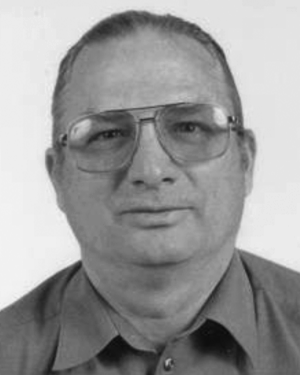 Walter L. Atchison合作论文数5
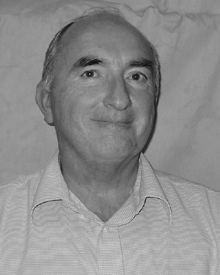 Jamie L Stokes合作论文数4L. J. Tabaka合作论文数4
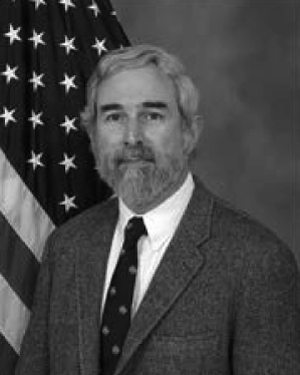 R. E. Reinovsky合作论文数4j c cochrane合作论文数4f c sena合作论文数3Wa Reass合作论文数3E.C. Martinez合作论文数3
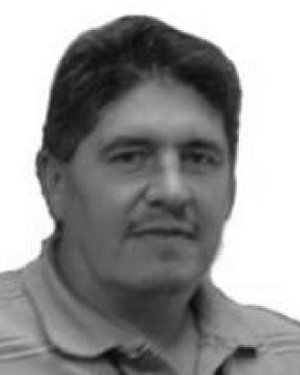 Griego, J.R.合作论文数3Gerald F. Kiuttu合作论文数3Thompson, M.C.合作论文数3Hosack, K.W.合作论文数3Marsh, S.P.合作论文数3Parsons, W.M.合作论文数3Janet Graham合作论文数3Hinckley, W.B.合作论文数3Kasik, R.J.合作论文数3R. R. Bartsch合作论文数3GA Wurden合作论文数2r j trainor合作论文数2RE REINOVSKY合作论文数2DA PLATTS合作论文数2Rhon K. Keinigs合作论文数2John F Jr Benage合作论文数2
 Gribble, R.F.合作论文数2Watt, R.G.合作论文数2Bowman, D.W.合作论文数2Ballard, E.O.合作论文数2Scudder, D.W.合作论文数2
 Shlachter, J.S.合作论文数2G. Sandoval合作论文数2M. D. Monroe合作论文数2
 C. A. Ekdahl合作论文数Los Alamos National Laboratory;Lawrence Livermore National Laboratory;Lawrence Berkeley National Laboratory;Lawrence Livermore National Laboratory, Lawrence Berkeley National Laboratory2G. A. Valdez合作论文数2S. A. Ney合作论文数2Stephen M Younger合作论文数2P. R. Fresquez合作论文数2H. R. Salazar合作论文数2G. A. Bennett合作论文数2Ke Hackett合作论文数1G. C. Idzorek合作论文数1




