We present MedASR, an open-source 105M-parameter model engineered for high-accuracy medical dictation. Prioritizing a "small, fast, and accurate" design, MedASR addresses 3 core pillars (1) Data: overcoming clinical corpora scarcity and class imbalance; (2) Modeling: efficient long-form training; and (3) Inference: accurate transcription via a pseudo-streaming sliding-window approach. Our evaluation shows that MedASR achieves a 58
We introduce Gemini Embedding 2, a native multimodal embedding model that allows embedding video, audio, image, and text modalities in a unified representation space. We leverage the multimodal capabilities of Gemini to produce embeddings for arbitrary combinations of interleaved inputs across all these modalities that generalize well across a wide variety of tasks. Applying large-scale contrastive learning in a multi-task multi-stage training setup, we achieve state-of-the-art performance on key embedding benchmarks including unimodal, cross-modal, and multimodal retrieval spanning a diverse set of tasks. We show that our embedding model demonstrates strong performance (with a score of 62.9 R@1 on MSCOCO, 68.8 NDCG@10 on Vatex, 69.9 on MTEB multilingual and 84.0 on MTEB Code) across a variety of tasks surpassing the performance of specialized models. These unified capabilities make Gemini Embedding 2 a promising candidate for downstream use cases such as RAG, recommendation and search. Furthermore, its robust zero-shot performance across distinct fields - from astronomy and bioscience to fine arts and the culinary arts - establishes it as a highly reliable, out-of-the-box representation even for specialized domains.
Audio is a critical component of multimodal perception, and any truly intelligent system must demonstrate a wide range of auditory capabilities. These capabilities include transcription, classification, retrieval, reasoning, segmentation, clustering, reranking, and reconstruction. Fundamentally, each task involves transforming a raw audio signal into a meaningful 'embedding' - be it a single vector, a sequence of continuous or discrete representations, or another structured form - which then serves as the basis for generating the task's final response. To accelerate progress towards robust machine auditory intelligence, we present the Massive Sound Embedding Benchmark (MSEB): an extensible framework designed to evaluate the auditory components of any multimodal system. In its first release, MSEB offers a comprehensive suite of eight core tasks, with more planned for the future, supported by diverse datasets, including the new, large-scale Simple Voice Questions (SVQ) dataset. Our initial experiments establish clear performance headrooms, highlighting the significant opportunity to improve real-world multimodal experiences where audio is a core signal. We encourage the research community to use MSEB to assess their algorithms and contribute to its growth. The library is publicly hosted at github.
The Massive Sound Embedding Benchmark (MSEB) has emerged as a standard for evaluating the functional breadth of audio models. While initial baselines focused on specialized encoders, the shift toward "audio-native" Large Language Models (LLMs) suggests a new paradigm where a single multimodal backbone may replace complex, task-specific pipelines. This paper provides a rigorous empirical evaluation of leading LLMs - including members from the Gemini and GPT families - across the eight core MSEB capabilities to assess their efficacy and audio-text parity. Our results indicate that while a significant modality gap persists regarding performance and robustness, the empirical evidence for an "optimal" modeling approach remains inconclusive. Ultimately, the choice between audionative and cascaded architectures depends heavily on specific use-case requirements and the underlying assumptions regarding latency, cost, and reasoning depth.
The accurate prediction of T cell epitope peptides within proteins of interest has a wide range of applications, but is complicated by the multiple determinants of antigenicity, the polymorphism of the Major Histocompatibility Complex (MHC) locus, and the great diversity of possible peptide antigens. Leading in silico methods use a variety of statistical approaches to learn from sequences identified through both in vitro MHC binding and peptide elution studies, but their performance remains imperfect, particularly for MHC II-restricted responses. Here we present MHCIIFold-GNN, an entirely orthogonal solution to this problem that combines three new elements: (i) a highly-multiplexed peptide:MHCII binding assay, (ii) generalizable structural modeling using AlphaFold3, and (iii) transfer learning with a Graph-based Neural Network. Trained exclusively on newly-generated in vitro binders, we show that MHCIIFold-GNN enables state-of-the-art prediction of CD4 T cell epitopes presented by diverse MHC II proteins, on par with non-structural methods that rely on much larger datasets including naturally-processed ligands. Moreover, when MHCIIFold-GNN and a leading non-structural method are combined, we observe unparalleled performance on a held-out test set (11 % boost), underscoring the orthogonality of the methods. These results highlight the power of a new class of structure-informed approaches to the CD4 T cell epitope prediction problem. ### Competing Interest Statement The authors have declared no competing interest.
Existing training criteria in automatic speech recognition (ASR) permit the model to freely explore more than one time alignments between the feature and label sequences. In this paper, we use entropy to measure a model’s uncertainty, i.e. how it chooses to distribute the probability mass over the set of allowed alignments. Furthermore, we evaluate the effect of entropy regularization in encouraging the model to distribute the probability mass only on a smaller subset of allowed alignments. Experiments show that entropy regularization enables a much simpler decoding method without sacrificing word error rate, and provides better time alignment quality.
We propose JEIT, a joint end-to-end (E2E) model and internal language model (ILM) training method to inject large-scale unpaired text into ILM during E2E training which improves rare-word speech recognition. With JEIT, the E2E model computes an E2E loss on audio-transcript pairs while its ILM estimates a cross-entropy loss on unpaired text. The E2E model is trained to minimize a weighted sum of E2E and ILM losses. During JEIT, ILM absorbs knowledge from unpaired text while the E2E training serves as regularization. Unlike ILM adaptation methods, JEIT does not require a separate adaptation step and avoids the need for Kullback-Leibler divergence regularization of ILM. We also show that modular hybrid autoregressive transducer (MHAT) performs better than HAT in the JEIT framework, and is much more robust than HAT during ILM adaptation. To push the limit of unpaired text injection, we further propose a combined JEIT and JOIST training (CJJT) that benefits from modality matching, encoder text injection and ILM training. Both JEIT and CJJT can foster a more effective LM fusion. With 100B unpaired sentences, JEIT/CJJT improves rare-word recognition accuracy by up to 16.4% over a model trained without unpaired text.
We introduce LAST, a LAttice-based Speech Transducer library in JAX. With an emphasis on flexibility, ease-of-use, and scalability, LAST implements differentiable weighted finite state automaton (WFSA) algorithms needed for training & inference that scale to a large WFSA such as a recognition lattice over the entire utterance. Despite these WFSA algorithms being well-known in the literature, new challenges arise from performance characteristics of modern architectures, and from nuances in automatic differentiation. We describe a suite of generally applicable techniques employed in LAST to address these challenges, and demonstrate their effectiveness with benchmarks on TPUv3 and V100 GPU.
We introduce the Globally Normalized Autoregressive Transducer (GNAT) for addressing the label bias problem in streaming speech recognition. Our solution admits a tractable exact computation of the denominator for the sequence-level normalization. Through theoretical and empirical results, we demonstrate that by switching to a globally normalized model, the word error rate gap between streaming and non-streaming speech-recognition models can be greatly reduced (by more than 50\% on the Librispeech dataset). This model is developed in a modular framework which encompasses all the common neural speech recognition models. The modularity of this framework enables controlled comparison of modelling choices and creation of new models.
Second-pass rescoring is a well known technique to improve the performance of Automatic Speech Recognition (ASR) systems. Neural Oracle Search (NOS), which selects the most likely hypothesis from an N-best hypothesis list by integrating information from multiple sources, such as the input acoustic representations, N-best hypotheses, additional first-pass statistics, and unpaired textual information through an external language model, has shown success in rescoring for RNN-T first-pass models. Multilingual first-pass speech recognition models often outperform their monolingual counterparts when trained on related or low-resource languages. In this paper, we investigate the use of the NOS rescoring model on a first-pass multilingual model and show that similar to the first-pass model, the rescoring model can be made multilingual. Our first-pass multilingual model does not require a language-id and we make a realistic assumption that an estimate of the language-id would be available for second-pass rescoring. We conduct comprehensive experiments on two sets of languages, one consisting of related low-resource languages, and the other with a high-resource language added to the first set to analyze the performance of the multilingual NOS rescorer under different settings. Our experimental results show that, multilingual NOS can improve the first-pass multilingual model resulting in average word error rate reduction of 9.4% in the first case, and 8.4% in the second, and out-performing the monolingual counterparts in both cases.
This paper explores rescoring strategies to improve a two-pass speech recognition system when the first-pass is a hybrid autoregressive transducer model and the second-pass is a neural language model. The main focus is on the scores provided by each of these models, their quantitative analysis, how to improve them and the best way to combine them to achieve better recognition accuracy. Several analyses are presented to emphasize the importance of the choice of the integration weights for combining the first-pass and the second-pass scores. A sequence level combination weight estimation model along with four training criteria are proposed which allows adaptive integration of the scores per acoustic sequence. The effectiveness of this algorithm is demonstrated by constructing and analyzing models on the Librispeech data set. It is shown that the proposed adaptive weight interpolation technique achieves 5 % relative gain over the baseline model with non-adaptive weights.
Language models (LMs) significantly improve the recognition accuracy of end-to-end (E2E) models on words rarely seen during training, when used in either the shallow fusion or the rescoring setups. In this work, we introduce LMs in the learning of hybrid autoregressive transducer (HAT) models in the discriminative training framework, to mitigate the training versus inference gap regarding the use of LMs. For the shallow fusion setup, we use LMs during both hypotheses generation and loss computation, and the LM-aware MWER-trained model achieves 10% relative improvement over the model trained with standard MWER on voice search test sets containing rare words. For the rescoring setup, we learn a small neural module to generate per-token fusion weights in a data-dependent manner. This model achieves the same rescoring WER as regular MWER-trained model, but without the need for sweeping fusion weights.
Text-only adaptation of a transducer model remains challenging for end-to-end speech recognition since the transducer has no clearly separated acoustic model (AM), language model (LM) or blank model. In this work, we propose a modular hybrid autoregressive transducer (MHAT) that has structurally separated label and blank decoders to predict label and blank distributions, respectively, along with a shared acoustic encoder. The encoder and label decoder outputs are directly projected to AM and internal LM scores and then added to compute label posteriors. We train MHAT with an internal LM loss and a HAT loss to ensure that its internal LM becomes a standalone neural LM that can be effectively adapted to text. Moreover, text adaptation of MHAT fosters a much better LM fusion than internal LM subtraction-based methods. On Google's large-scale production data, a multi-domain MHAT adapted with 100B sentences achieves relative WER reductions of up to 12.4% without LM fusion and 21.5% with LM fusion from 400K-hour trained HAT.
This paper explores rescoring strategies to improve a two-pass speech recognition system when the first-pass is a hybrid autoregressive transducer model and the second-pass is a neural language model. The main focus is on the scores provided by each of these models, their quantitative analysis, how to improve them and the best way to combine them to achieve better recognition accuracy. Several analyses are presented to emphasize the importance of the choice of the integration weights for combining the first-pass and the second-pass scores. A sequence level combination weight estimation model along with four training criteria are proposed which allows adaptive integration of the scores per acoustic sequence. The effectiveness of this algorithm is demonstrated by constructing and analyzing models on the Librispeech data set. It is shown that the proposed adaptive weight interpolation technique achieves 5 % relative gain over the baseline model with non-adaptive weights.
Personalization of speech models on mobile devices (on-device personalization) is an active area of research, but more often than not, mobile devices have more text-only data than paired audio-text data. We explore training a personalized language model on text-only data, used during inference to improve speech recognition performance for that user. We experiment on a user-clustered LibriSpeech corpus, supplemented with personalized text-only data for each user from Project Gutenberg. We release this User-Specific LibriSpeech (UserLibri) dataset to aid future personalization research. LibriSpeech audio-transcript pairs are grouped into 55 users from the test-clean dataset and 52 users from test-other. We are able to lower the average word error rate per user across both sets in streaming and nonstreaming models, including an improvement of 2.5 for the harder set of test-other users when streaming.
This paper proposes and evaluates alternative speech recognition design strategies using the hybrid autoregressive transducer (HAT) model. The different strategies are designed with special attention to the choice of modeling units and to the integration of different types of external language models during first-pass beam-search or second-pass re-scoring. These approaches are compared on a large-scale voice search task and the recognition quality over the head and tail of speech data is analyzed. Our experiments show decent improvements in WER over common speech phrases and significant gains on uncommon ones compared to the state-of-the-art approaches.
End-to-end (E2E) automatic speech recognition (ASR) models, by now, have shown competitive performance on several benchmarks. These models are structured to either operate in streaming or non-streaming mode. This work presents cascaded encoders for building a single E2E ASR model that can operate in both these modes simultaneously. The proposed model consists of streaming and non-streaming encoders. Input features are first processed by the streaming encoder; the non-streaming encoder operates exclusively on the output of the streaming encoder. A single decoder then learns to decode either using the output of the streaming or the non-streaming encoder. Results show that this model achieves similar word error rates (WER) as a standalone streaming model when operating in streaming mode, and obtains 10% -- 27% relative improvement when operating in non-streaming mode. Our results also show that the proposed approach outperforms existing E2E two-pass models, especially on long-form speech.
On-device end-to-end (E2E) models have shown improvements over a conventional model on Search test sets in both quality, as measured by Word Error Rate (WER) [1], and latency [2], measured by the time the result is finalized after the user stops speaking. However, the E2E model is trained on a small fraction of audio-text pairs compared to the 100 billion text utterances that a conventional language model (LM) is trained with. Thus E2E models perform poorly on rare words and phrases. In this paper, building upon the two-pass streaming Cascaded Encoder E2E model [3], we explore using a Hybrid Autoregressive Transducer (HAT) [4] factorization to better integrate an on-device neural LM trained on text-only data. Furthermore, to further improve decoder latency we introduce a non-recurrent embedding decoder, in place of the typical LSTM decoder, into the Cascaded Encoder model. Overall, we present a streaming on-device model that incorporates an external neural LM and outperforms the conventional model in both search and rareword quality, as well as latency, and is 318X smaller.
This paper proposes and evaluates the hybrid autoregressive transducer (HAT) model, a time-synchronous encoder-decoder model that preserves the modularity of conventional automatic speech recognition systems. The HAT model provides a way to measure the quality of the internal language model that can be used to decide whether inference with an external language model is beneficial or not. We evaluate our proposed model on a large-scale voice search task. Our experiments show significant improvements in WER compared to the state-of-the-art approaches (1).
 Tara Sainath合作论文数Google DeepMind12
 Cyril Allauzen合作论文数Google10
 Arun Narayanan合作论文数Google Inc.10
 Michiel Bacchiani合作论文数Google DeepMind9
 David Rybach合作论文数Apple8
 Tom Bagby合作论文数Google7
 Erik McDermott合作论文数Apple Inc.7
 Michael Riley合作论文数Google7
 Kevin W. Wilson合作论文数Google7Tongzhou Chen合作论文数Georgia Inst Technol, Atlanta, GA 30332 USA6
 Bhuvana Ramabhadran合作论文数Google;Columbia University6Ke Wu合作论文数5
 Ron Weiss合作论文数Google5
 Bo Li合作论文数Google DeepMind5
 Izhak Shafran合作论文数Google5
 Georg Heigold合作论文数Google4
 Chanwoo Kim合作论文数Department of Artificial Intelligence, College of Informatics, Korea University4
 Hynek Hermansky合作论文数Department of Electrical and Computer Engineering, Whiting School of Engineering, Johns Hopkins University4
 Rohit Prabhavalkar合作论文数Google DeepMind4Kean K. Chin合作论文数3
 Pedro J Moreno Mengibar合作论文数Humain3
 Ananya Misra合作论文数Department of Computer Science;Princeton University;Department of Computer Science, Princeton University3Trevor Strohman合作论文数University of Massachusetts Amherst3Neeraj Gaur合作论文数Google Inc, Mountain View, CA 94043 USA2
 Kamel Lahouel合作论文数Sidney Kimmel Comprehensive Cancer Center, Johns Hopkins University School of Medicine2
 Yu Zhang (张羽)合作论文数Meta Superintelligence Labs2
 Ignacio Lopez Moreno合作论文数Google DeepMind2
 Xin Lei合作论文数2
 Weiran Wang (汪蔚然)合作论文数Computer Science Department, University of Iowa2
 Jiahui Yu合作论文数Meta2
 Ronny Huang合作论文数Google2
 Zhong Meng合作论文数Google2
 Ruoming Pang (庞若鸣)合作论文数OpenAI2
 Matt Shannon合作论文数Engineering Department, Cambridge University2
 Hasim Sak合作论文数Google2
 Andrew W. Senior合作论文数Google DeepMind2
 Chung-Cheng Chiu合作论文数Google Brain2
 Mitchel Weintraub合作论文数2
 Ji Ma合作论文数Google2
 Feipeng Li合作论文数2
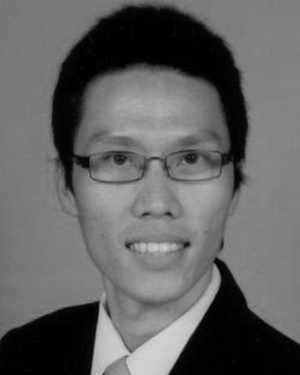 Khe Chai Sim合作论文数Google Research2
 Vijayaditya Peddinti合作论文数Stealth AI Startup2Pat Rondon合作论文数1
 Shuo-Yiin Chang合作论文数Google DeepMind1
 Megan Barnes合作论文数Google DeepMind1
 Gustavo Hernandez Abrego合作论文数Google1Schlattner Philippe合作论文数1Kilol Gupta合作论文数1
 Frank Palma Gomez合作论文数Boston University1